
Orchestrating Voice AI for Predictive Outage Response and Field Dispatch
A practical operating framework for utilities to deploy high‑volume Voice AI that validates callers, interprets predictive signals, opens or updates service requests, and routes human dispatch safely and audibly.
1. Why orchestrate Voice AI for outages now
Voice remains the dominant channel during incidents. Utilities can combine high‑volume Voice AI with predictive signals to reduce caller congestion and speed field dispatch, but only with strict controls around validation, routing, and human oversight.
Operational goals
Prioritize three operational goals: (1) capture accurate outage and service‑request intake at scale; (2) deliver timely, verified status to affected customers; (3) create prioritized, auditable work items for field crews with clear safety and escalation boundaries.
- Reduce time-to-first-response for high-priority events by automating validated intake.
- Lower unnecessary truck rolls by improving field-dispatch data quality.
- Maintain a transparent audit trail from call to work-order or escalation.
Non-goals and safety boundaries
Voice AI should not make operational safety decisions, control grid or waterworks systems, or replace emergency responders. It is an intake, routing, and advisory layer that escalates per policy-defined gates.
- Treat Voice AI as an input multiplexer and knowledge layer—not an actuator.
- Establish human-in-loop gates before any safety-critical or protective action.
- Log decisions and confidence scores for later QA and compliance review.
2. Canonical architecture and call flow
A repeatable, auditable call flow is the foundation. Keep the flow simple, deterministic, and tied to approved system APIs.
Canonical call flow
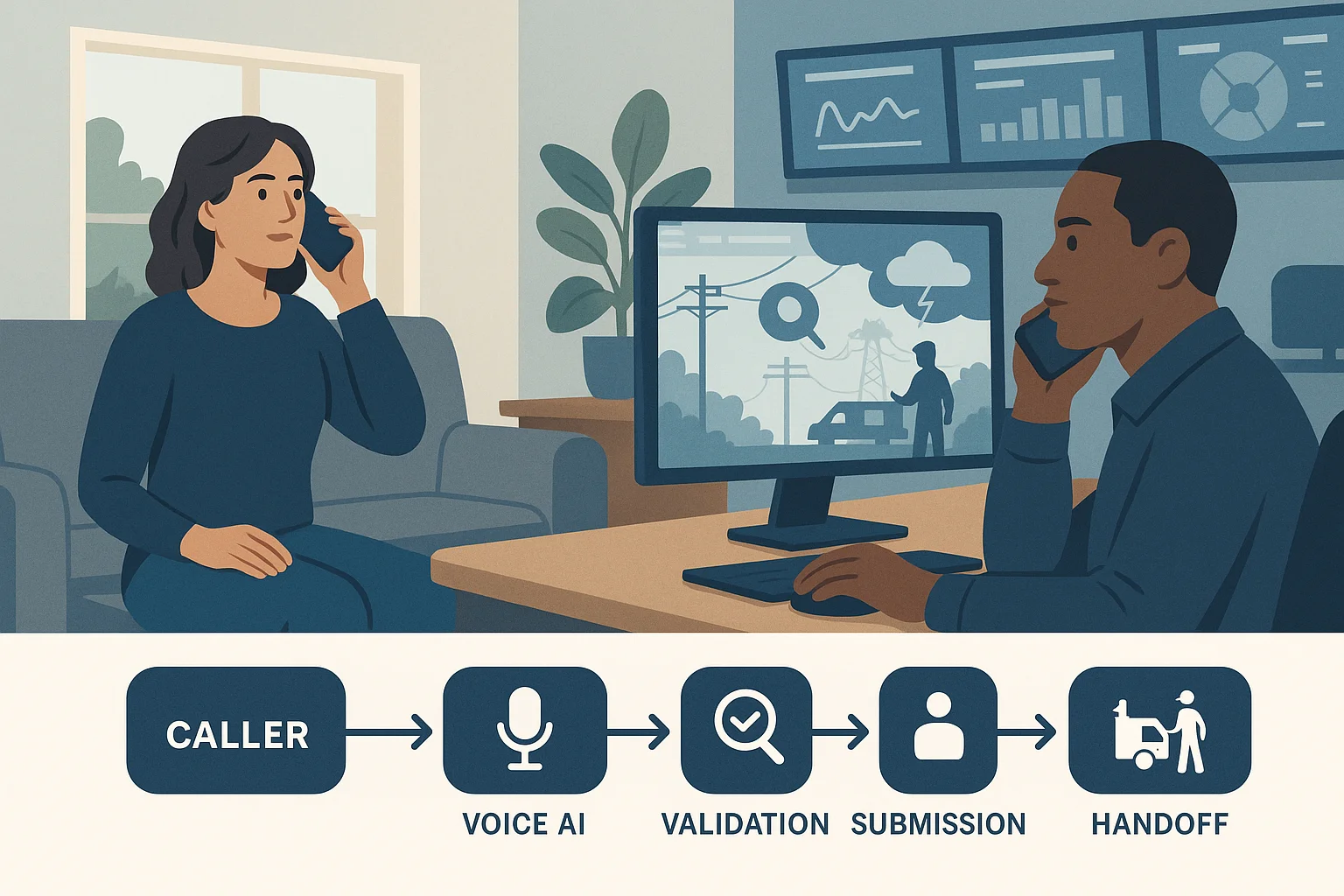
Design the call flow as: inbound customer call → IVR triage → Voice AI natural language intake → account/location validation → query approved utility APIs or knowledge sources → create or update service request, provide status, or route to human agent/dispatch. Each transition must record provenance, confidence, and the action taken.
- Record the transcript and Voice AI confidence metrics with each step.
- Require a validation token from the CIS/OMS lookup before any SR creation or modification.
- Implement a durable correlation ID per event to join call, telemetry, and work-order data.
Integration patterns and adapters
Prefer narrowly scoped, approved adapters that translate Voice AI intents into CIS/OMS/CRM API calls. Adapters enforce business rules (billing holds, unsafe-access flags) so the Voice AI cannot bypass system protections.
- Use read-only lookups for initial status responses; require elevated validation for write operations.
- Encapsulate vendor-specific logic in adapters to limit blast radius when replacing components.
- Provide fallback options (e.g., callback queue to human agents) when adapters fail.
3. Predictive triggers and event orchestration
Predictive telemetry—AMI voltage anomalies, weather forecasts, pump alarms—enables preemptive outreach and prioritized dispatch. Treat predictive signals as triggers, not autonomous determiners.
Signal-to-intake mapping
Define a catalog that maps predictive signals to intake templates and urgency scores. For example, a substation loss alarm might map to a high-priority outage template that prompts Voice AI to ask targeted validation questions and open a priority SR.
- Maintain a living catalog of signal definitions, provenance, and required validation steps.
- Attach evidence pointers (telemetry IDs, timestamps) to any SR created from predictive triggers.
- Allow operators to adjust mapping rules during evolving events with change approvals.
Orchestration and prioritization rules
Use a rules engine to translate combined inputs—predictive signals, caller reports, outage maps—into a prioritized work queue. Orchestration should be deterministic and auditable, with human overrides and clearly documented logic.
- Prioritization factors: safety risk, critical-customer impact, crew availability, weather.
- Log rationale for auto-prioritization decisions and expose them to supervisors.
- Define SLA windows for automated responses and for human review of high-priority auto-created SRs.
4. Account-safe validation, provenance, and privacy
Before modifying records, validate identity and premise using multiple, low-friction signals. Maintain provenance metadata to defend actions and support dispute resolution.
Validation tiers
Implement tiered validation: Tier 0 for anonymous status queries; Tier 1 for account-level confirmations (address, recent bill amount); Tier 2 for actions that modify CIS/OMS records (move requests, outage cancellations) requiring multi-factor or human verification.
- Always prefer read-only responses when caller validation is incomplete.
- Escalate to live agent when Tier 2 validation cannot be achieved within acceptable contact time.
- Persist redaction-friendly logs: store validation tokens and decision rationale without retaining excessive PII.
Data residency and cross-border notes
Make data residency, backup geography, and processor location explicit in procurement documents. Confirm retention periods, recording consent flows, and breach-notification duties with qualified advisors; obligations vary by jurisdiction.
- Designate hosting and backup regions in the SOW and architecture documents.
- Define subprocessors, remote-support access, and mechanisms for cross-border transfers.
- Ensure recording-consent scripts are configurable per jurisdiction and logged at call start.

5. Integration with OMS/CIS/CRM and field dispatch
Reliable dispatch depends on clean, authenticated system-of-record actions and clear handoffs to field crews. Voice AI is the intake and routing layer — not the dispatcher.
System-of-record interaction rules
Require explicit, auditable authorization before Voice AI writes to OMS/CIS. Use short-lived validation tokens and adapter-mediated write operations so the Voice AI cannot directly alter records.
- Design write-back operations to include the author (Voice AI agent id), validation level, and human approver where applicable.
- Support partial updates: if location is verified but not account, create a non-actionable SR flagged for human review.
- Synchronize SR identifiers and correlation IDs across systems for joined analytics.
Field handoff and human escalation
Define explicit handoff packets for crews: verified location, predicted cause, telemetry evidence, caller statements, and safety flags. Establish deterministic escalation criteria and measurable SLAs for manual review.
- Handoff packet contents must be standardized and machine- and human-readable.
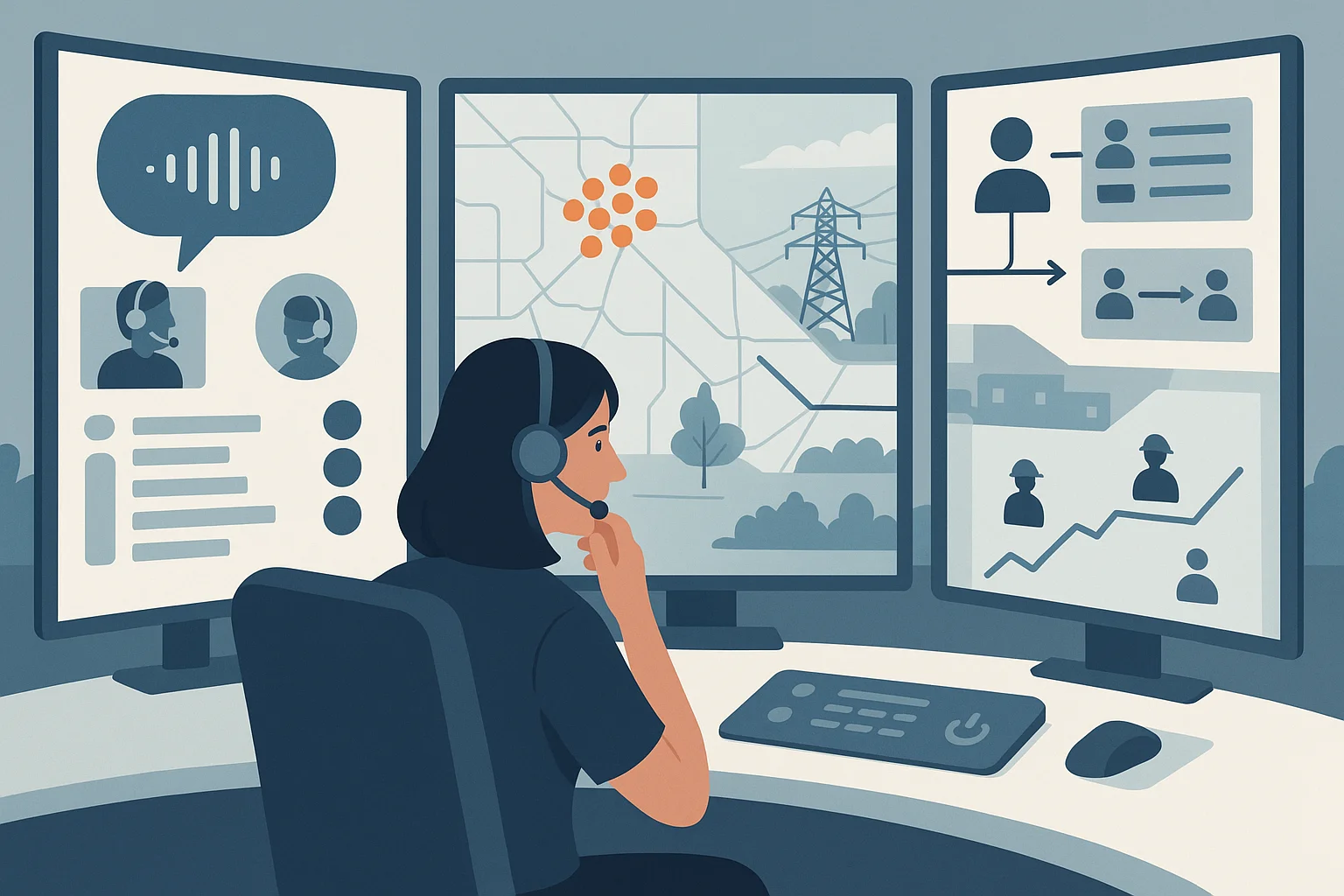
- Use a graded escalation ladder: Voice AI → contact centre agent → supervisor → field dispatcher.
- Track time-in-stage and provide supervisors real-time dashboards for interventions.
6. Resilience, cybersecurity, and incident readiness
Protect availability and integrity with defensive architecture, maturity-aligned controls, and an AI-aware incident playbook. Align practices to cross-sector cybersecurity goals and AI risk management principles.
Cybersecurity and operational resilience
Adopt layered controls for Voice AI: network segmentation, least-privilege service accounts, encrypted telemetry, and hardened adapters. Include surge‑capacity planning and graceful degradation modes that route to human queues when automation fails.
- Segment Voice AI infrastructure from operational-control networks; limit remote access and admin functions.
- Design for graceful degradation: clear fallback to human agents, recorded messages, or simple IVR status pages.
- Regularly exercise failover and incident response playbooks with cross-functional teams.
AI-specific risk management and governance
Use an AI risk management profile to document known model limitations, confidence thresholds, and testing regimes. Maintain audit trails for model decisions, data provenance, and corrective actions to support accountability and continuous improvement.
- Define acceptable confidence thresholds for each automated action and require human review below threshold.
- Instrument monitoring for drift, error rates, and unusual patterns in intake or SR creation.
- Ensure a documented remediation path for incorrect or harmful outputs.
7. Procurement, governance, KPIs, and rollout
Procure for integrations, surge capacity, observability, and clear responsibilities. Start small, measure, and expand with disciplined governance.
Procurement and contract language
RFPs and SOWs should demand: adapter ownership and interfaces, surge SLAs, incident response obligations, data residency and subprocessors, test harness access, and audit logs. Require demonstrable integration and security evidence rather than broad certification claims.
- Ask for staged proof-of-concept with live sandbox integrations to CIS/OMS APIs.
- Include acceptance tests for validation tiers and write-back controls.
- Specify obligations for logging, retention, breach notification, and remote-support constraints.
KPIs, QA, and phased rollout
Track operational KPIs tied to outcomes: verified SRs created, percentage of automated resolutions, escalation rate, average time-to-create SR, and field ticket accuracy. Use phased pilots by customer segment, geography, and event type before broad rollout.
- Start with daylight-hours pilot for non-safety incidents; expand to broader windows after demonstrating controls.
- Run parallel-mode testing where Voice AI suggests actions that humans approve in the backend.
- Maintain a continuous QA loop with replayable transcripts for periodic adjudication.
Related Peak Demand resources
Industry and AI sources reviewed
- Cross-Sector Cybersecurity Performance GoalsCybersecurity and Infrastructure Security Agency (CISA)
- Cybersecurity Capability Maturity Model (C2M2)U.S. Department of Energy
- AI Risk Management Framework — Critical Infrastructure ProfileNational Institute of Standards and Technology (NIST)
Utility cybersecurity, critical-infrastructure, records, customer-protection, and emergency-communications obligations vary by jurisdiction and service type. This article is operational guidance, not legal advice; organizations should confirm applicable requirements with qualified professionals.
Frequently asked questions
Use Voice AI to absorb high call volumes, provide approved outage and restoration messaging, validate the caller's account or service location, capture non-emergency service details, and route exceptions to trained staff. It should not estimate restoration times unless those estimates come from an approved utility system of record.
Official reference: Cross-Sector Cybersecurity Performance Goals
The integration design typically depends on the use case, but common systems include the customer information system, outage management system, CRM, knowledge base, notification platform, scheduling tools, and service-request or work-order systems. The Voice AI layer should receive only the data and actions required for the approved workflow.
Official reference: Cybersecurity Capability Maturity Model (C2M2)
No. Voice AI should remain a customer-communication, intake, validation, routing, and escalation layer. Infrastructure control, switching, dispatch authority, emergency response, and safety-critical decisions must remain within approved operational systems and qualified human teams.
Official reference: Cross-Sector Cybersecurity Performance Goals
Ask for evidence of surge and latency testing, account and premise validation, integration failure handling, auditable logs, data minimization, human escalation, change control, incident response, monitoring, and a clear operating model for updates after launch.
Official reference: Cross-Sector Cybersecurity Performance Goals
Build resilient utility customer-service automation
Peak Demand helps utilities connect Voice AI to approved customer-information, outage-communication, service-request, dispatch, escalation, and analytics workflows.
Schedule a discovery call


