
Managed Voice AI Services: What Enterprise Buyers Should Expect
A practical buyer and architecture guide for enterprise leaders evaluating managed Voice AI: architecture, managed‑service components, vendor selection, governance, security, and operational controls.
1. Executive summary: what a smart buyer expects
Managed Voice AI is a managed system: models alone are necessary but insufficient. Enterprise buyers should expect a fully integrated, observable service that ties caller experiences to approved enterprise systems, human escalation, and continuous quality controls.
Why 'managed' matters
A managed offering moves responsibility for day‑to‑day operations, model updates, call routing, logging, and first‑line escalation from the enterprise to the provider — but the enterprise retains responsibility for business rules, compliance, and data classification. Contracts must make the split explicit: who owns training data, who can change voice prompts or business rules, and who is accountable for incidents.
- Managed = operations + integrations + governance, not just hosted models.
- Expect co‑owned runbooks for incident response and data handling.
A realistic outcome
Successful projects deliver predictable containment of common contact‑centre traffic and clear escalation to humans for exceptions. Avoid vendors who promise end‑to‑end automation for high‑risk decisions without human controls and audit trails.
- Define 'success' metrics: containment rate, handoff latency, deflection quality, and customer satisfaction.
- Look for documented human‑escalation triggers and auditability.
2. Core architecture and operating model
Evaluate vendors against an explicit reference architecture. We recommend the following flow as the baseline for enterprise deployments.
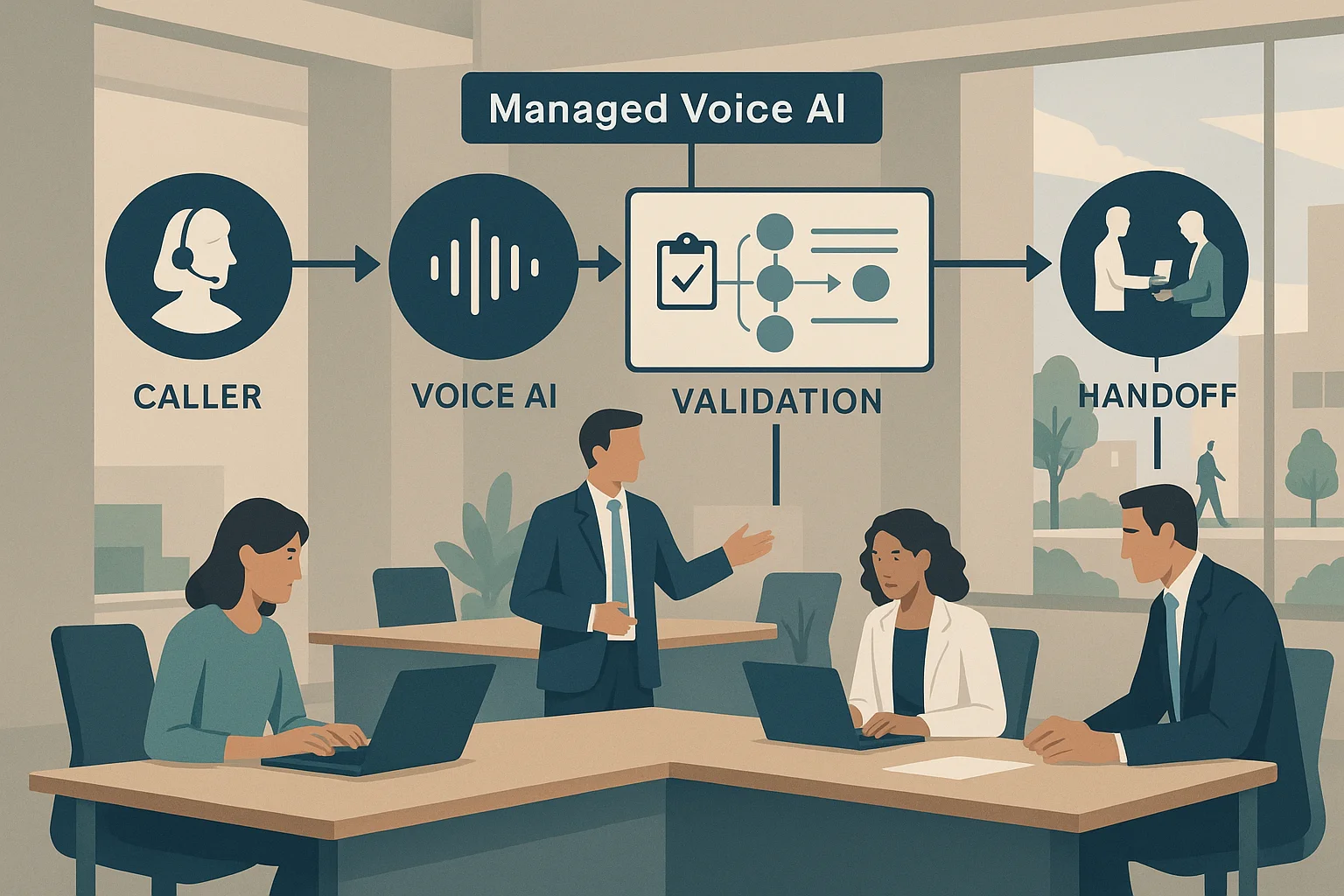
Canonical flow: Caller → Voice AI → Business‑rules layer → Enterprise systems → Response/Handoff
The enterprise reference model separates conversational intelligence from business logic. Voice inference and NLU/NLG live in the Voice AI layer; policy, permissions, fulfillment logic, and audit checks live in a dedicated business‑rules layer. The business‑rules layer calls approved systems of record (CRM, billing, order management) through secure adapters and returns a final action directive: synthesize response, execute a transaction, or escalate to a human agent.
- Decouple models and business rules to reduce explosion of model re‑training when business rules change.
- Adapters to enterprise systems should be explicit, logged, and versioned.
Model orchestration and MCP
Enterprises should expect model orchestration: routing prompts to specialised models (ASR, NLU, dialog, TTS) and applying a Model Context Protocol (MCP) that records context windows, prompt versions, and security tags. MCP provides an auditable context record for each interaction — valuable for debugging, compliance, and retraining decisions.
- MCP enables context preservation across multi‑turn interactions and handoffs.
- Ask vendors how they store MCP records, retention policies, and access controls.
Human handoff, escalation, and continuity
A robust managed service provides deterministic handoff: call state, intent hypotheses, context, and confidence scores should pass to human agents and downstream systems. Require low‑latency handoff, session transfer, and UI integration (screen pop) in the contract.
- Handoff must carry structured context (not just a transcript).
- Confidence thresholds and business rules determine handoffs; they must be configurable by the enterprise.
3. Vendor selection and procurement criteria
Assess vendors across capability pillars: integration services, custom infrastructure, QA, observability, security, and managed optimization. Score vendors for each pillar and require demonstration with live scenarios.
Integration and adapters
Prefer vendors who provide catalogue adapters for major enterprise systems and a clear plan for custom connectors. Verify support for your CRM, workforce‑management, billing, and authentication stacks. Ensure the vendor’s integration approach preserves enterprise access controls and logging.
- Ask for an interface control document (ICD) for each adapter.
- Require test harnesses and stubbed environments for integration testing.
Operational maturity — QA, observability, and optimisation
Operational maturity is judged by observable telemetry (call traces, NLU confidence, response times), synthetic test suites that run nightly, and a documented QA process that includes human review, root‑cause analysis, and continuous improvement. Contracts should include periodic review cycles and agreed KPIs for optimization work.
- Require synthetic tests for peak scenarios and edge‑case intents.
- Ask for dashboards, sample telemetry feeds, and change‑management logs.
Commercial and pricing models
Separate one‑time implementation and customization fees from ongoing managed‑service charges. Look for transparent pricing for peak concurrency, per‑minute media costs, and model‑inference consumption. Negotiate credits for under‑performance tied to measurable KPIs, and define change‑order processes for new dialogs or rules.
- Avoid all‑you‑can‑eat pricing without usage caps or clear surge terms.
- Negotiate a priced roadmap for additional integrations and feature work.
4. Managed service components and Peak Demand differentiation
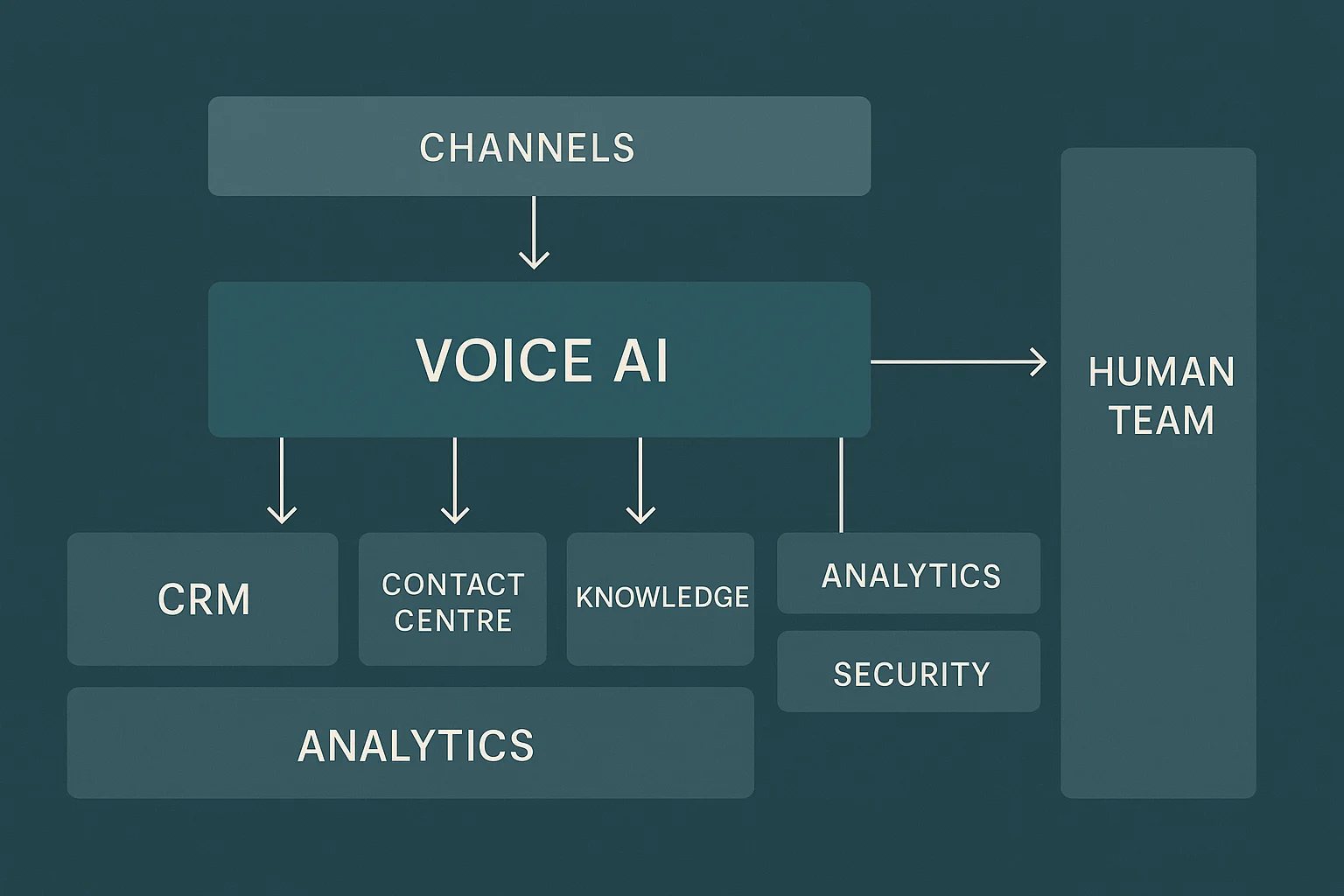
A managed offering should include service components beyond infrastructure. Below are the components we expect — and how Peak Demand differentiates in delivery.
Custom infrastructure and logic bridges
Enterprises need custom bridges that translate Voice AI outputs into enterprise actions. Peak Demand builds logic bridges — lightweight, auditable microservices — that mediate between the model outputs and enterprise systems, enforcing policies and formatting transactions before they touch systems of record.
- Logic bridges reduce blast radius by isolating AI output transformations.
- They enable rapid rollback and targeted instrumentation without changing core systems.
QA, human escalation, and managed optimisation
Peak Demand operates bilingual QA teams who review sampled interactions, label failure modes, and feed corrective rules into the business‑rules layer. Our managed optimization cycles include prioritized remediation tickets, measurable uplift targets, and A/B testing for new dialogs.
- Managed QA is a recurring service: not a one‑off training pass.
- Escalation pathways include on‑shift specialists who can patch rules and coordinate incident responses.
Observability and forensic tooling
Operational observability should include session‑level traceability, per‑component latency, confidence metrics, and synthetic test results. Peak Demand exposes tooling and regular reports so clients can verify containment, handoff quality, and trends without vendor black boxes.
- Require access to raw telemetry or push it to enterprise SIEMs under contract.
- Insist on retention policies and export capabilities for investigations.
5. Governance, security, accessibility, and domain-specific constraints
Governance must span model lifecycle, security, user privacy, and accessibility. Different verticals have additional operational constraints (e.g., transit data). Expect explicit vendor commitments and documented controls.
Security, data handling, and incident response
Contracts must define data classification, encryption at rest and in transit, key management, and who can view raw transcripts. Require SOC‑type assurances, explicit breach notification timelines, and agreed playbooks for data exfiltration or model misuse.
- Clarify whether the vendor uses tenant‑isolated infrastructure or multi‑tenant shared services.
- Specify retention, deletion, and export rights for audio, transcripts, and MCP context.
Accessibility and disability rights
Voice channels must be designed for accessibility and non‑discrimination. Enterprises should require vendors to demonstrate compatibility with accessibility norms, make remediation commitments, and include accessible fallback channels. Design and testing should reference international guidance on disability rights and web accessibility.
- Require acceptance testing that includes assistive‑technology users and documented remediation timelines.
- Ensure alternative contact paths and escalation options for users who cannot interact with Voice AI.
Domain-specific: transit and real‑time data
For public transport and other real‑time services, the Voice AI must integrate with live feeds and respect operational constraints. Use standard protocols and formats for schedule and vehicle position data to avoid stale or inconsistent responses.
- Verify support for real‑time transit feeds and adapter patterns.
- Define freshness SLAs for external data and fallbacks when feeds are unavailable.

6. Implementation, testing, and runbook expectations
A managed deployment should follow a predictable implementation playbook: discovery, design, integration, pilot, scale, and continuous improvement. Vendors should provide clear artifacts and acceptance criteria at each stage.
Discovery and design
Discovery should map call drivers, intents, persona scripts, integrations, and regulatory constraints. The design artifact must include the canonical reference architecture, an ICD for each adapter, data flows with classification, and an MCP specification for context capture.
- Expect a prioritized intent backlog and success metrics for the pilot.
- Require documented security and privacy impact assessments.
Pilot, acceptance testing, and synthetic validation
Pilots should run with a controlled volume of real callers plus synthetic traffic that targets error cases. Acceptance testing should include functional tests, performance under concurrency, accessibility testing, and reconciliation tests against enterprise systems of record.
- Synthetic test suites should include peak scenarios and degraded external dependencies.
- Acceptance criteria must include auditability and handoff fidelity checks.
Operational handover and continuous improvement
Handover includes runbooks, escalation maps, access to tooling, and a 30/60/90 day optimization plan. Continuous improvement requires scheduled QA cycles, telemetry reviews, and a prioritised backlog for rule changes or model improvements.
- Negotiate service review cadences and escalation SLAs in the contract.
- Require documented procedures for emergency rule changes and rollback.
7. Practical procurement checklist and next steps
Use a targeted checklist in RFPs and SOWs to avoid ambiguity and vendor lock‑in. Prioritise demonstrable capabilities and operational guarantees.
Minimum contractual requirements
Include: clear ownership of training and production data; access and export rights for telemetry and recordings; SLAs for handoff latency and containment; obligations for accessibility remediation; breach notification and forensic support; and priced roadmaps for integrations.
- Define KPIs and remedies — not vague 'best efforts'.
- Include a migration plan and data export format to reduce lock‑in risk.
Demo and proof of value
Insist on scenario demos using your data and systems where possible. A credible vendor will run a short proof‑of‑value that shows end‑to‑end flows including handoff, MCP context capture, and a sample of QA tickets resolved.
- Require a documented pilot acceptance checklist.
- Get demonstrable access to telemetry and a subset of tooling during the pilot.
Next steps for buyers
Start with a discovery engagement that produces the integration ICDs and a prioritized pilot scope. If you want a reference implementation, review Peak Demand’s managed offerings or case work for transit integrations and enterprise deployments.
- Book a discovery call and request a pilot SOW with explicit deliverables.
- Validate vendor claims with a short technical audit and pilot telemetry review.
Related Peak Demand resources
Industry and AI sources reviewed
- Artificial Intelligence Risk Management Framework (AI RMF 1.0)National Institute of Standards and Technology (NIST)
- AI Risk Management Framework: Generative AI ProfileNational Institute of Standards and Technology (NIST)
- OECD AI PrinciplesOrganisation for Economic Co-operation and Development
Privacy, telecommunications, recording-consent, cybersecurity, consumer-protection, employment, and records obligations vary by jurisdiction and use case. This article is operational guidance, not legal advice; organizations should confirm applicable requirements with qualified professionals.
Frequently asked questions
A serious managed service should include discovery, workflow design, telephony, integrations, validation rules, testing, monitoring, human escalation, incident handling, change control, analytics, and ongoing optimization. The value is the complete operating system around the model, not access to a model alone.
Official reference: Artificial Intelligence Risk Management Framework (AI RMF 1.0)
The operating model should assign clear owners for telephony, prompts, knowledge, APIs, credentials, incident response, analytics, approvals, and release management. Enterprise buyers should avoid deployments where those responsibilities are ambiguous or split across vendors without accountability.
Official reference: Artificial Intelligence Risk Management Framework (AI RMF 1.0)
Evaluate the complete workflow under realistic volume, latency, interruption, transfer, integration, and failure conditions. Measure task completion, escalation quality, unsupported responses, system errors, recovery behavior, and how quickly operators can detect and correct problems.
Official reference: Artificial Intelligence Risk Management Framework (AI RMF 1.0)
Ask for documented use-case boundaries, data handling, access controls, model and prompt change management, evaluation procedures, audit logs, human-oversight rules, incident response, subcontractor dependencies, and a process for reviewing material system changes.
Official reference: Artificial Intelligence Risk Management Framework (AI RMF 1.0)
Turn Voice AI infrastructure into a managed enterprise operation
Peak Demand designs, integrates, deploys, monitors, and improves Voice AI systems across customer service, enterprise systems, governance, escalation, and reporting.
Schedule a discovery call


