Designing Reliable Voice AI Escalation for Utility Contact Centres
A practical operational framework for deploying high-volume Voice AI in utility contact centres to validate accounts, answer outage and service requests, integrate with OMS/CIS/CRM, and escalate safely to humans.
1. Why Voice AI Escalation Matters for Utilities
Voice AI can reduce contact-centre load, speed routine interactions, and keep crews informed during outage events — but only when designed with the constraints and duties of regulated utilities in mind.
Buyer problems and primary use cases
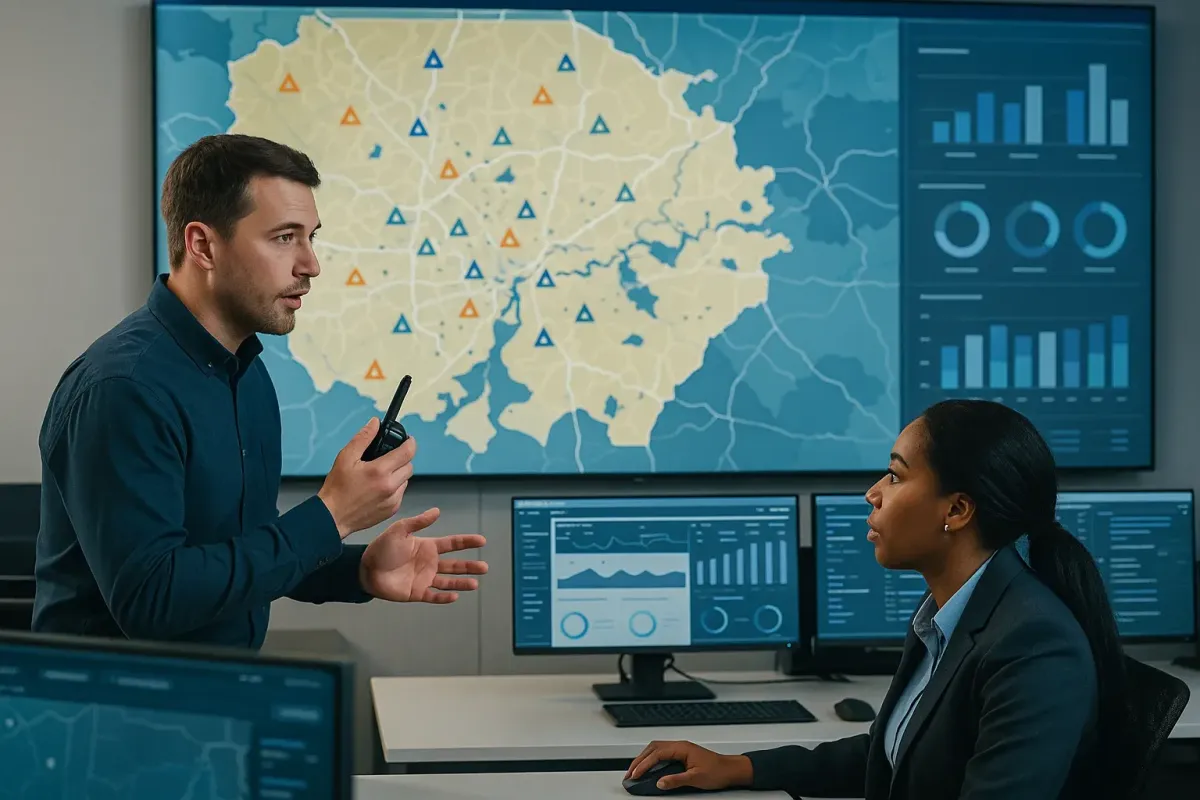
Utility contact centres face predictable surges (storms, equipment failure, major incidents) and constant volumes of routine requests: account balance queries, outage status checks, service scheduling, and meter issues. Buyers consistently ask for systems that reduce simple repeat work, scale quickly during peaks, and preserve traceable audit trails for regulatory and customer-dispute purposes. The first, highest-value workflows are: 1) outage reporting and status response, 2) basic service request intake (non-safety work like meter reads, billing inquiries, appointment scheduling), and 3) account or premise validation for routing and security.
- Prioritise high-volume, low-risk interactions that are rules-driven and measurable.
- Defer emergency, safety-critical, or infrastructure control tasks to human teams.
- Ensure every automated interaction leaves an auditable record tied to customer identity or premise.
Why operating boundaries matter
Utilities operate under safety, reliability, and privacy obligations. Voice AI should never be permitted to make operational decisions affecting grid assets, reclose lines, disable safety devices, or replace emergency dispatch processes. Operating boundaries reduce regulatory exposure and keep downstream operational risk manageable. Explicit boundaries also improve model performance because conversational scope is narrower and data requirements are limited.
- Define a clear do-not-automate list (e.g., emergency response, protective relay control, live-isolation commands).
- Treat any request that implies hazard, gas odor, or immediate danger as a mandatory human escalation.
- Publish and enforce escalation SLAs and script escalation paths for field-service dispatch.
2. Essential Workflows and Deterministic Escalation
Design rooted in deterministic logic improves safety and predictability. For each flow, map triggers that require human attention and articulate acceptable automated outcomes.
Outage intake and status lookup
Voice AI should capture the minimum information to confirm location and outage characteristics, then consult the utility's authoritative outage data source (typically the OMS or an approved outage API) to provide status. If the OMS indicates a widespread outage, the Voice AI can provide estimated restoration windows or safety guidance drawn from preapproved messages. If the caller reports hazardous conditions or conflicting evidence (reports of fire, gas smell, downed lines), escalate immediately to a trained agent.
- Query OMS read-only endpoints for confirmed outages before giving status updates.
- Use templated, pre‑approved messages for restoration times and safety guidance.
- Escalate on any free-text utterance matching hazard keywords or when confidence in intent or location verification falls below threshold.
Service request intake and change-of-service workflows
For standard service requests (meter read, billing inquiry, appointment booking), the Voice AI should validate account linkage and then create an intake record in the CIS/CRM using an API that enforces business rules (e.g., pending payments, access requirements). For changes that affect billing, third-party authorisations, or rate-plan changes, require human verification.
- Stage sensitive transactions for agent review or dual confirmation when business rules flag risk.
- Log request, timestamp, and requestor identity; return a reference number to the caller.
- Integrate with workforce systems to optionally propose technician windows, but only book after human or automated policy checks.
3. Account Safety, Validation, and MCP
Protecting customer and premise data while preserving a frictionless caller experience hinges on robust validation and an auditable context model.
Account and premise validation patterns
Use layered verification: ANI/CLI recognition, callback number validation, account-level knowledge-based checks (limited, non-sensitive facts), and verification tokens delivered through alternate channels (SMS, app push) when risk is elevated. Avoid asking for or relying on high-sensitivity data like full account numbers or account PINs over unrecorded channels unless your policies and consent mechanisms explicitly permit recordings or non‑recording per local rules.
- Prefer authenticated channels (customer app, logged-in web session) where possible to reduce acoustic verification needs.
- Keep validation steps minimal — enough to bind the caller to an account or premise without collecting unnecessary PII.
- Record verification outcomes in the event log for dispute resolution.
Model Context Protocol (MCP) for safe context binding
MCP provides a standardized way to attach verified context to the conversational model: verified account ID, validated location, active outage ID, and permitted actions. The Voice AI references the MCP token to determine what information may be disclosed or what write actions are allowed. MCP tokens must be time-limited, auditable, and generated only after successful validation.
- Use MCP to separate ephemeral conversational state from long-term account records.
- Ensure MCP tokens and their signatures are logged and retained according to retention policy.
- Revoke MCP tokens on anomalous behaviour or when the session terminates.
4. Integration Architecture and Data Flow
A simple, auditable architecture reduces operational risk. Keep integrations explicit: Voice AI should never directly manipulate grid controls or unmediated operational systems.
Canonical data flow
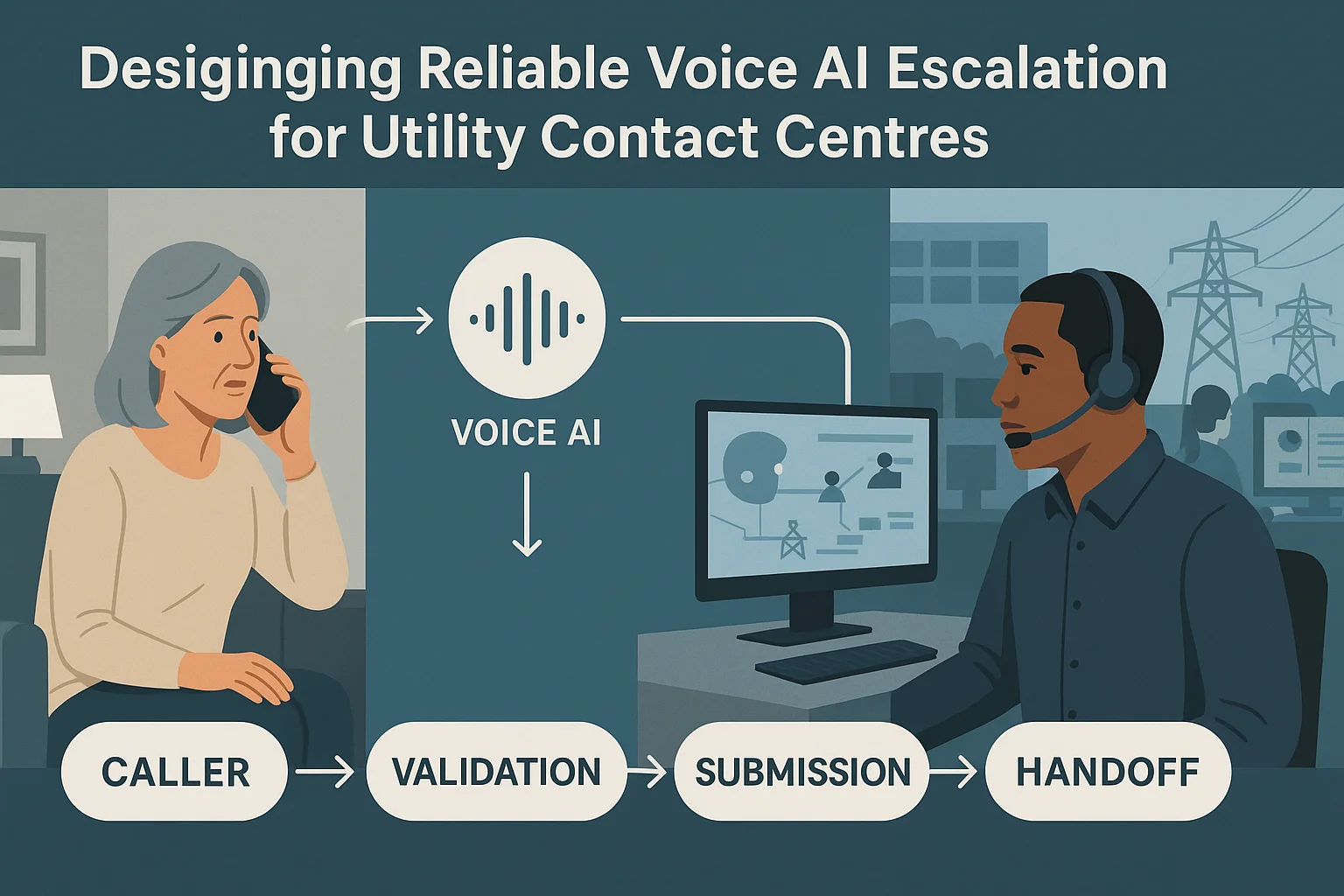
Customer call → Voice AI conversational layer → MCP-bound context → orchestration layer → approved utility API or knowledge source (CIS/OMS/CRM) → action (status response, create SR, or human escalation). The orchestration layer enforces business rules and records every decision. All writes to authoritative systems must be routed via the orchestration layer and only permitted after tokenized MCP validation.
- Keep the conversational model stateless with respect to authoritative data; use MCP tokens to bind context.
- Make orchestration the single point for authorization and audit logging.
- Segregate read-only outage/status queries from write-capable workflows by API scopes.
Integration safeguards
Use API gateways, role-based credentials, and scope-limited tokens. For each integration, document: endpoint location, hosting region, subprocessors involved, transfer mechanisms, retention rules for logs/recordings, and remote-support access controls. Maintain a list of fallback endpoints (e.g., read-only caches) to support surge or partial outages.
- Require least-privilege API credentials per integration and rotate them regularly.
- Document whether the integration uses cross-border transfers and where data is hosted or backed up.
- Enable read-only cached responses for non-critical queries to maintain service during backend outages.

5. Reliability, Failure Modes, and Human-in-the-Loop Controls
Plan for predictable failures: speech recognition errors, identity mismatches, backend API outages, and peak call surges. The system must fail safe and degrade to human handling in a controlled way.
Common failure modes and safe degradations
When the system detects low confidence, missing MCP context, or unavailable backend APIs, it should escalate to an agent or present limited, read-only information. Never attempt to autonomously confirm critical account changes when the orchestration layer is impaired.
- Define explicit fallbacks: callback scheduling, queue placement for agents, or SMS confirmation where voice must not proceed.
- During high-error periods, increase human oversight sampling and reduce auto-write privileges.
- Record and tag degraded sessions for prioritized QA review.
Human escalation design patterns
Provide agents with a pre-populated context panel that includes the MCP token, intent hypothesis, confidence metrics, the caller's last actions, and suggested next steps. Allow agents to take over the session with a single authorized action that consumes or reissues an MCP token.
- Make takeover seamless: agent audio bridge plus conversational history.
- Log agent interventions as events and link them to the original Voice AI session.
- Use agent feedback to label training data for continuous improvement.
Testing and staging for surge and partial-grid events
Simulate storms and surge volumes in a staging environment that mirrors production integrations and failure behaviors. Include chaos tests for backend latency, token revocation, and partial OMS downtime to validate fallback behavior and human escalation throughput.
- Run scheduled surge exercises with contact-centre staffing and field ops present.
- Validate end-to-end traceability from call intake to field dispatch in test scenarios.
- Document after-action reports with clear remediation action items.
6. Measurement, QA, Analytics, and Outcomes
Metrics must be outcome-focused and actionable. Don’t measure model sophistication — measure operational impact, safety, and auditability.
Core KPIs to instrument
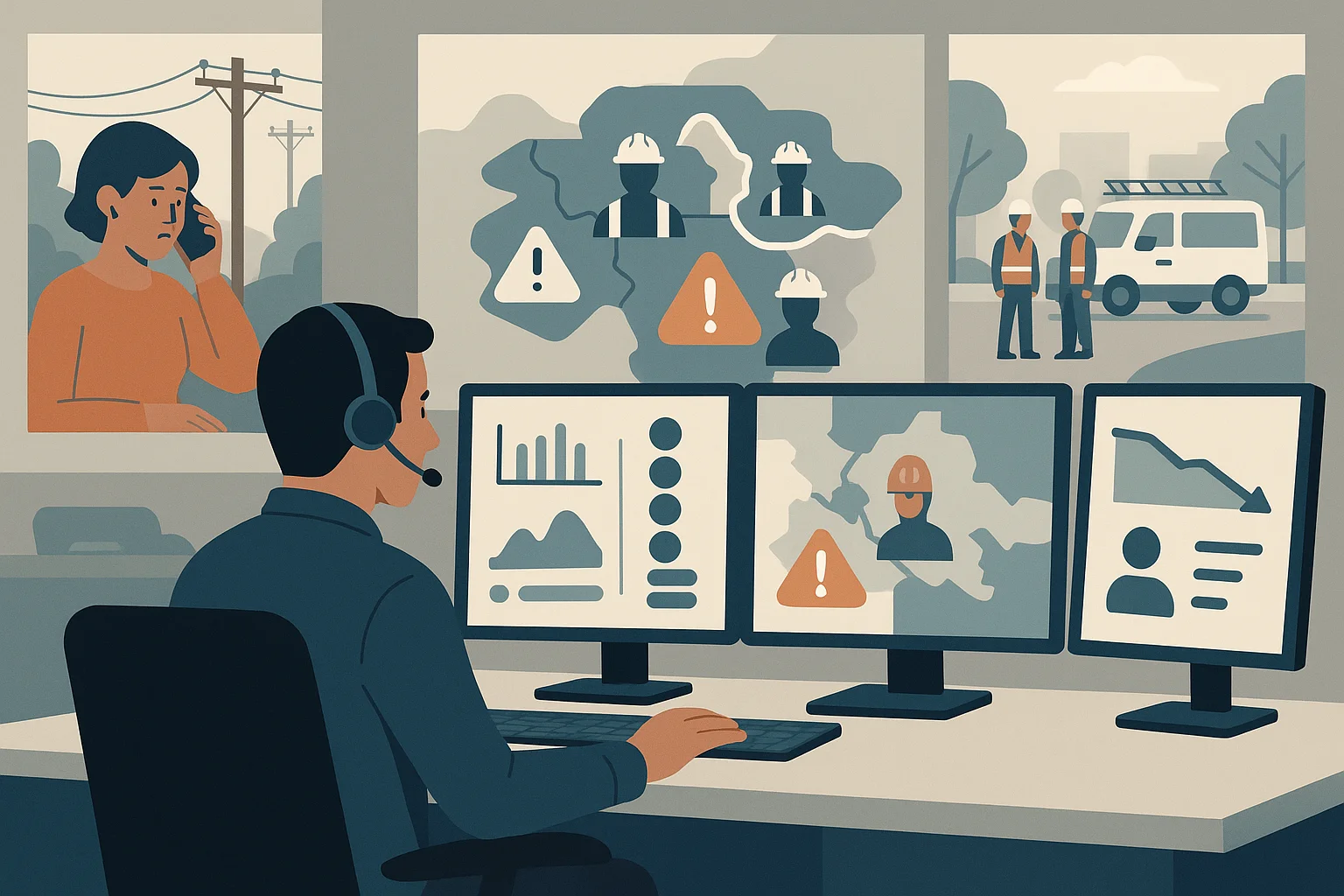
Track containment rate (percent of calls resolved without human handoff), escalation latency (time from trigger to agent connection), false-confirmation rate (verified-account mismatches), reconciliation exception rate (voice-created SRs that fail CIS reconciliation), and dispute overturn rate (customer disputes that reverse automated outcomes). Also track model confidence histograms, intent drift indicators, and system availability.
- Define KPI measurement methods and data sources before go-live.
- Use pre- and post-deployment baselines to evaluate impact rather than absolute claims.
- Make KPIs available to operations, field service, compliance, and executive stakeholders.
Quality assurance and sampling
Implement multi-tier QA: automated rule checks for every session, daily sampling of degraded or escalated calls, and weekly human review of a statistically valid sample. Feed labelled errors back into intent models and business-rule adjustments, but keep orchestration logic separate from model training to preserve auditability.
- Prioritise review of sessions with reconciliation exceptions or safety keyword triggers.
- Maintain a labelled dataset of verified escalations for training and regulatory review.
- Set formal change-control for model updates and for business-rule changes.
Outcomes to expect and how to report them
Report operational outcomes in business terms: reduced average handle time for routine queries, improved response times during outages, fewer repeat calls for status, and clearer audit trails for billing or service disputes. Present outcomes alongside caveats about test conditions, sample sizes, and jurisdictional limits.
- Publish outcome dashboards for outage performance and contact-centre load during events.
- Include a risk register for residual issues and mitigation timelines.
- Avoid extrapolating results beyond measured contexts; document what was out of scope.
Related Peak Demand resources
Industry and AI sources reviewed
- Cross-Sector Cybersecurity Performance GoalsCybersecurity and Infrastructure Security Agency (CISA)
- Cybersecurity Capability Maturity Model (C2M2)U.S. Department of Energy
- AI Risk Management Framework — Critical Infrastructure ProfileNational Institute of Standards and Technology (NIST)
Privacy, telecommunications, recording-consent, cybersecurity, consumer-protection, employment, and records obligations vary by jurisdiction and use case. This article is operational guidance, not legal advice; organizations should confirm applicable requirements with qualified professionals.
Frequently asked questions
Good starting points include billing and account questions, move-in or move-out intake, appointment scheduling, service-request capture, outage-status messaging from approved systems, payment-routing assistance, and structured escalation. Safety-critical and infrastructure-control decisions should remain with qualified utility teams.
Official reference: Cross-Sector Cybersecurity Performance Goals
Use the minimum approved identifiers needed for the workflow, validate them against the utility's system of record, limit data exposure, and provide a human-assisted path when verification fails. The Voice AI should not guess account, premise, or outage information.
Official reference: Cross-Sector Cybersecurity Performance Goals
Use controlled adapters, strict schemas, timeouts, retries, audit logs, safe failure states, and human escalation. The system should distinguish approved utility data from model-generated language and should never present stale or unverified operational information as fact.
Official reference: Cybersecurity Capability Maturity Model (C2M2)
Track containment by request type, successful validations, transfers, abandoned calls, integration errors, incorrect or stale responses, time to resolution, customer follow-up, and the percentage of cases completed safely without manual rework.
Official reference: Cybersecurity Capability Maturity Model (C2M2)
Turn Voice AI infrastructure into a managed enterprise operation
Peak Demand designs, integrates, deploys, monitors, and improves Voice AI systems across customer service, enterprise systems, governance, escalation, and reporting.
Schedule a discovery call


