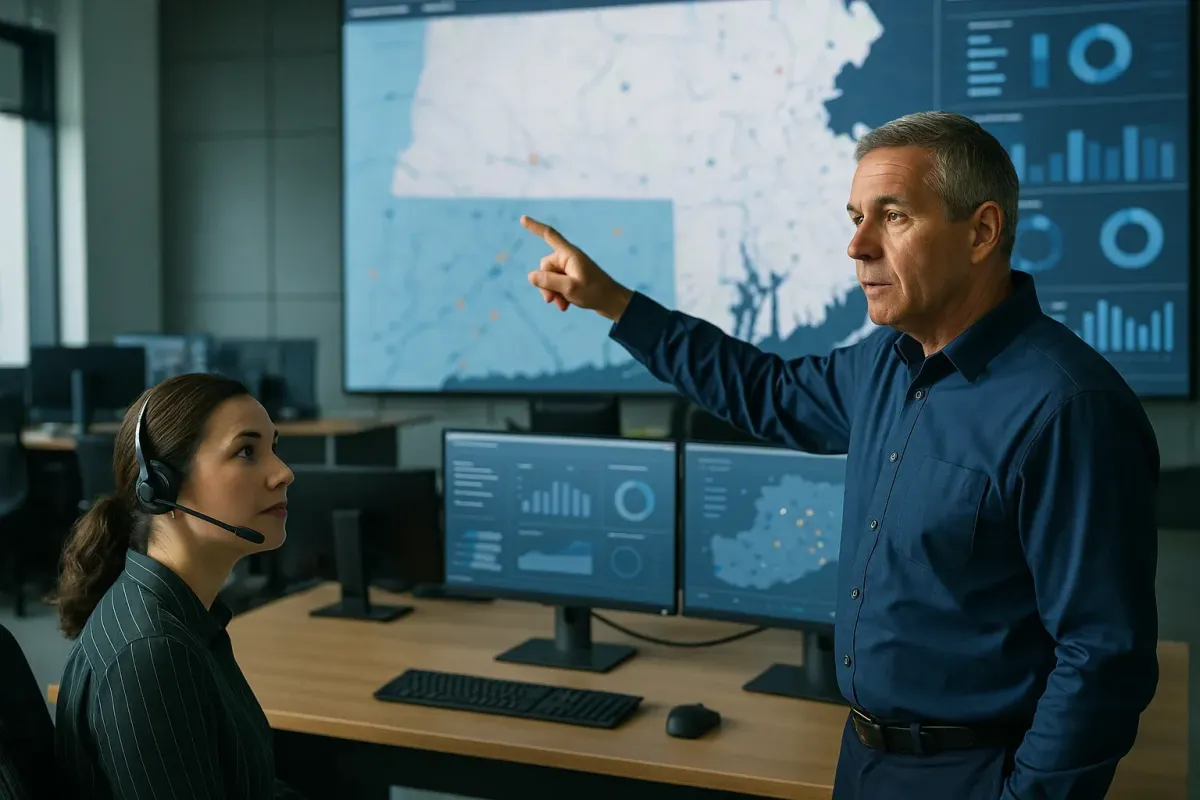
How Utilities Can Use Voice AI for High-Volume Customer Service
Operational framework for deploying high-volume Voice AI in electric, water, gas, and public utilities: integration patterns, validation controls, outage workflows, procurement choices, and measurable operating outcomes.
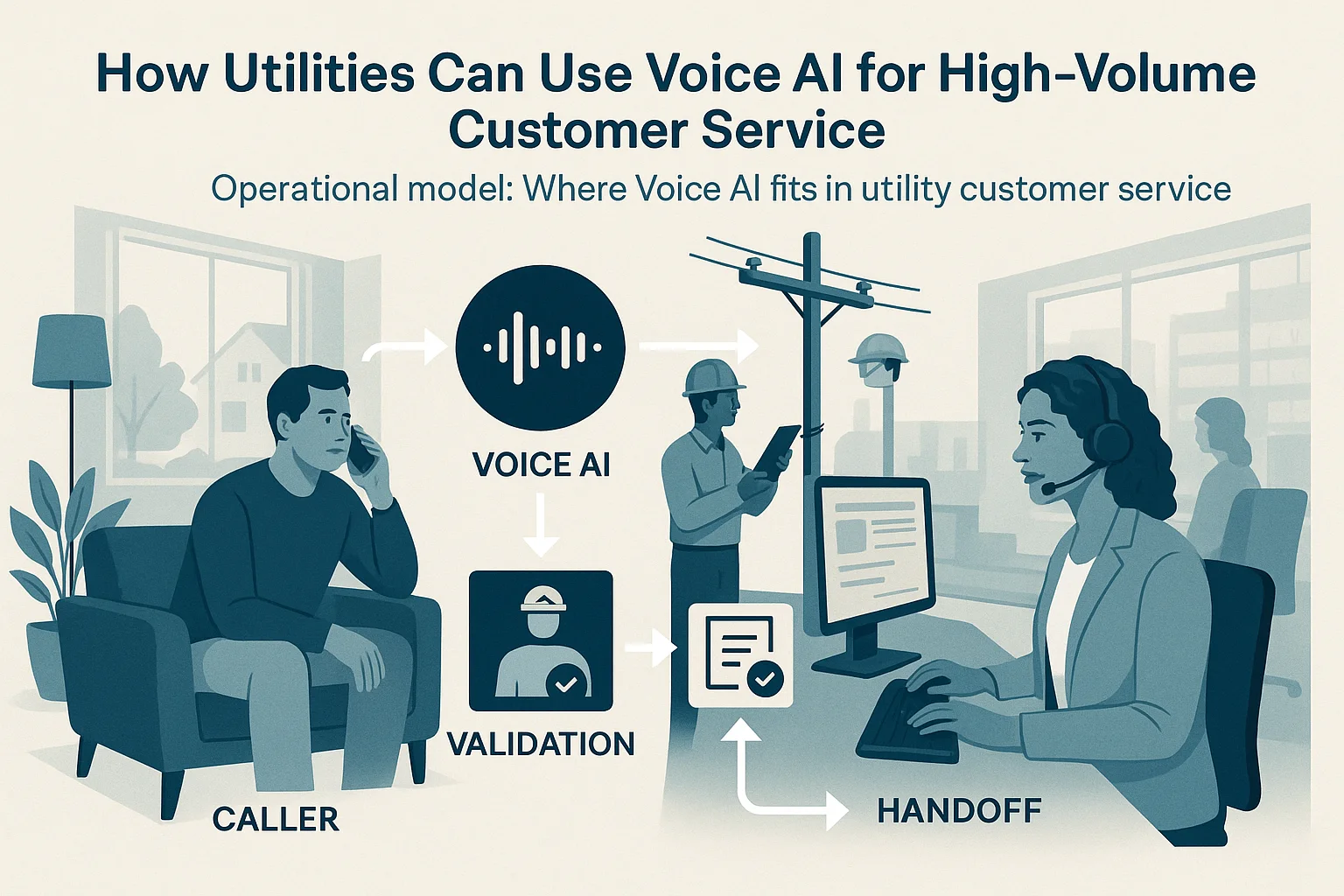
1. Operational model: Where Voice AI fits in utility customer service
A concise operational model clarifies responsibilities and limits. Voice AI should be treated as an automation and routing layer that improves throughput and consistency for high-volume interactions without taking control of grid, plant, or field devices.
Architecture snapshot
At scale, a deterministic flow reduces error and improves measurable outcomes. Typical architecture: - Customer call (PSTN / SIP / VoIP) → Voice AI receptionist (ASR+NLU+dialog manager) → account or location validation → approved utility API or knowledge system (billing, outage management, field dispatch) → outcome: service request created / status response delivered / human agent escalation. Maintain full, auditable logging at each step for compliance, analytics, and QA.
- Separate conversational layer from enterprise APIs; no direct device control.
- Embed tokenized session context for validated requests; avoid persistent storage of clear-text PII in the Voice AI stack.
- Preserve immutable event logs (call audio, transcripts, API calls, routing decisions) for post-incident review.
Roles and responsibilities
Define who owns each component: IT/Platform manages telephony and integration; Contact Centre owns conversational design and escalation policies; Operations/Dispatch accepts service requests and makes field decisions; Compliance and Privacy own data retention and disclosure policies. Clear ownership prevents ambiguous handoffs in outages and major events.
- Operations must own outage prioritization and field dispatch decisions—Voice AI is a front-end, not a decision-maker.
- Contact Centre must own escalation thresholds and human-in-loop policies.
- IT must enforce API authentication, rate limits, and schema contracts with Voice AI.
2. Primary use cases and deterministic workflows
Select use cases where Voice AI reliably adds capacity and reduces human load: high-frequency, low-variance tasks with defined decision trees and clear escalation rules.
Outage intake and status updates
Voice AI can handle inbound outage reports, perform basic triage, and provide real-time status when connected to outage management systems (OMS). Keep these rules strict: - Collect minimal identifying detail needed to locate the issue (meter/service point, cross-street), then validate the caller's authority where customer-specific details are requested. - If OMS reports a confirmed outage for the caller's location, Voice AI returns standardized status messages and expected next-steps; otherwise, generate an outage report and route to field ops if required. - Use event flags to escalate automated spikes (multiple reports from one area) to incident operations for faster response.
- Triage first, disclose second—only after validation can account-specific status be read.
- Aggregate reports by geohash or feeder ID for near real-time situational awareness.
- Trigger human incident management when report density, duration, or safety tags exceed threshold.
Service requests and field dispatch
For service requests that require field personnel (e.g., meter exchange, leak follow-up), Voice AI should capture structured details and create a ticket in the enterprise work-order system with validated location and priority fields filled. Include deterministic routing rules that map urgency and type to dispatch queues rather than leaving it to free-form intent.
- Validate location using meter ID, service address, or geolocation before scheduling.
- Use a structured form with explicit fields (issue type, severity, access constraints, safety observations) to reduce downstream triage.
- Attach transcript, timestamps, and confirmation number to the ticket to reduce repeat contacts.
Billing and account inquiries (limited scope)
Permit Voice AI to answer account-agnostic questions and limited account-specific queries only after step-up authentication (e.g., PIN, one-time passcode, or tokenized session). Route all sensitive tasks—payment arrangements, service termination—to supervised agents or secure web flows.
- Avoid voice-based full-payment flows unless PCI-compliant call-centre vaulting is implemented.
- Prefer one-time passcodes or tokenized links for high-risk actions.
- Record explicit consent when audio is stored for QA or dispute resolution.
3. Controls, validation, and safety boundaries
High-volume automation requires tight controls. These controls protect customers, prevent data exposure, and ensure the utility retains responsibility for safety-critical decisions.
Account-safe validation
Before disclosing account-specific information or creating authenticated service requests, require at least one automated validation factor: service address + meter ID, account number + one-time passcode, or caller ID match plus secondary factor. Prefer tokenized session authorization issued by the utility's identity service rather than storing credentials inside the Voice AI system.
- Design validation flows with fallbacks; if validation fails, offer a secure channel (SMS/email token) or route to an agent.
- Log validation outcome and the minimal proof used without persisting unnecessary PII.
- Coordinate with privacy and legal to align retention and redaction policies.
Human escalation and failure modes
Define explicit escalation triggers and maximum automated retries. Common triggers: failed validation, ambiguous intent after two prompt cycles, safety keywords (gas smell, downed line), and policy-based triggers (high-priority customer or outage cluster). Provide warm transfer with context: ticket ID, transcript excerpt, validation status, and relevant API data snapshot.
- Limit automated attempts; excessive repetition increases frustration and risk.
- Ensure agents see the same validated data the Voice AI observed—no black boxes.
- Use audio playback sparingly and only when permitted by local law.
Safety and decision boundaries
Do not use Voice AI to execute control actions (open/close breakers, operate valves) or to make safety-critical decisions. Voice AI should flag safety conditions and promptly route them to emergency-qualified human operators or dispatch. Maintain an explicit policy that operational control remains in human-operated systems.
- Treat Voice AI output as advisory or transactional, not commanding.
- Disallow direct API calls that change infrastructure state from the Voice AI layer.
- Document incident escalation and review processes.
4. Implementation choices and procurement checklist
Procurement should prioritize production-readiness, integration adapters, controls, and operational support rather than marketing claims. The right vendor reduces time-to-live and operational risk.
Deployment model: in-house, cloud, or managed
Consider three models: - In-house: fuller control over data and integration but requires significant telephony, AI, and DevOps capability. - Cloud-hosted: faster to deploy but verify multi-region data residency and encryption. - Managed service: Peak operational support, continuous tuning, and staffing. Use managed services when your organization lacks 24/7 contact-centre integration expertise.
- Match the model to your data residency and continuity requirements.
- Assess vendor SLAs for throughput, concurrency, and incident response.
- Check the ability to integrate with your OMS, CIS, and dispatch systems via secure APIs.
Vendor evaluation checklist
Evaluate vendors on technical and operational criteria: deterministic routing, tokenized validation, throughput testing under outage loads, auditable logs, supervised learning for dialog updates, accessibility compliance, and clear boundaries on data use. Ensure they provide instrumentation for event-level analytics and anomaly detection in call volumes.
- Request proof of integrations with utility-grade OMS/CIS platforms or a case study showing system-level integration.
- Validate ability to deliver warm transfer metadata and consistent confirmation numbers.
- Require documented incident escalation procedures and runbooks.
Managed services and integration references
If selecting a managed operator, confirm they provide live operations, continuous model tuning, and integrations with enterprise systems. Ask for existing integration patterns or references, and require a transition plan to your internal teams.
- Ensure managed provider supports business-hours and after-hours handover models.
- Confirm data separation and tenancy models to avoid cross-customer leakage.

5. Measurement, analytics, and operational outcomes
Define measurable KPIs tied to organizational objectives: reduced abandon rates, lower time to ticket creation, faster outage detection, and improved first-contact resolution for routine tasks.
Event-level analytics for outflows and outages
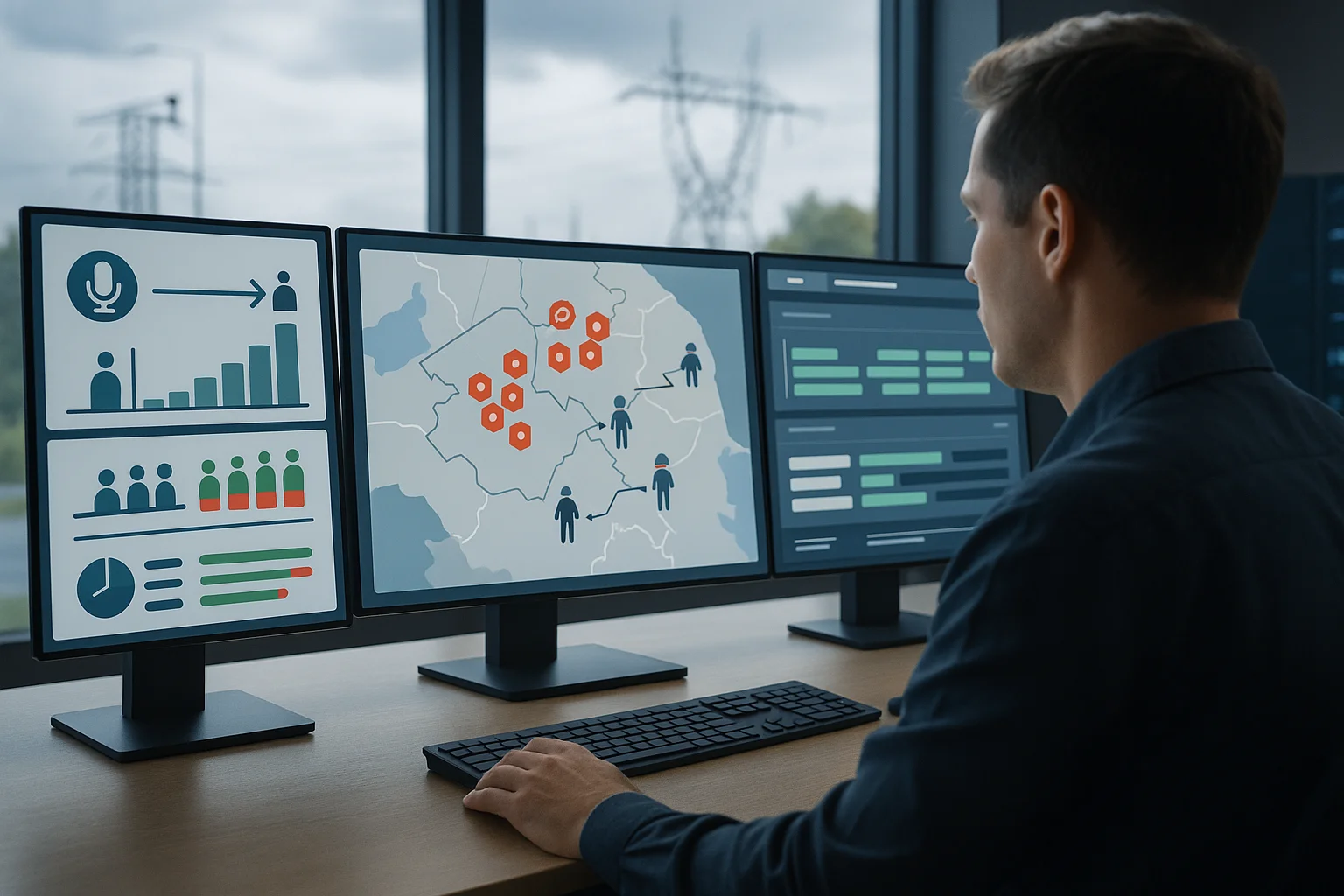
Instrument every transaction with event-level metadata: timestamp, caller geolocation (where available), intent, validation result, OMS lookup result, ticket ID, and disposition. Aggregate these events to detect clusters of reports that may indicate emergent outages before wider sensors trigger alarms.
- Use geohash aggregation and time-window thresholds for cluster detection.
- Feed analytic spikes into incident workflows to shorten detection-to-response time.
- Maintain an audit trail linking Voice AI events to OMS/dispatch actions.
Operational KPIs and QA
Track KPIs that reflect both automation effectiveness and customer experience: containment rate (percent resolved without agent), mean time to ticket creation, escalation latency, confirmation accuracy (voice transcript vs. stored record), and accessibility success rate (completion by disabled users). Use regular sampling and side-by-side agent reviews to validate model changes.
- Define containment targets appropriate to your operation and update them iteratively.
- Include quality-of-answer checks in agent training and continuous improvement loops.
- Measure false positives in safety keyword detection to manage noise.
6. Accessibility, interoperability, and regulatory cautions
Voice AI must be accessible and interoperable with external data sources. Design to international accessibility frameworks and open realtime standards when integrating third-party feeds.
Accessibility and inclusive design
Design voice interactions to meet obligations under international accessibility norms. Implement alternative channels and confirmation methods for people with disabilities: text/SMS follow-up, human agent options, voicemail-to-text, and visual dialogs when a smartphone is present. Ensure your choice architecture supports non-discrimination in access to service.
- Provide a clear, immediate human-assistance option inside every automated flow.
- Include captioning or text alternatives for voice content where practicable.
- Test voice flows with diverse user groups and incorporate their feedback.
Real-time data integration and interoperability
When integrating third-party realtime feeds—transit, weather, or public alerts—use well-defined standards and adapters. For example, GTFS Realtime demonstrates how to structure and consume broadcast-style real-time feeds; apply the same discipline to any public real-time data you ingest so your Voice AI presents consistent, current information.
- Normalize incoming feeds to your internal schema before exposing them to callers.
- Validate freshness and provenance of feeds; display timestamps in any status message.
- Design fallbacks if an external feed becomes unavailable to avoid misinformation.
Regulatory and privacy cautions
Local law governs recording consent, data retention, and disclosure. Treat these as jurisdictional: confirm obligations with counsel and privacy officers. Avoid claiming regulatory compliance; instead, describe how your architecture supports controls auditors commonly seek.
- Implement configurable retention and redaction policies.
- Segment PII and apply encryption both in transit and at rest.
- Obtain explicit recorded consent when required.
Related Peak Demand resources
Industry and AI sources reviewed
- AI Risk Management Framework — Critical Infrastructure ProfileNational Institute of Standards and Technology (NIST)
- Cross-Sector Cybersecurity Performance GoalsCybersecurity and Infrastructure Security Agency (CISA)
- Cybersecurity Capability Maturity Model (C2M2)U.S. Department of Energy
Utility cybersecurity, critical-infrastructure, records, customer-protection, and emergency-communications obligations vary by jurisdiction and service type. This article is operational guidance, not legal advice; organizations should confirm applicable requirements with qualified professionals.
Frequently asked questions
Good starting points include billing and account questions, move-in or move-out intake, appointment scheduling, service-request capture, outage-status messaging from approved systems, payment-routing assistance, and structured escalation. Safety-critical and infrastructure-control decisions should remain with qualified utility teams.
Official reference: Cross-Sector Cybersecurity Performance Goals
Use the minimum approved identifiers needed for the workflow, validate them against the utility's system of record, limit data exposure, and provide a human-assisted path when verification fails. The Voice AI should not guess account, premise, or outage information.
Official reference: Cross-Sector Cybersecurity Performance Goals
Use controlled adapters, strict schemas, timeouts, retries, audit logs, safe failure states, and human escalation. The system should distinguish approved utility data from model-generated language and should never present stale or unverified operational information as fact.
Official reference: Cybersecurity Capability Maturity Model (C2M2)
Track containment by request type, successful validations, transfers, abandoned calls, integration errors, incorrect or stale responses, time to resolution, customer follow-up, and the percentage of cases completed safely without manual rework.
Official reference: Cybersecurity Capability Maturity Model (C2M2)
Build resilient utility customer-service automation
Peak Demand helps utilities connect Voice AI to approved customer-information, outage-communication, service-request, dispatch, escalation, and analytics workflows.
Schedule a discovery call


