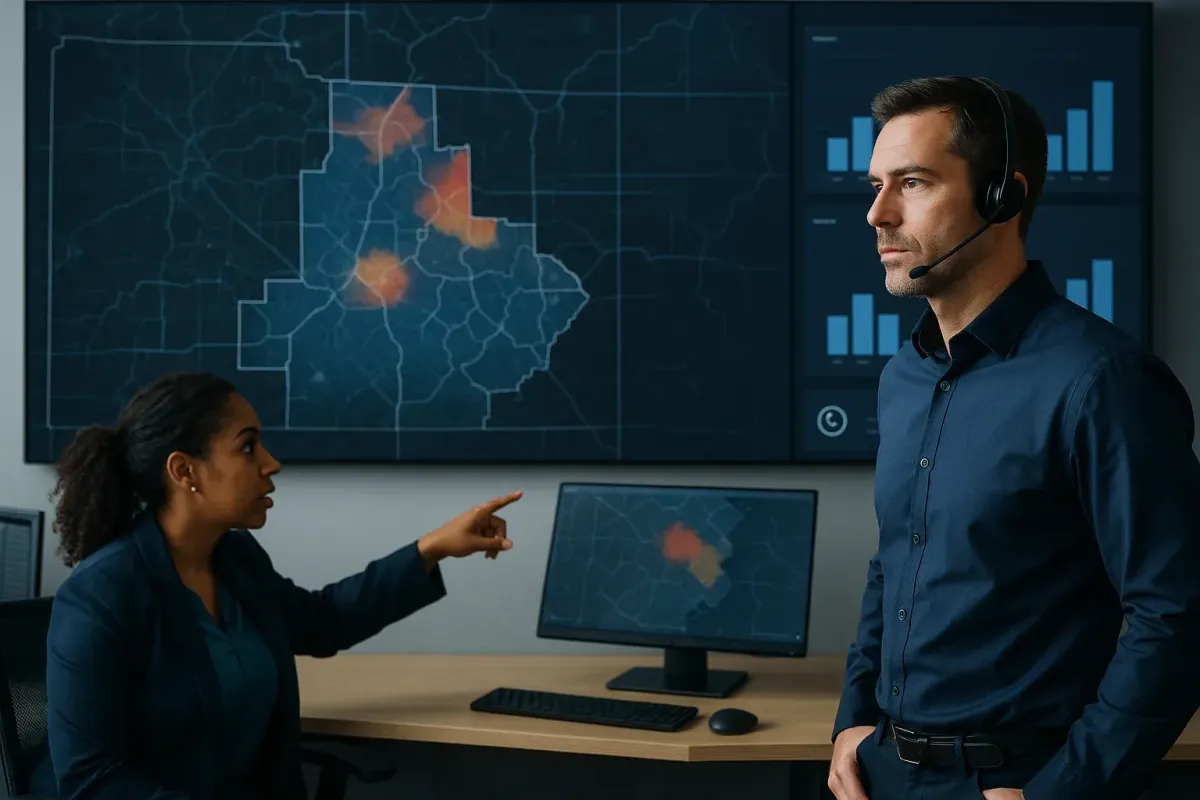
Voice AI for Utility Outage Communications and Service Requests
Operational framework for deploying high-volume Voice AI in electric, water, gas, and public utilities—covering call flows, account-safe validation, integrations, escalation controls, accessibility, procurement, and measurable KPIs.
1. Scope and operational goals
This section defines where Voice AI should be applied in utility operations and the measurable outcomes decision-makers should expect. It separates communications and advisory tasks from control or physical-asset actions and frames what success looks like.
Where Voice AI adds operational value
Use Voice AI for high-volume, deterministic customer contacts: outage status checks, service-request intake (e.g., meter reading issues, reconnections, billing queries tied to accounts), appointment scheduling, and proactive outbound notifications (pre-scripted status updates). Focus on functions that require read/write access only to transactional systems (service orders, CRM notes) and not to any command-and-control or safety-critical infrastructure.
- Containment of common inquiries to automated paths (status, estimated restoration time, ticket creation).
- Automated validation and routing of service requests to field dispatch systems.
- Outbound alerts (text/voice) for known outages or scheduled work—driven from event feeds.
Operational goals and constraints
Set specific, observable outcomes pre-deployment: reduction in average time to open a service ticket, percentage of calls fully handled by Voice AI (containment rate), mean time to human escalation when needed, and reduction in misrouted or duplicate work orders. Importantly, define actions the Voice AI will never perform (e.g., issuing remote switching commands, clearing lockout protections, advising customers in life-or-death medical emergencies).
- Define a list of prohibited actions with legal and operational owners.
- Measure containment, escalation latency, account-validation failure rate, and ticket accuracy.
- Ensure alignment between operations and legal/compliance teams on what constitutes emergency content.
2. Canonical architecture and call flow
Operational reliability depends on a clear, auditable data path between the customer call, the Voice AI model, and authorized utility systems. The following canonical flow is designed for regulated operations and high call volumes.
Canonical call flow (recommended)
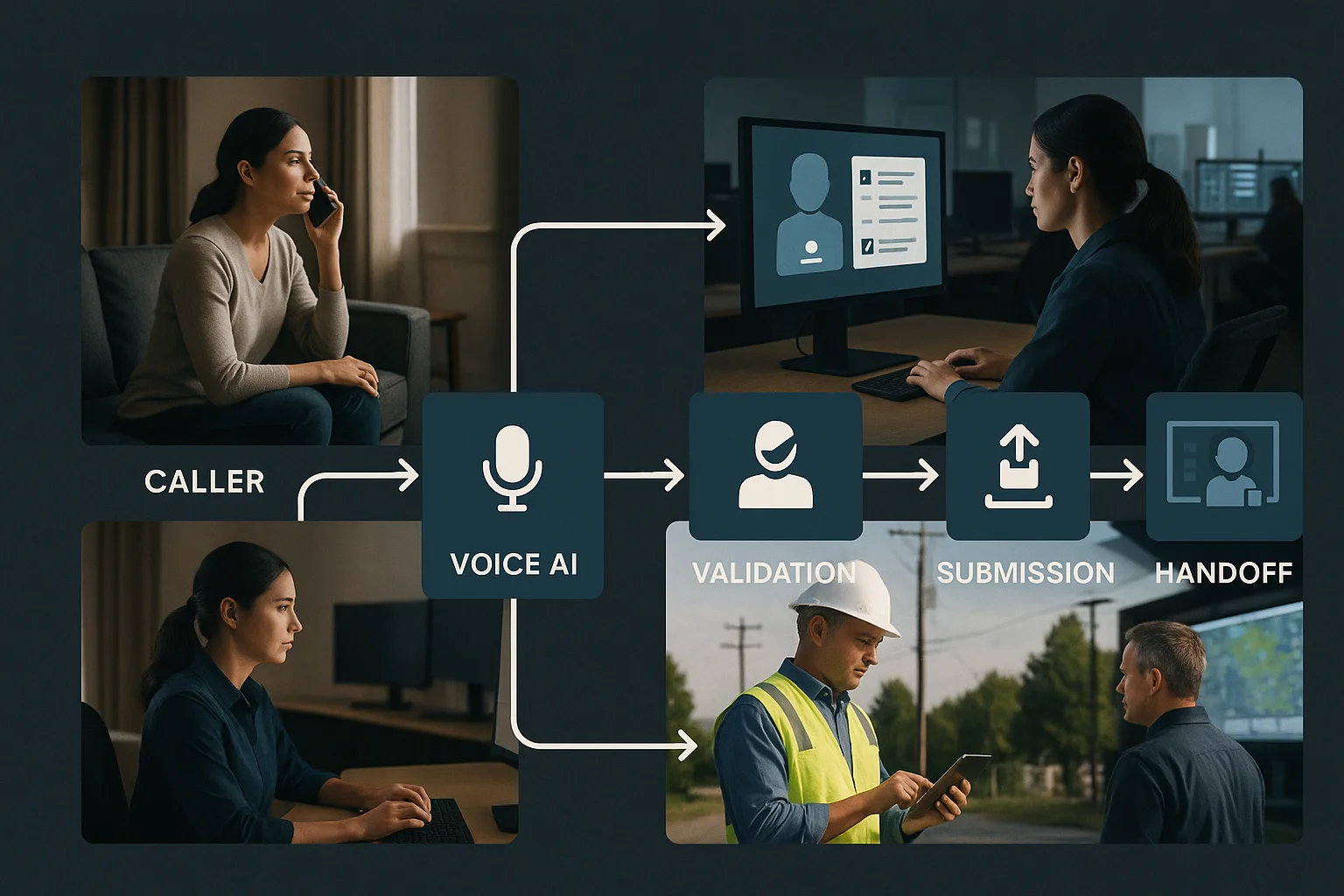
Customer call -> IVR entry -> Voice AI receptionist -> account or location validation -> approved utility API / knowledge source -> deterministic outcome: status response, create/augment service request, or human escalation. Every action that mutates utility systems must be backed by an authenticated API call and an auditable transaction record. The Voice AI is an orchestration and conversation layer, not a system of record.
- IVR routing offers DTMF/voice options and an explicit path to a human at each gate.
- Account validation uses multi-factor, least-privilege checks (e.g., callback number, account number + DOB fragment, service location verification).
- All write actions require tokenized API calls and transactional receipts written to the CRM or OMS.
Model Context Protocol (MCP) for context continuity
Use a Model Context Protocol (MCP) to pass structured, minimal context between the Voice AI model and downstream systems: call ID, validated account ID, action intent, and API transaction IDs. The MCP standardizes what context the model can use and persist for the session and ensures auditability. Do not store full transcripts in the MCP unless policy and customer consent allow it.
- MCP should be strictly scoped—no direct access to control systems or engineering telemetry.
- Include confidence scores and intent IDs so downstream systems can decide deterministic routing.
- Store MCP events in an immutable event log for post-incident review and analytics.
3. Account-safe validation and fraud controls
Utilities often handle PII and must avoid wrongful account access, fraudulent service requests, and social engineering. Design validation to be deterministic and conservative.
Validation strategies
Combine knowledge-based checks (account number, service address confirmation), possession checks (callback to pre-registered phone numbers), and behavioral flags (rapid repeated attempts). For higher-risk actions (meter access, service termination requests), require live agent confirmation or physical verification.
- Prefer tokenized one-time passcodes (OTP) sent via a validated channel for account changes.
- Limit the number of automated validation attempts per account and per phone number.
- Log all validation attempts with timestamps and source_call_ID in the MCP/event log.
Human-in-the-loop gates
Define deterministic gates based on intent confidence, PII requested, or action criticality. If the Voice AI's confidence score falls below a predetermined threshold, or the action involves a safety or billing-impacting decision, escalate to a qualified agent. Ensure human agents receive structured context (MCP payload) and the record of validation steps.
- Escalation requires automatic screen-pop with MCP and recent validation history.
- Use role-based access controls (RBAC) on the agent desktop to prevent unauthorized actions.
- Record human escalation durations for SLA monitoring and root-cause analysis.
4. Accessibility and regulatory considerations
Voice channels must meet accessibility obligations and provide equitable access. Incorporate recognized conventions and document compliance responsibilities.
Designing for disability access (UN CRPD, WCAG 2.2)
Design voice interactions with accessibility-first principles: provide clear spoken prompts, support for speech-impaired users (DTMF and callback options), and consistent fallbacks to text-based channels. Where visually-presented information is provided (e.g., web-based outage maps referenced in voice), ensure that linked resources meet WCAG 2.2 success criteria and that alternative channels are available per UN CRPD obligations. Consult legal counsel to confirm jurisdictional obligations and reasonable accommodations.
- Provide a single option to reach a human agent at every IVR menu.
- Offer an SMS or email transcript and a text-based interaction channel for users who cannot use voice.
- Document how the Voice AI meets accessibility checks and retain evidence for audits.
Privacy, retention, and disclosure
Minimize PII retention in model context payloads. Where call recordings or transcripts are retained for training, obtain explicit consent and document retention periods. Ensure selective redaction before any data is used for model training. Legal requirements vary by jurisdiction; consult qualified counsel and local privacy officers.
- Classify data types (telephony metadata vs. PII) and apply different retention policies.
- Use tokenization and key management for any stored identifiers.
- Maintain a transparent customer-facing privacy notice for Voice AI interactions.

5. Procurement and implementation choices
Decisions on on-prem vs cloud, managed services, and vendor contracts materially affect reliability and regulatory compliance. This subsection outlines procurement controls and operational choices.
Platform choices: cloud, on-prem, or managed
Utilities with 24/7 ops and mature security teams may prefer hybrid or on-prem deployments for sensitive workloads. Smaller utilities or those lacking continuous ops capability should consider managed Voice AI services that include 24/7 monitoring, escalation pathways, and compliance controls. Ensure SLAs cover availability, failover, data segregation, and incident response.
- For high-volume outage periods, ensure burst capacity in SLAs and tested disaster recovery plans.
- Require vendors to support private network peering or dedicated connectivity for secure API traffic.
- If using managed services, confirm the vendor's ability to integrate with your CRM/OMS and to provide exportable audit logs.
Contract and procurement safeguards
Negotiate obligations for data handling, security certifications, subprocessor disclosures, model update change control, and incident notification timelines. Insist on a right-to-audit clause and explicit handover procedures for operational runbooks and knowledge transfer at contract termination.
- Define measurable SLAs for containment, escalation latency, and ticket-accuracy rates.
- Specify acceptable model updates and require staged testing before production rollout.
- Require exportable MCP event logs and raw transcripts (subject to privacy rules) on contract exit.

6. Failure modes, testing, and analytics
Plan for predictable failure modes—model hallucination, connectivity loss, misvalidation, or surge events—and instrument the system for event-level analytics and root-cause analysis.
Failure boundaries and mitigation
Identify hard failure boundaries where Voice AI must stop attempting to resolve and must transfer to human agents: loss of API connectivity, repeated failed validations, ambiguity in safety-related content, or detection of an emergency. Implement automatic fallbacks to a human agent, queue music with estimated wait times, or safe scripted messaging. Never allow the Voice AI to provide procedural safety or emergency instructions.
- Test network and API outage scenarios in every deployment; implement circuit-breakers that route to human agents when backend services are unavailable.
- Run adversarial testing focused on social-engineering attempts to bypass validation.
- Use synthetic traffic and replay real outage events to validate throughput and containment under load.
Event-level analytics and feed design (design lessons from GTFS Realtime)
Design real-time event feeds to power outbound notifications and status queries. Utilities can adopt patterns used in GTFS Realtime—for example, concise event records with authoritative timestamps, event types, affected locations, and status (e.g., reported, confirmed, restored). These feeds should be source-of-truth for the Voice AI's read-only status responses and feed an analytics pipeline for operational reporting.
- Event records must include an authoritative originator ID and restoration estimate metadata where available.
- Correlate Voice AI interactions with event IDs in the MCP so you can measure voice-channel reach and response times per event.
- Maintain immutable event logs to support post-incident audits and regulatory reporting.
7. Deployment runbook and operational handover
Operationalize Voice AI with a phased rollout, training for agents, and a living runbook for incident response and analytics.
Phased rollout checklist
Begin with a narrow pilot (single service type, limited geography, off-peak hours). Validate containment, escalation flows, validation failure rates, and human handover quality. Expand by adding intents and regions only after meeting pre-agreed KPIs and running a post-pilot audit.
- Pilot objectives: validate account validation success and human handover TLs.
- Use dark-launch testing (agent assist with invisible AI suggestions) before full automation.
- Require an independent operational audit within 60–90 days of pilot expansion.
Training, SOPs and emergency readiness
Provide agent training on new screens, MCP payload interpretation, and escalation decision rules. Maintain SOPs for outage surges, regulatory reporting, and data subject access requests. Ensure on-call support for model and API failures with documented contact trees.
- Create a short, actionable SOP for agents that includes verification steps and escalation triggers.
- Maintain a cross-functional incident response plan that includes comms, operations, legal, and IT.
- Schedule regular tabletop exercises simulating large-scale outages to test voice-channel and human-capacity plans.
Related Peak Demand resources
Industry and AI sources reviewed
- AI Risk Management Framework — Critical Infrastructure ProfileNational Institute of Standards and Technology (NIST)
- Cross-Sector Cybersecurity Performance GoalsCybersecurity and Infrastructure Security Agency (CISA)
- Cybersecurity Capability Maturity Model (C2M2)U.S. Department of Energy
Utility cybersecurity, critical-infrastructure, records, customer-protection, and emergency-communications obligations vary by jurisdiction and service type. This article is operational guidance, not legal advice; organizations should confirm applicable requirements with qualified professionals.
Frequently asked questions
Use Voice AI to absorb high call volumes, provide approved outage and restoration messaging, validate the caller's account or service location, capture non-emergency service details, and route exceptions to trained staff. It should not estimate restoration times unless those estimates come from an approved utility system of record.
Official reference: Cross-Sector Cybersecurity Performance Goals
The integration design typically depends on the use case, but common systems include the customer information system, outage management system, CRM, knowledge base, notification platform, scheduling tools, and service-request or work-order systems. The Voice AI layer should receive only the data and actions required for the approved workflow.
Official reference: Cybersecurity Capability Maturity Model (C2M2)
No. Voice AI should remain a customer-communication, intake, validation, routing, and escalation layer. Infrastructure control, switching, dispatch authority, emergency response, and safety-critical decisions must remain within approved operational systems and qualified human teams.
Official reference: Cross-Sector Cybersecurity Performance Goals
Ask for evidence of surge and latency testing, account and premise validation, integration failure handling, auditable logs, data minimization, human escalation, change control, incident response, monitoring, and a clear operating model for updates after launch.
Official reference: Cross-Sector Cybersecurity Performance Goals
Build resilient utility customer-service automation
Peak Demand helps utilities connect Voice AI to approved customer-information, outage-communication, service-request, dispatch, escalation, and analytics workflows.
Schedule a discovery call


