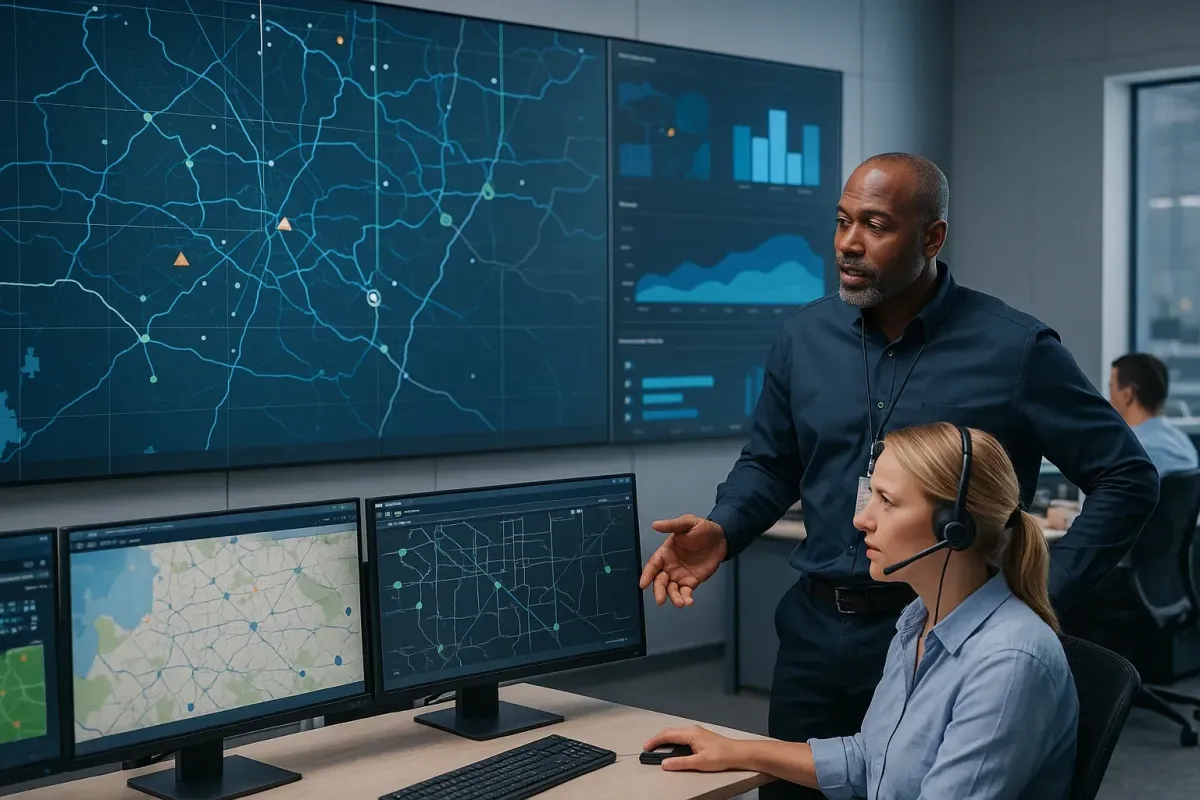
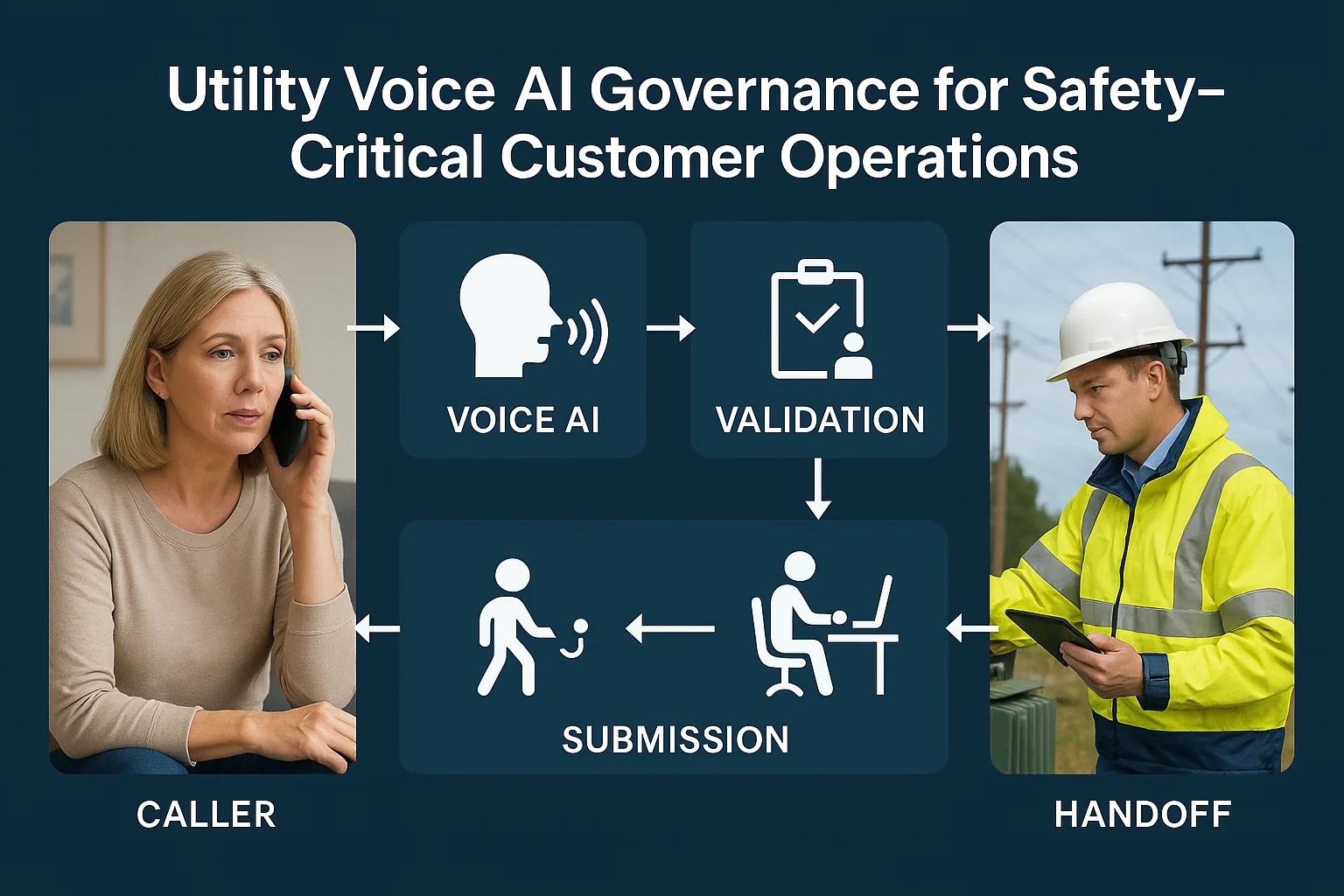
Utility Voice AI Governance for Safety-Critical Customer Operations
A jurisdiction-neutral operational framework for running high-volume Voice AI in utilities. End-to-end workflows, account-safe validation, routing, escalation, integration safeguards, and measurable outcomes for outage and service-request operations.
1. Governance scope and safety boundaries
Define what Voice AI will and will not do. Clear scope reduces ambiguity in operations, liability, and training.
Operational scope and exclusions
Start by listing permitted use cases (high-volume inbound outage status requests, service-request intake, appointment scheduling, billing inquiries where allowed) and explicit exclusions (emergency response, isolation/islanding commands, remote-control of grid assets, live switching requests). For each permitted use case, define the exact output types Voice AI may produce: informational responses, service-request creation, appointment proposals, or human-transfer. Track scope in the governance registry so operational teams and procurement evaluate exactly what adapters and approvals are required.
- Permitted: outage status lookups, estimated restoration time (from OMS), outage reporting, non-critical account updates (contact info), service-request intake.
- Excluded: issuing or authorizing physical commands, operational control, or emergency triage decisions; never rely on Voice AI for life-safety instructions.
Safety boundaries and human oversight
Specify decision gates where a human must approve escalation, service dispatch, or any action that could affect public safety or field crew safety. Examples: when a caller reports gas odor or exposed live conductors, route immediately to trained emergency dispatch or call center human agents; do not accept a caller-confirmed remediation action without human confirmation. Capture the human-in-the-loop requirements in both the voice flow and the downstream orchestration rules so that automated transcripts, timestamps, and handoff artifacts are retained for audit.
- Automatic escalation triggers: reports of fire, gas leak, downed lines, exposed equipment, or personal injury.
- Voice AI role: triage and transfer only; supply scripted safety guidance (non-technical) and immediate transfer to emergency services where required.
- Record: timestamps, decision rationale, and the identity or badge of the human agent taking control.
2. End-to-end call workflow: deterministic steps
Operationalize an unambiguous, auditable call flow so each inbound call follows the same validation and routing logic.
Canonical call flow (customer call → resolution or escalation)
Define a step-by-step sequence that every voice session follows. Keep the steps deterministic and minimal; prefer linear flows over complex branching where possible to reduce failure modes.
- 1) Session initiation: capture ANI (calling number), optional IVR selection (outage, billing, service), and consent to record if required by policy.
- 2) Caller intent identification: Voice AI classifies intent using a validated intent model anchored to a finite set of supported intents (e.g., 'report outage'.
- 3) Account or location validation: attempt layered validation (CIS account number, service address match, callback code via SMS or voice, or a shared secret).
- 4) Authoritative lookup: query OMS/CIS/CRM or knowledge base through an approved API adapter for outage status, estimated restoration time, or account details.
- 5) Action determination: respond with read-only status, create a service request (ticket), propose an appointment, or transfer to human agent based on intent, validation.
Account & location validation — layered controls
Validation is the single most important control to prevent misdirected actions. Build progressively stronger checks when the requested action could change customer data or trigger a field crew dispatch.
- Minimum (information-only): ANI and service address lookup; return read-only status when there is a high-confidence match.
- Medium (service-request creation): require account number or full service address plus callback verification (SMS or voice PIN) before allowing creation.
- High (dispatch/crew scheduling): require two-factor verification — account credential plus short-lived callback PIN or previously verified payment method token — and a human agent.
- Fallbacks: on failed validation attempts, fall back to human transfer or generate a hold-and-callback ticket with no automated crew dispatch.
3. Integration, data controls, and system ownership
Integrations must be explicit, auditable, and owned. Use controlled adapters and never permit ad hoc queries against operational control systems.
Approved APIs and authoritative data sources
Map every information or action Voice AI can request to an approved system owner and API. Typical authoritative systems include CIS/CRM (customer records), OMS (outage state), workforce management (scheduling), and ticketing systems. Restrict access to read-only tokens for status responses; enforce scoped write tokens for ticket creation with granular logging.
- Create an integration register: each adapter entry lists API endpoints, token scopes, owner, logging endpoint, and retention policy.
- Use adapters that transform intent into deterministic API calls; avoid natural-language-native write operations that synthesize commands.
- Log the API response alongside the Voice AI transcript and decision rationale for auditability.
Cybersecurity & maturity considerations
Voice AI integrations sit at the intersection of customer-facing software and critical operational systems. Use recognized frameworks to align technical controls and maturity planning. Adopt layered cybersecurity controls—least privilege credentials, segmented hosting, monitored orchestration, and regular third-party security assessments. Document the hosting region, backup region, subprocessors, and any remote-support arrangements to satisfy data residency, transfer, and breach-notification obligations.
- Segment Voice AI integrations from operational control networks; do not permit direct write access to systems that send control commands without explicit human-mediated approval.
- Require vendors to disclose subprocessors and remote-support procedures; define acceptable regions for primary and backup hosting and retention of call recordings.
- Plan periodic maturity reviews to progress defensive capabilities and incident response readiness.
4. Routing, escalation, and exception handling
Make escalation deterministic and measurable. Define routing policies that consider intent, validation level, time of day, and surge conditions.
Escalation rules and human-in-the-loop gates
Escalations should be rule-based and observable. Define priority levels and the exact triggers that move a session to a human agent. Include who owns the escalation (contact centre, outage desk, emergency dispatch) and the SLA for pickup or callback.
- Immediate human transfer: safety-related intents (gas leak, exposed lines), high-priority crew confirmations, or conflict-of-record evidence.
- Queued human callback: failed validation for service-request creation, complex billing disputes, or multi-premise outage reports; record expected callback SLA.
- Automated ticket with human review: low-risk updates (contact info), where Voice AI creates a ticket but flags it for a daily human QA review.
Exception handling and fail-safe fallbacks
Design a small number of explicit failure paths and automate them. Avoid ambiguous ‘try again’ loops that frustrate callers. Ensure every failure path produces an auditable artifact and a defined owner for the next manual step.
- Validation failure: if validation fails after N attempts, lock the automated flow and create a callback ticket assigned to a human queue with priority.
- Integration failure: if the OMS or CIS API is unavailable, the agent should inform the caller, create a recorded ticket with available metadata, and.
- Unrecognized intent: escalate to an agent after a single failed classification attempt to minimize customer friction.

5. Quality assurance, testing, and observability
Operational confidence requires continuous validation — simulated loads, synthetic tests, and event-level analytics that connect Voice AI decisions to downstream outcomes.
Simulation, validation, and QA cycles
Validate intents and flows with representative audio and failure scenarios. Include edge cases such as multi-language callers, partial data matches, and high-concurrency outage surges. Maintain a scorecard that tracks intent accuracy, validation success rates, and escalation correctness.
- Test plans: include unit tests for adapters, integration tests against staging APIs, and end-to-end voice tests that include human handoffs.
- Failure injection: periodically simulate downstream API outages so the flow’s fallback behavior and SLAs are exercised.
- QA cadence: nightly synthetic runs, weekly manual sampling by quality analysts, and monthly review with ops and vendor teams.
Event-level analytics and measurable outcomes
Instrument every session so you can connect Voice AI decisions to operational outcomes. Event-level telemetry enables performance measurement (tickets created, correct escalations, false transfers) and root-cause analysis when incidents occur.
- Minimum event set: session start/end, intent, validation level, API responses, action taken, human transfer events, and ticket IDs.
- KPIs: time-to-first-response, validation pass rate, correct-escalation rate, callback SLA adherence, and percentage of tickets requiring rework.
- Dashboards: present both real-time operational views for incident response and long-term trend analytics for capacity planning and model maintenance.
6. Procurement, operating ownership, and runbook essentials
Procurement and runbooks translate governance into day-to-day operations. Specify evidence, operating roles, and capacity plans explicitly in contracts and in the service runbook.
Vendor evaluation and contractual evidence
Procure Voice AI with clear evidence requirements: security posture, audit trail capabilities, subprocessor disclosure, hosting geography, incident response roles, and operational support SLAs. Require demonstrable integration capability with your CIS/OMS/crew systems and a documented approach to account-safe validation. Avoid one-size-fits-all claims; require vendor proofs through staged acceptance tests in your environment.
- Ask for: integration runbooks, sample event logs, test credentials for staging, subprocessors list, and documented remote-support procedures.
- Contractual clauses: data residency, permissible transfers, retention and deletion policy for call recordings, and breach-notification timelines.
- Acceptance testing: run the canonical call flow and failure-injection tests before cutover.
Operational ownership, surge capacity, and runbook items
Assign clear ownership for each artifact: who owns the training data, the intent model, integration adapters, and the incident response playbook. Define surge capacity expectations and the handoff to human ops when AI throughput reaches pre-defined thresholds. Keep a concise runbook that field supervisors and contact-centre leads can act upon during an outage.
- Roles: Voice AI product owner (business), integration owner (IT), security owner (CISO), outage desk owner (operations), vendor operations lead.
- Surge strategy: graceful degradation path that shifts requests from automated handling to prioritized human queues when concurrent sessions or API error rates exceed thresholds.
- Runbook essentials: escalation contacts, sample transcripts, validation failure checklist, API outage response steps, rollback criteria, and post-incident reporting templates.
Related Peak Demand resources
Industry and AI sources reviewed
- AI Risk Management Framework — Critical Infrastructure ProfileNational Institute of Standards and Technology (NIST)
- Cross-Sector Cybersecurity Performance GoalsCybersecurity and Infrastructure Security Agency (CISA)
- Cybersecurity Capability Maturity Model (C2M2)U.S. Department of Energy
Privacy, telecommunications, recording-consent, cybersecurity, consumer-protection, employment, and records obligations vary by jurisdiction and use case. This article is operational guidance, not legal advice; organizations should confirm applicable requirements with qualified professionals.
Frequently asked questions
Good starting points include billing and account questions, move-in or move-out intake, appointment scheduling, service-request capture, outage-status messaging from approved systems, payment-routing assistance, and structured escalation. Safety-critical and infrastructure-control decisions should remain with qualified utility teams.
Official reference: Cross-Sector Cybersecurity Performance Goals
Use the minimum approved identifiers needed for the workflow, validate them against the utility's system of record, limit data exposure, and provide a human-assisted path when verification fails. The Voice AI should not guess account, premise, or outage information.
Official reference: Cross-Sector Cybersecurity Performance Goals
Use controlled adapters, strict schemas, timeouts, retries, audit logs, safe failure states, and human escalation. The system should distinguish approved utility data from model-generated language and should never present stale or unverified operational information as fact.
Official reference: Cybersecurity Capability Maturity Model (C2M2)
Track containment by request type, successful validations, transfers, abandoned calls, integration errors, incorrect or stale responses, time to resolution, customer follow-up, and the percentage of cases completed safely without manual rework.
Official reference: Cybersecurity Capability Maturity Model (C2M2)
Turn Voice AI infrastructure into a managed enterprise operation
Peak Demand designs, integrates, deploys, monitors, and improves Voice AI systems across customer service, enterprise systems, governance, escalation, and reporting.
Schedule a discovery call


