
What Makes a Page Citation-Worthy for AI Answer Engines
Practical, evidence-led guidance for making pages more likely to be retrieved and cited by AI answer surfaces. Defines AEO/GEO, entities, structured data, retrieval mechanics, QA, measurement and multi-site scale.
1. Why "citation-worthy" matters — definitions and scope
Before tactical work begins, clarify the terms and the operating boundaries. This section defines AEO, GEO, entities, retrieval, citations, schema, and knowledge graphs in practical terms for digital and marketing leaders.
Definitions: AEO, GEO, entities, retrieval and citations
AEO (Answer Engine Optimization) and GEO (Generative Engine Optimization) are disciplines for making content more likely to be retrieved and used by AI-powered answer surfaces. An entity is a discrete thing that has attributes and a stable identity (brand, person, product, place). Retrieval is the process an engine uses to find source passages or documents that can satisfy a query. A citation in this context is the engine’s explicit or implicit attribution of an information source (a page, site, or knowledge-graph node) used to construct an answer. These are operational definitions — not promises of placement.
- AEO/GEO: optimization disciplines focused on retrieval signals, content quality, and attribution, not guaranteed inclusion.
- Entity: any named thing with stable properties used by knowledge graphs and retrieval systems.
- Citation: evidence that an engine used a page as a source; may be explicit (link or label) or implicit (not shown to users).
What search engines document vs. practitioner inference
Search engines publish guidance about structured data, people-first content, and product/FAQ markup. They do not publish exact retrieval algorithms, weights, or the mechanics of when they will display an attribution. Practitioners therefore combine documented guidance with empirical measurement and controlled experimentation to infer which pages are more likely to be retrieved and cited.
- Documented: schema and structured-data usage, people-first content guidance, and high-level AI feature guidance.
- Inferred: how entity prominence or site architecture affects retrieval probability; these remain practitioner hypotheses unless stated by the engine.
2. Core content and entity signals that make a page usable for answers
This section covers the content and entity attributes that matter in practice — canonical facts, clarity, topical coverage, and the difference between authoritative pages and background content.
Canonical facts and entity-first pages
AI answer surfaces favour pages that present canonical, verifiable facts about an entity in concise, structured ways. A 'canonical facts' page is focused on core attributes (who/what/when/where/how) and explicit identifiers (model numbers, official names, addresses, release dates). This helps retrieval systems match query intents to authoritative source passages.
- Keep entity identifiers (official names, IDs) obvious and consistent across pages and structured data.
- Use short, factual summaries near the top of the page for quick extraction.
- Distinguish canonical entity pages (authoritative) from commentary or opinion pages (contextual).
Topical authority and page graphs
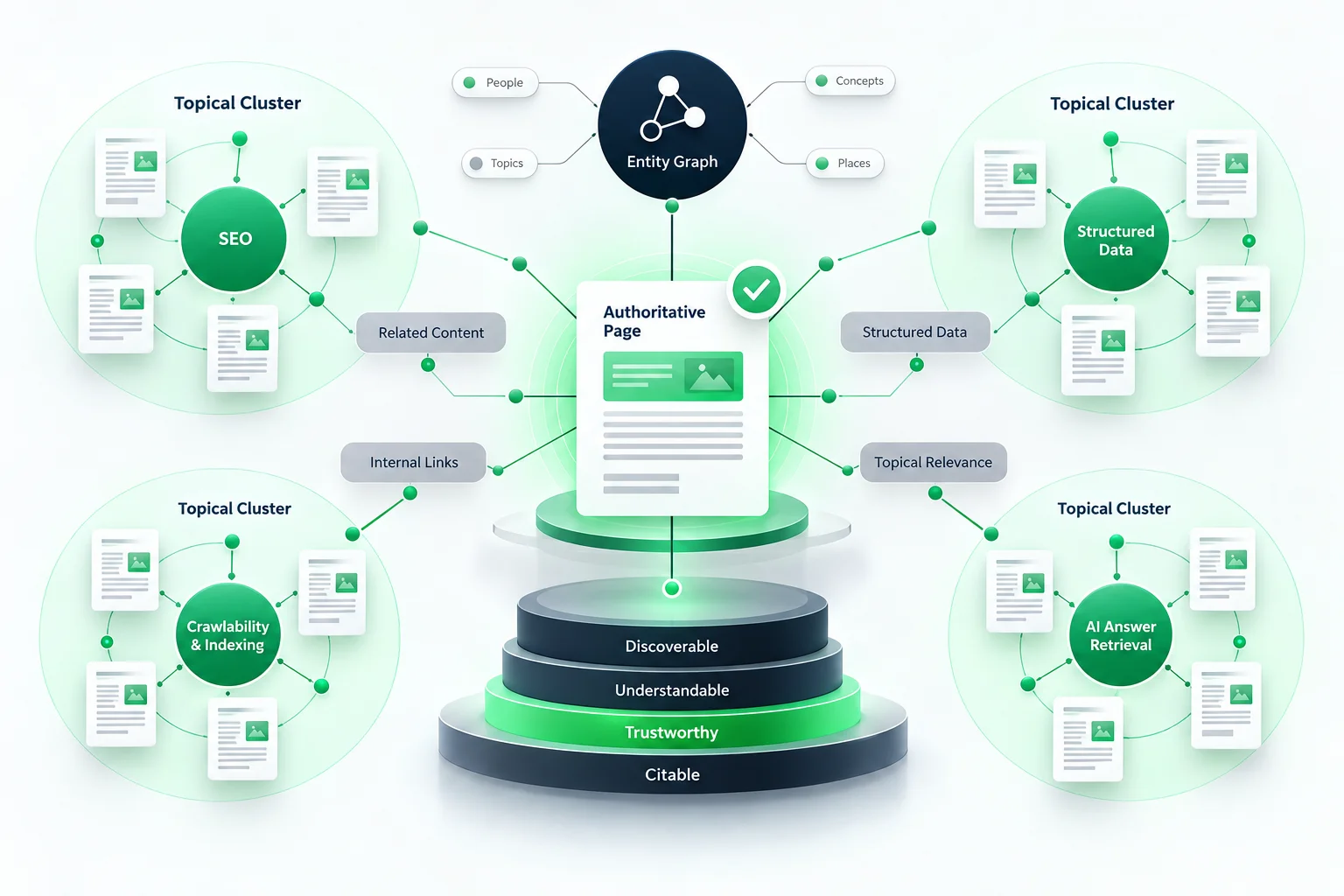
A single page rarely wins by itself. Engines consider topical coverage across a site or a coherent set of pages. Build a topic-and-page graph (research and entity model → topic and page graph → authoritative pages) so retrieval systems can find multiple corroborating sources. The page graph should include hub pages, entity profiles, and supporting evidence pages.
- Design hub pages that summarize a topic and link to canonical entity pages.
- Maintain factual consistency across the graph to reduce retrieval ambiguity.
- Use content clusters to show breadth and depth on a topic, which practitioners associate with higher retrieval likelihood.
3. Structured data and knowledge-graph readiness
Structured data encodes the machine-readable facts that feed knowledge graphs and retrieval systems. Implement schema precisely, but understand what search engines document about structured data and what remains inferred.
What structured data actually does
Structured data (schema.org) is a signal to search engines about the meaning and type of page content. It helps engines extract attributes reliably and can be used by knowledge-graph layers and AI features to surface quick facts. However, structured data does not guarantee a citation or that an engine will use it; it improves the clarity and extractability of facts.
- Implement types and properties that match the entity: Organization, Product, Person, Event, etc.
- Use the most specific schema types and include IDs (sameAs, identifier) where available.
- Validate structured data with tools and keep it in sync with visible content.
Knowledge-graph readiness and unique identifiers
Prepare pages to function as knowledge-graph nodes by exposing canonical identifiers and explicit relationships (sameAs links to official profiles, sitemaps for entity pages, linked data patterns where practical). These signals help retrieval systems disambiguate entities that share names or attributes.
- Publish sameAs links to official profiles (Wikidata, corporate profiles) where appropriate.
- Use persistent, human- and machine-friendly URLs for entity pages.
- Maintain an internal canonical ID mapping for multi-site and multilingual variants.
4. Technical retrieval hygiene and internal linking
Retrieval systems depend on clean technical signals and robust internal linking. Technical hygiene reduces noise and increases the chance an engine extracts the correct passage from the correct page.
Canonicalization, crawlability and canonical tags
Ensure the canonical version of each entity page is crawlable, returns consistent metadata, and uses canonical tags correctly across multilingual and multi-site deployments. Non-crawlable or duplicate pages introduce ambiguity that reduces retrieval confidence.
- Avoid index-blocking for canonical entity pages.
- Use rel=canonical consistently; avoid canonical chains.
- Serve consistent hreflang and structured data across language variants.
Internal linking and hub-and-spoke design
Internal links create signal pathways for retrieval systems and help demonstrate topical authority. Use hub pages, semantic anchors, and context-rich link text to connect entities and their supporting materials.
- Place essential entity facts on pages reachable within a few clicks from a hub.
- Use descriptive, entity-focused anchor text rather than generic “learn more”.
- Ensure supporting pages corroborate and cite back to the canonical entity profile.

5. Authority, distribution and Peak Demand’s operating model
Authority combines content quality, distribution, external references, and brand signals. Peak Demand’s approach connects entity architecture, structured data, internal linking, and measurement into a managed visibility system tailored for AI answer surfaces.
External references and publisher reputation
External citations (authoritative backlinks, references from trusted publishers) remain important signals for topical authority. For AI answer engines, publisher reputation plays a role in source selection, especially for fact-based queries; however, exact weighting is not published and must be treated as an empirical signal.
- Prioritize high-quality references and factual citations from domain-relevant publishers.
- Monitor how external references are described (anchors, context) to avoid ambiguous endorsements.
Peak Demand differentiation: integrated visibility systems
Peak Demand connects technical SEO, entity architecture, knowledge graphs, structured data, internal linking, topical coverage, content distribution, and measurement into a managed visibility system. That operating model (Research and entity model → topic and page graph → authoritative content → structured data and internal linking → distribution and brand signals → retrieval/citation surfaces → measurement and iteration) is designed to reduce ambiguity for retrieval layers and to operationalize containment and escalation quality.
- We design entity models that map to knowledge-graph-ready pages and schema implementations.
- We operate control planes for secure publishing, governance, and content distribution to reduce issuance errors — see our Secure Publishing Control Plane for AI.
- We offer implementation and measurement services to tie retrieval outcomes to business pipelines via our AI SEO services and search-to-pipeline infrastructure.

6. Measurement, QA and multi-site operational scale
Operational excellence determines whether a page remains citation-worthy as content, language, and facts change. This section describes the measurable KPIs, QA processes, and scale considerations that matter.
Key KPIs: containment, escalation quality and cost-to-serve
Containment rate measures how often user intents are satisfied by automated answers without human handoff. Escalation quality measures whether handoffs include the right context and reduce repeat work. Cost-to-serve aggregates the effort and infrastructure cost per answered request. Track these metrics continuously to quantify visibility improvements and downstream business impact.
- Containment rate: proportion of queries resolved by automated answers.
- Escalation quality: percentage of escalations with sufficient context for human resolution.
- Cost-to-serve: total cost divided by contained queries; use this to prioritize high-value entity pages.
Multisite and multilingual scale: governance and parity
At scale, maintain canonical ID maps, translation parity, and automated QA checks for structured data and visible facts. Governance controls must include change auditing, rollback paths, and a secure publishing control plane to prevent inconsistent facts from propagating into answer surfaces.
- Implement a canonical ID system across sites and locales.
- Automate structured-data validation and visible-content parity checks.
- Use governance and audit playbooks for knowledge graphs and answer surfaces to manage change.
Related Peak Demand resources
Industry and AI sources reviewed
- Creating helpful, reliable, people-first contentGoogle Search Central
- AI features and your websiteGoogle Search Central
- SEO Starter GuideGoogle Search Central
- Understand how structured data worksGoogle Search Central
- Schema.org DocumentationSchema.org
Search-engine and AI-answer behavior changes over time. Google documentation can establish published requirements and guidance, but inclusion in rankings, AI Overviews, citations, or LLM answers is never guaranteed. Practitioner observations should be labelled as inference or testing rather than official ranking factors. This article is operational guidance, not legal advice; organizations should confirm applicable requirements with qualified professionals.
Frequently asked questions
SEO improves visibility in traditional search results. AEO focuses on making content easy for answer systems to extract and use. GEO focuses on visibility in generative search and AI answer experiences. In practice, the strongest strategy combines technical accessibility, useful content, clear entities, strong internal relationships, structured data, and credible source authority rather than treating them as isolated channels.
Official reference: SEO Starter Guide
No. Structured data can make page entities and relationships more explicit and can support eligible search features, but it does not guarantee rankings, AI Overview inclusion, citations, or mentions in generative answers. It should reinforce accurate visible content rather than replace it.
Official reference: Understand how structured data works
Search and answer systems need to understand what a brand, person, product, service, or concept is and how it relates to other entities. Consistent naming, authoritative pages, structured relationships, internal linking, and corroborating references can reduce ambiguity and make a site easier to interpret and retrieve.
Official reference: Schema.org Documentation
Track traditional search visibility alongside query coverage, indexed pages, non-brand discovery, AI referral traffic where available, observed citations or mentions, entity consistency, content-cluster coverage, internal-link depth, and lead quality. Treat AI-surface monitoring as directional because answer composition can vary by model, query, user, and time.
Official reference: AI features and your website
Build a search and AI visibility system that compounds
Peak Demand connects technical SEO, entity architecture, knowledge graphs, structured data, topical authority, internal linking, distribution, and measurement into a managed SEO/AEO/GEO operating system.
Explore Peak Demand AI SEO, AEO & GEO


