
Entity SEO: How Search Engines Understand Brands, People, Products, and Services
A practical, evidence-led guide for marketing and SEO leaders: design entity-first systems—knowledge graphs, structured data, topical coverage, and operating workflows—to improve visibility in Google, AI Overviews, and other answer surfaces without promising placements.
1 — What is an entity and why it matters for modern search
Define the core terms and explain why marketing leaders should design for entities rather than only pages or keywords.
Entities, knowledge graphs, and retrieval — plain language
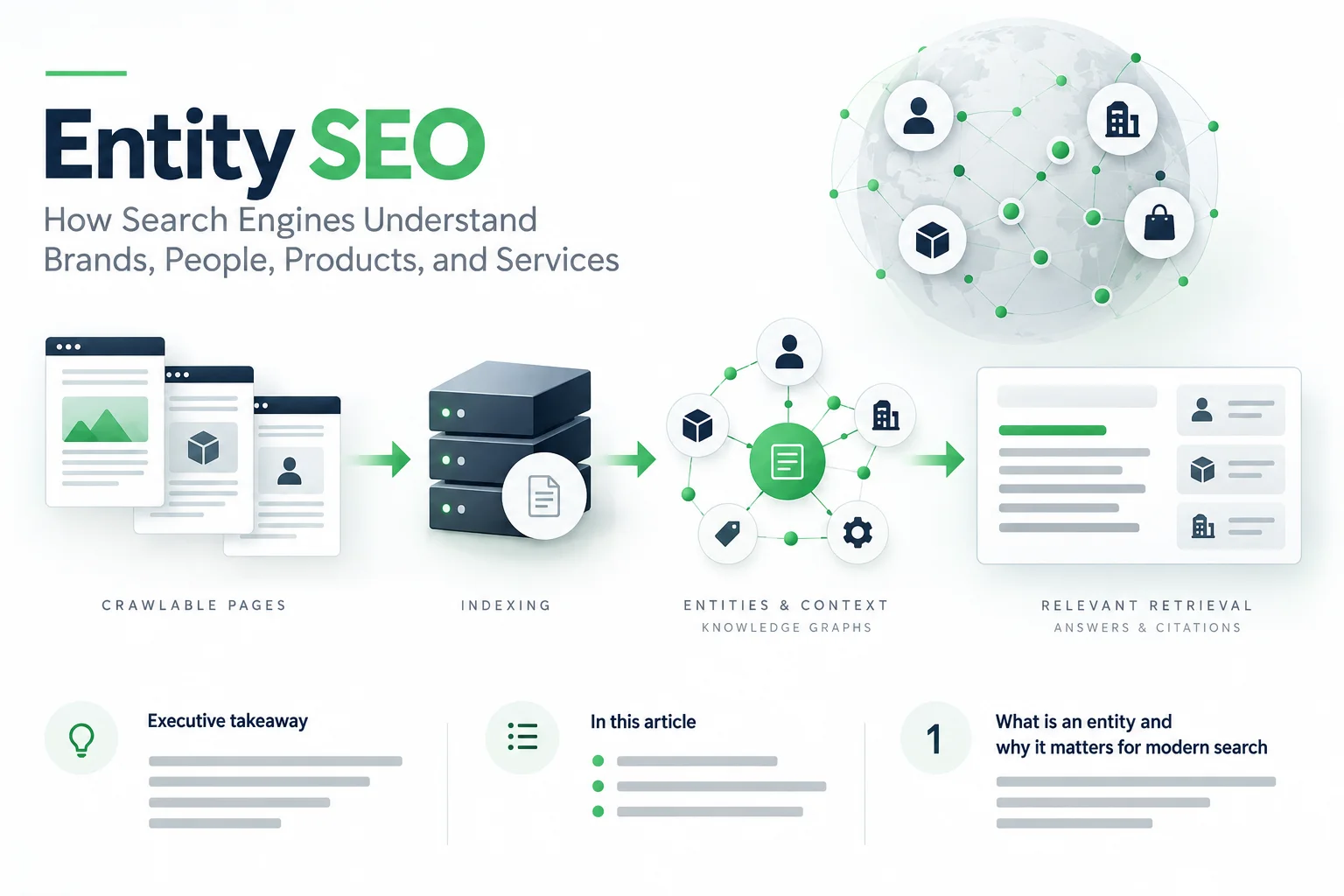
An entity is a distinct, identifiable thing: a brand, person, product, place, service, or concept. Search engines and AI systems map content and facts to entities in internal knowledge graphs (structured representations) so they can retrieve and assemble answers across sources. For your team, thinking in entities means: model each offer or person with a persistent identifier, represent attributes consistently, and ensure content references that entity in machine-friendly ways.
- Entities are persistent nodes of meaning that link data, pages, and citations.
- Knowledge graphs are the structured maps search engines use to connect facts and sources.
- Retrievability is the process that selects candidate documents or entity records for answers; it relies on signals that surface entities and their supporting content.
AEO, GEO, and SEO — what these acronyms mean in practice
Use the shorthand AEO (answer engine optimization) for optimizations targeted at extractive or assembled answers, GEO (generative engine optimization) for LLM-driven generative answers, and SEO for classic organic search visibility. These disciplines overlap: entities and authoritative structured signals are foundational for all three. Treat them as complementary optimization lenses rather than guaranteed placements.
- AEO focuses on concise, citation-ready facts and extractable content.
- GEO focuses on topical coverage, canonical sources, and signals that make your entity a plausible attribution.
- SEO focuses on discoverability, content quality, and classic relevance signals.
2 — What search engines document versus practitioner inference
Distinguish documented guidance from reasonable practitioner inference so teams know which controls are required and which are experimental.
Documented guidance you can act on
Google and schema.org publish practical instructions that directly affect implementation: use structured data to describe entities and attributes, follow the SEO Starter Guide for crawlability and canonicalization, and create helpful, people-first content. Google also provides guidance on AI features and how web content can appear in AI-generated summaries. Implementing these documented practices reduces risk and improves the chance of being considered high-quality by automated systems.
- Use schema.org types and properties for entity attributes (products, people, organizations).
- Ensure pages are indexable, canonicalized, and mobile-friendly as per SEO Starter Guide.
- Create people-first content that demonstrates first-hand expertise and trust signals for topical authority.
Practitioner inference and experimental tactics
Practitioners observe patterns—consistent structured markup, rich internal linking, authoritative citations, and strong distribution often improve inclusion in AI and answer surfaces. These are supported by experiments and case observations, but do not equate to guaranteed outcomes. Treat such tactics as hypothesis-driven investments: test, measure, and document results.
- Structured data consistency across site sections appears to improve retrievability—use it, but measure impact.
- Entity-level canonical pages with comprehensive, authoritative content are more likely to be cited by LLMs in experiments.
- Distribution (press, backlinks, brand mentions) strengthens source authority but does not guarantee AI citation.
3 — Architecture: the entity-to-answer operating model
A repeatable architecture ties research and editorial workflows to technical systems. Use this seven-step architecture as a design and governance blueprint.
Research and entity model
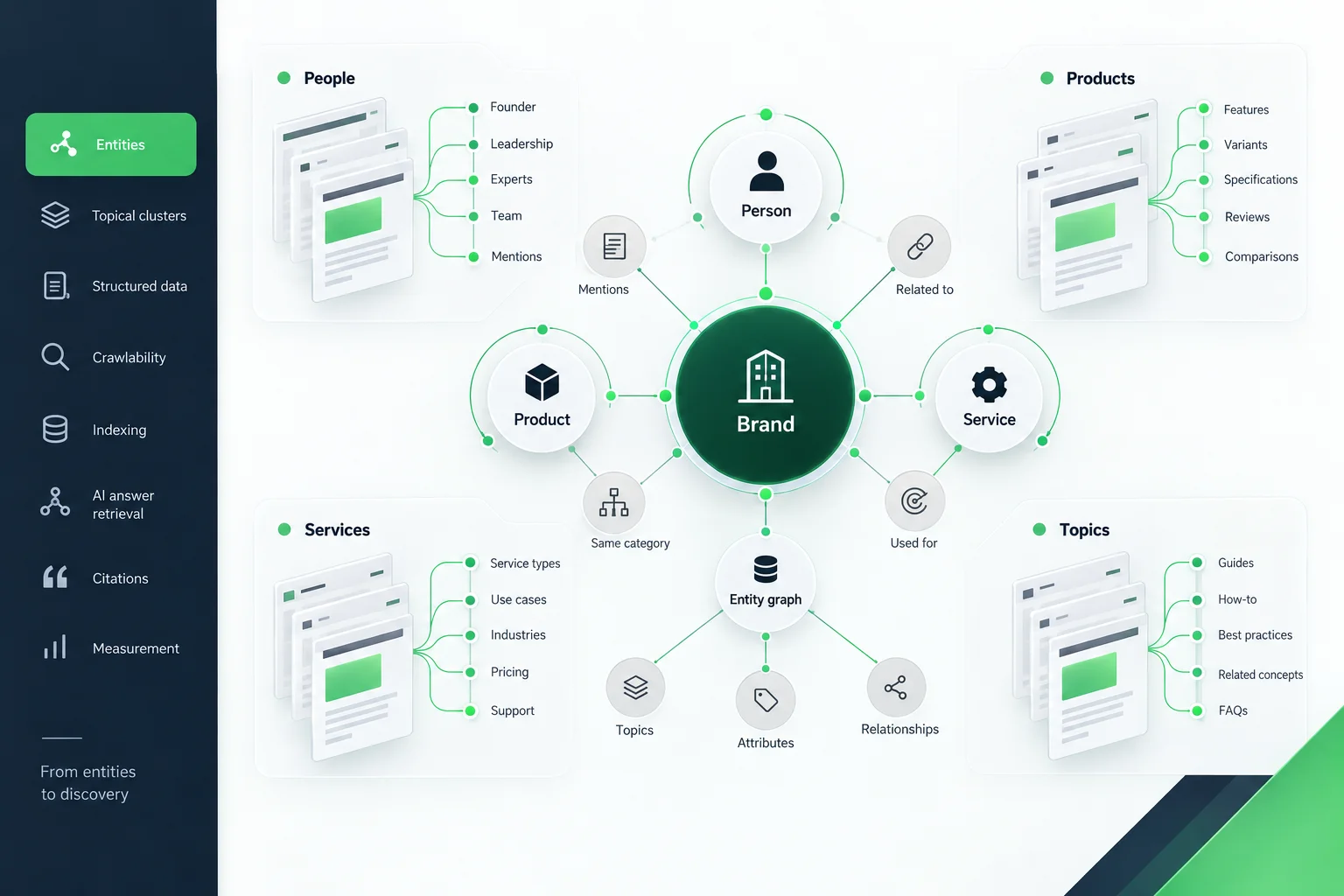
Start with entity discovery: inventory brands, SKUs, services, authors, and locations. Assign persistent IDs, map relationships (owns, manufactured_by, variant_of), and capture authoritative attributes (official name, identifiers, release dates). This entity model becomes the single source of truth for content teams, product managers, and schema generation.
- Create an entity registry with stable IDs and canonical names.
- Record authoritative attributes and permitted synonyms.
- Tag entities with topical clusters and intent signals.
Topic and page graph → authoritative content
Design a page graph where each canonical entity has a primary page and supporting topical pages (how-to, specs, reviews). Ensure each page's role is clear—canonical entity record, transactional detail, or topical analysis—and connect them via contextual links and facet-free navigation so crawlers and answer engines can traverse relationships.
- Primary entity pages should summarize authoritative attributes and link to supporting pages.
- Avoid duplicate entity representations—use canonical URLs and rel=canonical when needed.
- Use consistent language across pages to reinforce entity identity.
4 — Technical implementation: schema, canonicalization, and signals
Technical correctness underpins entity visibility. Focus on schema, indexability, and stable identifiers.
Schema strategy and best practices
Select the most specific schema.org type and include core properties: name, description, identifier (sku or official id), image, url, and relevant attributes like offers or aggregateRating. Validate markup and keep it synchronized with visible page content. Avoid misrepresenting content; Google stresses accurate, representative structured data.
- Map entity attributes to schema.org properties atomically (one property = one fact).
- Keep structured data consistent with human-visible content to avoid mismatches.
- Use schema.org's recommended types and extensions where appropriate.
Canonicalization, sitemaps, and indexability
Ensure each entity's canonical URL is reachable, returns 200, and is listed in XML sitemaps. Use rel=canonical to collapse duplicate representations (e.g., SKUs with multiple filter parameters). These are documented crawlability controls that materially affect whether an entity page is discoverable and retrievable.
- Expose canonical content and avoid soft-404s or heavy JavaScript blocking valuable content.
- Include entity pages in sitemaps and link them from crawlable sections.
- Audit and fix canonical conflicts and redirect chains.
5 — Content, internal linking, and authority for retrieval
Content is the human and machine presentation of entity facts. Build topical authority and retrieval readiness through coverage, linking, and citation hygiene.
Authoritativeness: coverage, original knowledge, and expertise
Authoritativeness grows from unique, verifiable content: spec sheets, original photos, first-hand reviews, and official statements. Google’s guidance on people-first content emphasizes first-hand knowledge and trust. For entities, prioritize primary facts and provenance so answer engines can rely on your source when assembling answers.
- Publish original specifications, release notes, and authoritative Q&A.
- Use author bylines, credentials, and contact information where applicable.
- Avoid thin or boilerplate pages that add little to entity understanding.
Internal linking and the page graph
Structure internal links to reflect entity relationships: canonical entity pages should be hubs linking to variants, related services, and documentation. Use contextual anchor text and navigation that makes the entity central. This improves both human navigation and the ability of retrieval algorithms to follow relationships.
- Use hub-and-spoke linking: entity hubs link to specific supporting resources.
- Include machine-readable relationship hints (schema sameAs, mainEntity) where appropriate.
- Avoid fan-out links from lists that dilute entity signal strength.
Citation hygiene and external authority
When other high-quality sources cite your entity data (press, product aggregators, publishers), it strengthens distribution signals and increases the chance retrieval systems regard your content as authoritative. However, upstream distribution is not a guaranteed path to AI citations—treat it as a credibility investment and measure downstream effects empirically.
- Track where your canonical entity pages are syndicated or referenced.
- Correct misinformation proactively and document authoritative sources.
- Use press releases and partner feeds to publish canonical facts to syndication channels.

6 — Operationalizing entity SEO: workflows, routing, and exceptions
Translate architecture into operational workflows so entity information remains accurate, discoverable, and auditable.
End-to-end workflow: from research to publication
Operationalize the seven-step architecture into concrete steps: entity discovery → canonical record creation → content brief → schema generation → technical deployment → distribution → monitoring. Assign clear owners at each stage (product, content, engineering, SEO). Use tickets or a visibility playbook to ensure work is tracked and auditable.
- Use an entity registry to trigger content briefs when new SKUs or services are launched.
- Automate JSON-LD generation from canonical fields to reduce markup drift.
- Include QA gates for schema validation and live URL checks before publish.
Validation, routing, and escalation
Build validation rules and routing logic: schema mismatches, missing canonical URLs, or content drift should create automatic tickets. Define escalation paths for data conflicts (product team → legal → comms) and set SLA expectations for fixes. This reduces the time entities spend in an inconsistent or non-retrievable state.
- Automate detection of schema failures and broken entity pages.
- Define who adjudicates conflicting authoritative attributes (e.g., naming, pricing).
- Maintain an audit log of changes to canonical entity data.
Exceptions and governance
Not all content fits the canonical model—support exceptions (legacy products, acquisitions, embargoed info) with documented handling rules. Governance should include retention policies, archival procedures, and a periodic review cadence to keep the entity graph current.
- Establish a review cadence (quarterly or per-release) for active entity pages.
- Document handling for discontinued or rebranded entities to avoid orphaned records.
- Track legal or privacy constraints separately and route actions to compliance owners.
Related Peak Demand resources
Industry and AI sources reviewed
- AI features and your websiteGoogle Search Central
- Creating helpful, reliable, people-first contentGoogle Search Central
- Understand how structured data worksGoogle Search Central
- SEO Starter GuideGoogle Search Central
- Schema.org DocumentationSchema.org
Search-engine and AI-answer behavior changes over time. Google documentation can establish published requirements and guidance, but inclusion in rankings, AI Overviews, citations, or LLM answers is never guaranteed. Practitioner observations should be labelled as inference or testing rather than official ranking factors. This article is operational guidance, not legal advice; organizations should confirm applicable requirements with qualified professionals.
Frequently asked questions
SEO improves visibility in traditional search results. AEO focuses on making content easy for answer systems to extract and use. GEO focuses on visibility in generative search and AI answer experiences. In practice, the strongest strategy combines technical accessibility, useful content, clear entities, strong internal relationships, structured data, and credible source authority rather than treating them as isolated channels.
Official reference: SEO Starter Guide
No. Structured data can make page entities and relationships more explicit and can support eligible search features, but it does not guarantee rankings, AI Overview inclusion, citations, or mentions in generative answers. It should reinforce accurate visible content rather than replace it.
Official reference: Understand how structured data works
Search and answer systems need to understand what a brand, person, product, service, or concept is and how it relates to other entities. Consistent naming, authoritative pages, structured relationships, internal linking, and corroborating references can reduce ambiguity and make a site easier to interpret and retrieve.
Official reference: Schema.org Documentation
Track traditional search visibility alongside query coverage, indexed pages, non-brand discovery, AI referral traffic where available, observed citations or mentions, entity consistency, content-cluster coverage, internal-link depth, and lead quality. Treat AI-surface monitoring as directional because answer composition can vary by model, query, user, and time.
Official reference: AI features and your website
Build a search and AI visibility system that compounds
Peak Demand connects technical SEO, entity architecture, knowledge graphs, structured data, topical authority, internal linking, distribution, and measurement into a managed SEO/AEO/GEO operating system.
Explore Peak Demand AI SEO, AEO & GEO


