
Secure Publishing Control Plane for AI Answer Surfaces and Knowledge Graphs
A practical blueprint for marketing leaders and SEO teams to design a secure publishing control plane that governs entities, structured data, provenance, and retrieval signals for AI answer surfaces and knowledge graphs.
1 — What the Control Plane Is (and What It’s Not)
Define the secure publishing control plane in operational terms and separate documented search-engine guidance from practitioner inference. This sets expectations for teams designing entity and knowledge-graph publishing workflows.
Definition and scope
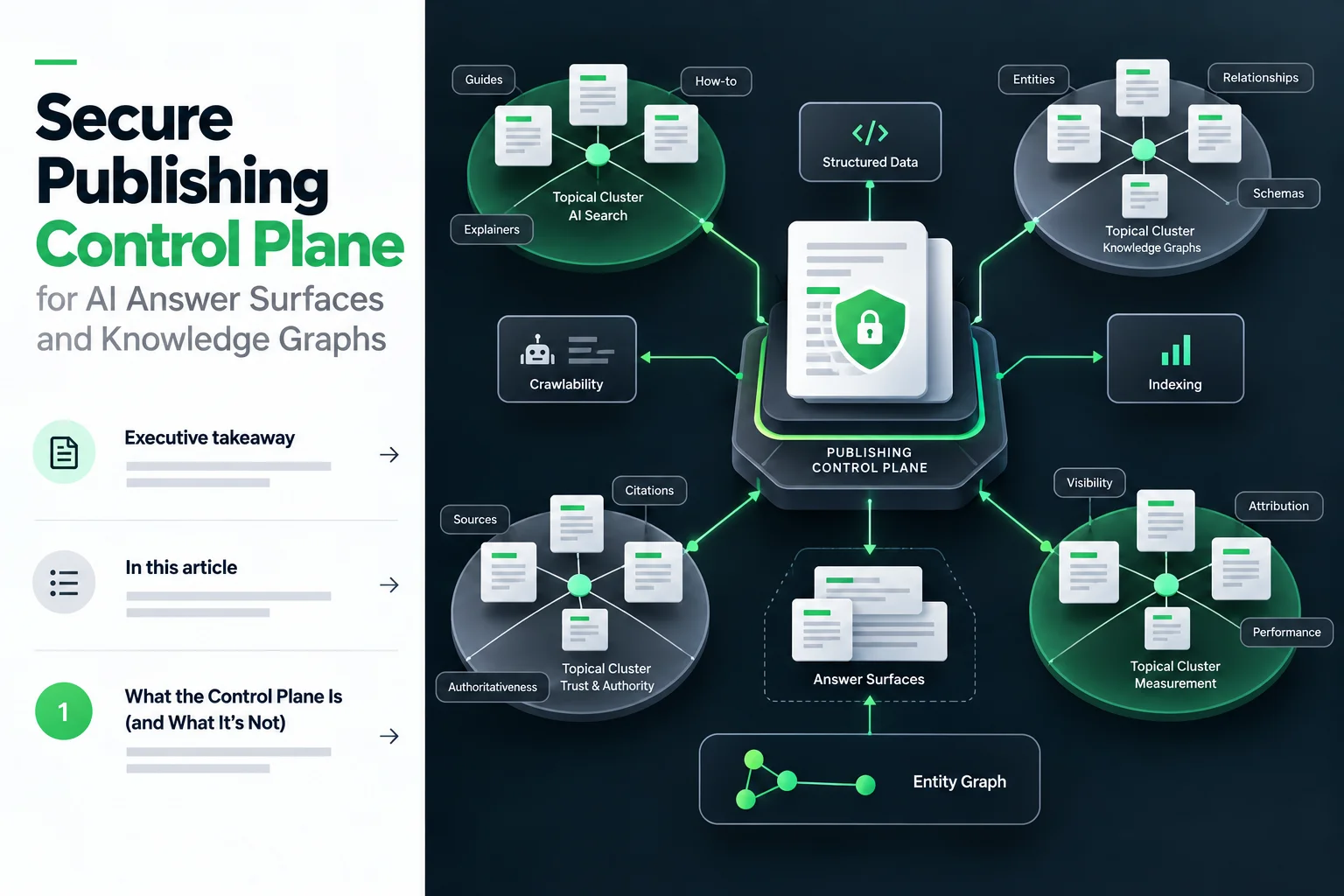
A secure publishing control plane is the system of people, processes, and technical controls that govern creation, validation, versioning, release, and retirement of entity records and published content that feed search and AI answer surfaces. It centralizes authority over canonical entity records, structured-data payloads, schema mappings, and the orchestration of update flows into web pages, APIs, feeds, and downstream content distribution. The control plane enforces gates: who can edit, what validation is required, who approves, when content deploys, and how changes are recorded.
- Controls cover entity records, structured data (JSON-LD, RDFa, microdata), canonicalization, internal linking updates, and publish pipelines.
- It includes audit logs, signed provenance metadata, staging and production environments, and human-in-the-loop review stages for high-risk changes.
- The control plane is not a guarantee of search or AI surface inclusion; it reduces operational risk and improves the fidelity of signals that.
What search engines document vs. practitioner inference
Engine documentation provides explicit instructions on implementation points: structured-data markup formats, content quality principles, and how to make content discoverable. Practitioners must infer retrieval and ranking behaviors from experiments and public signals. Be explicit about the boundary.
- Documented: Google publishes structured-data guidelines, helpful-content guidance, and advice on AI features and website readiness (see Google structured-data and helpful-content docs).
- Inferred: How LLM-based answer surfaces prioritize a given entity record, or whether a specific page will be quoted in an AI Overview, remains an.
- Operational implication: design for robust, auditable signals and let measurement determine how retrieval changes over time.
2 — Architecture: From Entity Research to Retrieval
Map the end-to-end architecture that your teams will operate and secure. Peak Demand recommends an architecture that links research and entity modelling through to retrieval and measurement.
Seven-layer operating model
Design the control plane around a repeatable flow: (1) Research & entity model, (2) Topic & page graph, (3) Authoritative content, (4) Machine-readable schema & internal linking, (5) Distribution & brand signals, (6) Retrieval & citation surfaces, (7) Measurement & iteration. This flow clarifies responsibilities and where governance and gates attach.
- Research and entity model: authoritative IDs, attributes, relationships, canonical URLs, and entity owners.
- Topic & page graph: mapping topics to pages and creating a controlled internal-link architecture that signals authority.
- Structured publishing and retrieval: machine-readable SEO and retrieval adapters transform entity records into consumable signals.
Operational integrations and service links
The control plane is principally about orchestration. Use machine-readable SEO to ensure canonical, structured payloads are validated and publishable. Peak Demand’s Machine-Readable SEO Services (https://seo.peakdemand.ca/machine-readable-seo-services) operationalize schema and entity payload validation across page templates and headless APIs. For surfacing to large language models and answer engines, integrate retrieval adapters and visibility tooling—see Peak Demand’s LLM Surfacing Services (https://seo.peakdemand.ca/llm-surfacing-services) for managed retrieval, citation control, and entity surfacing pipelines.
- Machine-readable validation as a gating step: reject or quarantine payloads that fail schema or provenance checks before they reach production.
- A retrieval adapter maps internal entity IDs to feed formats consumable by search indexers and downstream LLM-facing collectors.
3 — Entity and Content Model: Authoritativeness and Provenance
Define the canonical entity model and the metadata required for authoritative AI use. A control plane must capture who authored, when, why, and what level of verification supports each attribute.
Entity records: canonical IDs and attributes
An entity record should include a stable canonical ID, preferred name, type taxonomy, key attributes, relationship edges, canonical URL(s), and owner contact. Model attributes for the use-cases you care about: factual attributes (addresses, product specs), interpretive attributes (descriptions, positioning), and signals of verification (third-party references, attestation).
- Keep canonical IDs globally unique and referenceable in structured-data payloads.
- Store relationships explicitly—this is crucial for knowledge-graph traversal and for retrieval systems that use entity graphs.
Provenance, versioning, and immutable records
Record provenance metadata for every change: the editor identity, timestamps, justification, data sources, and approval state. Version each entity record and retain immutable audit trails. This enables rollback, regulatory response, and clearer explanations when a human reviewer must intervene.
- Capture signed change records and link published structured-data payloads to the exact entity version they reflect.
- Use version tags in page metadata and in any API feeds consumed by retrieval systems to facilitate traceability.
4 — Technical Controls: Validation, Staging, and Release Gates
Implement technical controls that prevent bad data from reaching public or downstream AI-facing surfaces. Treat schema validation, content-quality signals, and human approval as orthogonal but complementary gates.
Automated validation and schema compliance
Programmatic validation should be the first gate. Validate JSON-LD or other structured-data formats against schema definitions, required fields, and type constraints. Enforce a 'fail-closed' policy for critical attributes (e.g., credential claims, pricing, medical/legal disclaimers). Google’s structured-data documentation details expected markup formats and how structured data is consumed; make it a baseline for your validations.
- Integrate schema validation into CI/CD pipelines for templates and feeds.
- Flag or block payloads that lack required provenance or that exceed risk thresholds (high-impact attribute changes).
Staging, approval, and human-in-the-loop
Use multi-environment deployment: draft → staging (preview) → canary → production. Attach human approvals to high-risk change categories: legal language, pricing, safety-critical content, or anything that materially alters a claim. The control plane should force reviewers to confirm sources and sign attestation statements.
- Create pre-publish checklists that include source citations, schema validation, and SEO/AEO notes.
- Record approver identity and timestamp; expose this metadata as part of the provenance record.

5 — Structured Data, Internal Linking, and Retrieval Mechanics
Explain how schema, internal linking, and retrieval adapters work together to make content discoverable to search engines and answer surfaces. Use this layer to optimize signal fidelity rather than to 'game' outcomes.
Structured data as machine-readable facts
Structured data encodes entity facts and relationships in machine-readable formats (JSON-LD, RDFa, microdata). Follow documented patterns for property names and required types; schema.org remains the practical vocabulary. Use structured data to declare canonical URLs, entity IDs, and version metadata so downstream indexers and retrieval agents can interpret content consistently.
- Publish entity-version metadata in JSON-LD so a retrieval adapter can link a quoted fact back to a verifiable source record.
- Avoid duplicative or conflicting markup; a single canonical source per attribute reduces ambiguity.
Internal linking and the topic graph
Internal links are the operational expression of your topic & page graph. Use consistent anchor text, hierarchical taxonomies, and relationship pages (e.g., 'About', 'Specifications', 'Reviews') to help retrieval systems traverse and weight your entity context. Ensure internal linking updates are part of the same publish pipeline so link changes are versioned and auditable.
- Maintain relationship pages that explicitly list entity edges for machine consumption.
- Ensure link updates are validated in staging to avoid orphaning entity pages.

6 — Governance, Privacy, and Auditability
Operational governance and privacy controls are core to a control plane. Address role-based access, data residency considerations, audit trails, human oversight, and legal caution points.
Roles, access control, and separation of duties
Implement role-based access controls (RBAC) with least-privilege principles. Separate roles for content author, entity steward, schema maintainer, security reviewer, and release approver. Use identity federation and strong authentication for administrative operations and require multi-factor authentication for approvers.
- Assign explicit owner contacts for every entity and maintain a directory of stewards.
- Use time-limited elevated access and record all privileged actions in audit logs.
Privacy, data residency and compliance boundaries
Be explicit about the data your control plane stores: personal data, behavioral logs, and provenance metadata. Clarify hosting region(s), subprocessors, backup geography, retention policies, and procedures for data access requests. Do not assume uniform legal requirements across jurisdictions—consult qualified professionals to confirm obligations for GDPR, CCPA, or sector-specific privacy regimes.
- Log minimal personal data when possible and use pseudonymization where appropriate.
- Document subprocessors and cross-border transfer mechanisms for auditability.
Related Peak Demand resources
Industry and AI sources reviewed
- Understand how structured data worksGoogle Search Central
- Creating helpful, reliable, people-first contentGoogle Search Central
- AI features and your websiteGoogle Search Central
- Schema.org DocumentationSchema.org
- SEO Starter GuideGoogle Search Central
Search-engine and AI-answer behavior changes over time. Google documentation can establish published requirements and guidance, but inclusion in rankings, AI Overviews, citations, or LLM answers is never guaranteed. Practitioner observations should be labelled as inference or testing rather than official ranking factors. This article is operational guidance, not legal advice; organizations should confirm applicable requirements with qualified professionals.
Frequently asked questions
SEO improves visibility in traditional search results. AEO focuses on making content easy for answer systems to extract and use. GEO focuses on visibility in generative search and AI answer experiences. In practice, the strongest strategy combines technical accessibility, useful content, clear entities, strong internal relationships, structured data, and credible source authority rather than treating them as isolated channels.
Official reference: SEO Starter Guide
No. Structured data can make page entities and relationships more explicit and can support eligible search features, but it does not guarantee rankings, AI Overview inclusion, citations, or mentions in generative answers. It should reinforce accurate visible content rather than replace it.
Official reference: Understand how structured data works
Search and answer systems need to understand what a brand, person, product, service, or concept is and how it relates to other entities. Consistent naming, authoritative pages, structured relationships, internal linking, and corroborating references can reduce ambiguity and make a site easier to interpret and retrieve.
Official reference: Schema.org Documentation
Track traditional search visibility alongside query coverage, indexed pages, non-brand discovery, AI referral traffic where available, observed citations or mentions, entity consistency, content-cluster coverage, internal-link depth, and lead quality. Treat AI-surface monitoring as directional because answer composition can vary by model, query, user, and time.
Official reference: AI features and your website
Build a search and AI visibility system that compounds
Peak Demand connects technical SEO, entity architecture, knowledge graphs, structured data, topical authority, internal linking, distribution, and measurement into a managed SEO/AEO/GEO operating system.
Explore Peak Demand AI SEO, AEO & GEO


