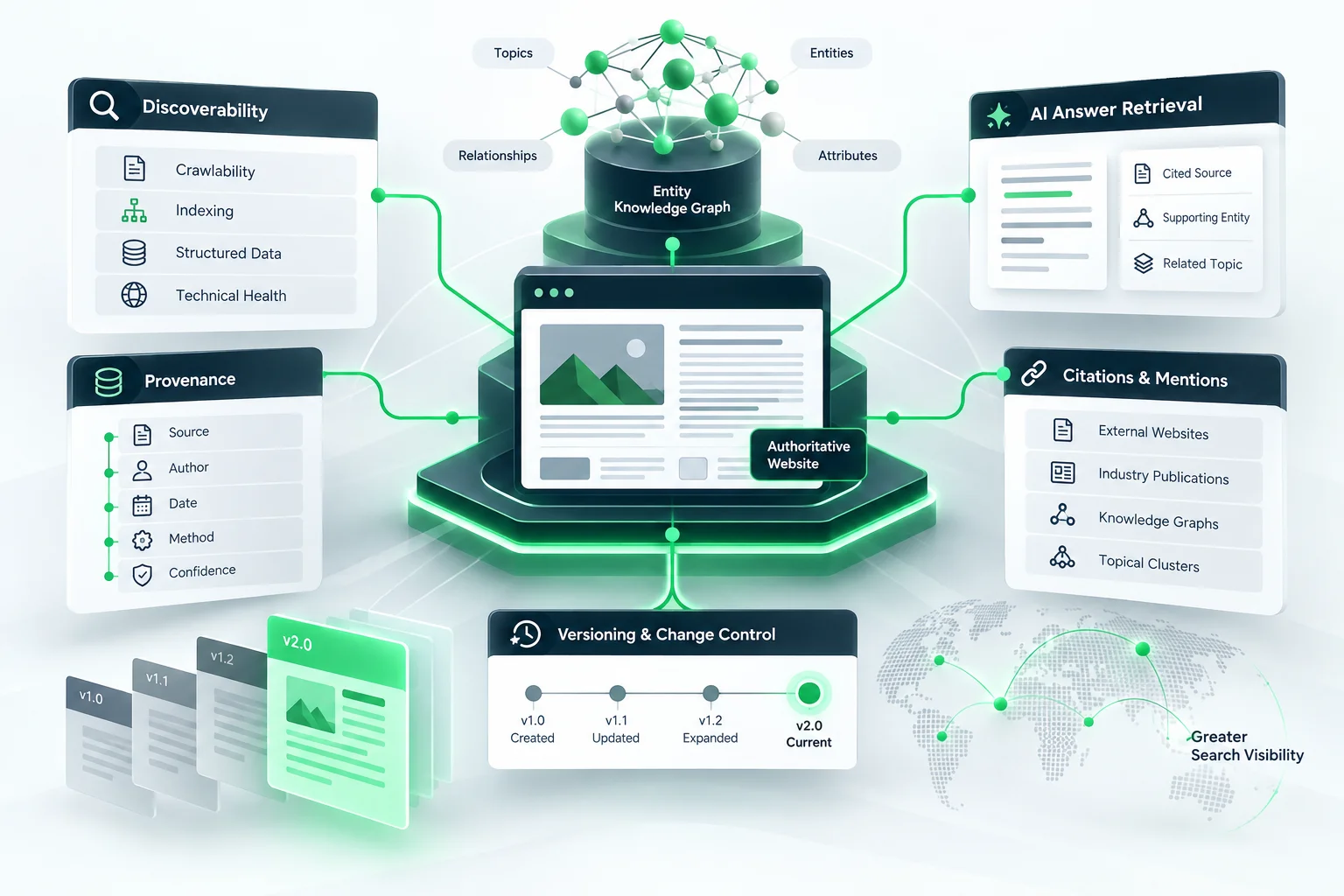
Provenance, Versioning, and Change Control for Entity Knowledge Graphs
Practical, governance-focused guidance for marketing and SEO leaders on building provenance, versioning and change-control systems for entity knowledge graphs to improve visibility in Google and AI answer surfaces while remaining auditable, private, and secure.
1. What this article covers and key definitions
A concise foundation: what AEO, GEO, entities, retrieval, citations, structured data and knowledge graphs mean for senior leaders building search and AI visibility programs.
Why this matters for marketing and product leaders
Answer-engine and generative surfaces (AEO/GEO) increasingly rely on structured entity representations to retrieve and assemble answers. An entity knowledge graph is a managed dataset of canonical records (brands, people, products, locations) plus relationships and attribution. For leaders, the practical stakes are visibility, reputation, error mitigation, and the ability to audit what facts are surfaced by AI systems. This article focuses on governance, provenance, versioning, security, and operational controls that make an entity graph reliable and defensible.
Concise definitions
Entity: a modeled real-world actor (brand, person, product, place) with stable identifiers and attributes. Knowledge graph: a system of canonical entity records, attributes and relationships used for retrieval. AEO (Answer Engine Optimization): optimizations to increase the chance an answer surface will use your content or facts. GEO (Generative Engine Optimization): broader optimizations for generative systems that assemble multi-source answers. Retrieval: the process an engine uses to select candidate facts or documents for a response. Citation: any explicit or inferred reference an engine uses to indicate source provenance in an answer. Structured data / schema: machine-readable markup (JSON-LD, RDFa) that labels content so engines can parse entity facts.
2. Why provenance, versioning and change control matter
High-level consequences and concrete failure modes if you omit governance.
Retrieval reliability and reputational risk
When AI systems assemble answers from multiple sources, inconsistent entity facts (phone numbers, hours, product specs, ownership) increase the chance of misinformation. Provenance metadata and versioned records reduce ambiguity during retrieval by providing traceable evidence about when, where and by whom a claim was asserted. For brands, this lowers the risk that an AI-generated response repeats an outdated or unauthorised claim.
- Provenance helps explain discrepancies between different web sources.
- Immutable change logs support rapid rollback when a harmful error appears in an answer surface.
Governance, auditability and compliance
Regulators, partners and internal auditors often require demonstrable records of who changed a fact, why, and when. A change-control system that records edits, approvals, and publication states (draft, staged, live, archived) creates the traceable evidence required for internal review and external audits. This matters for legal, safety, and brand-declaration scenarios where you need to prove due diligence.
- Capture approval metadata and reviewer identifiers for high-risk attributes (legal name, safety notices).
- Retain historical versions for a retention period consistent with your governance policies and legal obligations; consult counsel for jurisdictional requirements.
3. Core architecture and control points
A practical system architecture that connects entity modelling, content, structured signals and retrieval into a governed pipeline.
Entity model and canonical record
Start with a single canonical entity record per real-world object. The canonical record provides a stable internal identifier, a list of authoritative attributes, and pointers to source documents (URLs, internal dossiers, supplier feeds). The canonical record is the single source of truth for downstream structured-data generation, internal linking targets, sitemaps and API outputs. Treat the canonical record as a managed data product with owners, SLAs, and a documented schema.
- Separate core attributes (name, canonical URL, ID, type) from volatile attributes (hours, stock level, price).
- Record primary evidence links—where a claim originated—alongside each attribute.
Structured data, machine-readable export and internal linking
Expose canonical record facts via machine-readable structured data (typically JSON-LD) on the canonical page and in feeds. Consistent structured outputs make it easier for retrieval systems to parse and link facts back to your authority. Machine-readable exports should be generated from the canonical record, not hand-edited on pages. For enterprise implementations, consider a staging API that generates structured-data bundles for QA before publishing.
- Generate JSON-LD from the canonical model; avoid duplicated or contradictory markup across pages.
- Use consistent internal linking patterns to surface canonical pages and strengthen entity signals across your site.
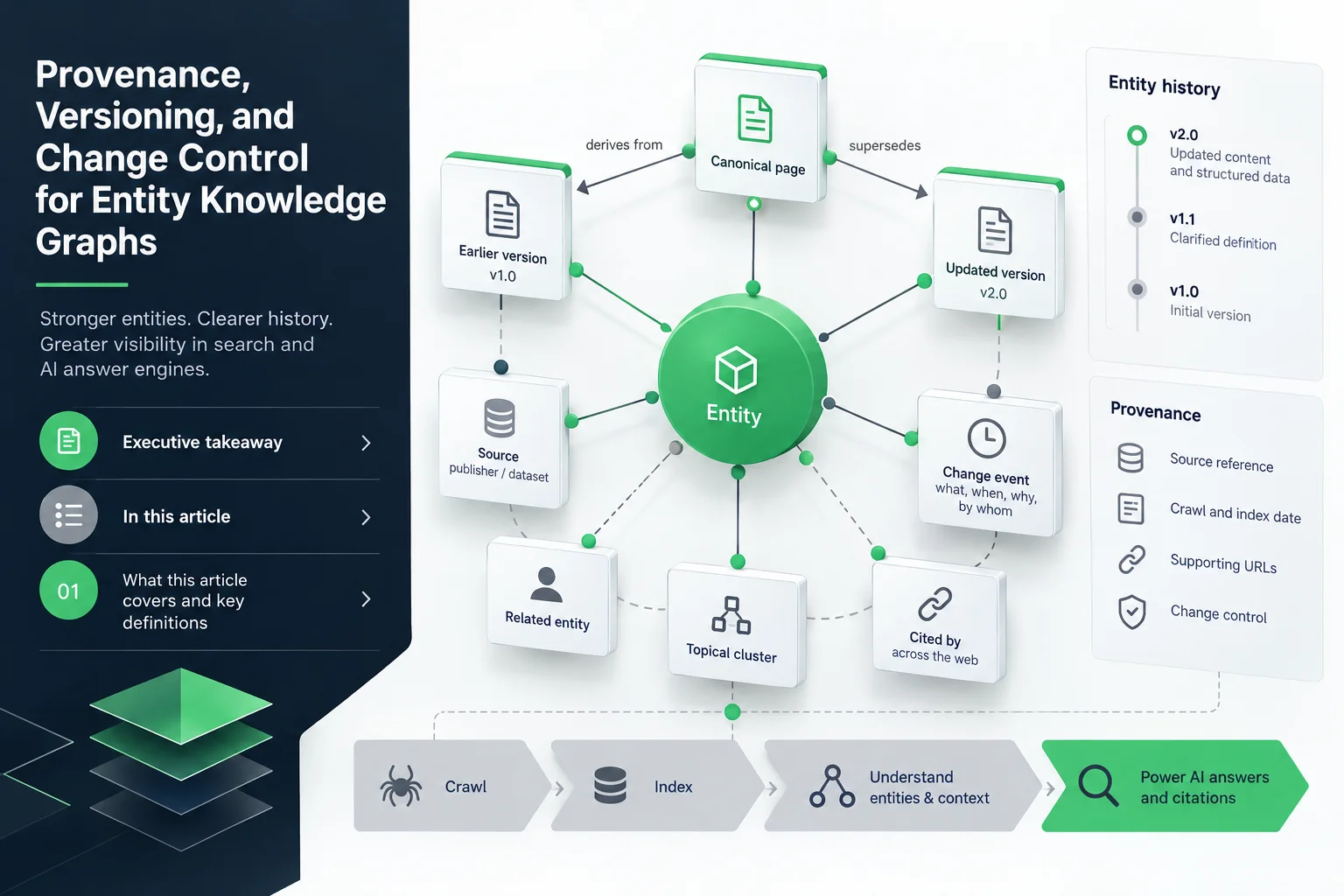
4. Provenance: how to record and expose evidence
Practical provenance fields and how to attach them to facts without leaking private data.
Essential provenance fields
Attach minimal but sufficient provenance metadata to each attribute: source_id (URL or internal dossier ID), source_type (official site, partner feed, user report), asserted_at (timestamp), asserted_by (author or system ID), and evidence_type (document, contract, API). For high-risk claims, include verification status and reviewer identity. Store this alongside the canonical record and expose non-sensitive provenance via public API or structured data when appropriate.
- Use ISO timestamps, persistent identifiers for sources, and enumerated values for source_type.
- Where possible, link to the primary public evidence (official page, PDF, regulatory filing) rather than a transient copy.
Structured provenance and schema considerations
Schema.org supports certain properties useful for provenance (e.g., sourceOrganization, primarySource, citation). Use these properties consistently, and prefer linking to canonical URLs. Avoid embedding private internal identifiers in public markup. For deeper auditability, keep full provenance and change logs in your internal systems and expose summarized provenance externally.
- Map your canonical provenance fields to schema.org properties where applicable, and validate generated JSON-LD using structured-data testing in staging.
- Keep the publicly exposed provenance minimal and non-sensitive; keep the full audit trail internal.
Human review, claims triage and editorial rules
Automated ingestion is essential for scale, but create tiered verification rules. Low-risk claims can follow an automated pipeline with periodic sampling; high-risk attributes should require editorial review and explicit approval metadata. Define rules that map attribute types to required evidence and reviewer seniority.
- Implement automatic triage that marks claims requiring human review.
- Log reviewer decisions, rationale and any supporting documents as part of the change record.
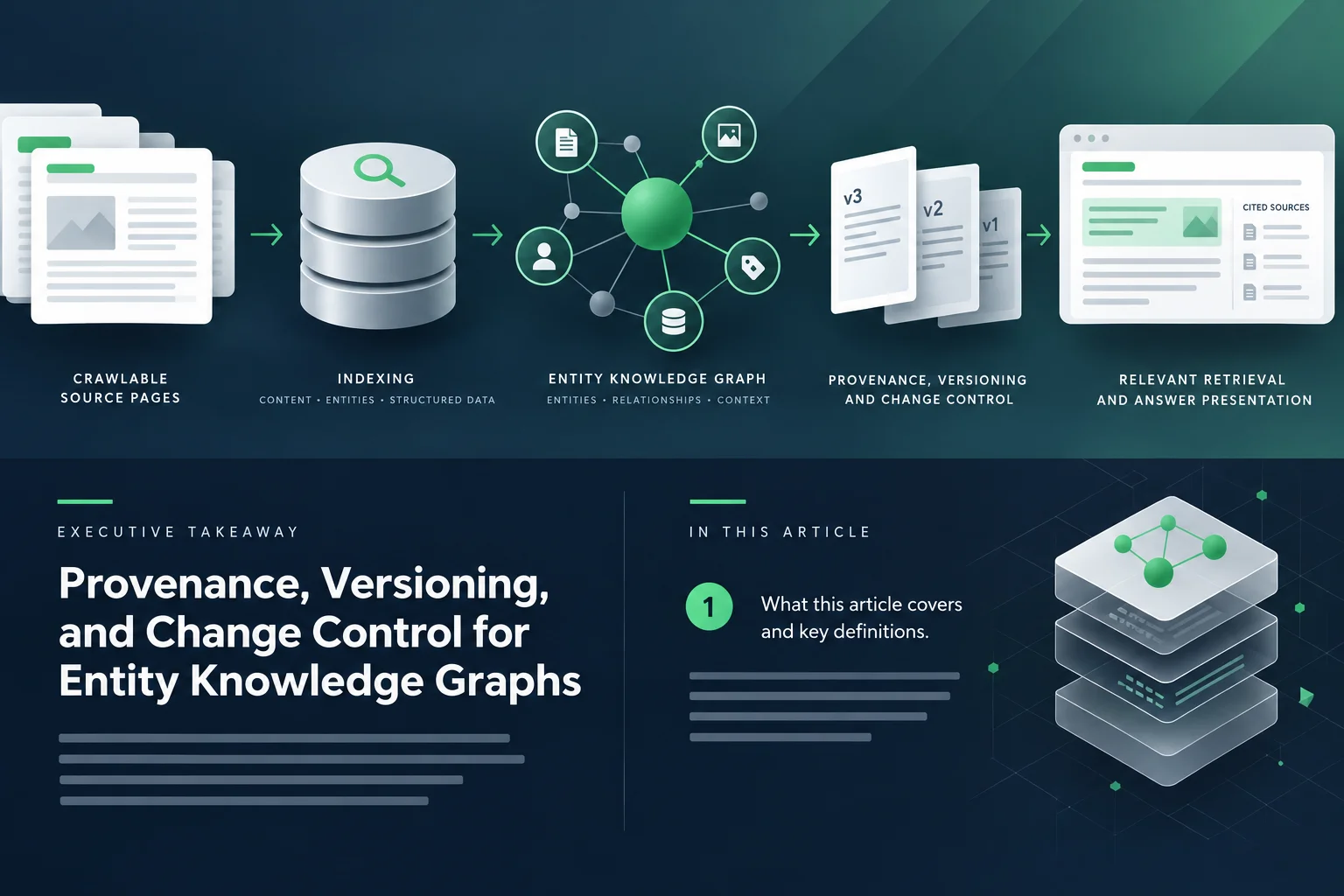
5. Versioning and change-control practices
How to model versions and manage risk during updates.
Immutable versions and semantic diffs
Store immutable snapshots of canonical records at each publish event. A lightweight semantic diff that shows which attributes changed (old value, new value, who, why) provides fast triage for auditors and operators. Immutable versions make rollbacks reliable and forensic analysis straightforward.
- Use content-addressable version identifiers or incremental version numbers.
- Persist the diff, approval metadata and any QA test results alongside the version.
Staging, canary publishing and rollbacks
Do not push entity changes directly to production. Stage changes in isolated environments, run retrieval and generation tests (simulated prompts and queries), then deploy to a canary subset of pages or regions before full rollout. Maintain clearly documented rollback procedures and automations that can revert the canonical export to a prior version.
- Run synthetic retrieval tests that reflect likely user queries before publishing.
- Automate rollback scripts that restore the previous JSON-LD bundle and update sitemaps if needed.
Change classification and retention
Classify changes by impact and retention policy: urgent legal or safety edits, routine updates, and experimental or A/B changes. Retain versions according to governance policy; be explicit about retention periods and disposal procedures and document jurisdictional backup locations and subprocessors.
- High-impact changes should include executive sign-off and a contact for rapid escalation.
- Define retention periods for audit logs consistent with local regulations and internal risk appetite (consult legal).
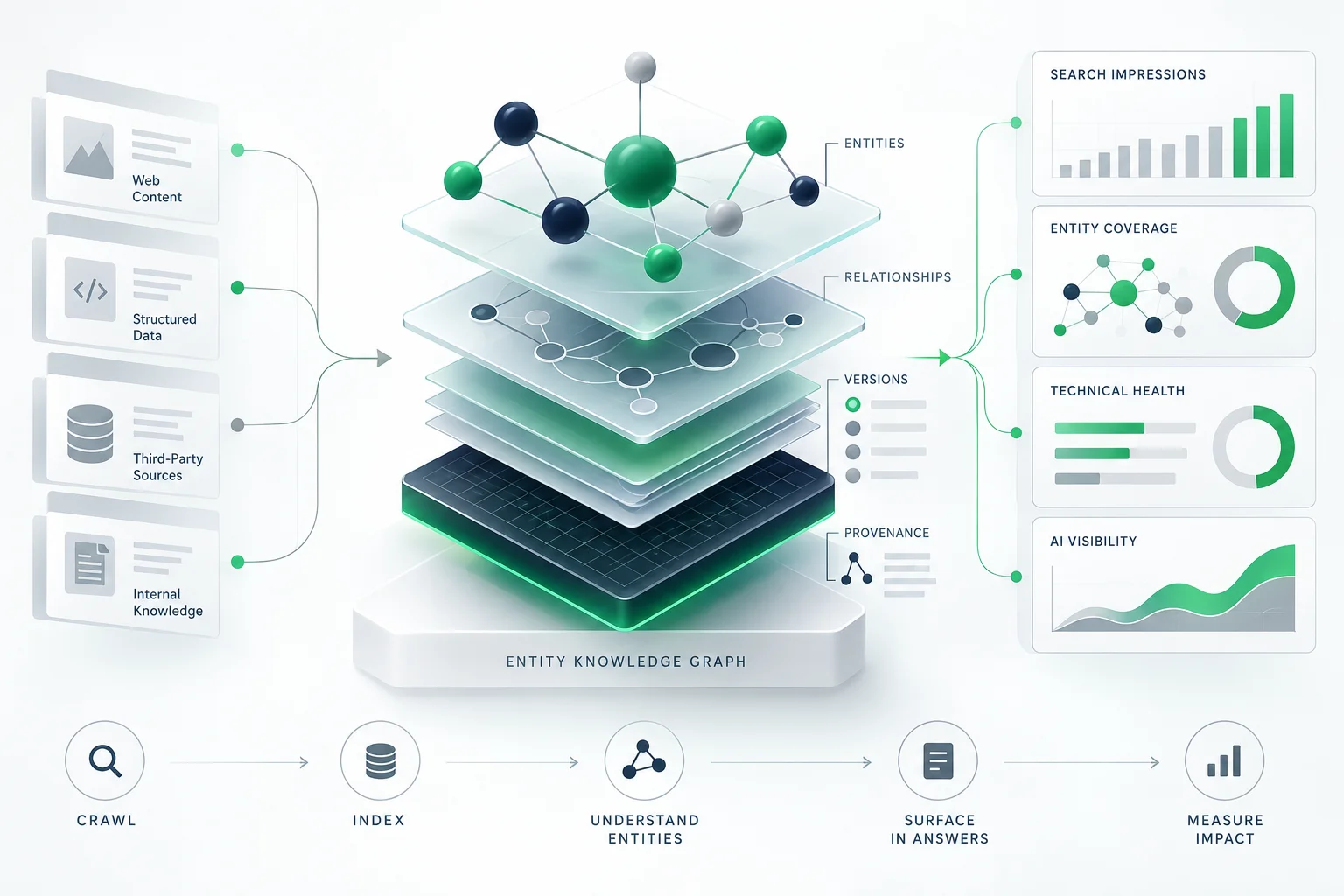
6. Security, privacy and jurisdictional controls
Practical security and privacy controls for entity graphs, and how to balance transparency with risk.
Access control, encryption and operational security
Treat the canonical graph and provenance store as sensitive systems. Apply least-privilege access, role-based approvals for changes, encryption at-rest and in-transit, and multi-factor authentication for editorial and engineering roles. Log access events and link them to change records for auditability.
- Use role-based workflows that separate ingestion from approval and publication.
- Ensure backup locations and subprocessors are documented and their access limited and logged.
Privacy, sensitive attributes and data residency
Avoid storing personal data in public provenance fields. For attributes that are personal or sensitive (health, identification), segregate them, restrict access, and consult privacy counsel on retention and transfer mechanisms. Be explicit about: hosting region, backup region, remote-support access, subprocessors, and retention — and confirm obligations with qualified legal counsel in relevant jurisdictions.
- Design the public-facing graph to expose only non-sensitive provenance.
- Document cross-border transfer mechanisms and subprocessors for audit reviews.
Related Peak Demand resources
Industry and AI sources reviewed
- SEO Starter GuideGoogle Search Central
- Understand how structured data worksGoogle Search Central
- Schema.org DocumentationSchema.org
- Creating helpful, reliable, people-first contentGoogle Search Central
- AI features and your websiteGoogle Search Central
Search-engine and AI-answer behavior changes over time. Google documentation can establish published requirements and guidance, but inclusion in rankings, AI Overviews, citations, or LLM answers is never guaranteed. Practitioner observations should be labelled as inference or testing rather than official ranking factors. This article is operational guidance, not legal advice; organizations should confirm applicable requirements with qualified professionals.
Frequently asked questions
SEO improves visibility in traditional search results. AEO focuses on making content easy for answer systems to extract and use. GEO focuses on visibility in generative search and AI answer experiences. In practice, the strongest strategy combines technical accessibility, useful content, clear entities, strong internal relationships, structured data, and credible source authority rather than treating them as isolated channels.
Official reference: SEO Starter Guide
No. Structured data can make page entities and relationships more explicit and can support eligible search features, but it does not guarantee rankings, AI Overview inclusion, citations, or mentions in generative answers. It should reinforce accurate visible content rather than replace it.
Official reference: Understand how structured data works
Search and answer systems need to understand what a brand, person, product, service, or concept is and how it relates to other entities. Consistent naming, authoritative pages, structured relationships, internal linking, and corroborating references can reduce ambiguity and make a site easier to interpret and retrieve.
Official reference: Schema.org Documentation
Track traditional search visibility alongside query coverage, indexed pages, non-brand discovery, AI referral traffic where available, observed citations or mentions, entity consistency, content-cluster coverage, internal-link depth, and lead quality. Treat AI-surface monitoring as directional because answer composition can vary by model, query, user, and time.
Official reference: AI features and your website
Build a search and AI visibility system that compounds
Peak Demand connects technical SEO, entity architecture, knowledge graphs, structured data, topical authority, internal linking, distribution, and measurement into a managed SEO/AEO/GEO operating system.
Explore Peak Demand AI SEO, AEO & GEO


