
Knowledge Graph Optimization for AI Search Visibility
A practical, enterprise-grade guide to optimise knowledge graphs, entity architecture, structured data, and workflows that drive visibility in Google, AI overviews, and generative answer engines.
1. What KGO Is — Clear definitions and why it matters
Define the core terms in plain, operational language. Distinguish documented guidance from practitioner inference so teams can act with confidence.
What is an entity and a knowledge graph?
An entity is a discrete thing a search system recognises — a brand, person, product, place, concept, or event. A knowledge graph is a machine-readable network of those entities and the factual relationships between them (attributes, types, and links). Entities are the identifiers and metadata retrieval systems use to match queries to answers.
- Entity = uniquely identifiable thing (with stable attributes and relationships).
- Knowledge graph = graph data model that connects entities and attributes for fast retrieval.
- KGO = the set of activities that make entities discoverable, accurate, and authoritative to retrieval systems.
Why KGO matters for AI and answer engines
AI and generative search surfaces increasingly rely on entity understanding and structured signals to select, summarise, and attribute answers. Optimising a knowledge graph raises the clarity and citation-worthiness of your brand’s signals without promising placements. Practically, KGO affects how often your content is retrieved, how accurately it’s represented, and whether it can be cited or summarised by an AI surface.
- Better entity signals improve retrieval relevance and candidate-source quality for LLM summarisation.
- Structured, canonical facts reduce hallucination risk in summaries by giving verifiable sources.
- KGO is an optimised pipeline for being findable and accurately described; it is not a guarantee of appearance in any particular AI overview or.
2. Documented guidance vs practitioner inference
Engine documentation gives guardrails; many advanced KGO practices are practitioner-led inferences from observed behaviour and tests. Know what you can rely on.
What search engines document
Google publicly documents baseline behaviours that directly affect KGO work: how to make content helpful and reliable, how structured data is used, and special notes about AI features that may use website content. These documents are implementation guides and policy constraints rather than recipe-level guarantees.
- Google's 'Creating helpful, reliable, people-first content' outlines content quality signals and is directly relevant to entity pages and canonical content.
- The 'Understand how structured data works' guide explains when and how structured data should be added and tested.
- 'AI features and your website' describes how AI features may use site content and emphasises accurate, high-quality information.
What experienced practitioners infer
SEO and AEO experts infer retrieval behaviour — how LLM-based systems select candidate sources and prefer canonical, well-structured entity hubs. These inferences come from reverse engineering, experiments, and signal correlation studies. They are valuable for designing workflows but should be treated as tactical hypotheses rather than certainties.
- Practitioners infer that entity pages with clear structured data, disambiguation, and consistent canonical metadata are more likely to be surfaced as sources.
- Inference-driven tactics include building explicit entity hubs, consistent schema usage, cross-domain citation networks, and API-accessible fact stores for verification.
3. KGO architecture: an operating model that works
A repeatable architecture turns KGO from an experiment into an operating capability. The architecture below is intentionally prescriptive and maps to measurable handoffs.
Research and entity model
Begin with inventory and canonical identifiers: brand names, products, key people, locations, and technical concepts. Use entity discovery to detect duplicates, name variants, and schema mismatches. Create an entity registry with IDs, authoritative attributes, confidence scores, and update cadence.
- Inventory across CMS, CRM, product catalogues, and editorial calendars.
- Assign canonical IDs and source-of-truth owners for each entity.
- Record variant names, aliases, and redirects to support signal consolidation.
Topic and page graph → authoritative content
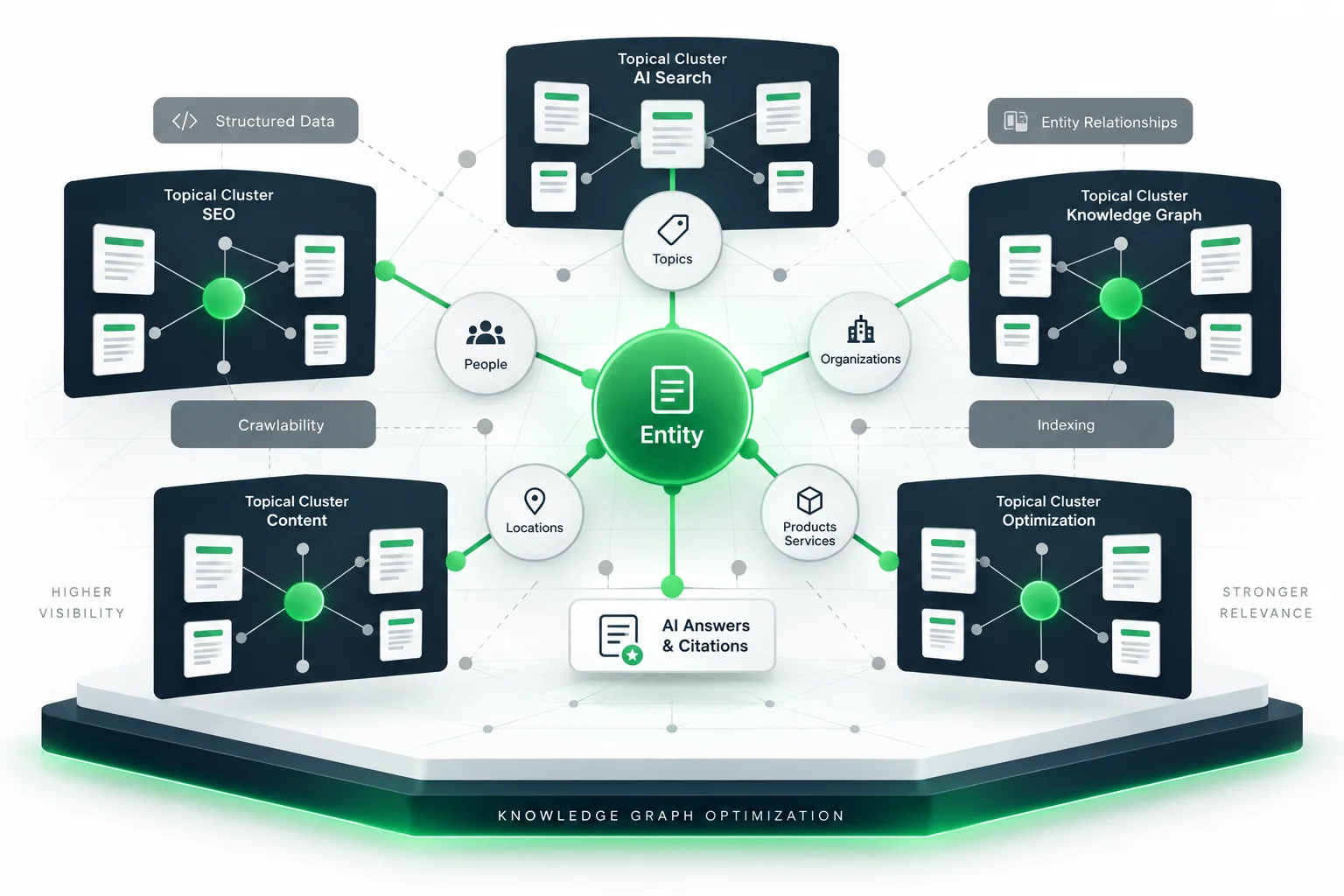
Map entities to a topic/page graph: hub pages (entity canonical page), spoke pages (related topics, FAQs, use cases), and data endpoints (APIs, structured facts). Prioritise authoritative content: verified facts, primary documentation, and original research that signals expertise and uniqueness.
- Hub pages should be canonical, unique, and factual with stable URL patterns.
- Spoke pages expand topical depth and link back to hubs to consolidate topical authority.
- Data endpoints (CSV/JSON-LD APIs or downloadable fact sheets) provide machine-consumable proof points for retrieval systems.
Structured data and internal linking
Layer schema.org markup and consistent internal linking to make entity attributes explicit. Use JSON-LD on canonical pages for entity type, identifiers (e.g., productID, ISIN), and relationships. Internal links route signals and help retrieval systems find canonical sources quickly.
- Use JSON-LD on hub pages to declare entity type and key attributes.
- Keep relationships explicit (e.g., product → manufacturer, person → role) rather than implicit text references.
- Use clear internal linking conventions: hub-to-spoke, spoke-to-hub, and cross-linking across product/service families.
4. Concrete KGO workflows: production to operating ownership
Turn the architecture into an end-to-end workflow that includes validation, routing, escalation, and exception handling.
Content & entity production pipeline
Define roles, inputs, validation gates, and outputs. Example steps: entity intake → canonical page authoring → schema annotation → QA/test → publish → distribution and monitoring. Tie each step to ownership and SLAs.
- Intake: Product/PR/ops submit entity changes via a controlled template (name, description, facts, sources).
- Authoring: Content team writes hub/spoke pages using editorial templates that require explicit citations and schema placeholders.
- Validation: Technical SEO runs schema and canonical checks (automated tests + human QA) before publish.
Routing, escalation, and exceptions
Not all updates are routine. Build a routing matrix: routine edits follow normal SLA; contested factual changes trigger a verification workflow with subject-matter experts; legal or regulated content escalates to compliance and legal reviewers. Maintain an exception log for audit and rollback.
- Define triage categories: routine, contested, regulated, emergency (e.g., product recall).
- Create clear escalation paths with contact roles and maximum response times.
- Log exceptions into a versioned change history that ties to the canonical entity ID.
Operating ownership and observability
Assign a visibility owner responsible for entity accuracy, schema coverage, and retrieval monitoring. Use dashboards to track schema validation, retrieval incidence, AI-surface impressions, and content health. Include a periodic audit cadence to prune or merge stale entities.
- Assign Visibility Owner: accountable for SLA, data quality, and remediation.
- Dashboards: show schema validity rates, retrieval candidate frequency, and anomaly alerts.
- Audit: quarterly reviews to merge duplicates and retire irrelevant entity pages.
5. Structured data, APIs and verification
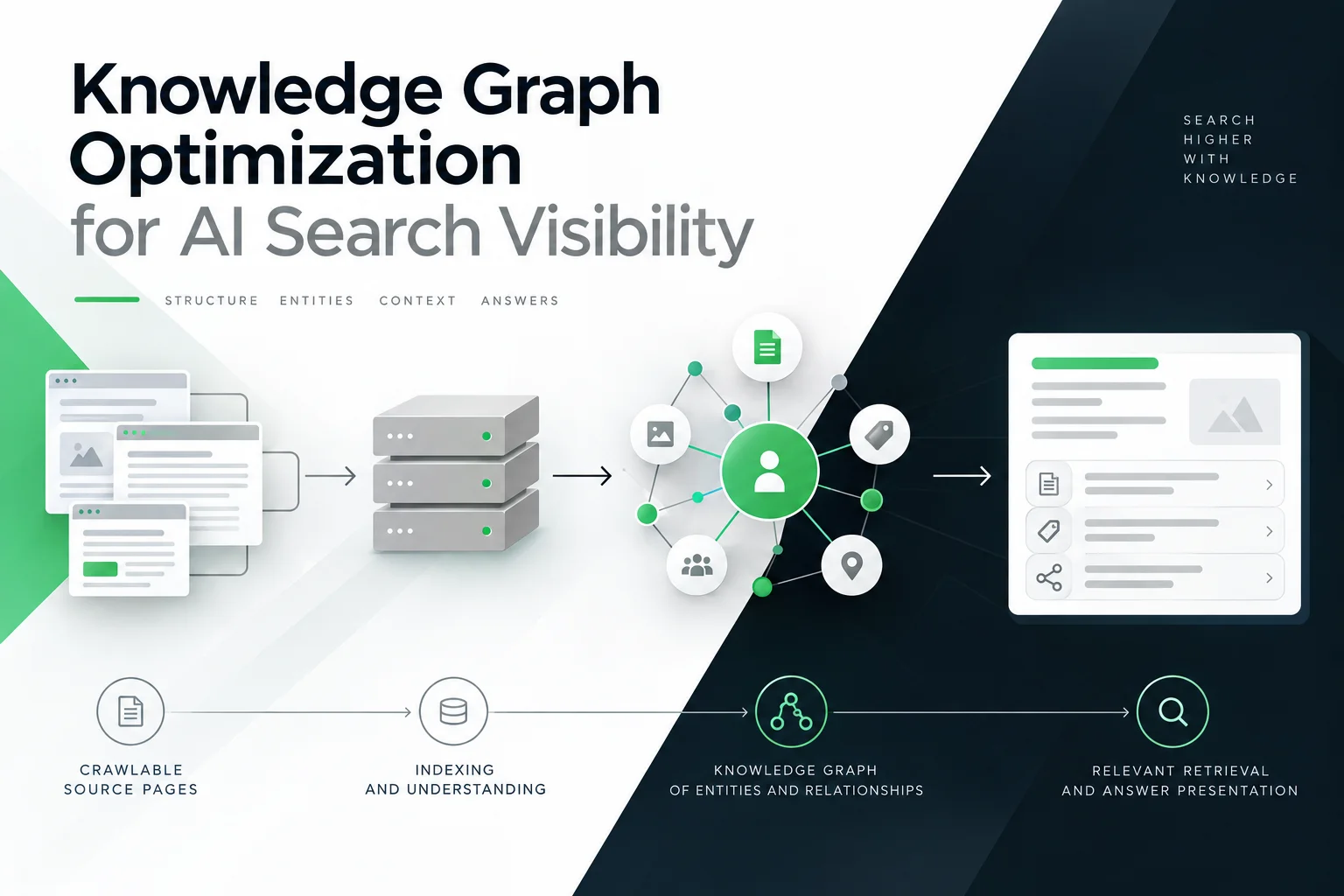
Structured data is necessary but not sufficient. Use JSON-LD, open APIs, and verifiable data endpoints to make facts machine-actionable.
Practical schema choices
Choose schema types that map directly to your entities: Organization, Person, Product, Event, SoftwareApplication, FAQPage, and Dataset are common. Use properties that matter to retrieval (name, identifier, sameAs, description, url, logo, releaseDate, version, provider). Avoid schema bloat; prefer accuracy over volume.
- Declare canonical identifiers (sameAs links to Wikidata or trusted registries where appropriate).
- Use dataset or dataset catalog schema for downloadable fact stores or CSVs.
- Mark FAQ and how-to content only when it matches schema intent and quality expectations.
APIs and machine-verifiable endpoints
Provide machine-accessible endpoints for high-value facts (e.g., product specs, pricing, availability). These endpoints should have predictable, versioned responses and clear provenance metadata to help retrieval systems and third-party consumers validate facts.
- Expose authenticated and public endpoints depending on sensitivity and licensing.
- Include provenance metadata and last-updated timestamps in API responses.
- Rate-limit and document endpoints; provide API keys and SLA details when needed.
Testing and continuous validation
Automate schema testing (linting, Google Rich Results Test, structured-data testing tools) and add post-publish monitors for schema drift and failed ingestion checks. Treat test failures as first-class incidents with routing to the visibility owner.
- Automate JSON-LD validation and render checks as part of CI/CD for content publishing.
- Monitor Search Console or equivalent for structured data warnings and errors.
- Integrate schema tests with change approval workflows to block low-confidence publishes.

6. Retrieval, measurement, and iteration
KGO success is about being retrieved reliably and used as a source. Measurement must be multi-layered and causally oriented.
Key metrics to track
Combine content-level, entity-level and retrieval-level metrics: impressions in answer surfaces, retrieval frequency, SERP features impressions, organic clicks, dwell behaviour, citation frequency in third-party summaries, and schema validation rates.
- Content metrics: organic impressions, CTR, time-on-page, bounce/refined queries.
- Entity metrics: retrieval hits (how often an entity page is included in candidate sets), canonical citation rate, and authoritative backlinks.
- Operational metrics: schema validity rate, API uptime, error counts, SLA compliance for triage.
Experimentation and causal validation
Use controlled experiments to validate KGO hypotheses. A/B test content rewrites for entity hubs, measure retrieval inclusion before/after structured-data changes, and run small-scale rewrite experiments to observe effects on candidate-source behaviour. Keep experiments narrow and repeatable.
- Pre/post analysis: measure retrieval candidate frequency and downstream click behaviour.
- Use holdout sets of entities to control for broad algorithm updates.
- Document experiments and outcomes in a visibility playbook for repeatability.
Related Peak Demand resources
Industry and AI sources reviewed
- Creating helpful, reliable, people-first contentGoogle Search Central
- Understand how structured data worksGoogle Search Central
- AI features and your websiteGoogle Search Central
- Schema.org DocumentationSchema.org
- SEO Starter GuideGoogle Search Central
Search-engine and AI-answer behavior changes over time. Google documentation can establish published requirements and guidance, but inclusion in rankings, AI Overviews, citations, or LLM answers is never guaranteed. Practitioner observations should be labelled as inference or testing rather than official ranking factors. This article is operational guidance, not legal advice; organizations should confirm applicable requirements with qualified professionals.
Frequently asked questions
SEO improves visibility in traditional search results. AEO focuses on making content easy for answer systems to extract and use. GEO focuses on visibility in generative search and AI answer experiences. In practice, the strongest strategy combines technical accessibility, useful content, clear entities, strong internal relationships, structured data, and credible source authority rather than treating them as isolated channels.
Official reference: SEO Starter Guide
No. Structured data can make page entities and relationships more explicit and can support eligible search features, but it does not guarantee rankings, AI Overview inclusion, citations, or mentions in generative answers. It should reinforce accurate visible content rather than replace it.
Official reference: Understand how structured data works
Search and answer systems need to understand what a brand, person, product, service, or concept is and how it relates to other entities. Consistent naming, authoritative pages, structured relationships, internal linking, and corroborating references can reduce ambiguity and make a site easier to interpret and retrieve.
Official reference: Schema.org Documentation
Track traditional search visibility alongside query coverage, indexed pages, non-brand discovery, AI referral traffic where available, observed citations or mentions, entity consistency, content-cluster coverage, internal-link depth, and lead quality. Treat AI-surface monitoring as directional because answer composition can vary by model, query, user, and time.
Official reference: AI features and your website
Build a search and AI visibility system that compounds
Peak Demand connects technical SEO, entity architecture, knowledge graphs, structured data, topical authority, internal linking, distribution, and measurement into a managed SEO/AEO/GEO operating system.
Explore Peak Demand AI SEO, AEO & GEO


