
Governance and Audit Controls for AI Answer Surfaces and Knowledge Graphs
Practical governance, audit, and control guidance for organisations that publish entities, knowledge graphs, and machine-readable signals to AI answer surfaces, Google Overviews, and generative search. Defines what is documented by search engines, what practitioners must control, and an operational model for secure, auditable AI visibility.
1. Why governance matters for AI answer surfaces
AI answer surfaces and knowledge graphs reshape how information is extracted and presented. Governance and audit controls turn opportunistic optimizations into repeatable, accountable processes that protect brand integrity, reduce safety incidents, and support compliance.
The new supply chain for answers
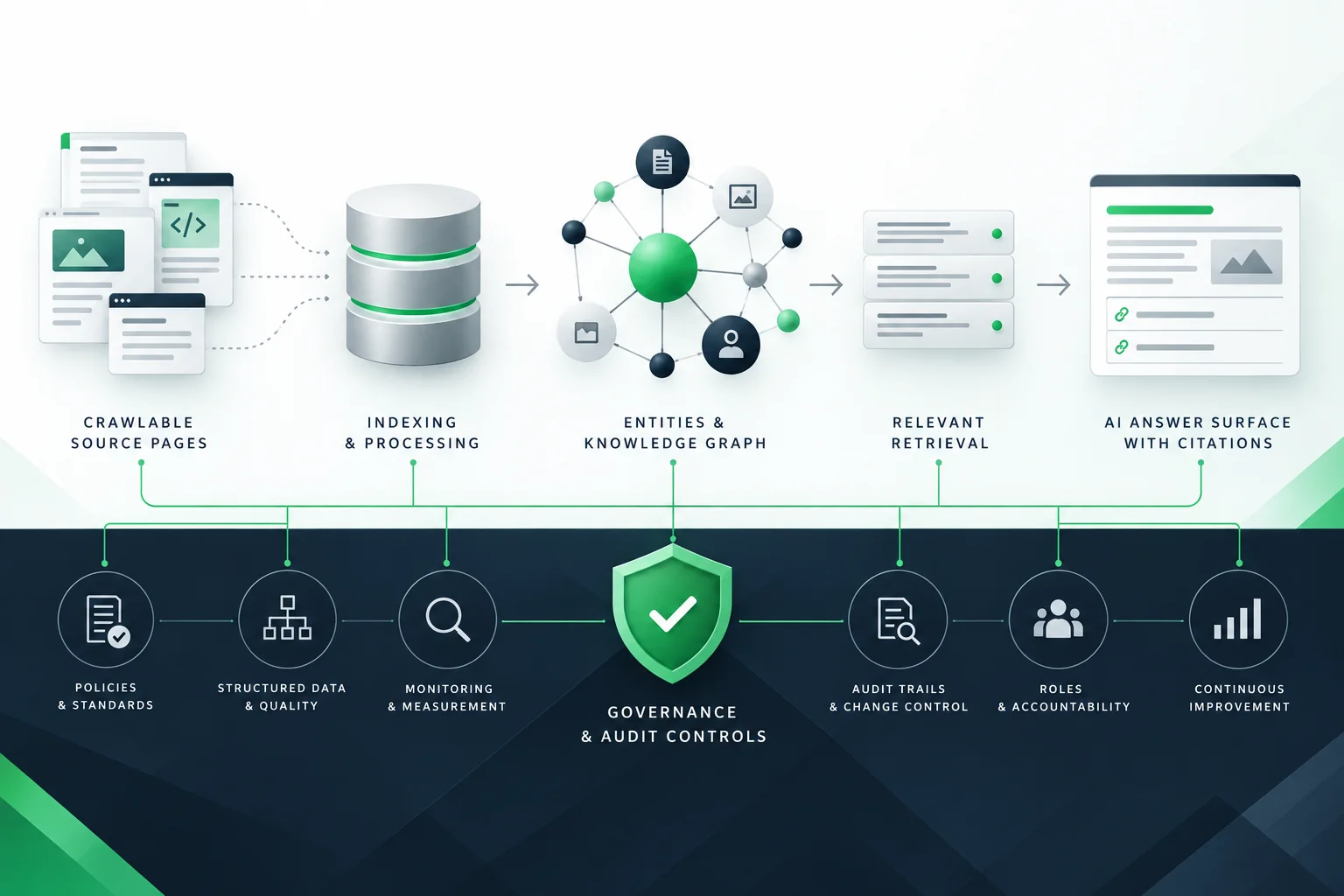
When your pages and entity records feed AI retrieval and knowledge graphs, the organisation becomes a supplier of structured signals and texts that can be synthesised or excerpted by models and answer engines. That supply chain has predictable control points — who edits canonical entity data, how structured data is published, which endpoints provide APIs, and how humans validate outputs. Treat these like content pipelines with approvals, not ad-hoc publishing.
- Entity creation and schema mapping
- Authoritative page publication and canonicalization
- Machine-readable feeds (JSON-LD, RDF) and APIs
- Distribution to third-party caches or knowledge services
Why auditability reduces risk
Auditability provides traceability when a model or answer engine reproduces inaccurate or unsafe content. Records let you answer: What source did we publish, who approved it, when did the canonical data change, and which version was live when the answer engine cached it? Without this, remediation is slow, legal risk increases, and trust with search and platform partners is harder to defend.
- Versioned entity records with timestamps and authors
- Immutable publish logs and hash-based verification for feeds
- Retention policies aligned to legal and business needs
2. Definitions — what to optimise and what to govern
Clear definitions align technical teams, content owners, and compliance. Below are practical, jurisdiction-neutral definitions used in this article.
AEO, GEO, entities, retrieval and citations
AEO (Answer Engine Optimization) is the practice of optimising content and signals so answer engines (search features that return direct answers) can use them reliably. GEO (Generative Engine Optimization) focuses on how generative models retrieve and surface your content. 'Entity' refers to a canonical real-world subject (company, person, product, place) represented in machine-readable form. 'Retrieval' is the mechanism that locates candidate source material for an answer. 'Citation' is the visible or machine-format pointer to the source used to support an answer — engines may or may not disclose these.
- AEO: optimize explicit answer signals and structured facts
- GEO: optimise retrievability and context for generative models
- Entity: canonical identifier + properties (name, type, attributes)
- Retrieval: query → candidate selection → ranking/scoring
Structured data and knowledge graphs
Structured data (JSON-LD, microdata, RDFa) provides machine-readable facts on web pages; knowledge graphs are internal or public graphs of entities and relationships that can be queried by retrieval systems. Both are signals to answer engines when published correctly, but they are neither the only input nor a guarantee of inclusion.
- Use schema-consistent JSON-LD for page-level facts
- Maintain a canonical knowledge-graph store for internal use and feeds
- Keep mappings between entity IDs and URLs in a single authoritative registry
3. Control pillars: five governance domains you must implement
Design governance around five control pillars that together enable auditability, safety, and trusted visibility.
1) Identity, provenance and source authority
Ensure every published entity and structured datum has a canonical owner, an internal identifier, and provenance metadata (who created/approved, timestamp, source system). Use cryptographic checksums or content hashes for feed integrity where feasible.
- Author and approver fields on every entity record
- Canonical ID registry that maps to live URLs and APIs
- Feed signing or checksums for critical exports
2) Human oversight and risk tiers
Classify content and entities by risk and require human verification for moderate-to-high risk classes (health, legal, financial, safety-critical). Low-risk factual updates (e.g., address formatting) may follow automated workflows with sampling-based QA.
- Define risk tiers and required approval steps
- Maintain tamper-evident review logs
- Embed human-in-the-loop checks for new entity types
4. Technical controls and machine-readable practices
Operationalise governance through concrete technical measures that search teams can audit and maintain.
Schema, structured data, and canonicalization (documented guidance)
Follow documented structured-data practices and Google’s recommendations when publishing machine-readable facts. Use schema.org types appropriate to the entity and prefer JSON-LD. Always implement canonical links and ensure the canonical page exposes the authoritative JSON-LD. Structured data increases the signal quality of your published facts, but Google documents that structured data does not guarantee special features or placements.
- Prefer JSON-LD and validate with schema-aware tools
- Ensure canonical URLs expose the canonical JSON-LD payload
- Avoid conflicting on-page markup and server-side exports
APIs, feeds and machine-readable source control
Treat APIs and exported feeds as first-class publication channels. Apply versioning, change logs, and access controls. Provide audit endpoints that can return historical versions of an entity record and the signing metadata required to dispute or verify a claim.
- Version API responses; include effective-from timestamps
- Require authenticated access for non-public exports
- Store immutable copies of exported feeds for audit
5. Measurement, audit trails and observability for AI visibility
Track retrieval, citation, and answer-surface performance differently from classic SERP rankings. Observability is a core control for governance because it supplies the forensic evidence you need during incidents.
What to measure (signals that matter)
Measure: retrieval frequency (how often your entities are selected as candidates), citation incidence (when engines show a link or attribute the source), answer-surface impressions (features where your content appears), and downstream engagement (CTR, task completion). These are complemented by internal logs: feed versions, API query traces, and cache timestamps.
- Instrument API queries and responses with version tags
- Track feature impressions separately from organic clicks
- Measure content freshness vs. engine cache timestamps
Audit trails: retention and forensic capability
Retain the following minimally: entity version history, release manifests, signed feed artifacts, and publish logs mapping releases to calendar time. Retention periods should match business risk and regulatory needs; consult legal counsel for jurisdiction-specific obligations.
- Retain versioned exports and associated manifest files
- Tie publish logs to human approvers and tickets
- Provide replay capability to reconstruct public state
Experimentation, sampling and bias checks
Run controlled experiments to measure how retrieval and generative responses change with different structured-data payloads. Sample outputs for quality checks, and audit for biased or harmful summarizations. Keep experiment metadata and control groups as part of the audit record.
- A/B retrieval experiments with pinned control data
- Sample automated answers for manual review
- Record model/engine version used during experiments

6. Operational model: from entity research to measurement
A repeatable operating model reduces friction and clarifies ownership. Peak Demand structures visibility programs across seven integrated layers.
Seven-layer operating architecture
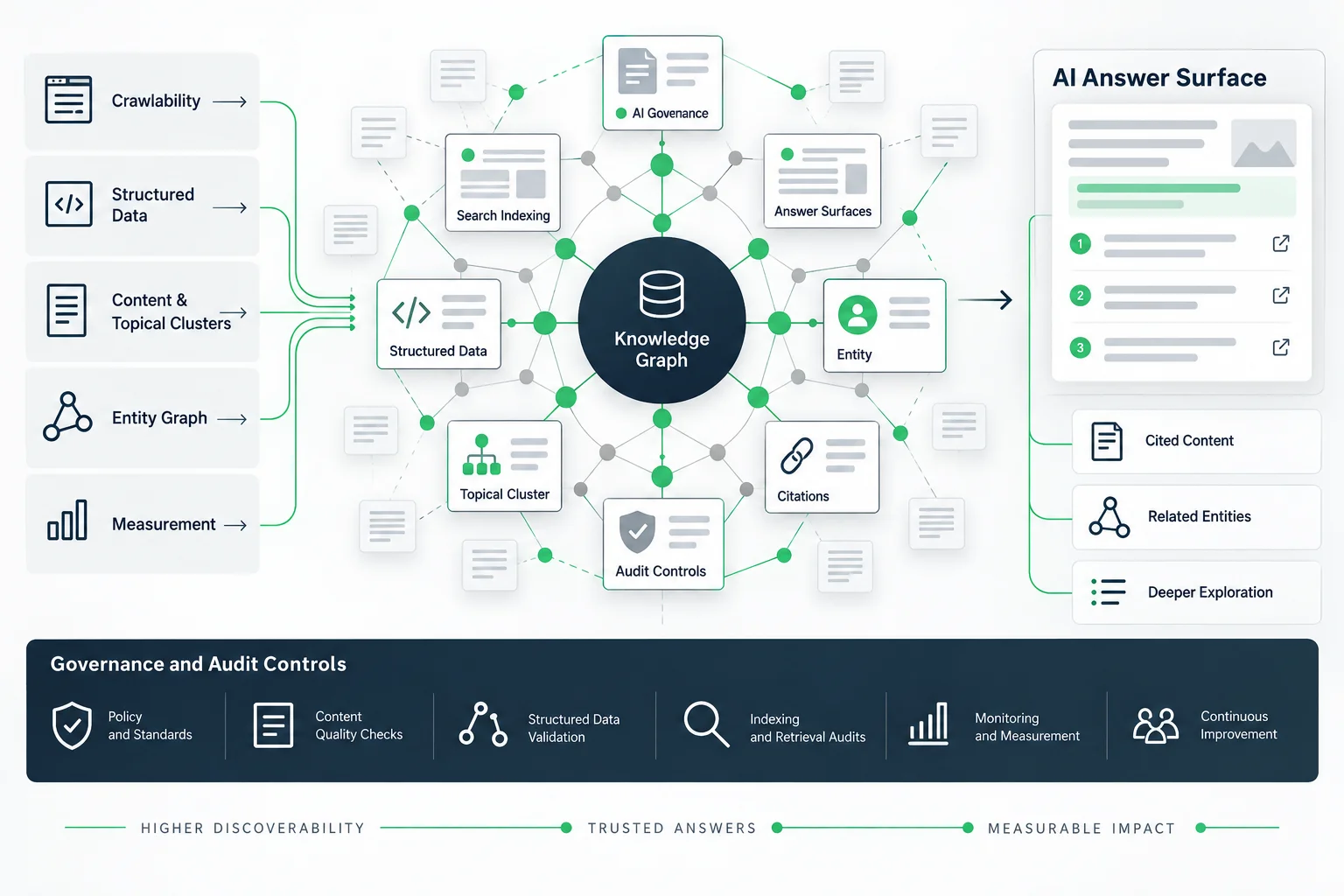
Research and entity model → topic and page graph → authoritative content → structured data and internal linking → distribution and brand signals → retrieval and citation surfaces → measurement and iteration. Each layer is a control boundary with specific governance tasks — for example, the entity model requires ID governance; the structured-data layer requires schema validation and feed versioning.
- Research & entity model: canonical IDs, types, and attributes
- Topic & page graph: internal linking and canonical URL mapping
- Authoritative content: editorial standards and human verification
- Structured data & linking: JSON-LD, canonical exposure
- Distribution: feeds, APIs, content delivery controls & signing
Peak Demand differentiation
Peak Demand connects technical SEO, entity architecture, knowledge graphs, structured data, internal linking, topical coverage, source authority, content distribution, and measurement into a managed visibility system designed for Google and AI answer surfaces. This orchestration treats ML retrieval as an operational interface — not a black box — and builds governance controls into the publishing pipeline.
- Single-source-of-truth entity registry
- Machine-readable release manifests maintained alongside content
- Integrated observability from API to answer-surface
Practical services to operationalise control
Operationalising these controls commonly requires service work: generating machine-readable payloads at scale, mapping enterprise entity stores to schema.org, and instrumenting feeds for observability. Two practical services to consider are Peak Demand’s machine-readable SEO work for schema, entity mapping and internal linking, and LLM surfacing services for retrieval-focused visibility and audits.
- Map enterprise entity IDs to canonical URLs and schema types
- Create versioned JSON-LD exports and signed feeds
- Instrument observability for retrieval and answer impressions
Related Peak Demand resources
Industry and AI sources reviewed
- Understand how structured data worksGoogle Search Central
- Schema.org DocumentationSchema.org
- SEO Starter GuideGoogle Search Central
- AI features and your websiteGoogle Search Central
Search-engine and AI-answer behavior changes over time. Google documentation can establish published requirements and guidance, but inclusion in rankings, AI Overviews, citations, or LLM answers is never guaranteed. Practitioner observations should be labelled as inference or testing rather than official ranking factors. This article is operational guidance, not legal advice; organizations should confirm applicable requirements with qualified professionals.
Frequently asked questions
SEO improves visibility in traditional search results. AEO focuses on making content easy for answer systems to extract and use. GEO focuses on visibility in generative search and AI answer experiences. In practice, the strongest strategy combines technical accessibility, useful content, clear entities, strong internal relationships, structured data, and credible source authority rather than treating them as isolated channels.
Official reference: SEO Starter Guide
No. Structured data can make page entities and relationships more explicit and can support eligible search features, but it does not guarantee rankings, AI Overview inclusion, citations, or mentions in generative answers. It should reinforce accurate visible content rather than replace it.
Official reference: Understand how structured data works
Search and answer systems need to understand what a brand, person, product, service, or concept is and how it relates to other entities. Consistent naming, authoritative pages, structured relationships, internal linking, and corroborating references can reduce ambiguity and make a site easier to interpret and retrieve.
Official reference: Schema.org Documentation
Track traditional search visibility alongside query coverage, indexed pages, non-brand discovery, AI referral traffic where available, observed citations or mentions, entity consistency, content-cluster coverage, internal-link depth, and lead quality. Treat AI-surface monitoring as directional because answer composition can vary by model, query, user, and time.
Official reference: AI features and your website
Build a search and AI visibility system that compounds
Peak Demand connects technical SEO, entity architecture, knowledge graphs, structured data, topical authority, internal linking, distribution, and measurement into a managed SEO/AEO/GEO operating system.
Explore Peak Demand AI SEO, AEO & GEO


