
Technical SEO for AI Crawlers, Search Indexing, and Retrieval
A practical, architecture-first guide for marketing and technical teams to align technical SEO, entity architecture, structured data, and system integration for visibility in Google and AI answer surfaces.
1) What AEO, GEO, Entities, and Retrieval Mean for Technical Teams
Start by aligning terminology and scope so engineering, SEO and marketing teams make the same trade-offs. Definitions below focus on what teams control and what search engines have documented.
Define the terms practically
AEO (Answer Engine Optimization) and GEO (Generative Engine Optimization) are optimization disciplines aimed at improving the likelihood that an answer engine or generative surface will retrieve and use your content when producing an answer. They are not guarantees of placement or of being cited by a model. An entity is a uniquely identifiable real-world thing (brand, product, person, place) represented by consistent attributes and identifiers. Retrieval is the technical process where an index or vector store selects candidate content for a prompt or query; citation is the later step where an engine decides whether to attribute or surface material. Treat AEO/GEO as cross-disciplinary work that requires engineering, content, and trust signals.
- AEO/GEO = optimization disciplines, not guaranteed outcomes.
- Entity = canonical, stable representation of a thing with attributes and identifiers.
- Retrieval = candidate selection from indexes; separate from ranking or attribution.
Documented guidance vs. industry inference
Google publishes clear guidance about structured data, site quality, and people-first content. These documents show what makes content machine-readable and eligible for enhanced features, but do not promise inclusion. Industry practice has extended this guidance into entity graphs, topical authority programs, and retrieval testing. Keep explicitly separated notes in design docs: cite documented guidance where present and label experimental techniques as practitioner inference.
- Use Google documentation for what to implement (structured data, crawlability) and treat surfacing behavior as empirical.
- Log the distinction in team playbooks: documented directive vs. experimental hypothesis.
2) System architecture: From entity model to retrieval
A repeatable architecture keeps signals consistent across crawlers, indexers, and AI systems. We recommend a seven-stage pipeline that maps to both search-engine expectations and enterprise systems.
Seven-stage visibility pipeline
Design your visibility system as: (1) Research and entity model, (2) Topic and page graph, (3) Authoritative content production, (4) Structured data and internal linking, (5) Distribution and brand signals, (6) Retrieval/citation surfaces (search indexes, vector stores, APIs), (7) Measurement and iteration. Each stage has inputs, outputs and testable contracts.
- Stage 1: canonical entity registry (IDs, names, alternate names, relationships).
- Stage 3–4: content and schema that maps cleanly to the entity registry.
- Stage 6: index/embeddings, retrieval API, and a controlled adapter layer to downstream LLM consumers.
Where technical SEO fits
Technical SEO delivers the canonical, crawlable surface: correct HTTP status codes, canonical tags, robots directives, sitemaps, and speed/UX basics. These ensure search engine crawlers and AI features can find and evaluate the authoritative content you expose. For enterprise teams, combine technical SEO work with a controlled content API that provides the same canonical attributes to internal indexes and partner systems.
- Keep canonical values aligned between HTML, API payloads, and structured data.
- Automate export of the canonical entity registry into sitemap or API feeds.
3) Crawlability, Indexing, and AI features: What to implement
Implement technical basics first — they remain prerequisites for any AI surface to use your content. Then layer features that make content usable for AI retrieval and snippet generation.
Core crawl and index hygiene
Ensure authoritative pages are indexable: allow crawl access (robots.txt), use consistent canonical tags, avoid soft-404s, and publish XML sitemaps for priority URLs. Validate redirects and eliminate duplicate or low-value pages. These are foundational and documented in search-engine guidance.
- Robots.txt and meta robots: permit indexing for canonical pages.
- Canonical tags: one canonical URL per logical content object.
- Sitemaps: include canonical URLs and update changefreq/lastmod sensibly.
Make content machine-actionable for AI features
Structured data, clear headings, semantic HTML, and consistent entity identifiers make content easier for AI features and answer engines to interpret. Google’s AI features docs explain that sites should use structured data where applicable and follow people-first content principles. Structured data won’t force inclusion but can increase eligibility for rich features and improve machine interpretation.
- Use schema.org types for products, articles, FAQs, HowTo, organization, person, and product where they apply.
- Expose canonical entity IDs in data-attributes, JSON-LD, and API responses.
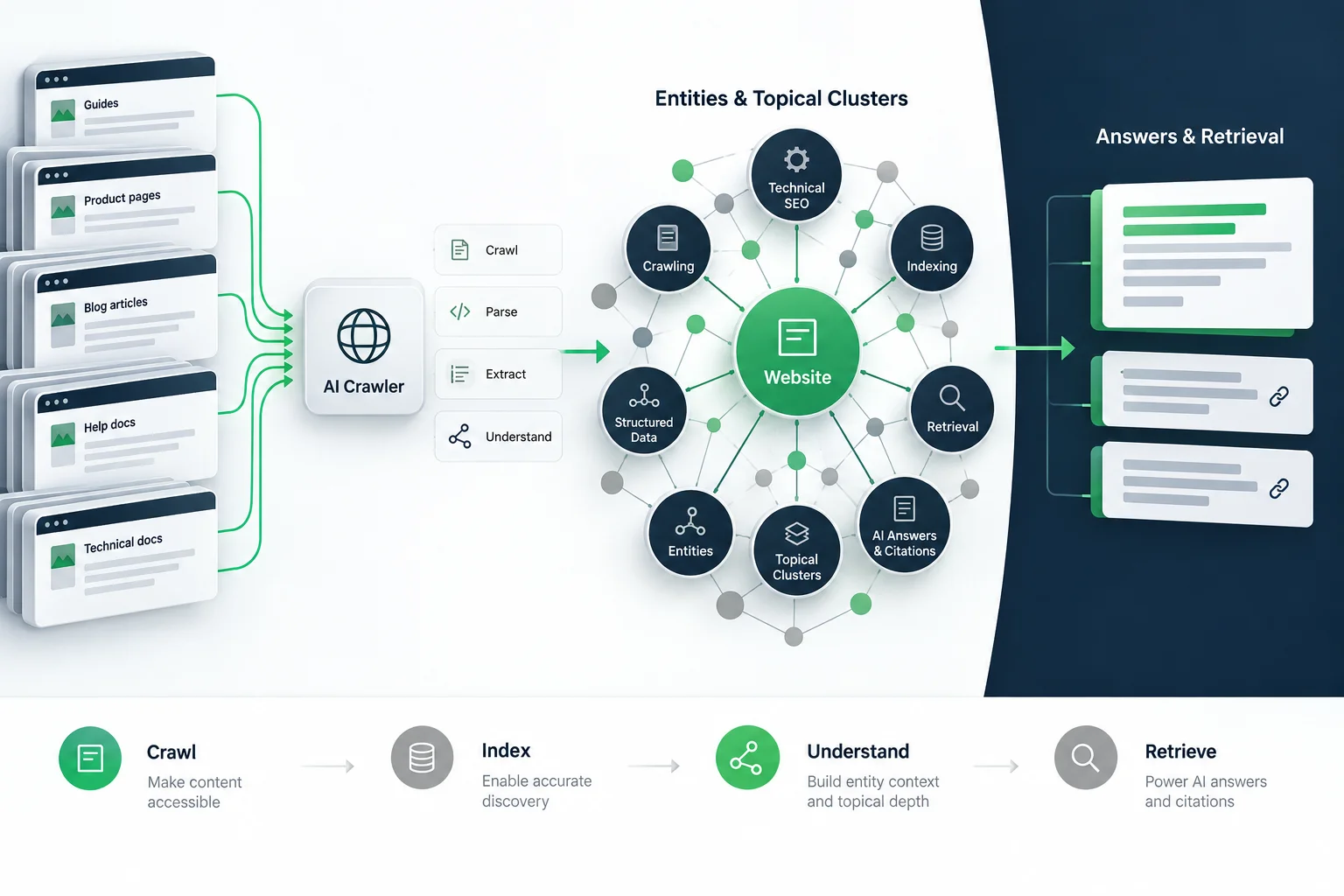
4) Entities, Knowledge Graphs and Structured Data
Entities and knowledge graphs connect your website’s pages to stable identifiers and relationships. Structured data is the most practicable way to broadcast those entity signals to crawlers.
Entity modeling and canonical identifiers
Create an internal entity registry (IDs, canonical names, alternate names, relationships, authoritative attributes). Use stable identifiers across HTML, API outputs, sitemaps, and structured data so both crawlers and downstream systems see a single source of truth. Where applicable, map to public identifiers (e.g., Wikidata QIDs) but maintain your canonical ID as the primary reference in your systems.
- Store name variants and common misspellings to support matching.
- Model relationships (parent company, product family, locations) to drive topical connections.
Practical structured data and schema usage
Prefer JSON-LD and schema.org types that match the content. Aim for correctness over exhaustiveness: every schema block should validate and reflect the visible page content. Use schema to expose entity IDs via property values (sameAs, identifier) and to describe relationships. Follow Google’s structured data documentation for technical rules and supported types.
- Validate JSON-LD with schema.org patterns and Google’s structured data testing tools.
- Do not use schema to publish content that is not visible to users or to misrepresent facts.
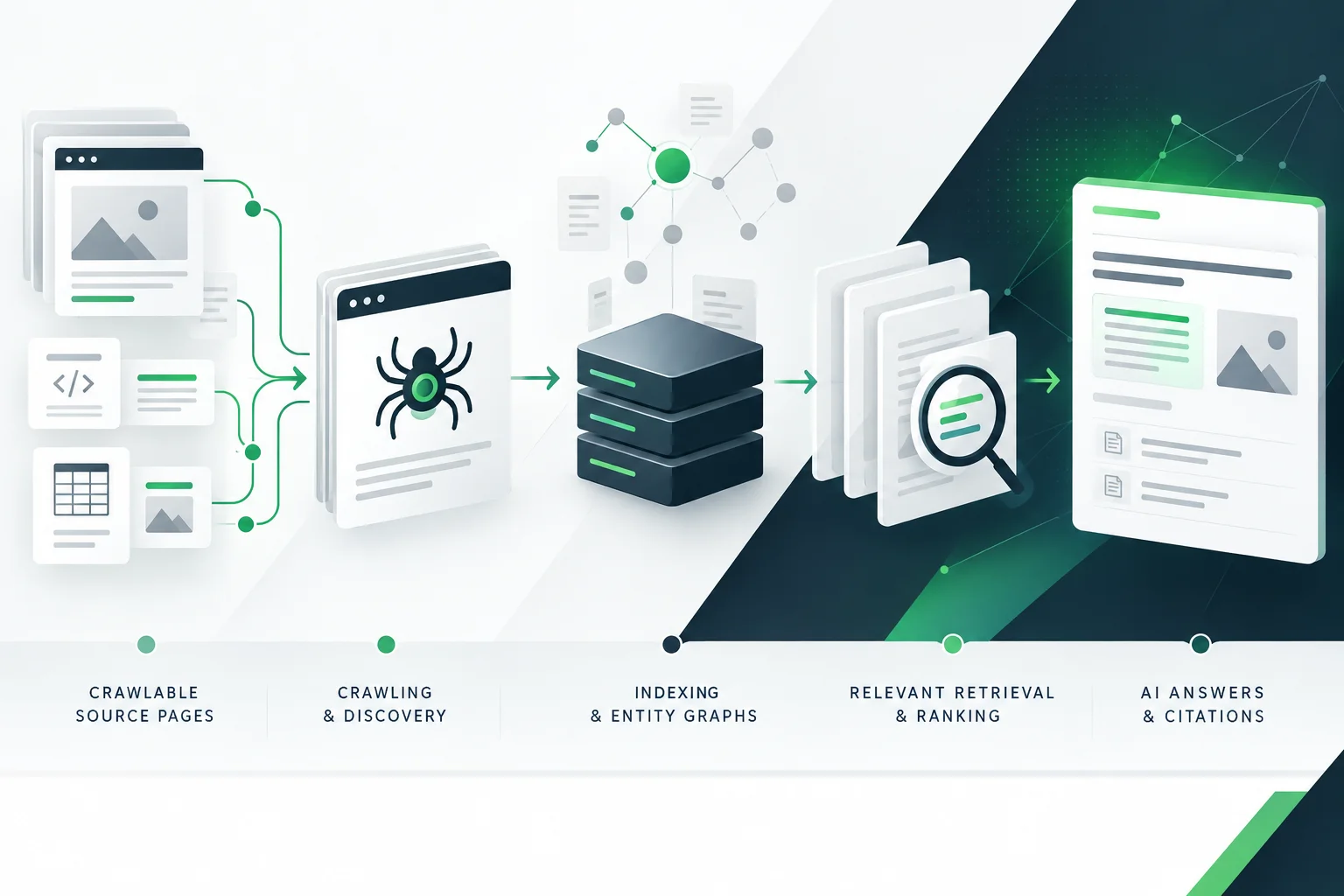
5) Integration: APIs, data contracts, and identity
AI retrieval and enterprise search frequently consume content via APIs or direct crawling. Design contracts so both crawlers and internal consumers receive identical canonical data.
Designing data contracts
A data contract is the formal spec for the payloads your content API serves to indexes and internal systems. Include canonical ID, title, canonical URL, publish dates, content blocks, entity relations, schema-json, and a quality score. Version contracts and include changelogs so retrieval systems can react to schema changes.
- Provide both HTML and API endpoints with identical canonical metadata.
- Version fields and keep deprecation schedules for consumers.
Identity, authority, and trust signals
Identity controls span authenticated publisher profiles, verified organization metadata, and stable ownership signals in structured data and sitemaps. Maintain publisher identity consistency (logo, name, published-by) and use structured data Organization/Author blocks to tie content to an authoritative publisher entity. These measures help downstream systems disambiguate sources.
- Publish a clear publisher page with canonical structured data.
- Use authenticated admin flows for content changes and log authorship.

6) Reliability, Observability, and Failure Recovery
Indexes, crawlers, and LLM adapters are operational systems. Plan for observability, SLA-driven recovery, and safe fallbacks when API calls or features fail.
Observability and telemetry
Track crawlability metrics (crawl errors, indexation rate), structured-data validation rates, API availability, content drift, and retrieval performance (precision/recall on sampled queries). Instrument logs and expose dashboards for SRE, content ops, and SEO teams. Use synthetic tests that validate canonical JSON-LD presence and API payload parity.
- Key metrics: crawl success rate, index coverage, structured-data validation errors, API error-rate, retrieval latency.
- Schedule regression tests on schema and entity mapping after content deployments.
Failure recovery and safe tool use
Design safe fallbacks for downstream LLM adapters and search clients: if the canonical API is unavailable, use a cached static snapshot; if structured data fails validation, fall back to visible page parsing. Establish change windows for schema changes and require sign-off from content, engineering and SEO stakeholders. For any generative tool use (summarization, answer drafting), require human verification before public publication.
- Implement cached snapshots for critical endpoints with clear TTL and purge controls.
- Require human-in-the-loop review for generated outputs exposed to customers.
Related Peak Demand resources
Industry and AI sources reviewed
- SEO Starter GuideGoogle Search Central
- Creating helpful, reliable, people-first contentGoogle Search Central
- Understand how structured data worksGoogle Search Central
- AI features and your websiteGoogle Search Central
- Schema.org DocumentationSchema.org
Search-engine and AI-answer behavior changes over time. Google documentation can establish published requirements and guidance, but inclusion in rankings, AI Overviews, citations, or LLM answers is never guaranteed. Practitioner observations should be labelled as inference or testing rather than official ranking factors. This article is operational guidance, not legal advice; organizations should confirm applicable requirements with qualified professionals.
Frequently asked questions
SEO improves visibility in traditional search results. AEO focuses on making content easy for answer systems to extract and use. GEO focuses on visibility in generative search and AI answer experiences. In practice, the strongest strategy combines technical accessibility, useful content, clear entities, strong internal relationships, structured data, and credible source authority rather than treating them as isolated channels.
Official reference: SEO Starter Guide
No. Structured data can make page entities and relationships more explicit and can support eligible search features, but it does not guarantee rankings, AI Overview inclusion, citations, or mentions in generative answers. It should reinforce accurate visible content rather than replace it.
Official reference: Understand how structured data works
Search and answer systems need to understand what a brand, person, product, service, or concept is and how it relates to other entities. Consistent naming, authoritative pages, structured relationships, internal linking, and corroborating references can reduce ambiguity and make a site easier to interpret and retrieve.
Official reference: Schema.org Documentation
Track traditional search visibility alongside query coverage, indexed pages, non-brand discovery, AI referral traffic where available, observed citations or mentions, entity consistency, content-cluster coverage, internal-link depth, and lead quality. Treat AI-surface monitoring as directional because answer composition can vary by model, query, user, and time.
Official reference: AI features and your website
Build a search and AI visibility system that compounds
Peak Demand connects technical SEO, entity architecture, knowledge graphs, structured data, topical authority, internal linking, distribution, and measurement into a managed SEO/AEO/GEO operating system.
Explore Peak Demand AI SEO, AEO & GEO


