Topical Authority in the Age of Generative Search
A practical, evidence-led guide for marketing and SEO leaders: build an entity-first, measurement-driven system that increases visibility in Google, AI overviews, and generative answer surfaces without promising placements.
1. Why topical authority matters for AEO and GEO
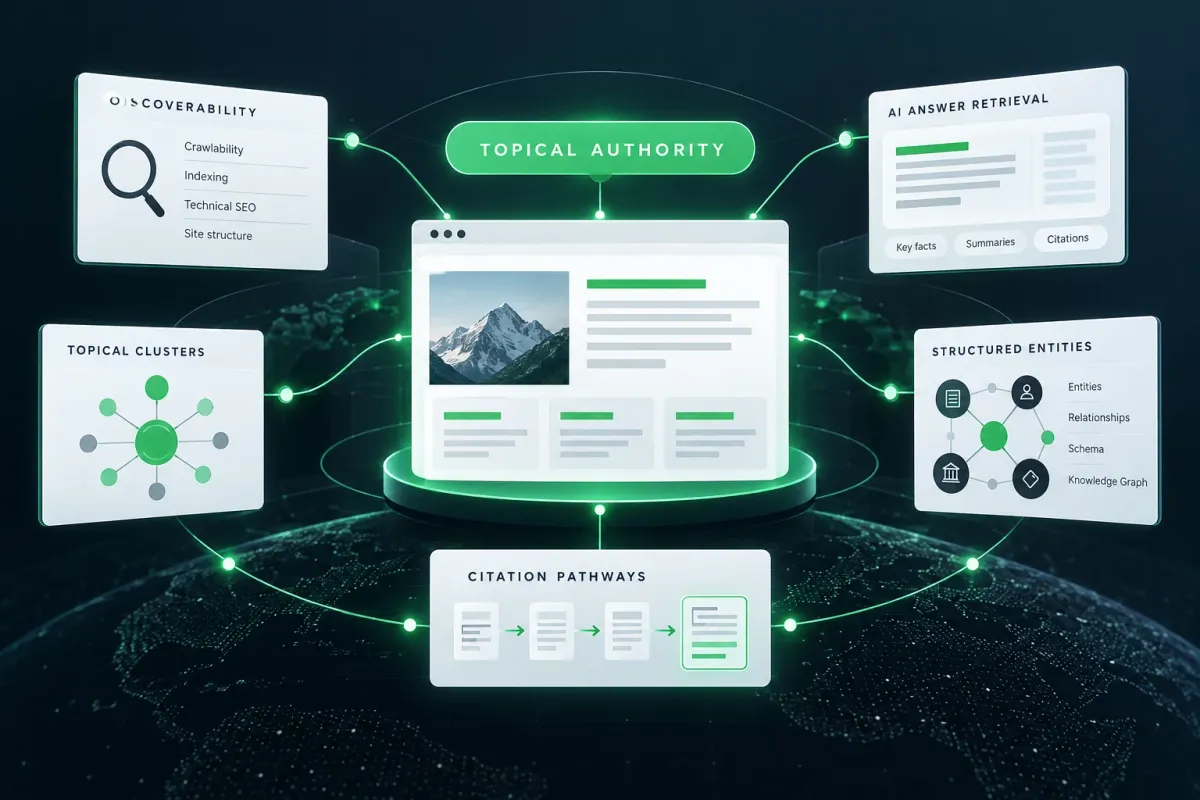
Topical authority is the organized, demonstrable coverage of subjects and their entities so search and generative engines can find, understand, and trust your content when answering queries. In the generative era, visibility is as much about being retrievable and citable as it is about rank.
Define the disciplines: AEO, GEO, and how they relate to SEO
Treat AEO (answer engine optimization) and GEO (generative engine optimization) as outcome-oriented specializations inside the broader SEO discipline. SEO optimizes pages for discovery and ranking. AEO optimizes for short-form answers, featured snippets, and concise direct responses. GEO optimizes content and systems to be retrieved and used by generative models and answer services. None guarantees placement; all are optimizations to increase the probability that engines retrieve and surface your content.
- SEO: discovery, ranking, organic traffic.
- AEO: concise, factual answers and snippet-ready content.
- GEO: content, entity signals and systems that improve retrievability for LLM-powered assistants and overviews.
Why entities and knowledge graphs are central
Engines increasingly reason with entities (people, brands, products, locations, topics) and relationships. A knowledge graph is the structured model engines use to connect entities. Topical authority is therefore less about isolated pages and more about an entity-backed network of pages that collectively express expertise, coverage, and trustworthiness.
- Model entities explicitly: canonical names, aliases, types, key attributes, and relationships.
- Design content to assert factual attributes an engine can verify (dates, specs, ownership, relationships).
- A coherent site-level entity graph reduces ambiguity and improves retrieval precision.
2. Start with an entity-first research and modelling phase
Operational topical authority begins with research: identify the entities you own, their relationships, and the content gaps that prevent engines from constructing a coherent view of your domain.
Inventory the entity universe
Map brands, products, key people, locations, services, common variants and topical concepts. This is the canonical entity list you will use across content, structured data, and internal linking. Track unique identifiers (internal IDs, GTINs, SKUs, ORCID—where applicable) and canonical page URLs.
- Use authoritative sources to validate entity facts (manufacturer pages, regulatory registries, open data).
- Record aliases and common misspellings to support redirect and anchor-text strategies.
Connect to entity SEO frameworks
Entity work benefits from established frameworks that align knowledge-graph thinking with content strategy. See our practitioner guidance on entity modelling and how search engines understand brands and services for practical patterns and operational examples.
- Use entity definitions to seed topic clusters and page intents.
- Keep separate documentation for entity schema, canonical URLs, and verification sources.
3. Build a topic-and-page graph, not isolated pages
Topical authority is achieved by deliberate coverage and relationships between pages: a topic graph (or page graph) that signals depth, breadth and authoritative hubs.
Design the topic graph and page types
For each entity and topic, define core hub pages (authoritative explainers), satellite pages (deep dives, how-tos, specs), and signal pages (case studies, data, citations). Map internal links and navigation so hubs aggregate signals and satellites answer specific intents.
- Hubs synthesize and link to satellites; satellites link back with contextual anchors.
- Differentiate pages by intent: informational, transactional, navigational, and entity-resolution pages.
Internal linking and anchor strategy
Linking is the connective tissue of topical authority. Use clear, informational anchors that reflect entity names and topic phrases. Avoid over-optimised anchors; prefer natural language that supports entity disambiguation. Ensure every canonical entity has at least one stable hub that aggregates related content.
- Use breadcrumbs, related links, and hub pages to create predictable retrieval paths for crawlers and agents.
- Maintain a link governance log to detect orphan pages or weakly linked satellites.
4. Structured data, knowledge-graph signals, and retrieval
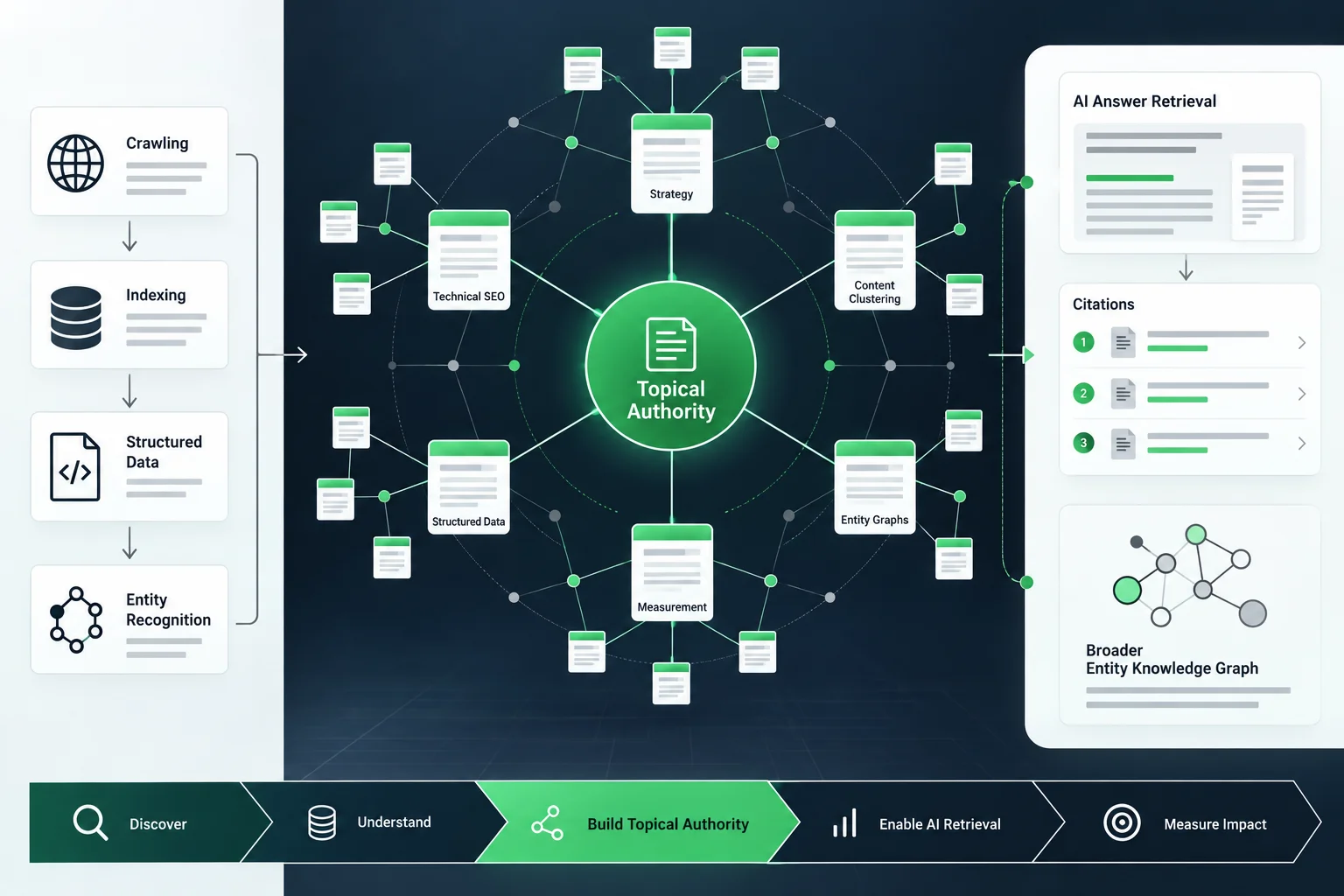
Structured data and explicit entity markup clarify facts to engines. Use schema consistently, but follow documented guidance; schema is a tool to express facts, not a shortcut to guaranteed features.
Structured data: documented guidance and practical patterns
Follow Google's documented structured-data guidance and Schema.org as the canonical vocabulary for marking up entity facts. Appropriate schema types (Organization, Product, Person, FAQ, HowTo, Article, Dataset) make attributes machine-readable and reduce entity ambiguity.
- Only mark up content visible to users; avoid hidden facts or markup mismatch.
- Validate markup with official tools and monitor Search Console for errors and enhancement reports.
Knowledge graph optimisation in practice
Structured data is one input to a knowledge-style representation engines construct. Complement schema with consistent site-level facts (about pages, canonical URLs), verified external citations (press releases, registries), and authoritative cross-references. For hands-on tactics, see practitioner guidance on knowledge-graph optimisation.
- Provide canonical entity pages with clear, verifiable facts.
- Use structured lists and tables for attributes that agents may extract.
Retrieval mechanics and documented AI features
Google and other vendors publish guidance on AI features and how content may be used in overviews and AI-assisted features. These docs explain what engines consider (clarity, structure, reliability) and how to make content accessible for retrieval — but they stop short of promising inclusion.
- Make content concise, factual, and properly attributed to improve retrievability.
- Follow site quality and transparency best practices described in vendor docs.
5. Distribution, citations, and external verification
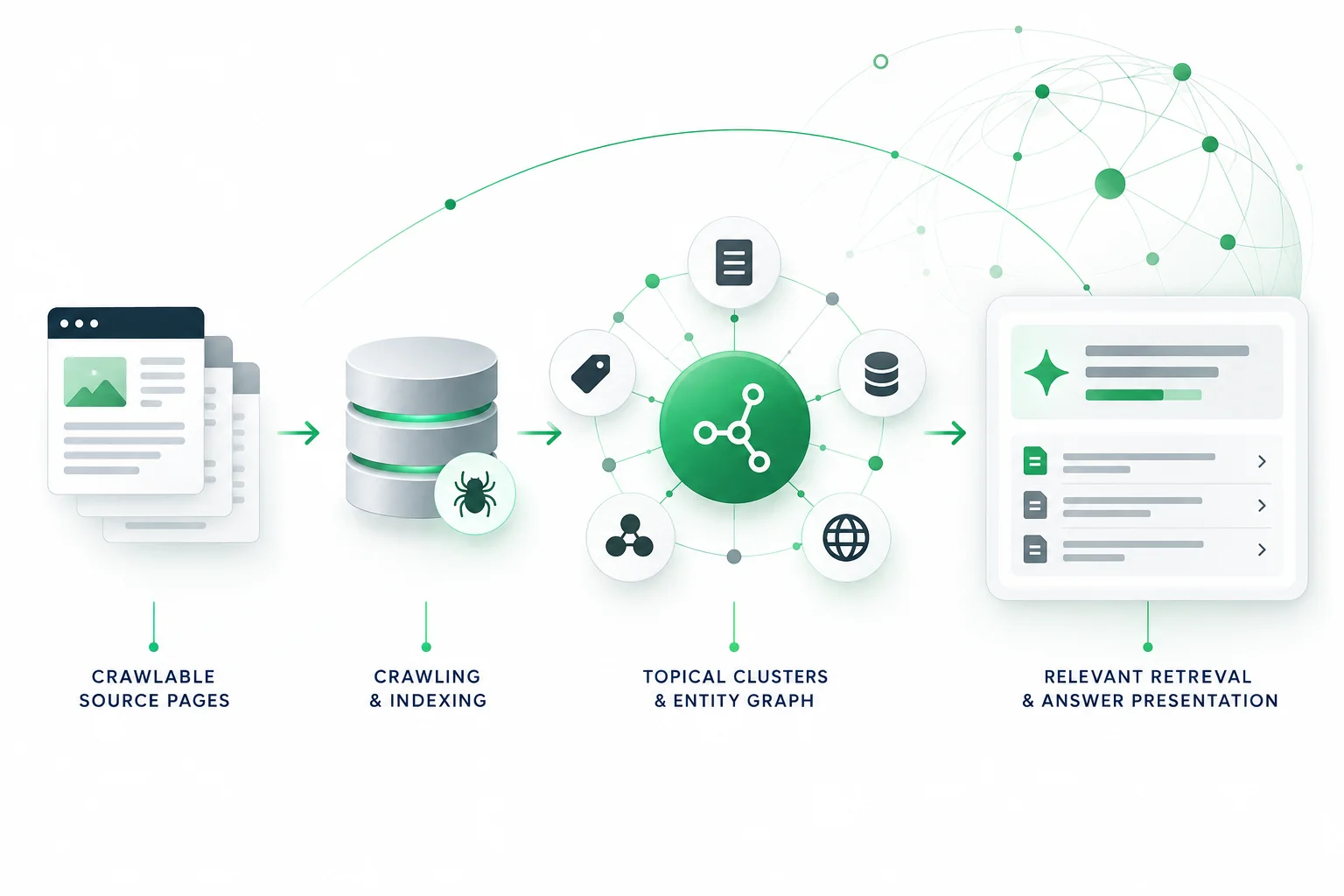
Topical authority depends on both on-site signals and off-site verification. Generative systems often re-use or cite external sources; your objective is to be a reliably citable source, not to coerce citations.
Earn verifiable citations and endorsements
Prioritise primary-source content (data, official documents) and clear authorship. Where applicable, publish datasets, whitepapers or official records that other sites and agents can reference. Track inbound citations and authoritative mentions as part of operating metrics.
- Capture and record the provenance of facts so you can demonstrate source quality.
- Use press, partnerships and data releases to create durable external references.
How LLM retrieval and citation differ from classic links
LLMs and retrieval-augmented systems may use content without a traditional link-based signal; instead, they rely on extractable facts, provenance metadata, and trusted sources. Study retrieval behaviour experimentally (APIs and logs) to see which content is surfaced as evidence for answers.
- Collect retrieval logs, API responses and agent feedback to validate which pages are used.
- Avoid claiming that you can force citations; instead, design to be a reliable evidence source.

6. Operationalising topical authority: workflows, validation and ownership
Authority is a system that needs defined workflows: who researches entities, who publishes, how evidence is validated, and how exceptions are handled. Convert strategy into repeatable operations.
End-to-end workflow: from research to retrieval validation
A recommended workflow: (1) Research & entity modelling; (2) Topic & page graph design; (3) Content creation & factual validation; (4) Schema and metadata markup; (5) Internal linking & canonicalization; (6) Distribution & citation outreach; (7) Retrieval testing & measurement. Each step must have named owners and SLAs.
- Include a verification gate: content with factual claims must link to or reproduce primary sources.
- Schedule regular re-validation for time-sensitive entity facts (prices, specs, regulatory statuses).
Routing, escalation and exception handling
Define routing rules for content issues: fact disputes, legal/privacy flags, and emergent crises. Escalation paths should include SMEs, legal, and a content incident owner. For generative surfaces, create an expedited correction process to update source pages and notify distribution channels.
- Maintain a content incidents register with timestamps, actions taken, and rollbacks.
- Establish a fast-track update path for entity pages used in high-value retrieval scenarios.
Operating ownership and cross-functional governance
Assign a visibility owner (platform-level role) responsible for the entity model, schema governance, retrieval testing, and measurement. This role coordinates SEO, content, product, legal and developer teams and enforces schema consistency and revalidation cadences.
- Visibility owner runs monthly retrieval reports and quarterly topical coverage audits.
- Keep an approval matrix for schema changes and hub/satellite relationships.
Related Peak Demand resources
Industry and AI sources reviewed
- Understand how structured data worksGoogle Search Central
- Schema.org DocumentationSchema.org
- AI features and your websiteGoogle Search Central
- Creating helpful, reliable, people-first contentGoogle Search Central
- SEO Starter GuideGoogle Search Central
Search-engine and AI-answer behavior changes over time. Google documentation can establish published requirements and guidance, but inclusion in rankings, AI Overviews, citations, or LLM answers is never guaranteed. Practitioner observations should be labelled as inference or testing rather than official ranking factors. This article is operational guidance, not legal advice; organizations should confirm applicable requirements with qualified professionals.
Frequently asked questions
SEO improves visibility in traditional search results. AEO focuses on making content easy for answer systems to extract and use. GEO focuses on visibility in generative search and AI answer experiences. In practice, the strongest strategy combines technical accessibility, useful content, clear entities, strong internal relationships, structured data, and credible source authority rather than treating them as isolated channels.
Official reference: SEO Starter Guide
No. Structured data can make page entities and relationships more explicit and can support eligible search features, but it does not guarantee rankings, AI Overview inclusion, citations, or mentions in generative answers. It should reinforce accurate visible content rather than replace it.
Official reference: Understand how structured data works
Search and answer systems need to understand what a brand, person, product, service, or concept is and how it relates to other entities. Consistent naming, authoritative pages, structured relationships, internal linking, and corroborating references can reduce ambiguity and make a site easier to interpret and retrieve.
Official reference: Schema.org Documentation
Track traditional search visibility alongside query coverage, indexed pages, non-brand discovery, AI referral traffic where available, observed citations or mentions, entity consistency, content-cluster coverage, internal-link depth, and lead quality. Treat AI-surface monitoring as directional because answer composition can vary by model, query, user, and time.
Official reference: AI features and your website
Build a search and AI visibility system that compounds
Peak Demand connects technical SEO, entity architecture, knowledge graphs, structured data, topical authority, internal linking, distribution, and measurement into a managed SEO/AEO/GEO operating system.
Explore Peak Demand AI SEO, AEO & GEO


