How to Measure AI Search Visibility Beyond Traditional Rankings
Move past rank-tracking. Learn a practical, architecture-first approach to measuring AI search visibility — AEO, GEO, entity authority, retrieval telemetry, structured data, and observability.
1. Why rank tracking is no longer enough
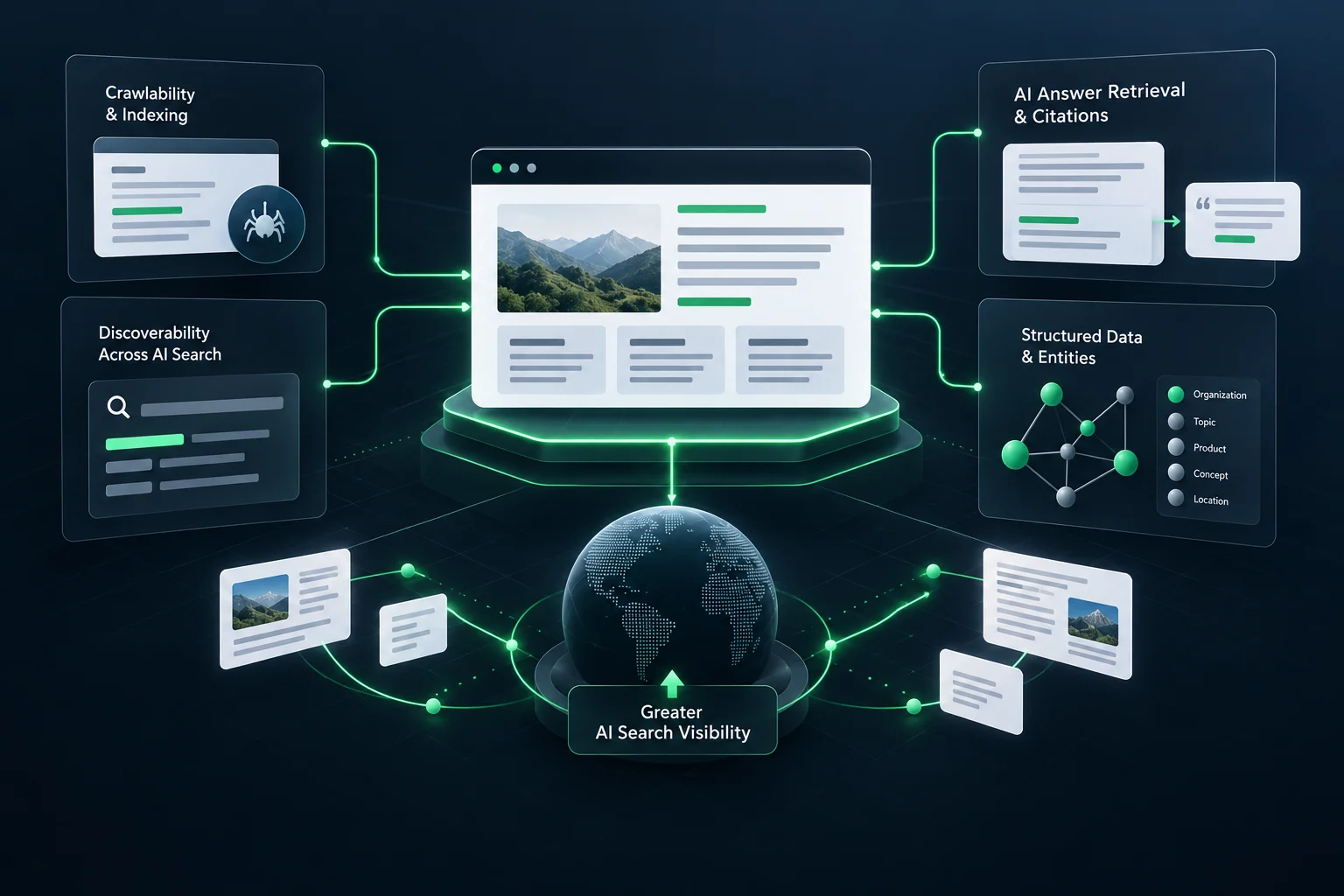
Search visibility has expanded beyond 10 blue links. Modern AI and answer surfaces use entities, retrieval, knowledge graphs, and generative models. This section explains what AEO, GEO, entities, and knowledge graphs are, and why they change how you measure success.
Define the terms that matter
AEO (Answer Engine Optimization) and GEO (Generative Engine Optimization) are optimization disciplines focused on helping search and generative systems find and use your content to answer user queries. An entity is a discrete concept — a person, product, place, or idea — represented by identifiers and attributes in an entity model or knowledge graph. Retrieval is the process that systems use to fetch candidate documents or entity records for a query. Citation in this context means an explicit or implicit reference to a source used by an AI feature or answer engine when producing a response. Structured data is machine-readable markup (schema.org and variants) that describes page content, and knowledge graphs are graphs of entities.
- AEO/GEO are optimizations, not placement guarantees.
- Entities and knowledge graphs drive retrieval and contextual relevance.
- Structured data makes content easier to match, but it doesn't force inclusion.
Why classic rank metrics miss the signal
Position-focused metrics assume a single SERP layout and editorial placement. AI features aggregate content, paraphrase answers, and can surface facts without sending traditional clicks. That means you may be contributing to answers or getting surfaced programmatically while seeing flat or declining organic ranks. Measuring contributions to AI outputs requires measuring retrieval, snippet inclusion, citation occurrences, and downstream engagement — not just rank.
- Clicks can fall while visibility rises in non-click surfaces.
- SERP features may show your content as source material without a URL-level rank improvement.
- APIs and telemetry are required to capture retrieval and citation events at scale.
2. Signals that indicate AI search visibility
Decide which signals are measurable, reliable, and causally meaningful for your business goals. The list below separates documented signals from plausible inferences and experimental metrics.
Documented, platform-level signals
Use platform-exposed metrics where available. Google Search Console provides impressions and rich-result reporting; Google documents structured data and AI features behavior. These are primary starting points for measuring visibility into documented features.
- Impressions for queries, pages, and rich results (GSC).
- Structured data reports and enhancements (GSC structured-data reports).
- Search Console coverage and indexing telemetry.
Operational signals you should capture
Because documented metrics are incomplete for AI surfaces, instrument operational telemetry: retrieval logs from your content retrieval service or API, citation events extracted from SERPs or third-party answer APIs, snippet match rates, and LLM prompt/response logs when you operate surfacing integrations.
- Retrieval-event counts: how often your pages or entity records are returned as candidates.
- Citation-event counts: where your canonical URI or brand is referenced in an answer or overview.
- Snippet-match rate: fraction of generated answers that use your snippet or structured-data text.
- Engagement and conversion: downstream clicks, conversions, assisted metrics.
3. Measurement system architecture: from entity model to telemetry
Design a measurement system that maps your entity and page graph into traceable telemetry. A rigorous architecture prevents attribution gaps and accelerates reliable insights.
High-level operating model
Align around this pipeline: Research and entity model → topic & page graph → authoritative content → structured data & internal linking → distribution & brand signals → retrieval/citation surfaces → measurement and iteration. Treat each stage as both a production artifact and a telemetry source.
- Entity model: authoritative list of entity types, stable IDs, canonical URIs, and attribute contracts.
- Page graph: pages mapped to entity IDs and topics; version-controlled.
- Telemetry sources: GSC, server logs, retrieval API logs, CDN logs, LLM surfacing logs, and analytics.
Identity, data contracts, and canonical mapping
Canonical URIs and stable entity IDs are the core data contracts that let you join telemetry from different systems. Implement canonicalization rules, ensure redirects and hreflang/rel-canonical hygiene, and publish stable schema/JSON-LD with the same canonical identifiers so downstream retrieval systems can match sources reliably.
- Assign stable entity IDs (GUIDs or URIs) and expose them in structured data.
- Document attribute contracts: which fields must exist and their formats.
- Map analytics and retrieval logs to the canonical ID to avoid breakage when URLs change.
4. Structured data, internal linking, and entity authority
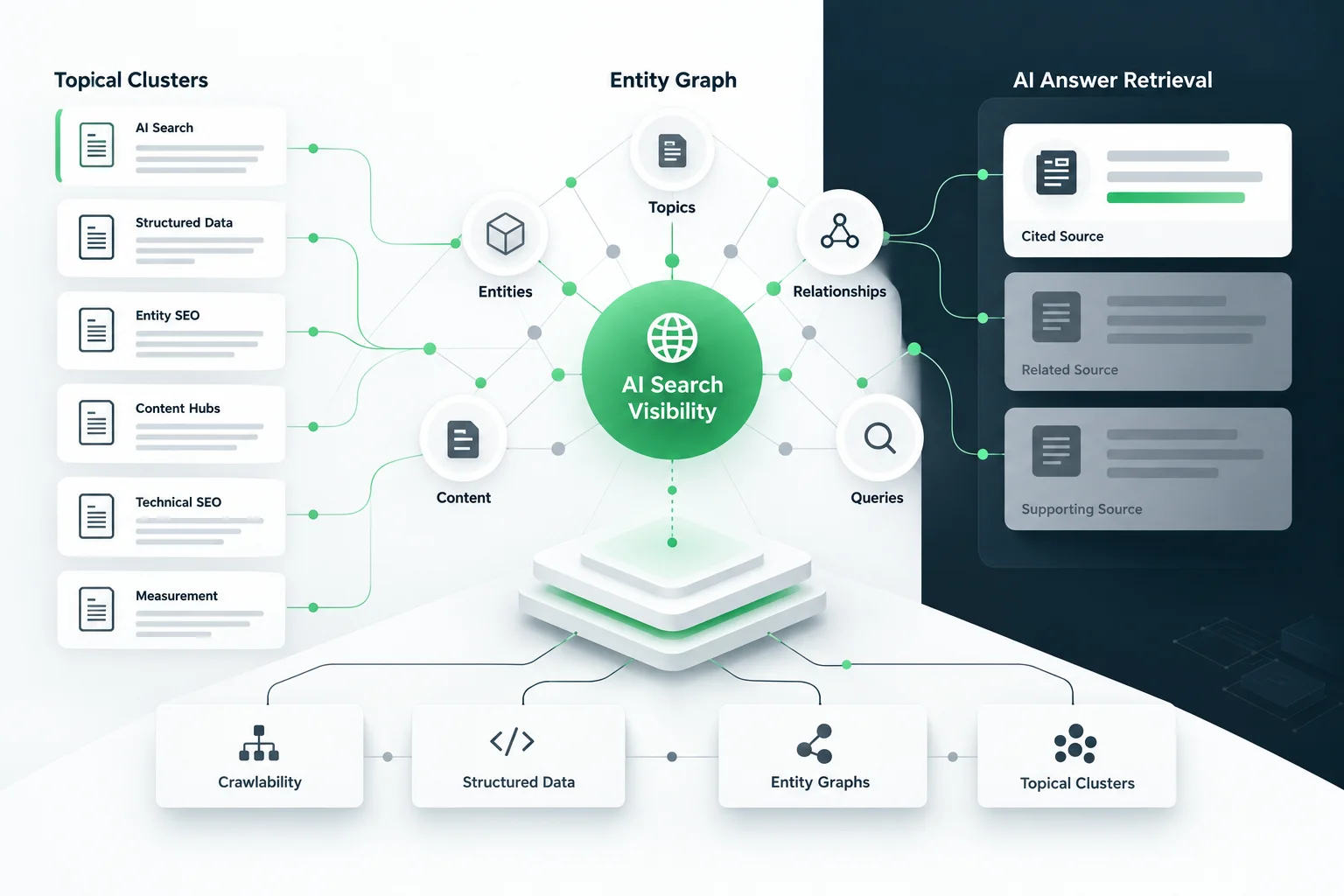
Structured data and internal linking are concrete, implementable levers that signal entity relationships and content structure to retrieval systems. Google documents structured data usage and AI features behavior; treat schema as a communication contract, not a magic wand.
Schema and structured data as a signal
Implement schema.org markup to consistently expose entity IDs, types, and key attributes. Use JSON-LD where possible, and keep structured data in sync with visible content. Google documents how structured data works, and using it improves machine-readability — which aids retrieval and rich-result eligibility — but it does not guarantee inclusion in AI features.
- Include canonical identifiers and authoritative attributes in JSON-LD.
- Validate structured data regularly and monitor Search Console structured-data reports.
- Keep markup consistent across language and regional variants.
Internal linking and the page-entity graph
Design an internal linking model that mirrors your entity relationships: hub pages for entities and in-depth topic pages for attributes. Use navigational links, contextual in-body links, and topic hub templates to make relationships explicit for crawlers and retrieval systems.
- Map link topology to your entity graph and instrument link-level metadata (anchor text, intent tags).
- Use site-wide hubs for canonical entity records and attribute pages for deep coverage.
- Ensure canonical tags and redirects preserve graph integrity during site changes.
5. Retrieval, LLM surfacing, and citation telemetry
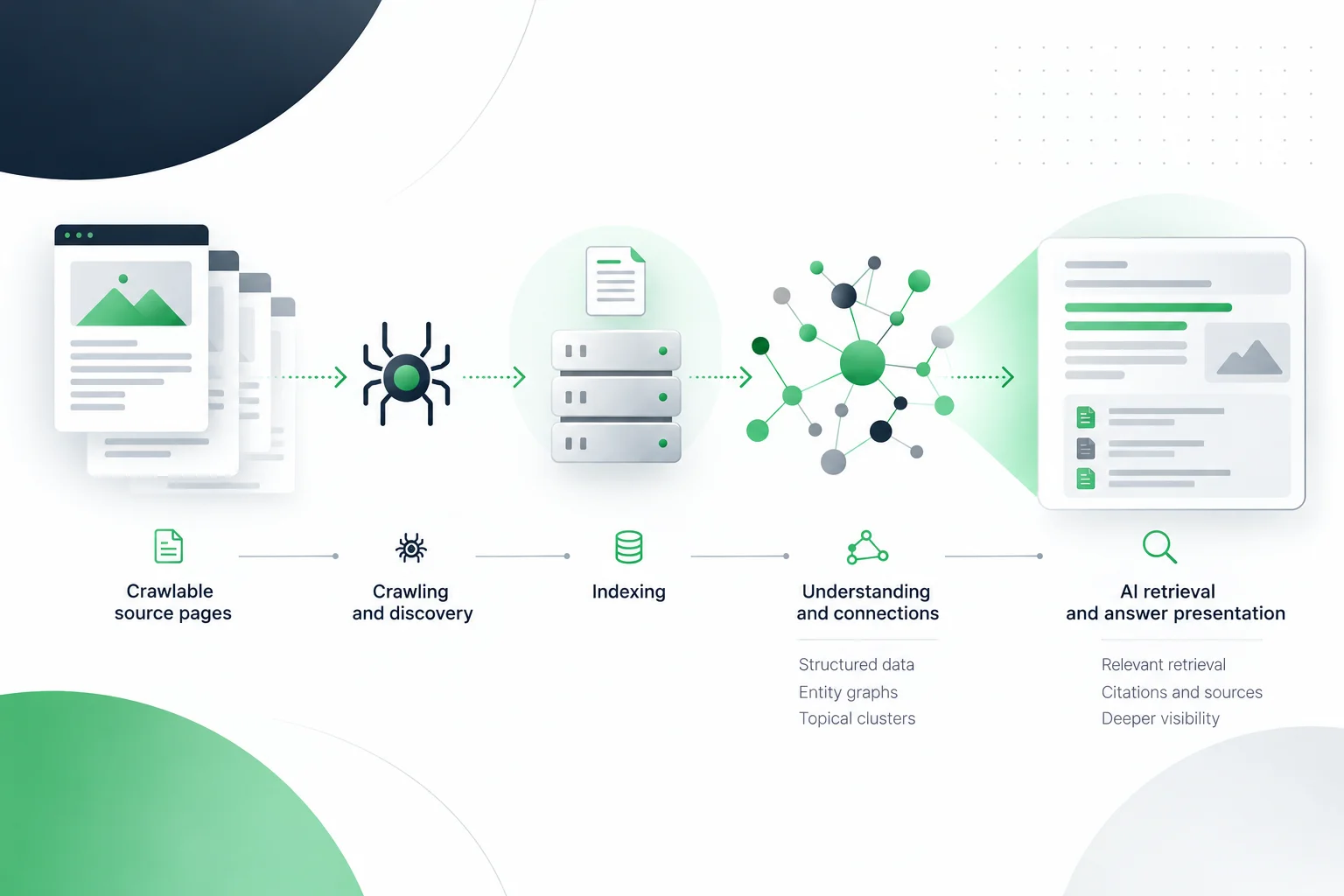
Measuring how often your content is retrieved or cited by answer engines and LLM surfaces requires telemetry at the retrieval and model-integration layers.
Capture retrieval and citation events
When you operate or integrate with retrieval services or LLM surfacing layers, log each retrieval candidate and each time a generated answer cites or links your content. Standardize event payloads with query context, model version, candidate rank, and a confidence score. These telemetries are the clearest signals that your content is being used in answers.
- Log retrieval hits with entity_id, page_uri, query, timestamp, and retrieval_score.
- Log citation events when an answer references your URI, brand, or canonical entity ID.
- Correlate citation events with downstream engagement to demonstrate value.
LLM surfacing: what you can measure and what you cannot guarantee
LLM surfacing — the process of having external models surface your content — is testable but non-deterministic. You can measure surfacing events in your controlled integrations and capture prompt/response pairs where legal and privacy-compliant, but you cannot guarantee inclusion by external models or third-party engines. Consider managed surfacing services that provide telemetry and versioning so you can iterate.
- Measure surfacing in managed integrations via observability logs and model-version tagging.
- Do not treat third-party LLM behavior as a deterministic channel — run experiments and validate outcomes.
- Peak Demand's LLM Surfacing Services can help design retrieval contracts and surfacing telemetry for enterprise integrations.

6. Observability, reliability, and failure recovery
A measurement system must be observable and resilient. This section covers SLIs/SLOs, monitoring, incident response, and safe tool usage.
Observability and service levels
Define SLIs (e.g., event ingestion rate, retrieval-latency P95, schema-validation pass rate) and SLOs to maintain confidence in your telemetry. Use dashboards for freshness, coverage (percent of canonical pages that emitted events), and drift (changes in retrieval rates).
- SLIs: ingestion completeness, event-processing latency, retrieval latency.
- SLOs: target thresholds and error budgets for telemetry gaps.
- Alerting: automatic alerts when ingestion or mapping falls below thresholds.
Failure recovery and provenance
Plan for partial outages: implement buffered ingestion, durable event stores, replay capability, and deterministic rehydration of entity mappings. Maintain provenance metadata (who, when, model version) for each event so you can audit how an answer was assembled.
- Enable buffering and replay for telemetry collectors to avoid data loss.
- Version entity-model exports and retain snapshots for auditing.
- Record model and prompt versions when surfacing experiments to keep provenance.
Related Peak Demand resources
Industry and AI sources reviewed
- SEO Starter GuideGoogle Search Central
- Understand how structured data worksGoogle Search Central
- AI features and your websiteGoogle Search Central
- Schema.org DocumentationSchema.org
Search-engine and AI-answer behavior changes over time. Google documentation can establish published requirements and guidance, but inclusion in rankings, AI Overviews, citations, or LLM answers is never guaranteed. Practitioner observations should be labelled as inference or testing rather than official ranking factors. This article is operational guidance, not legal advice; organizations should confirm applicable requirements with qualified professionals.
Frequently asked questions
SEO improves visibility in traditional search results. AEO focuses on making content easy for answer systems to extract and use. GEO focuses on visibility in generative search and AI answer experiences. In practice, the strongest strategy combines technical accessibility, useful content, clear entities, strong internal relationships, structured data, and credible source authority rather than treating them as isolated channels.
Official reference: SEO Starter Guide
No. Structured data can make page entities and relationships more explicit and can support eligible search features, but it does not guarantee rankings, AI Overview inclusion, citations, or mentions in generative answers. It should reinforce accurate visible content rather than replace it.
Official reference: Understand how structured data works
Search and answer systems need to understand what a brand, person, product, service, or concept is and how it relates to other entities. Consistent naming, authoritative pages, structured relationships, internal linking, and corroborating references can reduce ambiguity and make a site easier to interpret and retrieve.
Official reference: Schema.org Documentation
Track traditional search visibility alongside query coverage, indexed pages, non-brand discovery, AI referral traffic where available, observed citations or mentions, entity consistency, content-cluster coverage, internal-link depth, and lead quality. Treat AI-surface monitoring as directional because answer composition can vary by model, query, user, and time.
Official reference: AI features and your website
Build a search and AI visibility system that compounds
Peak Demand connects technical SEO, entity architecture, knowledge graphs, structured data, topical authority, internal linking, distribution, and measurement into a managed SEO/AEO/GEO operating system.
Explore Peak Demand AI SEO, AEO & GEO


