
Structured Data for AEO: What Schema Can and Cannot Do
Structured data (schema) is a powerful signal for AI and answer engines, but it has limits. This article explains what schema reliably provides, what it cannot guarantee, and how to design operational workflows that turn machine-readable metadata into measurable AEO/GEO authority.
1. Quick definitions: AEO, GEO, entities and structured data
Start with a shared vocabulary. Marketing leaders and technical teams must align on terms before designing schema-driven workflows.
What AEO and GEO mean in practice
AEO (Answer Engine Optimization) focuses on improving content and signals so information surfaces in answer engines and AI-powered result panels. GEO (Generative Engine Optimization) is a broader practice considering how generative models and retrieval systems surface, synthesize, and cite your content. Treat both as optimization disciplines — not guarantees of placement.
- AEO: Optimizations aimed at short, directly surfaced answers delivered by search or answer-engine surfaces.
- GEO: Optimizations for generative and retrieval-augmented systems that synthesize and present content from multiple sources.
Entities, knowledge graphs and structured data — practical shorthand
An entity is a discrete real-world thing (brand, person, product, place) represented in search engines’ internal graphs. Knowledge graphs are structured representations of entities and their relationships. Structured data (schema.org markup, JSON-LD) is machine-readable metadata added to pages to describe entities and their attributes, helping retrieval systems disambiguate meaning and eligibility.
- Entity = identifiable concept (e.g., Acme SaaS, Widget Model X).
- Knowledge graph = nodes (entities) and edges (relationships) used by engines to reason about connections.
- Structured data = explicit, standardized statements about entities on web pages (type, properties, ids).
2. What structured data can do — documented capabilities and realistic benefits
Separate what search engines explicitly document from useful practitioner outcomes that follow logically.
Documented capabilities (what Google and schema.org say)
Google and schema.org document that structured data helps search engines understand page content and can make content eligible for specific rich features (rich snippets, product results, FAQ snippets, HowTo cards, etc.). Structured data is explicitly described as a way to provide machine-readable information about entities and their attributes.
- Eligibility for structured-rich features when markup follows documented types and properties.
- Clearer identification of entity types and attributes (e.g., Product, Organization, Event).
- Feeder data for machine processing and downstream features (subject to engine policies and systems).
Practitioner benefits (evidence-led inferences and observable outcomes)
Practitioners find that valid, well-modeled schema improves disambiguation, reduces misinterpretation by parsers, and can increase the rate of rich result impressions. When combined with strong entity modeling, internal linking and authoritative content, schema helps retrieval systems locate the correct canonical resource for an entity.
- Fewer misattributed attributes in third-party knowledge panels because entities are clearly described.
- Improved chance of being used as a source in answer surfaces — though not guaranteed.
- Faster troubleshooting and automated extraction during crawling and indexing.
3. What structured data cannot do — hard limits and common misconceptions
Avoid overstating schema’s power. Being explicit about limits prevents mismatch between expectation and outcome.
Documented limits from search engines
Google’s documentation makes clear that structured data does not change ranking directly and is only one of many signals considered for features. Eligibility for a feature does not equal ranking or inclusion; engines use many additional systems, policies, and signals to select content.
- Structured data does not guarantee rich results or feature inclusion.
- Mark-up must follow published guidelines to avoid being ignored or penalized.
- Search engines may ignore markup they consider misleading or incorrect.
Practitioner pitfalls and incorrect expectations
Teams sometimes expect schema to ‘force’ AI Overviews, citations, or higher rankings. In practice, schema improves clarity but cannot control how an external system chooses sources, synthesizes answers, or weighs expertise and trust. Over-reliance on schema without content authority, citations, and distribution is a common failure mode.
- Schema won’t override poor content quality or lack of topical authority.
- You can’t dictate how an AI paraphrases or cites your content.
- Incorrect schema can create noise and harm eligibility.
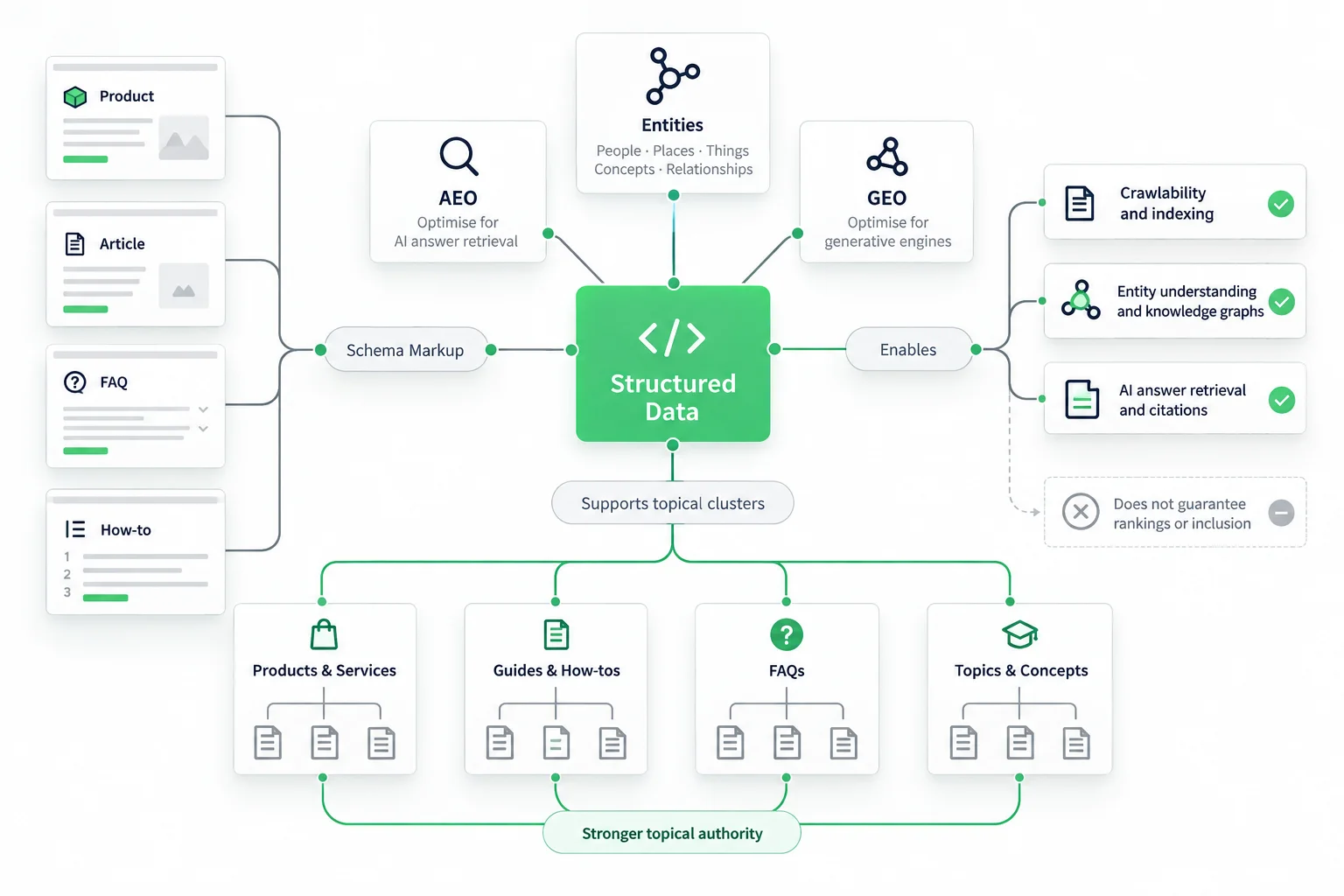
4. Where schema sits in an end-to-end AEO/GEO architecture
Structured data is one layer in a visibility architecture. Implement it within an operating model that connects research, content, technical delivery, distribution, and measurement.
The architecture — from entity model to retrieval
A practical architecture: Research and entity model → topic and page graph → authoritative content → structured data and internal linking → distribution and brand signals → retrieval and citation surfaces → measurement and iteration. Schema is the machine-readable bridge between authoritative content and retrieval systems.
- Entity model: canonical identifiers, relationships, and attributes.
- Page graph: clear canonical pages for each entity and topic cluster.
- Schema layer: JSON-LD implementing entity ids, canonical URLs, and relationships.
Technical implementation and services (where to invest first)
Prioritize schema that maps directly to entity identifiers and high-impact content types: Organization, WebSite, Article, Product, FAQ, LocalBusiness, and Breadcrumb. For enterprise rollouts, coordinate technical SEO and machine-readable schema workstreams to ensure safe deployment and monitoring — see machine-readable and technical SEO services for operational fit.
- Start with pages that serve as canonical entity endpoints (e.g., product pages, contact pages, service pages).
- Use JSON-LD injected server-side when possible; favor stable identifier properties.
- Automate schema generation from structured back-end records where feasible to reduce drift.

5. Operational workflows: validation, routing, escalation and ownership
Large-scale schema programs require clear workflows so changes are safe, auditable, and measurable.
Validation and QA pipelines
Validation must be automated and staged. Implement schema linting during CI, pre-release checks in staging, and post-deploy monitors in production. Validation should include syntax checks, property presence, canonical URL alignment, and sampling against live rendered HTML.
- CI hooks: JSON-LD syntax linting and type/property validators.
- Staging spot-checks: render pages and run live parse tests (simulate crawler user agents).
- Production monitoring: scheduled parsers to detect schema drift and missing required properties.
Routing, escalation and exception handling
Define clear ownership and routing rules. Typical model: SEO owns policy and schema templates; engineering owns deployment; content owns semantics and entity correctness; legal reviews required for regulated claims. Create escalation paths for high-impact exceptions (e.g., schema causing misattribution in knowledge panels or triggering manual action).
- Triage: severity levels (data quality incident, eligibility regression, policy violation).
- Escalation: immediate rollback for policy-violation markup, 48–72 hour remediation for high-severity quality incidents.
- Audit trails: change logs, versioned schema templates, and rollback capability.
Operating ownership and roles
Assign cross-functional ownership: an AEO/GEO product owner to coordinate, SEO engineers for templates and validation, content leads for entity semantics, and platform/infra for deployment and monitoring. Document SLA expectations for fixes and updates.
- Product owner: prioritization and stakeholder alignment.
- Technical SEO/Engineering: template development, CI/CD, observability.
- Content/Subject Matter Experts: entity accuracy and updates.

6. Retrieval, citations and measurement — what to monitor and how to interpret results
Move measurement beyond simple ranking metrics. Focus on retrieval, feature eligibility, and attribution signals that indicate schema effectiveness.
Key metrics and signals
Use a combination of search-console-derived metrics, internal telemetry, and controlled experiments. Track impressions and click-throughs for rich features, crawling and parsing success rates, entity-mention spikes, and downstream traffic from answer surfaces where detectable.
- Search Console: rich result impressions and errors, indexing coverage.
- Crawl logs and parsing success: percentage of pages parsed with valid JSON-LD.
- Controlled A/B experiments on markup presence for eligibility-sensitive features.
Attribution challenges and realistic interpretation
Attribution in AEO/GEO is noisy. A spike in answer-surface traffic may correlate with other signals (PR, backlinks, or distribution). Use multi-touch experiments, holdouts, and careful labelling (Utm, canonical IDs) to isolate the schema effect where possible. Never claim direct causation without controlled validation.
- Use control pages or sample rollouts to measure incremental effect.
- Combine qualitative auditing (parse outputs) with quantitative telemetry.
- Expect lag: indexation and feature-selection pipelines can take days to weeks to reflect changes.
7. Practical rollout checklist and common pitfalls
A concise playbook for enterprise rollouts. Prioritize, test, deploy, monitor, and iterate.
Priority checklist
Start small, instrument thoroughly, and scale by proven impact. Focus on canonical entity pages first and schema types relevant to your business.
- Map entities and canonical URLs (entity inventory).
- Prioritize schema types: Organization, WebSite, BreadcrumbList, Article, Product, FAQ, HowTo, LocalBusiness.
- Implement automated validation, monitoring and dashboards before scaling.
Common pitfalls and remediation
Avoid templates that inject incorrect attributes, shallow QA, or siloed responsibility. If schema causes problems (incorrect attributes, policy flags), revert, investigate root cause, and harden templates with stricter validation.
- Pitfall: generating schema from stale CMS fields — remediate via field validation and canonical ID mapping.
- Pitfall: mixing up entity IDs (causes misattribution) — remediate by aligning internal IDs with canonical URLs and company identifiers.
- Pitfall: ignoring policy/format updates — remediate via scheduled documentation and template review.
Related Peak Demand resources
Industry and AI sources reviewed
- AI features and your websiteGoogle Search Central
- Creating helpful, reliable, people-first contentGoogle Search Central
- Schema.org DocumentationSchema.org
- Understand how structured data worksGoogle Search Central
- SEO Starter GuideGoogle Search Central
Search-engine and AI-answer behavior changes over time. Google documentation can establish published requirements and guidance, but inclusion in rankings, AI Overviews, citations, or LLM answers is never guaranteed. Practitioner observations should be labelled as inference or testing rather than official ranking factors. This article is operational guidance, not legal advice; organizations should confirm applicable requirements with qualified professionals.
Frequently asked questions
SEO improves visibility in traditional search results. AEO focuses on making content easy for answer systems to extract and use. GEO focuses on visibility in generative search and AI answer experiences. In practice, the strongest strategy combines technical accessibility, useful content, clear entities, strong internal relationships, structured data, and credible source authority rather than treating them as isolated channels.
Official reference: SEO Starter Guide
No. Structured data can make page entities and relationships more explicit and can support eligible search features, but it does not guarantee rankings, AI Overview inclusion, citations, or mentions in generative answers. It should reinforce accurate visible content rather than replace it.
Official reference: Understand how structured data works
Search and answer systems need to understand what a brand, person, product, service, or concept is and how it relates to other entities. Consistent naming, authoritative pages, structured relationships, internal linking, and corroborating references can reduce ambiguity and make a site easier to interpret and retrieve.
Official reference: Schema.org Documentation
Track traditional search visibility alongside query coverage, indexed pages, non-brand discovery, AI referral traffic where available, observed citations or mentions, entity consistency, content-cluster coverage, internal-link depth, and lead quality. Treat AI-surface monitoring as directional because answer composition can vary by model, query, user, and time.
Official reference: AI features and your website
Build a search and AI visibility system that compounds
Peak Demand connects technical SEO, entity architecture, knowledge graphs, structured data, topical authority, internal linking, distribution, and measurement into a managed SEO/AEO/GEO operating system.
Explore Peak Demand AI SEO, AEO & GEO


