
Privacy, Access Controls, and Audit Trails for SEO‑driven Knowledge Graphs
Practical governance and technical controls for knowledge graphs that feed search, answer engines, and AI overviews — covering privacy, access control, provenance, and auditable change.
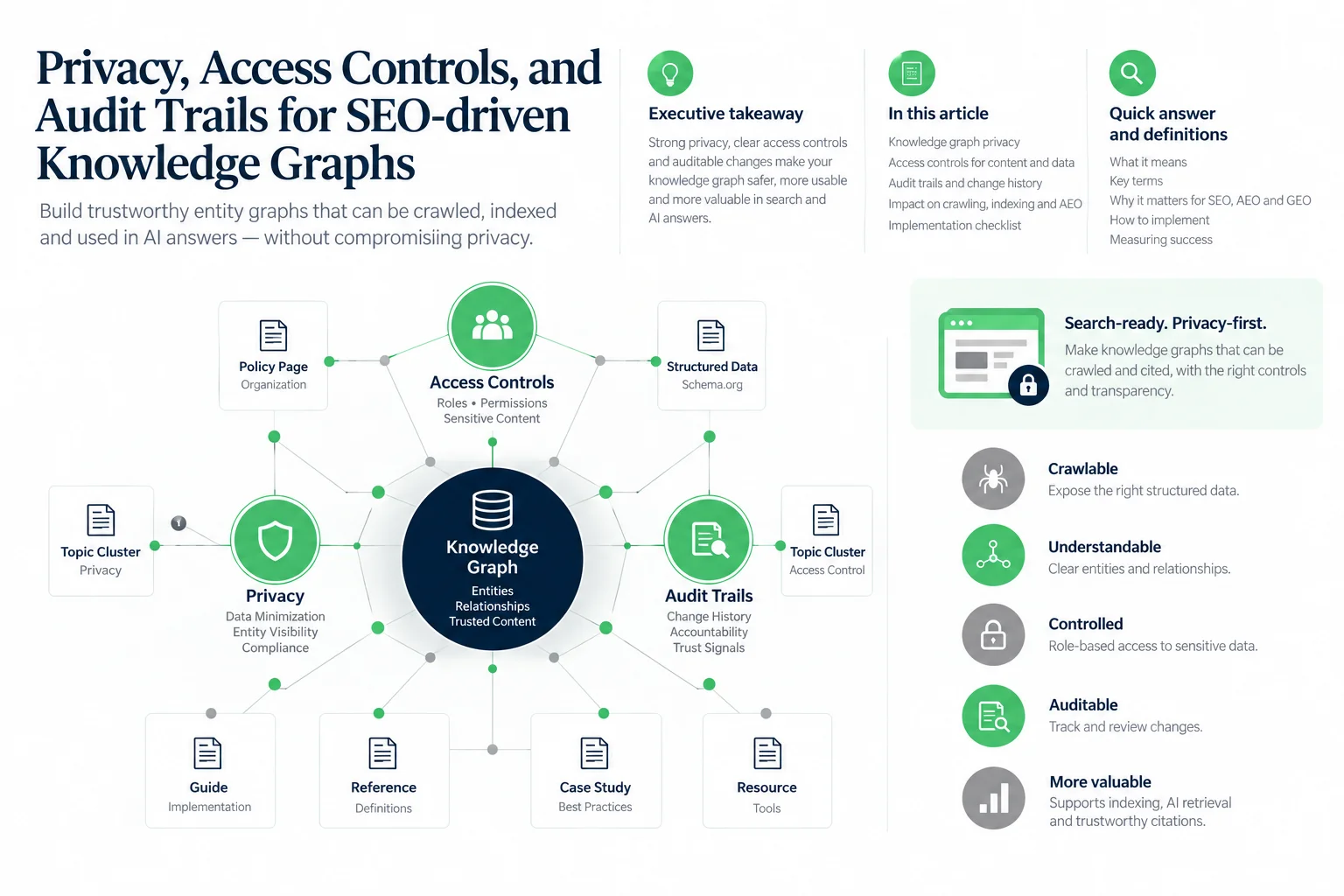
Quick answer and definitions
A concise practical answer and plain-language definitions for decision-makers.
Short answer
Protect knowledge graphs with role-based access, least-privilege controls, immutable audit logs, and provenance metadata. Combine these controls with structured-data best practices and documented change control so entity facts used by SEO, AEO (answer engine optimization), and GEO (generative engine optimization) are accurate, auditable, and privacy-aware.
Key definitions
Define the terms you’ll see throughout the article so teams align on scope and responsibilities.
- Entity: a real-world thing or concept represented in your system (brand, product, person, location) with stable identifiers and attributes.
- Knowledge graph: a system of entities, relationships, and attributes used to power APIs, machine-readable feeds, and structured-data exposures that search engines and AI features.
- Structured data / schema: machine-readable markup (JSON-LD, microdata) and vocabularies (Schema.org) that describe entities and content.
- Retrieval: the process by which search engines or AI systems locate, fetch, and score facts or passages from your graph or site.
- Citation / provenance: evidence about where a fact came from (source URL, timestamp, author) used to establish trust or traceability.
Why governance, privacy, and auditability matter for visibility
Visibility in modern search and AI is not just about keywords. Governance and controls materially affect entity representation and the risk surface.
Visibility depends on trusted facts
Search engines and AI features increasingly combine multiple signals — content, structured data, incoming authority, and on-site behavior — to form entity representations. When facts are inconsistent or edited without controls, retrieval systems can surface incorrect or stale information that harms visibility and brand trust.
- Inconsistent entity attributes (e.g., address, canonical name) create retrieval ambiguity and may reduce the clarity of AI summaries.
- Controlled provenance makes it easier to debug why a given fact surfaced and to supply corrected sources.
Privacy and compliance affect what you can expose
Personal data, contractual obligations, and intellectual property constraints dictate what parts of a graph can be publicly exposed. Treat public-facing structured data and internal knowledge graphs as separate surfaces with controlled transformations between them.
- Segment data according to access needs and sensitivity before exposing it to crawlers or public APIs.
- Document retention rules, consent records, and downstream sharing agreements to reduce legal and reputational risk.
Governance architecture: from entity model to visibility system
A practical operating model that aligns data, content, technical controls, and distribution for predictable visibility.
Recommended architecture flow
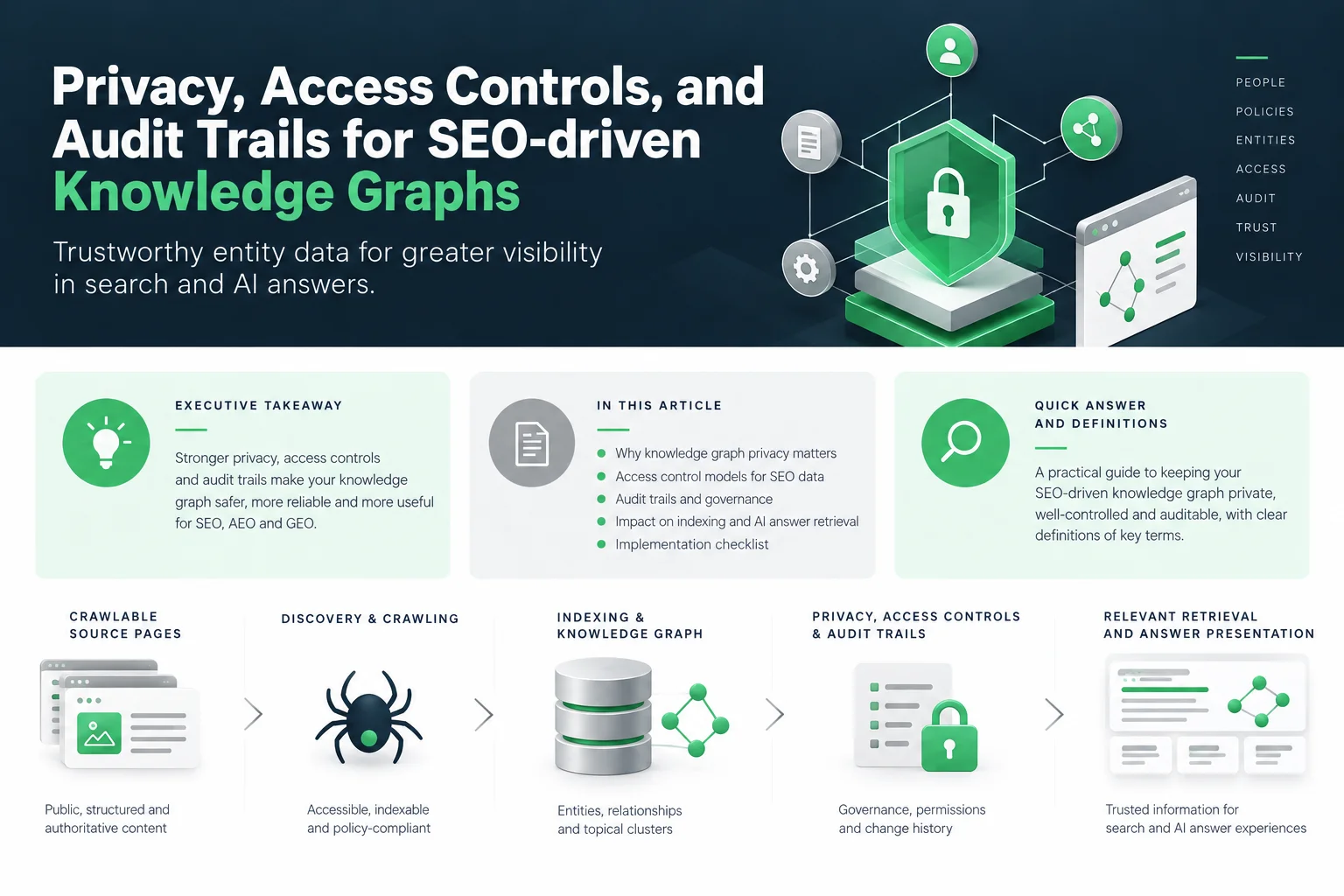
Implement a managed visibility system that intentionally connects: research and entity model → topic and page graph → authoritative content → structured data and internal linking → distribution and brand signals → retrieval/citation surfaces → measurement and iteration.
- The entity model is the canonical source for attributes and identifiers used across pages and feeds.
- Internal linking and topic graphs map entity relationships to content that supports retrieval.
- Machine-readable outputs (JSON-LD feeds, APIs) emit the same canonical facts used on pages.
Peak Demand differentiation
Peak Demand integrates technical SEO, entity architecture, knowledge graphs, structured data, internal linking, topical coverage, content distribution, and measurement into a managed visibility system designed for Google and AI answer surfaces. This alignment reduces mismatch between human-facing pages and machine-facing feeds.
- Operationally, this reduces manual reconciliation between content teams and the canonical entity store.
- Technically, it standardizes structured-data emissions and retrieval endpoints to simplify monitoring and auditing.
Technical controls: access, encryption, and data residency
Concrete controls that protect the graph and limit accidental or malicious changes.
Access management
Use role- and attribute-based access controls (RBAC/ABAC), least privilege, and multi-factor authentication for any system that edits or publishes entity data. Separate editorial roles (content authors, SEO editors) from systems roles (data engineers, API tokens). Implement approval workflows for high-impact attributes (names, legal identifiers, ownership).
- Document who can edit canonical entities and which fields require approvals.
- Rotate and scope API credentials; use short-lived tokens for automation.
Encryption, backups, and residency
Encrypt data at rest and in transit, and document backup geography and retention. Identify subprocessors and backup regions, and record cross-border transfer mechanisms. These are operational controls — confirm legal obligations with qualified professionals for your jurisdiction.
- Record primary hosting region, backup region, and subprocessors in an inventory.
- Apply encryption and test restoration processes as part of regular disaster-recovery exercises.
Structured data, provenance, and change control
How to use schema, provenance metadata, and versioning to make entity facts auditable and machine-friendly.
Structured data best practices
Use Schema.org vocabularies and Google’s structured-data guidance to expose authoritative entity attributes and relationships in machine-readable form. Prefer JSON-LD and ensure markup mirrors the canonical entity model. Avoid duplicative or conflicting markup across pages.
- Validate markup with schema validators and monitor for changes after deployments.
- Limit public exposure of sensitive attributes; publish only what is appropriate for public discovery.
Provenance, versioning, and change logs
Emit provenance metadata where feasible (source URL or system, timestamp, author, rationale) and maintain immutable change logs for canonical entities. For machine-readability, include version identifiers and lastUpdated timestamps in APIs and JSON-LD so consumers can detect changes.
- Record both human-readable change reasons and machine-readable version IDs.
- Use semantic versioning for API feeds where consumers depend on schema stability.
Change control and release policy
Define controlled deployment windows, test harnesses, and rollback procedures for schema and entity updates. Maintain staging environments that mirror production retrieval paths (sitemaps, feeds, APIs) so you can observe how changes affect structured-data outputs and crawling.
- Require peer review and sign-off for high-risk edits.
- Run automated tests that validate schema, canonical URLs, and feed integrity in CI/CD pipelines.

Audit trails, observability, and measurement
Design logs, dashboards, and success metrics that connect governance to visibility outcomes.
What to log and why
Capture immutable logs for edits (who, what, when, why), API accesses (consumer, endpoint, token), and publishing events (build id, sitemap changes, feed generation). These logs support forensic analysis, provenance queries, and regulatory requests.
- Ensure logs are tamper-evident and retained according to your retention policy.
- Record both successful and failed ingestion attempts to detect silent errors.
Visibility measurement
Measure both technical health (structured-data coverage, schema errors, crawlability) and retrieval outcomes (mentions in AI summaries, frequency of LLM-sourced citations, SERP features). Use a mix of internal instrumentation and external observation. Note: search engines document some signals but do not publish everything they use to rank or generate AI overviews.
- Track indexing and feed consumption logs to correlate changes with retrieval differences.
- Create dashboards that join change logs with visibility metrics to accelerate root-cause analysis.
Operationalizing governance and human oversight
Processes, roles, and incident readiness that make controls effective day-to-day.
Roles and approval gates
Define clear roles: data stewards (entity owners), content owners (editorial), platform operators (publishing and API), and auditors (compliance reviewers). Use approval gates for high-impact entity attributes and require documented rationale for changes.
- Map roles to access controls and to the audit log so accountability is traceable.
- Rotate steward responsibilities to reduce single-person failure.
Incident response and rollback
Create runbooks for rapid rollback of erroneous entity updates and for coordinated notifications to SEO, content, and legal teams. Include steps to patch structured data, regenerate feeds, and reindex pages where necessary.
- Test rollback procedures regularly in staging and during maintenance windows.
- Keep communications templates and an assigned liaison for external inquiries about visible errors.
Tooling and services to consider
Standardize on tooling that supports versioned feeds, schema validation, and API access control. For organizations building AI-visible entity surfaces, consider services that specialize in machine-readable SEO outputs and LLM surfacing so the same canonical facts power both pages and retrieval endpoints.
- Leverage machine-readable SEO pipelines to enforce consistent markup across pages and feeds.
- Use specialized surfacing services to monitor how canonical facts are used by LLM-driven features.
Related Peak Demand resources
Industry and AI sources reviewed
- Schema.org DocumentationSchema.org
- ISO/IEC 27001 Information Security Management SystemsInternational Organization for Standardization
- Understand how structured data worksGoogle Search Central
- AI features and your websiteGoogle Search Central
- SEO Starter GuideGoogle Search Central
Search-engine and AI-answer behavior changes over time. Google documentation can establish published requirements and guidance, but inclusion in rankings, AI Overviews, citations, or LLM answers is never guaranteed. Practitioner observations should be labelled as inference or testing rather than official ranking factors. This article is operational guidance, not legal advice; organizations should confirm applicable requirements with qualified professionals.
Frequently asked questions
SEO improves visibility in traditional search results. AEO focuses on making content easy for answer systems to extract and use. GEO focuses on visibility in generative search and AI answer experiences. In practice, the strongest strategy combines technical accessibility, useful content, clear entities, strong internal relationships, structured data, and credible source authority rather than treating them as isolated channels.
Official reference: SEO Starter Guide
No. Structured data can make page entities and relationships more explicit and can support eligible search features, but it does not guarantee rankings, AI Overview inclusion, citations, or mentions in generative answers. It should reinforce accurate visible content rather than replace it.
Official reference: Understand how structured data works
Search and answer systems need to understand what a brand, person, product, service, or concept is and how it relates to other entities. Consistent naming, authoritative pages, structured relationships, internal linking, and corroborating references can reduce ambiguity and make a site easier to interpret and retrieve.
Official reference: Schema.org Documentation
Track traditional search visibility alongside query coverage, indexed pages, non-brand discovery, AI referral traffic where available, observed citations or mentions, entity consistency, content-cluster coverage, internal-link depth, and lead quality. Treat AI-surface monitoring as directional because answer composition can vary by model, query, user, and time.
Official reference: AI features and your website
Build a search and AI visibility system that compounds
Peak Demand connects technical SEO, entity architecture, knowledge graphs, structured data, topical authority, internal linking, distribution, and measurement into a managed SEO/AEO/GEO operating system.
Explore Peak Demand AI SEO, AEO & GEO


