
Operational KPIs and QA Playbook for Scaling Multisite AEO & Knowledge Graphs
A practical, operational playbook for measuring and assuring quality as organizations scale multisite Answer Engine Optimization (AEO), generative engine optimization (GEO), and enterprise knowledge graphs. Includes KPIs, acceptance tests, containment and escalation quality, multilingual operations, and continuous optimization.
1 — Why operational KPIs and QA matter for AEO/GEO
AEO (answer engine optimization) and GEO (generative engine optimization) optimize content, entities, and technical signals so search and generative systems retrieve and re-use your authoritative answers. Knowledge graphs encode entities and their relationships to improve retrieval. For multisite organizations, ad hoc changes break entity resolution, increase misattribution, and make the business unable to measure containment and escalation quality. This section clarifies terms and separates documented guidance from practitioner inference.
Definitions and boundaries
AEO — optimization to improve the likelihood that search/answer surfaces retrieve, synthesize, or quote your content as an authoritative answer. GEO — overlap with AEO focused on generative engines and LLM-driven surfaces. Entity — a real-world thing (brand, product, person, location) represented in your data and content with a stable identifier in the knowledge graph. Knowledge graph — an organized, queryable model of entities, attributes, and relationships that feeds retrieval. Retrieval — the process by which a search or generative system selects candidate documents or entity records to synthesize an answer. Citation — a pointer to a source used in an answer; how systems attribute or surface provenance varies and cannot be guaranteed. Structured data/schema.
- Documented guidance: use structured data and clear metadata to help systems understand content (see structured data guidance).
- Practitioner inference: measuring containment (answers served without human escalation) and escalation quality (how well handoffs work) is the best operational proxy for real business.
What search engines document vs. what we infer
Google and other engine providers publish best practices (use schema, make helpful people-first content, and follow technical SEO basics). They do not publish deterministic shortcuts to feature inclusion. Practitioners must therefore treat AEO/GEO as a measurement and control problem: design for retrievability, instrument behavior, and iterate based on observed surfacing and downstream business metrics.
- Documented: structured data improves machine-readability; helpful content guidance improves user-centric signals (Google docs).
- Inferred: surplus topical authority, provenance, and internal linking increase the chance of being chosen by retrieval layers—this is practical, evidence-led inference not an engine.
2 — Operational architecture for multisite AEO and knowledge graphs
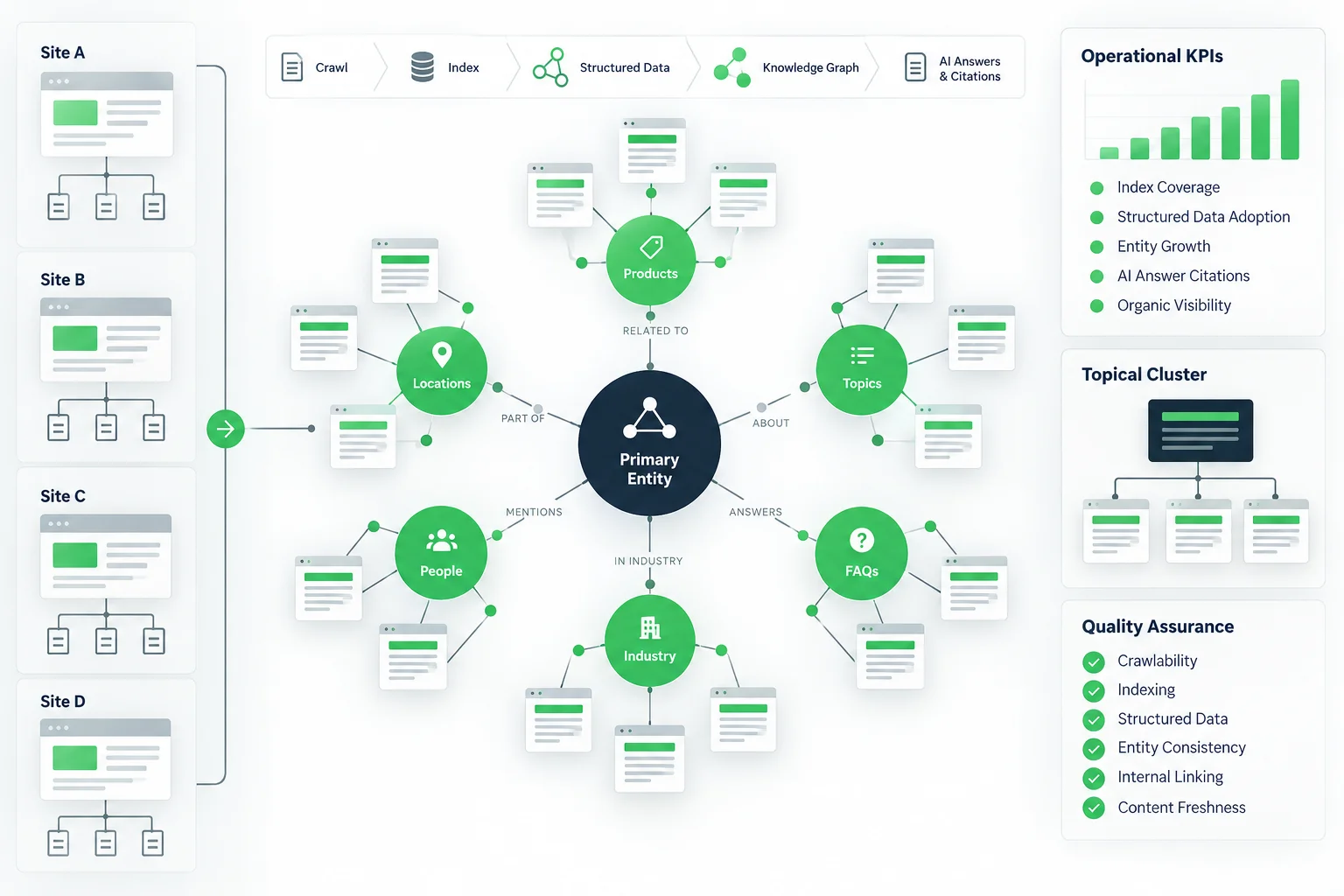
A deterministic operational architecture reduces variance across sites: it converts research into canonical entity models, maps those entities to page graphs, adds authoritative content and structured data, and then measures retrieval and answer quality. The flow below is practical and repeatable.
Canonical workflow: from research to retrieval
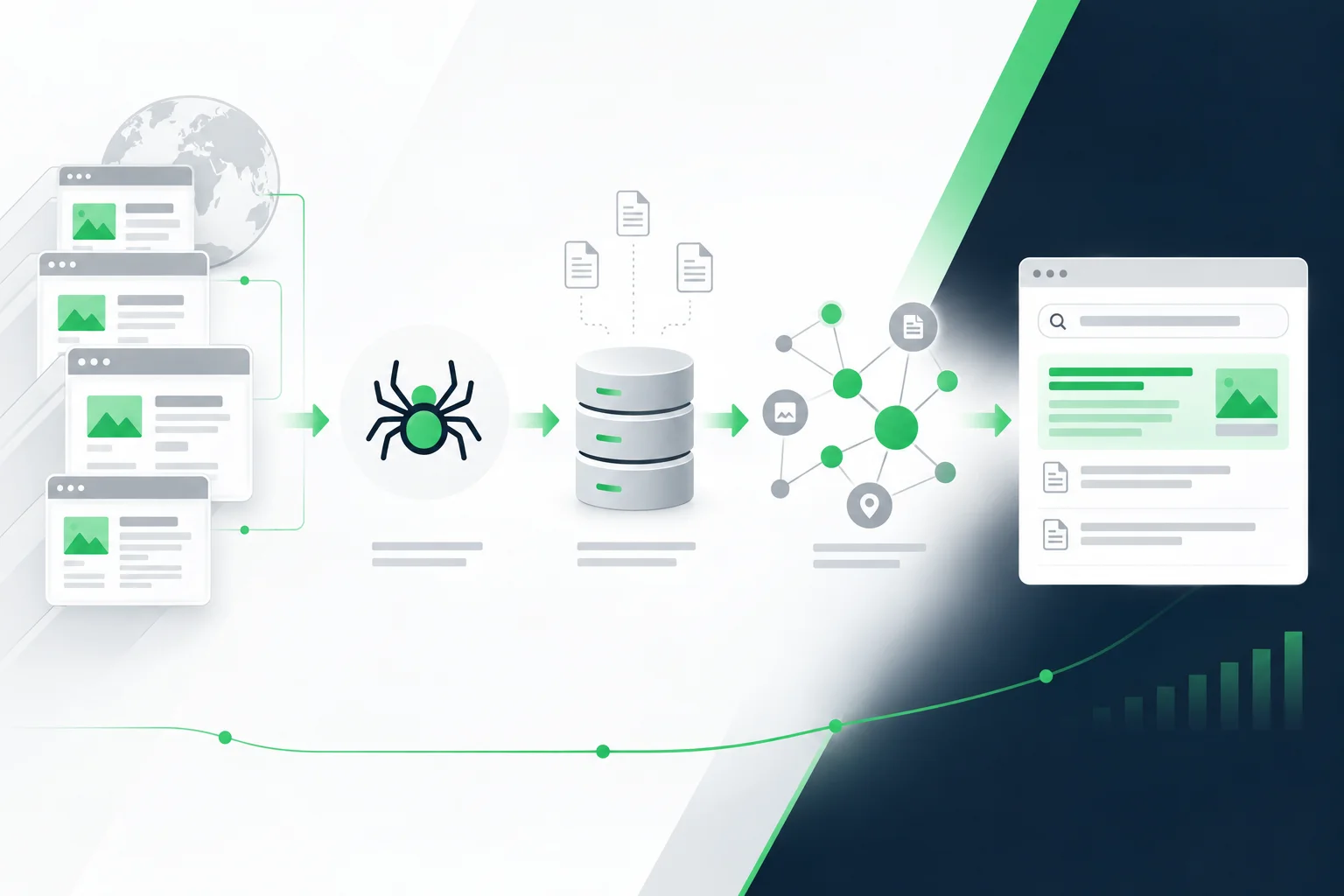
Operate through a repeatable pipeline: research and entity model → topic and page graph → authoritative content → structured data and internal linking → distribution and brand signals → retrieval and citation surfaces → measurement and iteration. Treat each step as a versioned deliverable with acceptance tests and owner(s).
- Entity model: unique IDs, canonical attributes, cross-site mappings.
- Page graph: canonical pages, localized variants, and related topics mapped as edges.
- Structured data: JSON-LD at page-level to expose entity IDs and relationships.
Peak Demand differentiation and practical tooling
Peak Demand integrates technical SEO, entity architecture, knowledge graphs, structured data, internal linking, and measurement into a managed visibility system. The practical result is a control-plane approach: canonical entities and schemas are published consistently, internal linking enforces topic graphs, and surfacing telemetry feeds optimization cycles. Where organizations need LLM and AI visibility engineering, our LLM surfacing and machine-readable SEO services operationalize retrieval signals into measurable outcomes.
- Use a controlled publishing plane and schema registry to avoid drift.
- Feed retrieval telemetry back into the topic graph to prioritize content fixes.
3 — Core KPIs: what to measure and why
KPIs must be operational (measurable daily/weekly), tied to value (containment reduces cost-to-serve), and actionable (point to remediation owners). Below are recommended KPIs grouped by retrieval, quality, and economics.
Retrieval and visibility KPIs
Track how often your entity records or pages are selected as retrieval candidates and how often they appear in AI features or LLM-driven outputs (observed surfacing). Because engines publish limited detail on feature inclusion, use telemetry and synthetic sampling as proxies.
- Retrieval frequency: number of times an entity record or page was returned in candidate sets (from telemetry/logs).
- Observed citation rate: times a surface references your domain or entity (measured via scraped AI-feature instances, where permitted).
- Structured-data coverage: percentage of canonical pages with valid entity JSON-LD.
Answer quality and containment KPIs
Containment quality measures whether answers are resolved without human intervention. Escalation quality measures whether necessary handoffs contain the correct context, minimal friction, and trackable outcome.
- Containment rate: percentage of queries resolved automatically (no human escalation).
- Escalation accuracy: percent of escalated cases where human agents had the correct entity context and resolved the query on first contact.
- Accuracy sampling score: periodic human-annotated accuracy rate on synthesized answers.
4 — QA playbook: tests, acceptance criteria, and SLAs
Operational QA must be concrete: automated schema validation, entity resolution tests, synthetic queries with expected answers, and human acceptance tests for edge cases. Use data contracts and change-control to prevent regressions.
Automated checks and acceptance tests
Implement automated pipelines: JSON-LD schema validation, schema completeness checks, entity reconciliation (ID collisions, orphaned nodes), and synthetic Q&A tests that assert expected answer snippets and metadata. Each pipeline run should produce a pass/fail with a severity-based incident policy.
- Schema validator: fail build when required entity attributes are missing or invalid (use schema.org docs for property expectations).
- Entity reconciliation tests: ensure one-to-many and many-to-one relationships remain within expected bounds.
- Synthetic Q&A tests: assert that canonical answers contain required facts and provenance fields.
Data contracts, provenance, and change control
Data contracts define required fields, allowed value sets, update frequency, and owners. Maintain provenance and versioning so every answer can be traced to a data version and content change. This supports audits, rollbacks, and trust signals.
- Acceptance test inclusions: schema validity, entity-resolution success rate, containment rate thresholds, and observed surfacing targets.
- Provenance: record the source, author, timestamp, and version for every entity attribute change.
- Change control: gate schema and entity-model changes behind staged rollout and canary tests.
5 — Multisite and multilingual scale: operational patterns
Scaling across regions and languages introduces complexity: entity canonicalization, localized attributes, translation quality, and legal/data residency concerns. Operational patterns reduce risk and maintain measurement fidelity.
Entity canonicalization and local variants
Keep a single canonical entity ID per real-world thing and expose localized attributes as variant records. Map site-language combinations to the canonical ID and ensure internal linking and JSON-LD refer to the canonical identifier to avoid split authority.
- Canonical ID must be globally unique and immutable; local attributes (hours, address formats, pricing) live on variant nodes.
- Ensure hreflang and rel-alternate references match entity mappings to prevent duplicate-entity fragmentation.
Translation, quality, and governance
Treat translations as content operations with separate QA. Machine translation is acceptable for drafting but require linguistic QA for meaning-critical fields. Maintain acceptance tests for localized synthetic queries and entity attribute correctness.
- Test localized synthetic queries and containment rates separately.
- Record translation source, reviewer, and version to support provenance.
Operational and legal boundary checks
Identify hosting region, backup region, subprocessors, retention windows, and cross-border transfer mechanisms for knowledge-graph data and telemetry. Be cautious: legal obligations vary—work with counsel for jurisdictional compliance.
- Document data residency requirements and note where telemetry may cross borders.
- Ensure audit logs and access controls meet internal and regulated requirements.

6 — Measurement, telemetry, and continuous optimization
You cannot improve what you do not measure. Design telemetry to capture retrieval events, answer syntheses, user interactions, and downstream conversions. Combine automated signals with periodic human annotation.
Telemetry to instrument retrieval and containment
Capture candidate retrieval logs (which entity/page was returned and with what score), observed answer events (when an AI feature generated a response referencing your asset), click and conversion events, and escalation traces. Tag events with entity IDs, schema versions, and deployment versions to support rollback and root-cause.
- Event model: retrieval_request, retrieval_candidate, answer_rendered, user_interaction, escalation_opened, escalation_resolved.
- Attach entity_id, schema_version, page_version, and locality to every event.
Experimentation and optimization cycles
Run controlled experiments: A/B test schema changes, internal linking strategies, and content rewrites. Use synthetic query suites as canary tests before broad rollouts. Prioritize experiments by cost-to-serve and potential containment impact.
- Run canary deployments with a sampled portion of traffic and monitor containment and escalation metrics.
- Prioritize fixes that increase containment for high-volume, high-cost queries first.
Dashboards and reporting
Provide executive dashboards for business KPIs (containment, cost-to-serve, escalation quality) and operational dashboards for engineers (schema error rates, entity reconciliation failures, synthetic-test pass rates). Automate alerts for SLA breaches.
- Daily digest for on-call: schema failures, entity collision incidents, and containment dips.
- Weekly strategic report: trend of containment, automation coverage, and cost-to-serve.
Related Peak Demand resources
Industry and AI sources reviewed
- Understand how structured data worksGoogle Search Central
- Schema.org DocumentationSchema.org
- Creating helpful, reliable, people-first contentGoogle Search Central
- SEO Starter GuideGoogle Search Central
- AI features and your websiteGoogle Search Central
Search-engine and AI-answer behavior changes over time. Google documentation can establish published requirements and guidance, but inclusion in rankings, AI Overviews, citations, or LLM answers is never guaranteed. Practitioner observations should be labelled as inference or testing rather than official ranking factors. This article is operational guidance, not legal advice; organizations should confirm applicable requirements with qualified professionals.
Frequently asked questions
SEO improves visibility in traditional search results. AEO focuses on making content easy for answer systems to extract and use. GEO focuses on visibility in generative search and AI answer experiences. In practice, the strongest strategy combines technical accessibility, useful content, clear entities, strong internal relationships, structured data, and credible source authority rather than treating them as isolated channels.
Official reference: SEO Starter Guide
No. Structured data can make page entities and relationships more explicit and can support eligible search features, but it does not guarantee rankings, AI Overview inclusion, citations, or mentions in generative answers. It should reinforce accurate visible content rather than replace it.
Official reference: Understand how structured data works
Search and answer systems need to understand what a brand, person, product, service, or concept is and how it relates to other entities. Consistent naming, authoritative pages, structured relationships, internal linking, and corroborating references can reduce ambiguity and make a site easier to interpret and retrieve.
Official reference: Schema.org Documentation
Track traditional search visibility alongside query coverage, indexed pages, non-brand discovery, AI referral traffic where available, observed citations or mentions, entity consistency, content-cluster coverage, internal-link depth, and lead quality. Treat AI-surface monitoring as directional because answer composition can vary by model, query, user, and time.
Official reference: AI features and your website
Build a search and AI visibility system that compounds
Peak Demand connects technical SEO, entity architecture, knowledge graphs, structured data, topical authority, internal linking, distribution, and measurement into a managed SEO/AEO/GEO operating system.
Explore Peak Demand AI SEO, AEO & GEO


