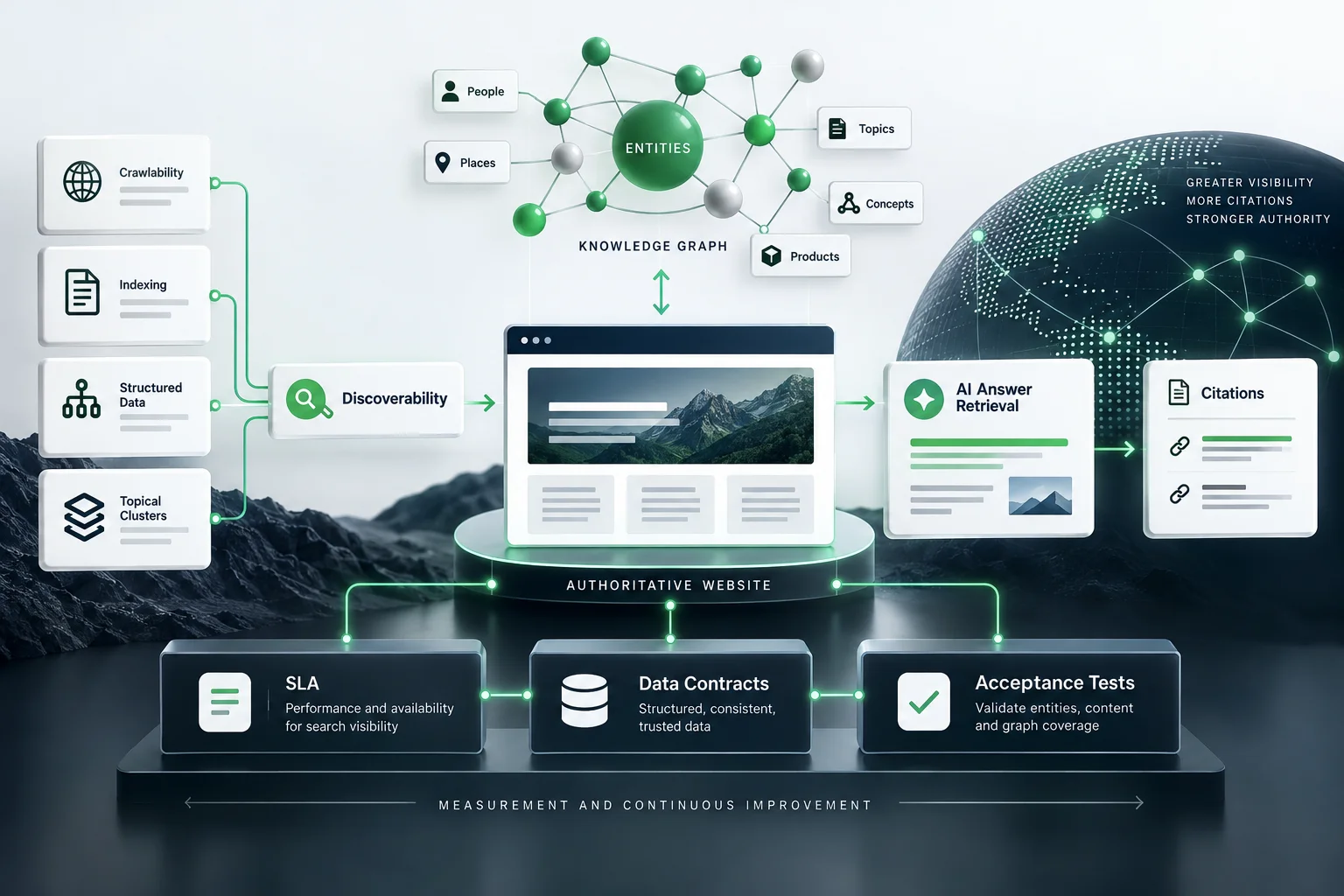
SLA, Data Contracts, and Acceptance Tests for Knowledge Graphs in AEO
A decision-useful playbook for procurement, vendor evaluation, rollout and testing of knowledge-graph systems that power AEO/GEO visibility. Defines SLAs, data contracts, acceptance tests and measurement for enterprise buyers.
1. What buyers must know (definitions and scope)
Before drafting SLAs or acceptance tests, senior teams need clear, shared definitions. This section sets practical definitions of AEO, GEO, entities, knowledge graphs, retrieval, citations, and structured data in buyer-facing language.
Define the terms (practical, procurement-ready)
AEO (Answer Engine Optimization) and GEO (Generative Engine Optimization) are disciplines that optimize an organisation’s content, entity model, and signals so AI-enhanced search systems can surface accurate, concise answers. They are optimizations, not guarantees of placement or citation. An entity is a uniquely identifiable real-world or conceptual object (company, person, product, place) represented by canonical identifiers and attributes. A knowledge graph is a managed dataset of entities and relationships used by retrieval and ranking systems to resolve queries and support answer surfaces. Retrieval is the process the engine uses to fetch candidate passages, documents, or entity nodes; citation is the surface-level attribution or source reference an engine may present. Structured data (schema.org and related machine-readable.
- AEO/GEO: Optimization disciplines—improve likelihood of useful retrieval, not a promise.
- Entity: stable canonical ID with attributes and authoritative provenance.
- Knowledge graph: curated entity and relationship store intended for retrieval.
- Retrieval vs. citation: retrieval is internal to an engine’s process; citation is what may appear to users.
What a knowledge-graph procurement covers
Procure the system as an operational visibility capability, not solely as a data project. That means contracting for: the entity model and schema, ETL and canonicalisation, APIs and change feeds, provenance and versioning, structured-data output, monitoring and observability, security and access controls, and a defined acceptance test plan that exercises retrieval and evidence quality.
- Deliverables: schema, canonical IDs, API spec, change-log, provenance metadata, structured-data endpoints.
- Operational remit: SLAs, incident response, change-control, and handover documentation.
- Acceptance deliverables: automated test suites, test data, and runbooks for production rollouts.
2. Why SLAs, data contracts, and acceptance tests matter for AEO/GEO
Search engines and LLM-based answer systems rely on dependable, authoritative, and well-described entity signals. Poor data discipline reduces retrieval fidelity, increases stale answers, and lengthens time-to-correct. SLAs, data contracts, and acceptance tests change the engagement from 'best effort' to measurable outcomes.
Risk and value map
Without SLAs and contracts, errors propagate quickly into summarised answers and downstream syndicated surfaces. With them, organisations control freshness, provenance, and traceability—factors that materially improve the utility and defensibility of answers. Procurement should therefore price not only raw engineering work but also the governance, test automation, and monitoring that underpin visibility.
- Risk: stale or contradictory entity attributes, missing canonical IDs, undocumented transforms.
- Value: faster correction cycles, clearer escalation, repeatable acceptance criteria, and traceable evidence for audits.
What search engines document vs. what practitioners infer
Documented guidance from search engines emphasises structured data, clear authoritativeness signals, and quality content. Practitioners infer that consistent entity modelling, robust provenance and internal linking increase the chance of retrieval and helpful answers. Distinguish documented requirements (what vendors should demonstrably produce) from inference-based best practices (what tends to improve outcomes but remains outside any engine SLA).
- Documented: use structured data, publish helpful content, expose machine-readable metadata (see Google guidance).
- Inferred: canonicalisation, internal entity graphs and strong authoritativeness signals often improve retrieval quality.
3. Core SLA dimensions and measurable metrics
An SLA for a knowledge-graph capability should be specific, measurable, and testable. Below are the core SLA dimensions to include, with practical measurement guidance and example thresholds for procurement evaluations.
Availability and API performance
Availability covers the uptime of APIs, change feeds, and structured-data endpoints. Performance covers median and p95 response times for read and write operations. Define monitoring, alerting, and scheduled maintenance windows in the SLA.
- Availability: e.g., 99.9% uptime for critical API endpoints (specify exact endpoints and SLA clock).
- Latency: median read <200ms; p95 <1s for entity read APIs (adjust to context).
- Error budget and incident response times: initial acknowledgement, root-cause ETA, and resolution SLA.
Freshness, completeness and provenance fidelity
Freshness is the maximum permitted age for critical attributes (e.g., contact info, ownership). Completeness is the percentage of required attributes populated for in-scope entities. Provenance fidelity requires recording the authoritative source, time-stamp, and confidence score for each attribute.
- Freshness: e.g., ‘phone and address must be updated within 24 hours of verified change; other attributes within 72 hours’ (example).
- Completeness: e.g., 98% of in-scope entities must have canonical name, ID, description and primary contact where applicable.
- Provenance: every attribute must include source ID, source timestamp, and version id.
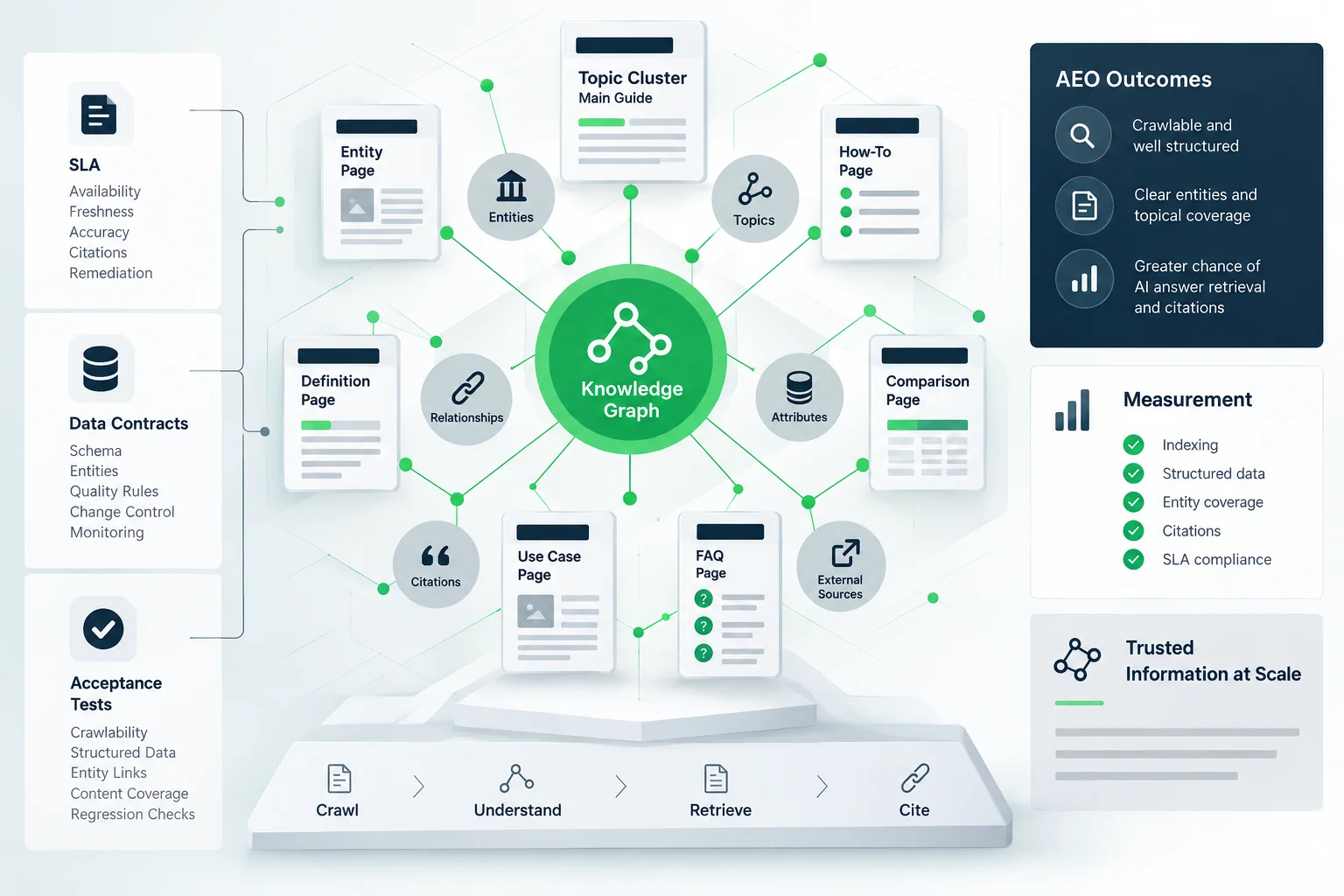
4. Data contracts: what to require in procurement
A data contract is a machine-readable, enforceable agreement about data shape, semantics, allowed transforms, and change behaviour. Require explicit contract elements in vendor statements of work.
Essential contract fields
A robust contract must be explicit about canonical identifiers, schema, attribute cardinality, enumerations, provenance fields, versioning rules, and permitted transformations. The contract should be machine-readable (OpenAPI/JSON Schema or protocol buffers) and accompanied by a testable mock endpoint.
- Canonical ID policy: format, collision handling, and authority resolution.
- Schema: JSON Schema or equivalent with required/optional flags and examples.
- Provenance: source_id, source_type, observed_at, confidence_score, ingest_job_id.
Change control and versioning
Define breaking-change policies, deprecation windows, and backward compatibility. Use semantic versioning for API and schema changes and require a change-log feed with timestamps and migration guidance.
- Deprecation windows and migration guides for schema changes.
- Automated contract tests that fail on breaking changes.
- Signed change approvals and audit logs for schema or transform updates.
Security, privacy and residency considerations
Specify authentication methods, role-based access, audit trails, logging retention, and subprocessors. Identify hosting regions, backup geography, and subprocessors in the contract. Do not assume legal conclusions—require vendors to document their posture and let buyers validate with counsel if necessary.
- Authentication: OAuth2 or mutual TLS for ingest APIs.
- Auditability: immutable change logs and access logs retained for the agreed period.
- Residency & subprocessors: documented hosting regions and subprocessors; buyers should validate legal requirements with qualified advisors.
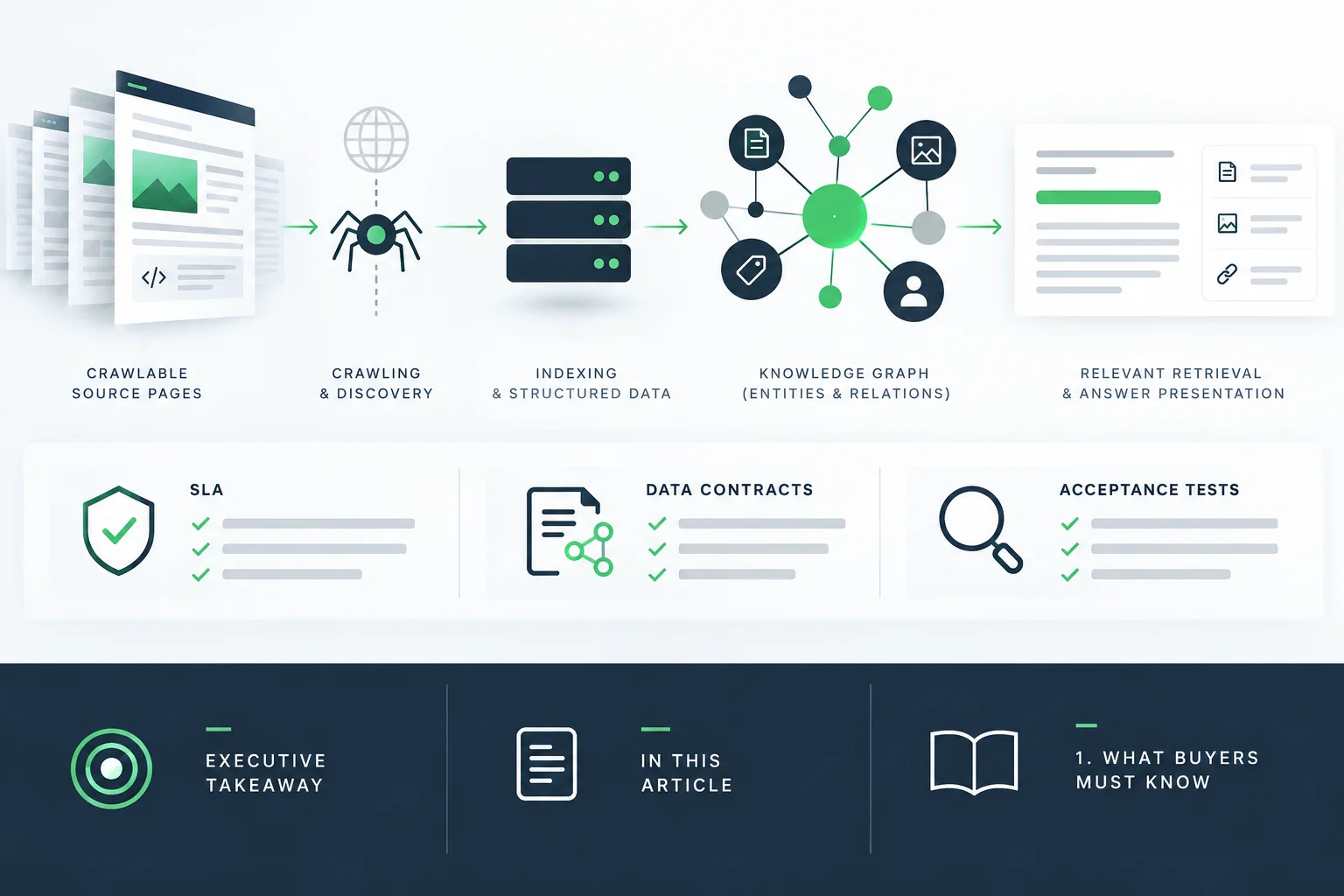
5. Acceptance tests: design and examples
Acceptance tests operationalise the contract. They should be automatable, repeatable, and evidence-focused. Include both technical contract tests and retrieval/evidence tests that simulate real AEO/GEO behaviour.
Contract tests (unit and integration)
Automated contract tests validate schema compliance, required fields, canonical ID resolution, and transform correctness. These tests should run in CI/CD and block deployments when contract violations occur.
- Schema validation against JSON Schema / OpenAPI examples.
- Canonical ID uniqueness and idempotency tests for reingestion.
- Provenance presence tests and timestamp sanity checks.
Retrieval and evidence tests (synthetic queries)
Create a deterministic suite of synthetic queries that reflect target user intents. For each query, define expected entity hits, required attributes, and evidence provenance. Run these as part of acceptance to measure retrieval-coverage and evidence-fidelity.
- Top-N coverage: expected entities appear in top-N retrieved nodes.
- Evidence checks: required attributes match official sources in X% of cases.
- Regression tests: maintain a baseline set to detect drops in retrieval quality.
Human evaluation and spot checks
Automated tests will miss subtle errors. Include a panel of subject-matter reviewers to perform periodic spot checks of evidence fidelity, relevance and helpfulness. Capture reviewer decisions in the change-control system.
- Reviewer rubric: correct, partially correct, incorrect, missing evidence.
- Audit sampling: stratified sampling of recent changes plus high-traffic entities.
- Acceptance gating: human acceptance required for major entity-model changes.

6. Rollout, operational handover and vendor evaluation checklist
Evaluate vendors against both technical delivery and operational capability. Phase rollouts to limit risk, and insist on runbooks and measurable handover criteria.
Phased rollout model
Pilot with a narrow entity slice and synthetic retrieval tests, progress to canary with partial traffic, then staged rollout by entity scope or geographic region. Define rollback triggers and a clear plan for post-launch support.
- Pilot: functional verification on representative entities and contract tests.
- Canary: small percentage of live queries or surfaces routed to new graph to validate behaviour.
- Staged rollout: expand by entity type or region with monitoring and A/B comparisons.
Vendor evaluation checklist (procurement-ready)
Ask vendors for a reproducible demo that includes ingest, transformation, API, structured-data outputs, change-log, and a test-run of your synthetic query suite. Require sample monitoring dashboards, runbooks, and evidence of governance processes.
- Deliver a machine-readable contract and mock endpoints for buyer testing.
- Supply a reproducible acceptance-test runbook and CI artifacts.
- Provide Service Levels with concrete measurement endpoints and escalation contacts.
Operational handover items
Handover must include runbooks, monitoring dashboards, SLO/SLA calculators, escalation contacts, and documentation for schema and transforms. Confirm the vendor will remain in support for a defined warranty/transition period.
- Runbooks for incidents and recovery steps.
- Monitoring: uptime, freshness, evidence-quality dashboards.
- Transition support period and knowledge-transfer sessions.
Related Peak Demand resources
Industry and AI sources reviewed
- Creating helpful, reliable, people-first contentGoogle Search Central
- SEO Starter GuideGoogle Search Central
- Understand how structured data worksGoogle Search Central
- Schema.org DocumentationSchema.org
- ISO/IEC 27001 Information Security Management SystemsInternational Organization for Standardization
- ISO/IEC 27701 Privacy Information ManagementInternational Organization for Standardization
- AI features and your websiteGoogle Search Central
Search-engine and AI-answer behavior changes over time. Google documentation can establish published requirements and guidance, but inclusion in rankings, AI Overviews, citations, or LLM answers is never guaranteed. Practitioner observations should be labelled as inference or testing rather than official ranking factors. This article is operational guidance, not legal advice; organizations should confirm applicable requirements with qualified professionals.
Frequently asked questions
SEO improves visibility in traditional search results. AEO focuses on making content easy for answer systems to extract and use. GEO focuses on visibility in generative search and AI answer experiences. In practice, the strongest strategy combines technical accessibility, useful content, clear entities, strong internal relationships, structured data, and credible source authority rather than treating them as isolated channels.
Official reference: SEO Starter Guide
No. Structured data can make page entities and relationships more explicit and can support eligible search features, but it does not guarantee rankings, AI Overview inclusion, citations, or mentions in generative answers. It should reinforce accurate visible content rather than replace it.
Official reference: Understand how structured data works
Search and answer systems need to understand what a brand, person, product, service, or concept is and how it relates to other entities. Consistent naming, authoritative pages, structured relationships, internal linking, and corroborating references can reduce ambiguity and make a site easier to interpret and retrieve.
Official reference: Schema.org Documentation
Track traditional search visibility alongside query coverage, indexed pages, non-brand discovery, AI referral traffic where available, observed citations or mentions, entity consistency, content-cluster coverage, internal-link depth, and lead quality. Treat AI-surface monitoring as directional because answer composition can vary by model, query, user, and time.
Official reference: AI features and your website
Build a search and AI visibility system that compounds
Peak Demand connects technical SEO, entity architecture, knowledge graphs, structured data, topical authority, internal linking, distribution, and measurement into a managed SEO/AEO/GEO operating system.
Explore Peak Demand AI SEO, AEO & GEO


