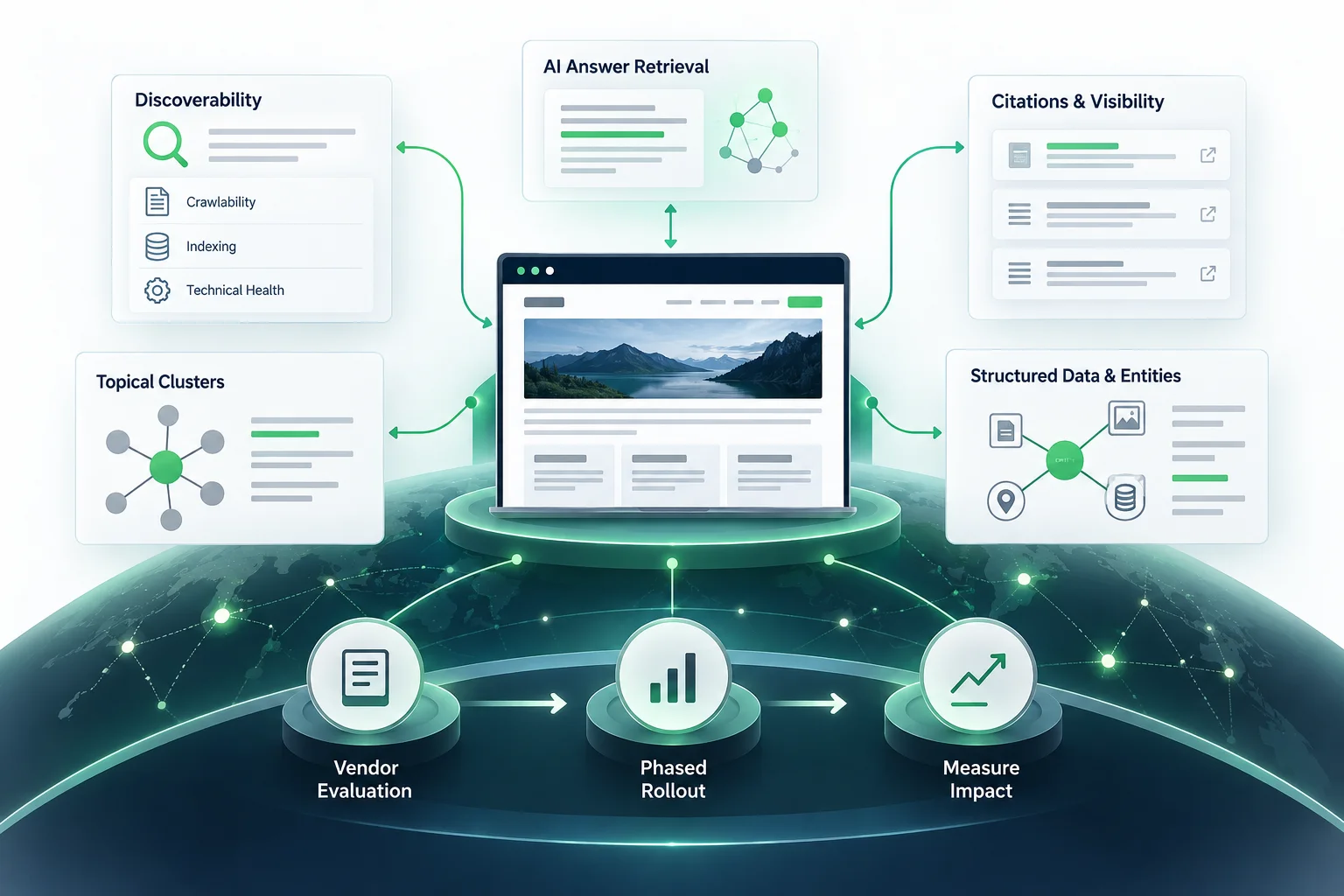
Vendor Evaluation and Phased Rollout Guide for AI Answer Surfaces
A procurement- and rollout-focused guide to evaluate vendors, scope implementations, and phase deployments for AI answer surfaces, covering entity architecture, structured data, retrieval, citations, and measurable visibility outcomes.
1. What this guide covers — clear definitions and scope
Concise definitions and the operating model you will use to evaluate vendors and plan a phased rollout for AI answer surfaces.
Practical definitions (AEO, GEO, and related terms)
AEO (Answer Engine Optimization) and GEO (Generative Engine Optimization) are optimization disciplines focused on improving how content, entities, and site signals are discovered and used by answer-generating systems and generative search. In this context: entities are discrete, identifiable subjects (brands, products, people, places) represented as nodes in a knowledge graph; retrieval is the process an engine uses to select source documents or facts to surface; citations (or provenance) are references the engine uses to attribute facts to sources; structured data (schema) is machine-readable markup that describes page elements; topical authority is measurable breadth and depth of content on related entity topics.
- AEO/GEO are optimization disciplines, not guaranteed placements.
- Entities + knowledge graphs increase retrieval precision by providing canonical references.
- Structured data improves signal clarity but does not guarantee answer-surface inclusion.
Documented guidance vs. practitioner inference
Search engines publish limited definitive guidance for AI features and structured data; practitioners extend that guidance with experiments and engineering best-practices. Always separate: what search engines directly document (e.g., structured-data expectations, helpful-content principles, AI features guidance) from reasonable implementation inferences (e.g., entity graph design, retrieval scoring heuristics).
- Documented guidance: structured-data formats, content quality principles, and high-level AI feature notes.
- Practitioner inference: optimal signal weighting, knowledge-graph topology, or vendor-specific API behavior.
- Procurement should require vendors to explicitly label which parts of their proposal are experimental versus productized.
2. Why vendor selection matters for AI answer surfaces
The right vendor reduces operational risk and increases the chance your content and entities are usable by answer systems. Here are the practical capability classes to prioritise.
Core capability classes
Vendors must be assessed across capabilities that materially affect visibility and credibility on AI answer surfaces:
- Entity and knowledge-graph modelling: canonical identifiers, relationship taxonomies, provenance attributes, and versioning.
- Structured-data authoring and validation: automatic schema generation, page-level coverage, and error remediation.
- Retrieval and attribution controls: document selection policies, citation provenance, and content freshness controls.
- Observability and audit trails: logging, change history, and measurable test harnesses for A/B or holdout tests.
- Security, privacy, and deployment architecture: hosting regions, subprocessors, access controls, and incident processes.
Vendor risk vectors to insist on clarifying in proposals
Ask vendors to disclose and contractually limit risks that influence legal, operational, and visibility outcomes.
- Training data handling and any use of customer content for model training (explicit opt-in/opt-out).
- Third-party subprocessors, data residency, and cross-border transfer mechanisms.
- Change control for knowledge graph edits and structured-data updates (rollback and versioning).
- Explainability and provenance: how the vendor surfaces source attribution for generated answers.
3. Vendor evaluation checklist and RFP essentials
A concise procurement checklist you can use or convert into RFP language. Each item should be verifiable and include acceptance criteria.
Mandatory technical and signal capabilities
Require vendors to demonstrate these capabilities in writing and through a short proof-of-concept (PoC):
- Entity model export/import in standard formats (JSON-LD, RDF, or other documented formats) and an API for canonical updates.
- Page-level structured data generation and a validation report consistent with schema.org and Google’s structured-data guidance.
- Retrieval control primitives: content allow/deny lists, freshness windows, and ranking/boosting knobs.
- Audit trail and provenance metadata for each entity and content piece, with immutable change logs.
- Observability APIs: query logs, impression/click telemetry, answer-labeling, and a test harness for controlled experiments.
Commercial, security and legal requirements to include
Contract clauses and SOW items that reduce vendor and procurement risk:
- Service-level objectives (SLOs) for API availability, ingestion throughput, and error resolution times.
- Data processing addendum with subprocessors, hosting regions, retention rules, and breach notification timelines.
- Change-control SLAs and acceptance criteria for knowledge-graph or schema updates.
- Termination and export clauses to ensure you retain canonical entity and structured-data snapshots on exit.
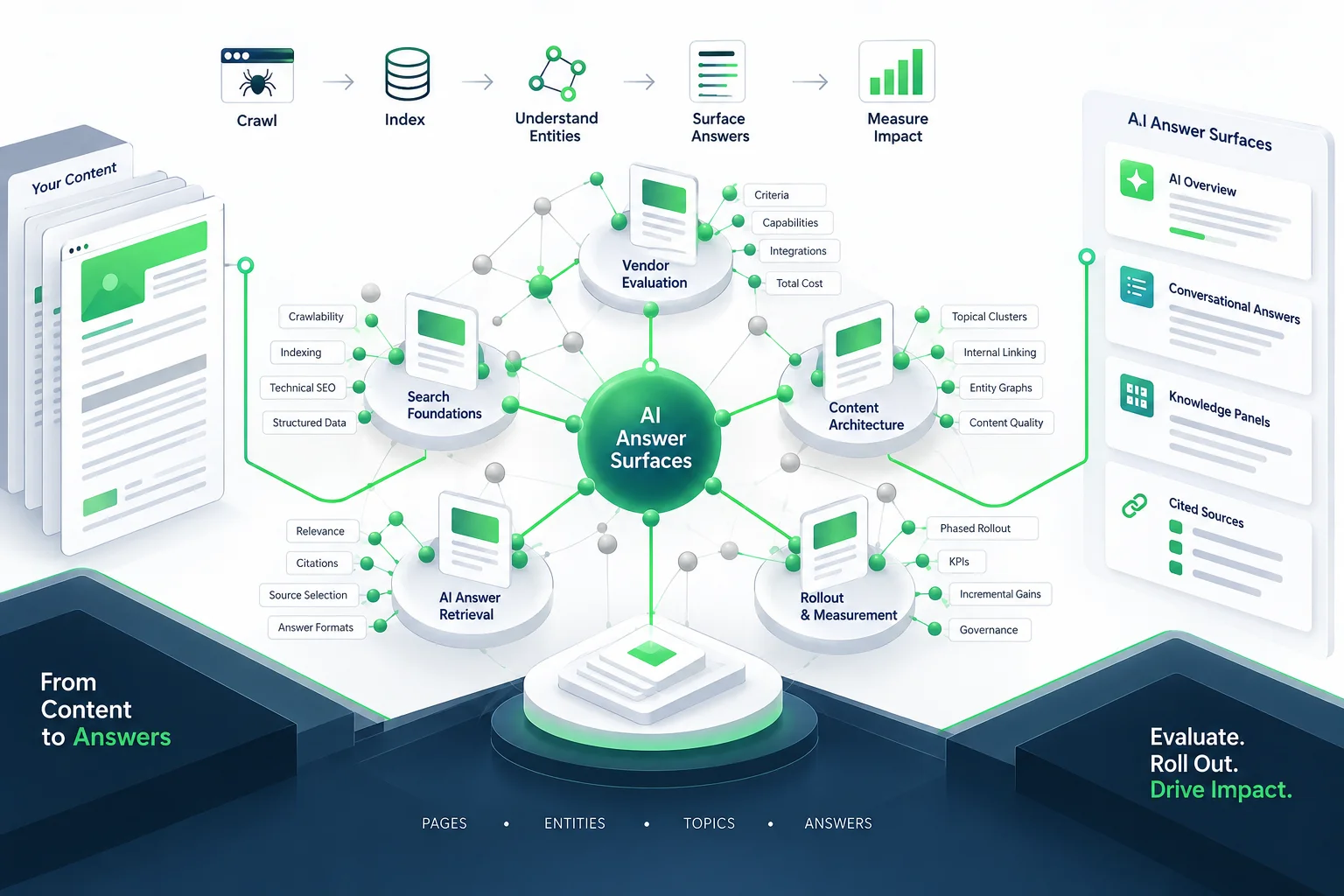
4. Phased rollout: pilot → vertical expansion → hardened production
A three-phase deployment reduces business risk and delivers measurable evidence to expand. Each phase must have gates, success criteria, and a rollback plan.
Phase A — Controlled pilot
Scope: 1–3 business-critical entity types or one site section with strong analytics instrumentation.
- Objective: validate entity model, structured-data generation, retrieval behavior, and measurement capture.
- Success criteria examples: error-free structured-data coverage for pilot pages, recorded query/impression telemetry, and a measurable improvement in SERP feature or answer-surface quality in a.
- Duration: 6–12 weeks typical for enterprise PoC; shorter for narrowly scoped pilots.
Phase B — Vertical or topical expansion
Scale the model to adjacent entity types or site sections after pilot acceptance. Focus on automating validation and remediating edge cases discovered in the pilot.
- Objective: expand coverage while keeping rollout reversible and observable.
- Acceptance gates: automated validation rates (e.g., >95% compliant markup), rollback-tested deployment pipelines, and sustained telemetry.
- Add: controlled A/B or holdout experiments to measure incremental visibility gains attributable to the rollout.
Phase C — Hardened production and continuous iteration
Move to full production once operational SLOs are met. Embed governance and continuous improvement into the operating model.
- Objective: maintain entity integrity, low false-positive answer signals, and demonstrable observability.
- Requirements: automated monitoring alerts, governance workflows for entity edits, and a scheduled experiment cadence.
- Plan for incident response, major schema evolutions, and reporting to executive stakeholders.
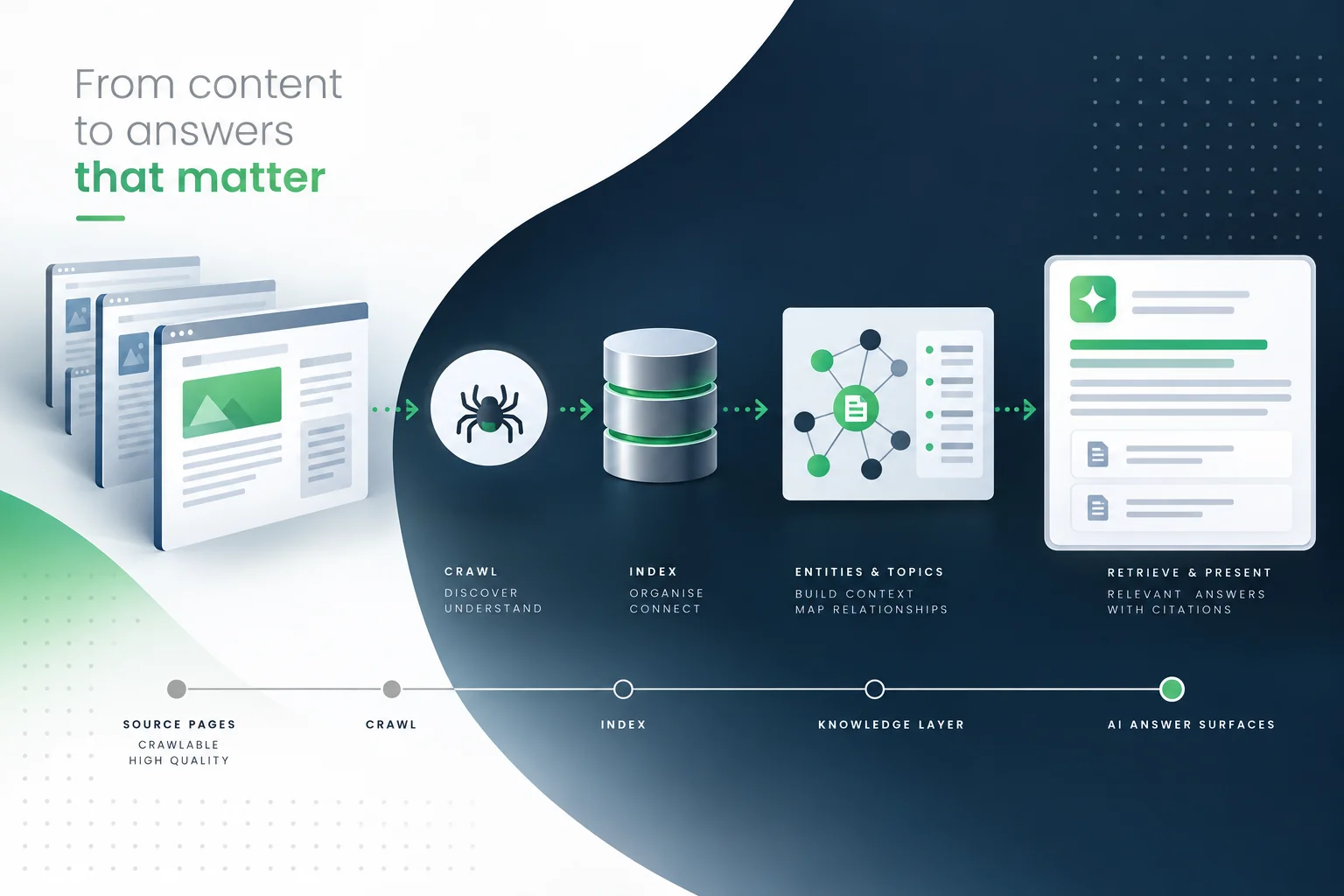
5. Technical scope: data, content, schema, retrieval and internal linking
Concrete implementation elements that determine whether AI systems can find, trust, and correctly use your content and entities.
Entity and knowledge-graph design
Design entities as canonical objects with stable identifiers, human-readable labels, relationship edges, provenance attributes, and versioning. Ensure the graph supports programmatic export and reconciliation (e.g., when an external knowledge graph references the same entity).
- Canonical ID: a persistent, vendor-agnostic identifier.
- Provenance fields: author, source URL, last-verified timestamp, and confidence scores.
- Graph edges: expressed relationships (parent, subsidiary, product-of) to boost retrieval context.
Structured data and page-level fidelity
Structured data should be generated and validated according to schema.org semantics and Google’s structured-data documentation. Prioritise accuracy over exhaustive markup: incorrect or misleading schema is worse than none.
- Use JSON-LD for portability and clarity; validate with the vendor’s and Google’s tools.
- Mark critical assertions (pricing, availability, support contacts, canonical IDs) with explicit fields.
- Include verification timestamps and a version reference to the knowledge graph node.
Retrieval, citation and internal linking
Retrieval controls determine which documents are eligible to be cited in answers; internal linking and topical page graphs improve retrieval relevance by surfacing canonical sources.
- Provide retrieval scoping: allow/deny lists, freshness windows, and ranking boosts for canonical pages.
- Preserve clear internal linking from entity hub pages to supporting pages to signal topical authority.
- Log retrieval decisions and citation candidates for post-hoc audit and quality labeling.

6. Testing, measurement, and what success looks like
Define test design, telemetry to collect, and how to attribute changes to vendor work. Focus on measurable visibility, answer quality, and operational metrics.
Essential telemetry and KPIs
Instrument the system to collect both search-engine-facing metrics and internal signals that correlate with answer quality.
- Search signals: impressions and clicks in Search Console-like telemetry, rich result counts, and SERP-feature presence where available.
- Retrieval logs: queries, selected documents, rank positions, and citation occurrences (when available).
- Quality labels: human-annotated relevance/accuracy scores collected by a continuous-feedback pool.
- Operational metrics: markup validation pass rates, entity sync latencies, API error rates, and SLO adherence.
Experimentation framework and attribution
Use holdout experiments, A/B tests, and phased rollouts to separate vendor impact from other SEO activity. Predefine attribution windows and confidence thresholds for decision gates.
- Holdouts: pick sections of the site or entity subsets to exclude from rollout as controls.
- Time windows: define pre- and post-deployment windows long enough to capture search-indexing cycles.
- Decision gates: require both quantitative improvements and qualitative answer audits before expansion.
Related Peak Demand resources
Industry and AI sources reviewed
- Creating helpful, reliable, people-first contentGoogle Search Central
- Understand how structured data worksGoogle Search Central
- Schema.org DocumentationSchema.org
- AI features and your websiteGoogle Search Central
- ISO/IEC 27001 Information Security Management SystemsInternational Organization for Standardization
- ISO/IEC 27701 Privacy Information ManagementInternational Organization for Standardization
- SEO Starter GuideGoogle Search Central
Search-engine and AI-answer behavior changes over time. Google documentation can establish published requirements and guidance, but inclusion in rankings, AI Overviews, citations, or LLM answers is never guaranteed. Practitioner observations should be labelled as inference or testing rather than official ranking factors. This article is operational guidance, not legal advice; organizations should confirm applicable requirements with qualified professionals.
Frequently asked questions
SEO improves visibility in traditional search results. AEO focuses on making content easy for answer systems to extract and use. GEO focuses on visibility in generative search and AI answer experiences. In practice, the strongest strategy combines technical accessibility, useful content, clear entities, strong internal relationships, structured data, and credible source authority rather than treating them as isolated channels.
Official reference: SEO Starter Guide
No. Structured data can make page entities and relationships more explicit and can support eligible search features, but it does not guarantee rankings, AI Overview inclusion, citations, or mentions in generative answers. It should reinforce accurate visible content rather than replace it.
Official reference: Understand how structured data works
Search and answer systems need to understand what a brand, person, product, service, or concept is and how it relates to other entities. Consistent naming, authoritative pages, structured relationships, internal linking, and corroborating references can reduce ambiguity and make a site easier to interpret and retrieve.
Official reference: Schema.org Documentation
Track traditional search visibility alongside query coverage, indexed pages, non-brand discovery, AI referral traffic where available, observed citations or mentions, entity consistency, content-cluster coverage, internal-link depth, and lead quality. Treat AI-surface monitoring as directional because answer composition can vary by model, query, user, and time.
Official reference: AI features and your website
Build a search and AI visibility system that compounds
Peak Demand connects technical SEO, entity architecture, knowledge graphs, structured data, topical authority, internal linking, distribution, and measurement into a managed SEO/AEO/GEO operating system.
Explore Peak Demand AI SEO, AEO & GEO


