
Utilities Voice AI Architecture for Reliable System Integration
A practical architectural and operational framework for integrating Voice AI into utility customer service, outage communications, and field-service workflows with predictable reliability, safety boundaries, and measurable outcomes.
1. Architectural Principles and Operational Boundaries
This section sets the fundamental rules that make Voice AI practical and safe for customer-service, outage communications, and service-request workflows in electric, water, gas, and municipal utilities.
Principle: Voice AI as an Orchestration Layer
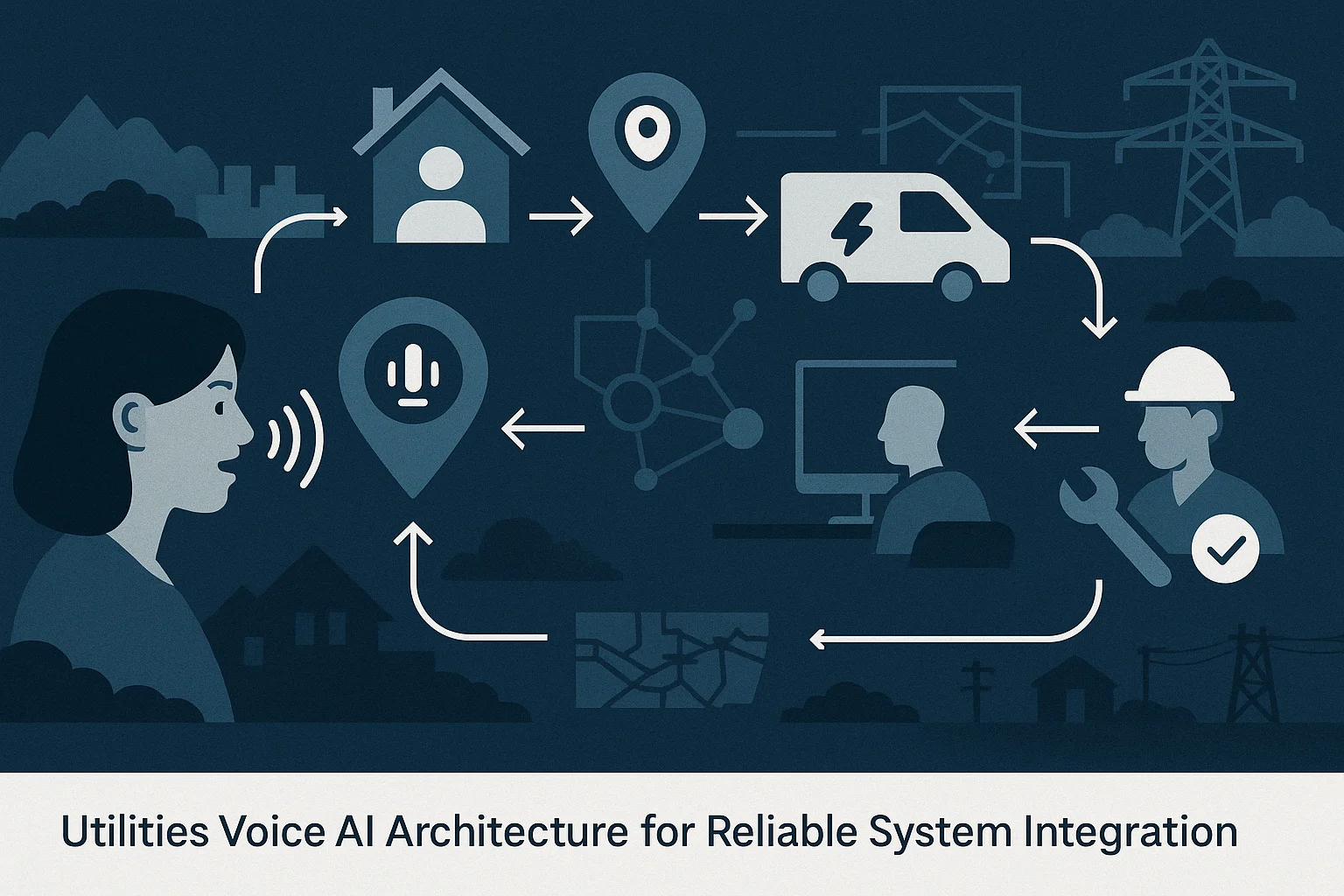
Design Voice AI to orchestrate information and requests rather than make operational decisions. The canonical flow is: Customer call → Voice AI → account or premise validation → approved utility API or knowledge source → action (service request, status response) or human escalation. Keep infrastructure control, safety decisions, and field instructions under explicit human ownership and system-enforced gates.
- Do not permit Voice AI to execute remote-control commands for physical devices (valves, relays, switches, pumps).
- Limit automated actions to low-risk outcomes: status lookups, appointment scheduling, service-request creation, and FAQ responses.
- Log every interaction with an immutable event that links utterance, validation steps, API call, and outcome.
Failure Boundaries and Human Escalation
Define deterministic failure boundaries. If any validation step fails, confidence is below threshold, or intent maps to a safety-critical category, the system must escalate to a human agent. Escalation must include context: transcript snippet, validation results, location, and recommended routing.
- Set explicit confidence thresholds for speech-to-text, intent classification, and entity extraction.
- Escalate immediately for keywords tied to danger (gas leak, downed line, exposed conductor) and provide a human with a fast priority channel.
- Capture and surface the last successful validation checkpoint to speed human intervention.
2. Integration Patterns and Data Contracts
Robust, auditable integrations are the backbone of reliable Voice AI. This section explains API patterns, data contracts, and event architecture that utilities need.
API-First Integration Model
Integrate Voice AI with operational and business systems through well-defined APIs and controlled adapters. Treat utility systems (CIS, OMS, CRM, workforce management) as authoritative sources for account, outage, and dispatch data. Avoid direct database access from the Voice AI runtime; use an integration layer that enforces authorization, rate limits, and schema validation.
- Use read-only endpoints for status queries; require explicit, auditable endpoints for creating or modifying records.
- Enforce role-based access and short-lived credentials for any adapter or service account used by Voice AI.
- Document request/response contracts (fields, types, error codes) and version them; implement graceful degradation when schemas evolve.
Event Architecture and Data Contracts
Emit structured events for every phase: call start, validation checkpoint, API query, API response, action taken, and call end. Events are the unit of audit, analytics, and continuous improvement. Define and govern data contracts so downstream systems and analytics teams can rely on consistent event payloads.
- Adopt an event schema that includes call ID, timestamp, account/premise identifiers, validation results, intent classification, confidence scores, invoked API endpoints, and final disposition.
- Store minimal PII in events; use tokenization or pointers to secure stores for sensitive fields.
- Use the event stream for post-incident forensics and model-performance measurement.
3. Account and Location Validation Controls
Validation is the most critical control for preventing misdirected service requests, false outage reports, and unsafe actions.
Multi-Factor, Account-Safe Validation
Employ multi-layer validation: CLI/ANI match, account number or service address read-back, secondary identifier (last payment, meter ID), and dynamic challenge when necessary. Design the flow to minimize friction for frequent callers while escalating validation for change requests or high-value operations.
- Prefer passive signals first (ANI, linked device IDs) and escalate to active challenges only when needed.
- Keep validation logic server-side in the integration layer; do not hard-code rules inside speech models.
- Log which elements passed and which failed for compliance and fraud reviews.
Premise Confirmation and Safety Hand-offs
For outage reports or safety complaints, confirm premise location using multiple cues (service address, meter ID, nearest transformer ID). If the caller reports an immediate hazard, transfer to an emergency line or dispatch with high priority and provide the operator with the validation packet and confidence score.
- Do not allow automated dispatch for life-safety incidents without human confirmation.
- If location validation is incomplete, offer the caller alternatives (SMS link to confirm address, operator transfer) rather than guessing.
- Include field-service routing metadata (access notes, meter placement, gate codes) in the human escalation packet when available.
4. Escalation, Routing, and Contact-Centre Interoperability
A predictable, low-friction handoff between Voice AI and human agents preserves service levels and prevents rework.
Safe Escalation Workflows
Escalation must be immediate, stateful, and prescriptive. The agent workspace should rehydrate the call state: intent, transcript, validation checkpoints, API replies, and suggested next steps. Route based on the event taxonomy—billing, outage, emergency, field dispatch—and on operational load.
- Use priority channels for outages affecting critical infrastructure or safety.
- Attach recommended actions and required confirmations to the escalation packet to reduce handle time.
- Design agent denial or rollback controls for actions that were already created by the Voice AI.
Workforce and Field-Dispatch Integration
When a service request requires field work, the Voice AI should create a draft work order and hand it to WFM/dispatch for review. Include structured assignment metadata and a lifecycle hook so field crews can update status which reflects back in the Voice AI for caller inquiries.
- Avoid automatic appointment confirmations without workforce availability checks.
- Model work orders as stateful objects with change events for ETA, crew en route, on-site, and completed.
- Provide a rollback path if a human cancels or reschedules a request created by Voice AI.

5. Reliability, Observability, and Surge Capacity
Operational reliability requires explicit capacity planning, observability, and incident response measures tailored to utility peaks—storms, outages, or public-safety events.
Designing for Peak Demand and Failure Modes
Plan for sudden spikes in inbound volume by specifying scale, burst capacity, and prioritized routing. Define graceful degradation modes: switch to read-only status queries, queue callbacks, or message listeners. Maintain a measured cap on simultaneous automated transactions to protect backend systems (OMS/CIS).
- Contractually define burst capacity, retention of overflow calls, and fallback behaviors in procurements.
- Throttle non-critical API calls during high-load events to preserve core status and safety functions.
- Simulate peak events (fire season, winter storm) in capacity tests and tabletop exercises.
Observability and Event-Level Analytics
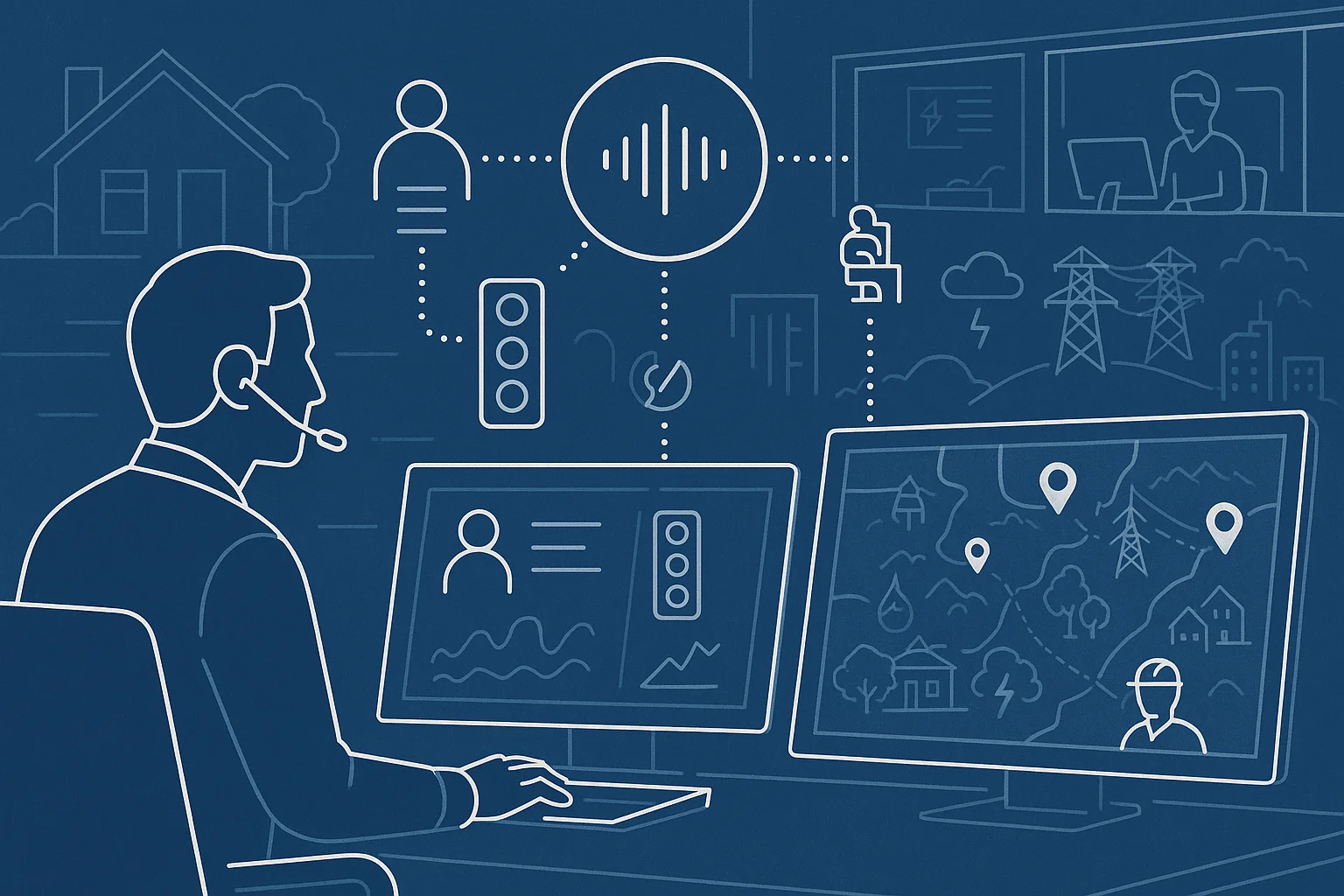
Instrument every integration point. Collect metrics for availability, latency, end-to-end success rate, intent accuracy, and human-handoff times. Use event-level analytics to spot model drift, systemic errors, and API regressions.
- Define SLOs for request completion, escalation latency, and validation pass rates.
- Correlate call outcomes with external events (weather feeds, outage maps) for operational insight.
- Keep a durable, queryable event store for post-incident analysis and regulatory reporting when required.
6. Governance, Procurement, and Vendor Evaluation
A procurement and governance framework prevents supplier lock-in, clarifies responsibility boundaries, and embeds measurable SLAs for integration quality.
Vendor Evaluation: Integration Risk and Evidence
Assess vendors for integration maturity: documented API adapters for CIS/OMS/CRM, event-export capability, secure credential handling, and evidence of high-volume deployments. Require observable deliverables: canonical event schema, replayable logs, escalation UX mockups, and documented failover modes.
- Request end-to-end test scripts and runbooks that replicate your typical outage and service-request scenarios.
- Validate vendor support for field-service workflows and human-in-the-loop escalation.
- Require third-party security assessments, but evaluate them in the context of your own risk model and system architecture.
Governance, Roles, and Audit Trails
Define a governance body that owns the Voice AI operating rules, escalation taxonomy, data retention policies, and audit review cadence. Maintain role separation: operations owns runbooks and capacity, security owns credentialing and access, business owns validation rules and escalation policies.
- Mandate immutable event logs and a regular audit schedule to review false positives, failed validations, and near misses.
- Preserve human accountability: track which agent accepted or modified each AI-created request.
- Establish a change control board for model updates that affect intent mapping or validation logic.
7. Implementation Roadmap and Measurable Outcomes
A staged rollout with clearly defined KPIs reduces operational risk and enables learning before scaling.
Pilot to Scale: Phased Implementation
Begin with a narrow scope: status checks and bill-pay routing for authenticated callers, then expand to outage triage and appointment scheduling with human review. Use parallel runs where the Voice AI suggests actions that agents approve. Iterate on validation rules and event contracts before enabling automated write actions.
- Phase 1: Read-only queries and FAQs; measure intent accuracy and validation pass rates.
- Phase 2: Draft service requests and agent-confirmed actions; measure time-to-resolution improvements.
- Phase 3: Limited automated actions for low-risk tasks with strict rollbacks and monitoring.
KPIs, SLOs, and Operational Metrics
Track availability (99.x% target depending on appetite), intent accuracy, validation pass rate, escalation rate, mean time to human-handoff, and percent of caller issues resolved without agent assistance. Use these metrics in procurement and governance to enforce continuous improvement.
- Define SLOs for end-to-end call completion and for API response times from authoritative systems.
- Monitor false escalation and false automation rates to understand risk trade-offs.
- Report outcomes to stakeholders in operations, field services, and regulators where necessary.
Related Peak Demand resources
Industry and AI sources reviewed
- AI Risk Management Framework — Critical Infrastructure ProfileNational Institute of Standards and Technology (NIST)
- Cross-Sector Cybersecurity Performance GoalsCybersecurity and Infrastructure Security Agency (CISA)
- Cybersecurity Capability Maturity Model (C2M2)U.S. Department of Energy
Utility cybersecurity, critical-infrastructure, records, customer-protection, and emergency-communications obligations vary by jurisdiction and service type. This article is operational guidance, not legal advice; organizations should confirm applicable requirements with qualified professionals.
Frequently asked questions
Good starting points include billing and account questions, move-in or move-out intake, appointment scheduling, service-request capture, outage-status messaging from approved systems, payment-routing assistance, and structured escalation. Safety-critical and infrastructure-control decisions should remain with qualified utility teams.
Official reference: Cross-Sector Cybersecurity Performance Goals
Use the minimum approved identifiers needed for the workflow, validate them against the utility's system of record, limit data exposure, and provide a human-assisted path when verification fails. The Voice AI should not guess account, premise, or outage information.
Official reference: Cross-Sector Cybersecurity Performance Goals
Use controlled adapters, strict schemas, timeouts, retries, audit logs, safe failure states, and human escalation. The system should distinguish approved utility data from model-generated language and should never present stale or unverified operational information as fact.
Official reference: Cybersecurity Capability Maturity Model (C2M2)
Track containment by request type, successful validations, transfers, abandoned calls, integration errors, incorrect or stale responses, time to resolution, customer follow-up, and the percentage of cases completed safely without manual rework.
Official reference: Cybersecurity Capability Maturity Model (C2M2)
Build resilient utility customer-service automation
Peak Demand helps utilities connect Voice AI to approved customer-information, outage-communication, service-request, dispatch, escalation, and analytics workflows.
Schedule a discovery call


