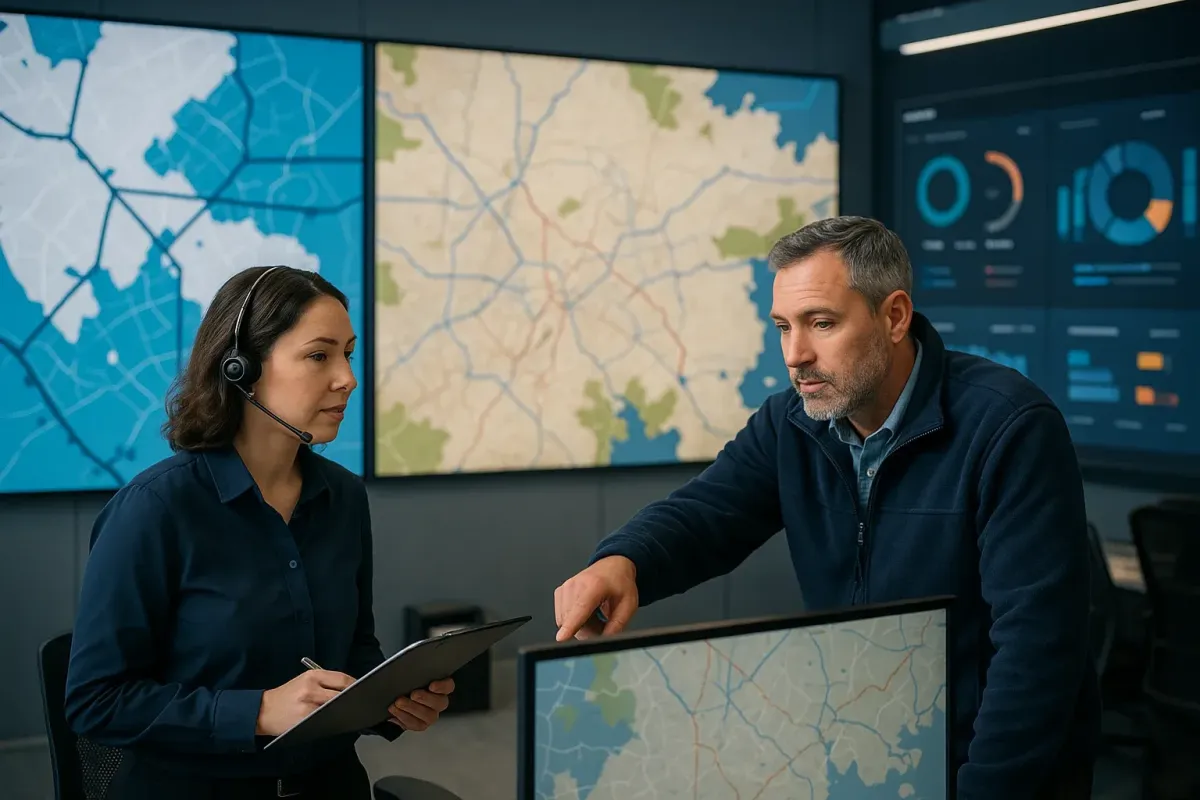
How Utilities Should Evaluate Voice AI Vendors and Integration Risk
A practical, procurement‑grade framework for utilities to evaluate Voice AI vendors, design account‑safe workflows, define escalation and exception boundaries, validate integrations to OMS/CIS/CRM, and measure operating outcomes.
Scope and operating model
This section defines the article's scope, the buyer roles for whom these controls matter, and the recommended high‑level operating model every procurement and operations team should use as a baseline.
What this guidance covers
Audience: customer‑service, outage communications, operations, IT, field‑service, and regulatory leaders in electric, water, gas, and public utilities. We focus on high‑volume inbound voice use cases: outage reporting and status, routine service requests (billing queries, meter reading, minor repairs), and call triage. We do not treat safety‑critical field controls or emergency response decision‑making as tasks for autonomous Voice AI. Instead, the recommended setup places Voice AI as an intake, validation, routing, and information agent that escalates explicitly to humans for safety or doubt.
- Inbound, high‑volume customer calls: outage reports, status checks, service requests.
- Workflow ownership: how calls move from Voice AI to systems or humans.
- Integration risk: validated adapters to OMS/CIS/CRM and auditable transaction records.
Recommended operating model
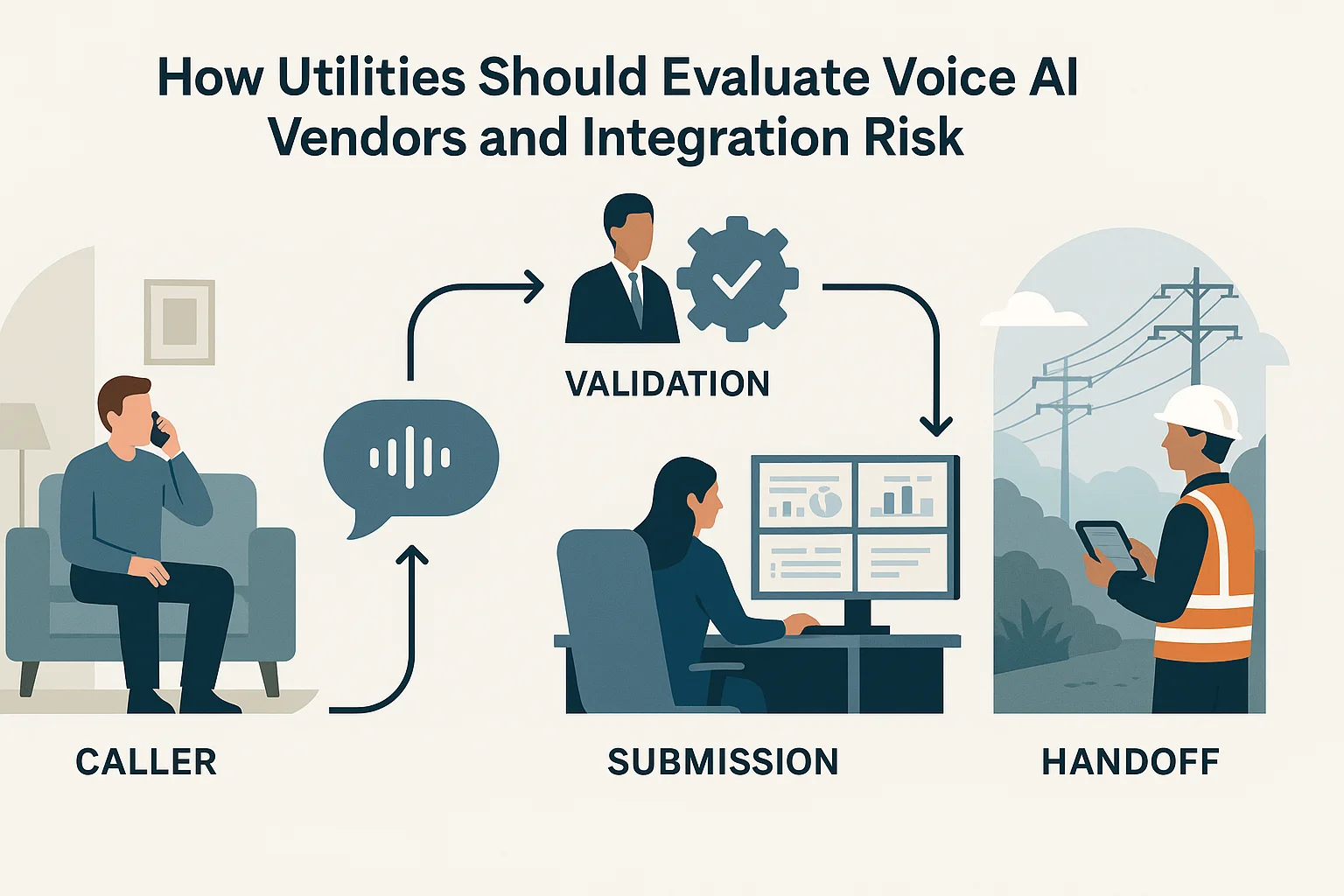
Adopt a simple, auditable flow for every call: Customer call → Voice AI agent (intake, intent & sentiment analysis) → account or premise validation → approved utility API or internal knowledge source lookup → approved action: status response, service request ticket, or human escalation. Each transition must be logged with event IDs, timestamps, and agent transcripts. Design decision ownership explicitly: who owns routing, who owns escalations, and who owns post‑call reconciliation.
- Event ID issued at call start and maintained across every system handoff.
- Validation gates before any write operation to utility systems.
- Human escalation occurs on defined triggers: low confidence, safety keywords, unresolved validation, or customer request.
Vendor capability checklist
Move beyond marketing: evaluate vendors on operational capabilities and evidence you can verify in procurement and pilots.
Core functional requirements
Require evidence for these operationally critical features, not just feature statements. Ask for live demonstrations using your anonymized sample calls or sanitized transcripts, run pre‑production tests against your call patterns, and insist on measurable outcomes.
- High‑volume concurrency and surge handling: documented load test results and test harness scripts.
- Account/premise validation primitives: ANI, OTP via SMS, meter ID verification, address normalization, and CRM/CIS cross‑checks.
- Intent accuracy and confidence scoring with configurable thresholds that control routing and escalation.
- Human takeover (barge/whisper/transfer) with immediate session continuity and transcript handoff.
- Auditable transaction logs, recording metadata (consent flags, retention policy), and event‑level analytics.
Operational service and SLAs
Procure Voice AI as an operational service: define uptime, response time, escalation latency, and surge SLAs in the contract. Require penalty or remediation terms for missed critical SLAs and explicit responsibilities for third‑party subprocessors. Verify their support model for 24/7 incidents and access controls during incidents.
- Uptime and availability for primary region and failover region.
- Maximum allowed time to connect a human after an escalation decision (e.g., 30–120 seconds depending on queue priorities).
- Data breach notification timelines, subprocessor disclosure, and remote‑support controls.
Integration and end‑to‑end workflow design
Integration is where risk concentrates. The more direct the Voice AI write path into operational systems, the tighter the validation and audit controls must be.
End‑to‑end architecture pattern
Implement a controlled adapter pattern: Voice AI agents call only approved APIs or an orchestration layer owned by the utility. Avoid granting direct, unrestricted access from a vendor instance to production OMS/CIS/CRM databases. Use scoped service accounts, API gateways, and an orchestration service that enforces validation gates and rate limits.
- Customer call → Voice AI agent → orchestration adapter → utility API (read/write) or knowledge store.
- All writes require a validated token acquisition step and a two‑factor confirmation for sensitive actions.
- Record every lookup and write with event ID, source node, and user agent so incidents can be replayed.
Validation, routing, and escalation workflow
Design workflows that end in one of three outcomes: information exchange (status), non‑destructive change (service request ticket), or human escalation. For each path, define the exact validation gates and confidence thresholds that must be met. Example workflow for an outage report:
- Intake: voice transcription + intent recognition + initial sentiment check.
- Validate: meter ID or service address + ANI match or OTP challenge (if billing/account access is needed).
- Decision: if confidence >= threshold and validation succeeds, optionally create a ticket via orchestration; if not, escalate to human.
- Handoff: transfer session with full transcript, confidence scores, and suggested tickets to human agent.
Peak Demand differentiation: outage and service‑request integrations
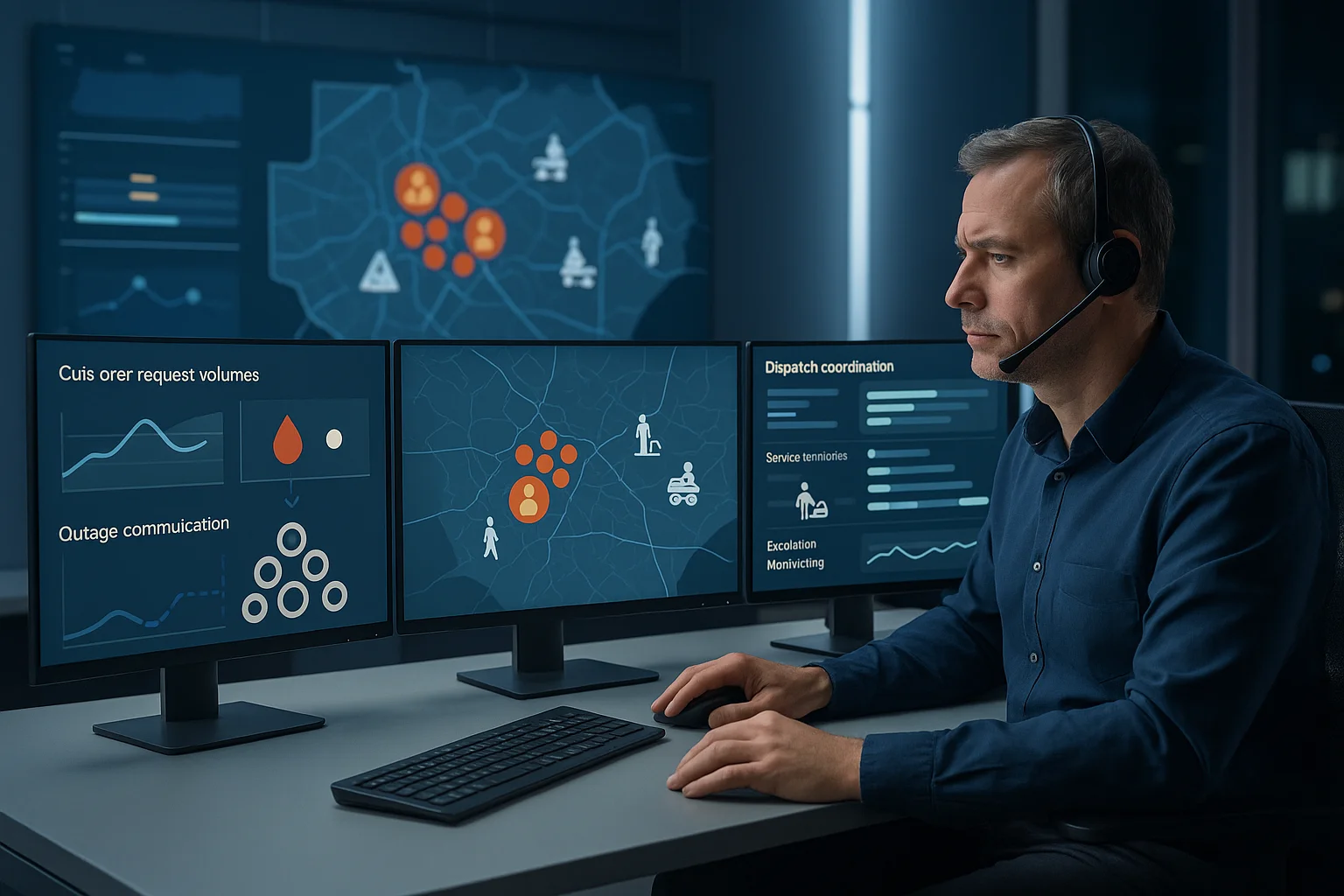
Vendors should demonstrate event‑level analytics and routing hygiene for outage contexts (mass event spikes, multiple callers from same feeder). Peak Demand recommends designing for correlated event detection: the orchestration layer aggregates inbound reports, cross‑references SCADA/AMI feeds where permitted, and suppresses duplicate tickets while preserving caller records. This reduces noise for dispatch and preserves high‑quality handoffs for field crews.
- Correlated event detection prevents duplicate dispatches while keeping per‑caller logs.
- Account‑safe automated ticket creation for routine requests; human confirmation for any work that affects physical infrastructure or access.
- Event‑level analytics for post‑event reconciliation and regulatory reporting.
Safety, exception handling, and operating boundaries
Define what Voice AI may and may not do. Safety boundaries are non‑negotiable in regulated environments.
Safety and emergency boundaries
Voice AI must never make operational, safety‑critical decisions or authorize field crew actions without human confirmation. For emergency phrases (gas leak, downed lines, fire), the system should: immediate priority transfer to a trained human dispatcher, notify emergency line scripts, and log the incident with high‑urgency tags. Keep a strict policy that AI may suggest but not authorize any change that affects physical services.
- Emergency keywords trigger immediate human transfer with highest queue priority.
- No autonomous dispatch or infrastructure command from Voice AI.
- Clear customer prompts and opt‑out for voice recordings and escalation consent.
Exception handling and reconciliation
Design explicit exception paths: low confidence, failed validation, API timeouts, or repeated retries. Each exception should route to a specialty queue (validation team, outage triage, IT integration support). Include fallback strategies: scheduled callbacks, recorded message with case ID, or SMS verification links when phone validation fails.
- Define retry policies and timeouts for third‑party APIs (e.g., three attempts with exponential backoff).
- Assign ownership for unresolved calls: which team will follow up and by when.
- Provide customers with a case/reference ID and an expected SLAT for human contact.

Security, privacy, and regulatory controls
Security and privacy are central procurement filters: require documented controls and map them to the utility’s risk appetite and applicable jurisdictions.
Cybersecurity and supply‑chain fundamentals
Request evidence of cybersecurity maturity and supply‑chain hygiene. Use cross‑sector performance goals and energy sector maturity models to structure requirements, then validate during vendor due diligence and technical review.
- Require a written security architecture, patching cadence, and incident response plan that details remote‑support procedures and subprocessors.
- Demand transparency on subprocessors, their jurisdictions, and data flows.
- Perform penetration tests and source code or design reviews where contractually permitted.
Privacy, data residency, and AI management
Define data handling obligations explicitly: recording consent, retention windows, recording deletion procedures, and cross‑border transfers. Confirm the vendor’s privacy management system and how it maps to your jurisdictional obligations. Additionally, require AI governance artifacts that show how models are monitored for drift and erroneous behavior.
- Explicitly document where audio, transcripts, and logs are stored (primary and backup regions), subprocessors, and retention duration.
- Require deletion or anonymization controls for recordings tied to customer requests.
- Ask for an AI management policy that covers monitoring, bias assessment, and model update governance.
Testing, QA, and measurable operating outcomes
Define measurable outcomes and test plans that prove the vendor can operate in your environment before granting production access.
Pilot, load testing, and surge validation
Run an acceptance test plan that includes: integration tests with non‑production APIs, end‑to‑end functional tests using synthetic and real anonymized calls, and load tests that replicate storm or outage spikes. Verify the vendor’s ability to scale, their failover behavior, and the orchestration layer’s throttling rules.
- End‑to‑end acceptance criteria must include successful validation, correct ticket creation, and transcript fidelity thresholds.
- Surge tests should demonstrate both voice concurrency and backend throughput (API write rates).
- Failover tests: confirm how calls are handled when adapter or OMS endpoints return errors.
KPIs, observability, and QA loops
Operationalize continuous QA: set KPIs and dashboards for call containment, human handoff rate, false acceptance rate (validation failures), mean time to human transfer, and post‑call QA score. Use event‑level analytics to drive weekly tuning: update confidence thresholds, retrain voice models on rejected transcripts, and adjust routing rules.
- Suggested KPIs: call containment rate, first‑contact resolution for routine requests, mean time to escalation, and validation false acceptance rate.
- Include quality sampling and human review for a defined percentage of calls (e.g., 2–5%) and for all escalations.
- Monitor model drift and customer feedback as inputs to scheduled model updates.
Related Peak Demand resources
Industry and AI sources reviewed
- Cross-Sector Cybersecurity Performance GoalsCybersecurity and Infrastructure Security Agency (CISA)
- Cybersecurity Capability Maturity Model (C2M2)U.S. Department of Energy
- ISO/IEC 27001 Information Security Management SystemsInternational Organization for Standardization
- ISO/IEC 27701 Privacy Information ManagementInternational Organization for Standardization
- ISO/IEC 42001 Artificial Intelligence Management SystemInternational Organization for Standardization
- AI Risk Management Framework — Critical Infrastructure ProfileNational Institute of Standards and Technology (NIST)
Privacy, telecommunications, recording-consent, cybersecurity, consumer-protection, employment, and records obligations vary by jurisdiction and use case. This article is operational guidance, not legal advice; organizations should confirm applicable requirements with qualified professionals.
Frequently asked questions
Good starting points include billing and account questions, move-in or move-out intake, appointment scheduling, service-request capture, outage-status messaging from approved systems, payment-routing assistance, and structured escalation. Safety-critical and infrastructure-control decisions should remain with qualified utility teams.
Official reference: Cross-Sector Cybersecurity Performance Goals
Use the minimum approved identifiers needed for the workflow, validate them against the utility's system of record, limit data exposure, and provide a human-assisted path when verification fails. The Voice AI should not guess account, premise, or outage information.
Official reference: Cross-Sector Cybersecurity Performance Goals
Use controlled adapters, strict schemas, timeouts, retries, audit logs, safe failure states, and human escalation. The system should distinguish approved utility data from model-generated language and should never present stale or unverified operational information as fact.
Official reference: Cybersecurity Capability Maturity Model (C2M2)
Track containment by request type, successful validations, transfers, abandoned calls, integration errors, incorrect or stale responses, time to resolution, customer follow-up, and the percentage of cases completed safely without manual rework.
Official reference: Cybersecurity Capability Maturity Model (C2M2)
Turn Voice AI infrastructure into a managed enterprise operation
Peak Demand designs, integrates, deploys, monitors, and improves Voice AI systems across customer service, enterprise systems, governance, escalation, and reporting.
Schedule a discovery call


