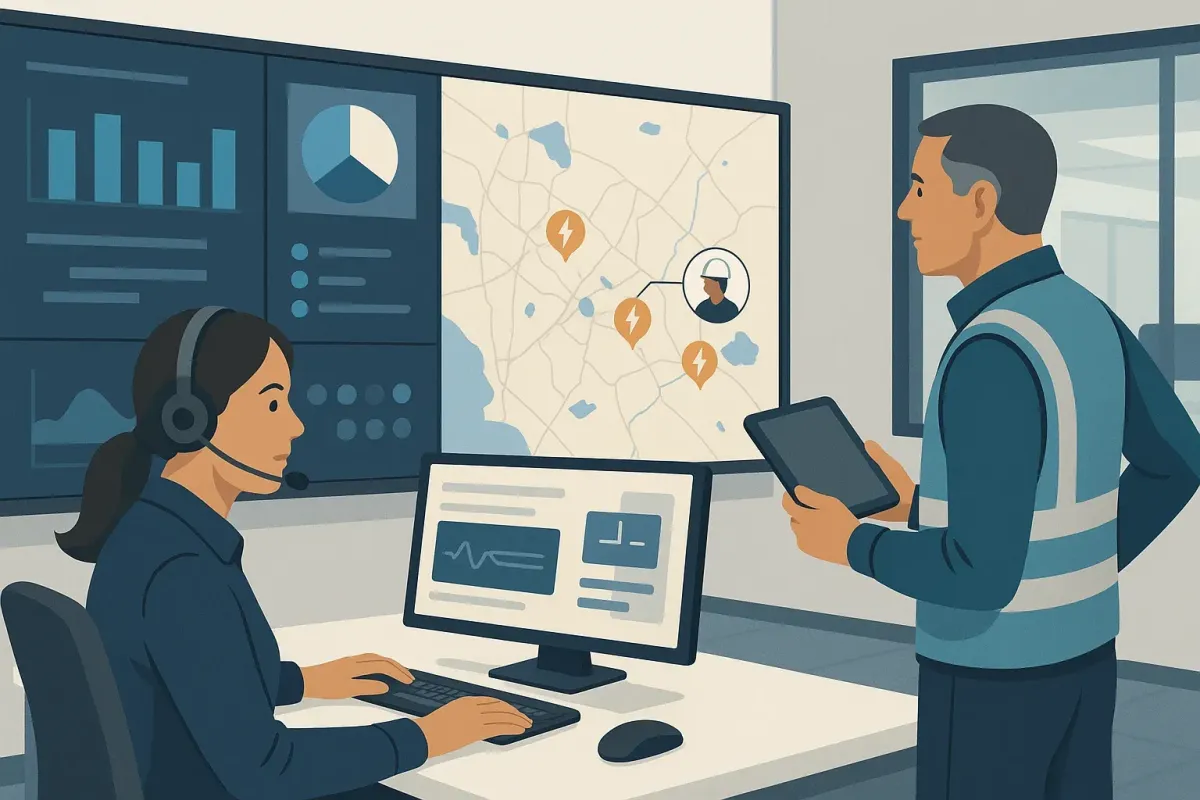
Role-Based Controls, Emergency Overrides, and Auditability for Utility Voice AI
Practical operational framework for role-based access, emergency override patterns, and auditable controls for high-volume utility Voice AI handling outage communications, service requests, and field-work routing.
1. Scope, operating model, and safety boundaries
This framework applies to voice-driven customer interactions for electric, water, gas, and municipal utilities where automated call handling may: provide outage status, create or update service requests, schedule field visits, or route calls to humans. It excludes direct control of physical infrastructure and emergency response actions — Voice AI must not actuate network switches, valves, or field equipment.
Operating model (call flow)
Adopt a deterministic flow: Customer call → Voice AI (NLP + dialog manager) → account/premise validation → approved utility API or authoritative knowledge source → proposed action (status response, SR creation, schedule) → action execution (automated or human-approved) → confirmation and audit event. All actions that change account data or dispatch work require a discrete validation token and role verification before execution.
- Validation token: short-lived cryptographic token issued after successful identity/premise verification.
- Action staging: Voice AI may stage proposed changes but must not auto-execute high-impact tasks without a pre-authorised role.
- Separation of duties: read-only information vs propose vs execute.
Safety boundaries
Define and document explicit boundaries where Voice AI offers information only (read), proposes actions (write-propose), or executes transactions (write-execute). Safety-critical decisions — e.g., directed de-energization, reopening gas service, or isolating water service — must always require human authorization documented in an audit trail.
- Label each intent with an action-impact tier (information, low-impact change, high-impact change).
- Permit automated closures for low-impact, reversible tasks (e.g., bill-payment receipts) where business rules and audit trails are sufficient.
- Mandate human approval for high-impact tasks; include a designated approval authority list.
2. Role‑based controls and identity validation
Role-based controls are the first line of defence to limit what Voice AI can propose and who can make it final. Combine identity verification of callers and operator roles with system-authenticated service accounts for machine-to-machine calls.
Designing roles and permissions
Create granular roles aligned to business processes: e.g., Caller (authenticated customer), Agent-CSR (customer service rep), Agent-Dispatcher (dispatches crews), Supervisor-Escalation, System-Adapter (machine service account). For each role define least-privilege permissions along three axes: data access (read, masked read), operational verbs (propose, execute), and scope (account-level, premise-level, geographic).
- Use attribute-based access control to bind permissions to event context (time-window, incident status, geographic containment).
- Require multi-person authorization for cross-account or cross-utility operations at high-impact tiers.
Account-safe validation patterns
Use layered verification: possession (call from known number), knowledge (two-factor knowledge check with limited challenge items), and system confirmation (one-time short-lived validation token from CIS/CRM). Never rely solely on caller ANI (CLID). For sensitive tasks, require a callback token exchange or human-agent confirmation.
- Token issuance: the CIS/CRM returns a time-limited token when identity checks pass; the Voice AI must present this token for any subsequent action.
- Masked responses: when reading account balances or details, redact sensitive data unless caller is verified to the required tier.
- Fallbacks: if validation fails, route the interaction to a human agent with a prefilled context.
3. Emergency overrides and human-in-loop patterns
Emergency override controls let authorised staff expedite actions during major incidents while preserving auditability and safety. Build overrides that are explicit, constrained, and reversible.
Emergency override design
Treat overrides as time‑boxed, role-gated operations that require a two-step confirmation: (1) initiation by an authorised role using multi-factor authentication and (2) human confirmation of the proposed action and rationale. Record both steps as separate audit events and require mandatory post-incident justification within the change-control system.
- Limit scope: overrides should carry a narrowly scoped permission set (e.g., transiently elevate propose→execute for a specific SR ID).
- Timebox: automatic expiry (e.g., 15–120 minutes) after which normal controls resume.
- Mandatory metadata: incident id, initiating user, approver, justification text, and associated event tokens.
Human escalation and handoff
Define deterministic handoff points with prefilled context and suggested actions. Use an escalation queue that captures Voice AI confidence, validation token, and why the handoff happened. Ensure SLA for escalation differs by incident tier — e.g., immediate human pickup for life-safety or gas-leak flags, sub-minute SLA for major outage hotlines.
- Attach a transcript, confidence scores, and proposed action to each escalation so agents see the full context.
- Allow agents to reject, modify, or accept proposed actions; any accept becomes an auditable execution event.

4. Auditability, logging, and records management
Robust audits require correlated data across channels: voice recordings, dialog transcripts, system API calls, validation tokens, and human approvals. Design logs so investigators can reconstruct who authorized what, when, and why.
Event model and immutable logs
Record events as structured, time‑ordered objects: call start/stop, NLP intent, validation token issuance, API call request/response, proposed action, human approval/override, and execution result. Use append-only storage with cryptographic integrity checks to make tampering evident. Correlate events with unique incident IDs and SR numbers.
- Store both raw audio and redacted transcripts; link both to the same event ID.
- Log external API latencies and error codes to support root-cause analysis during outages.
- Record system principal (service account) activity separately from human principal activity.
Retention, access, and jurisdictional notes
Define retention and access policies consistent with regulatory obligations and business needs. Specify hosting region, backup region, subprocessors, cross‑border transfer mechanisms, and breach notification duties in contracts. Organizations must confirm obligations with legal counsel; check local rules for data residency and retention.
- Differentiate recordings retention (often longer for dispute resolution) from transient debug logs.
- Control access via audited roles and time-limited forensic access tokens.
- Document subprocessors and remote-support arrangements in vendor contracts.

5. Integration safeguards and operational resilience
Voice AI is only as reliable as its integrations. Protect operational paths with adaptation layers, rate controls, and clear failure modes that prioritise safety and customer communication during outages.
Adapter patterns and approved APIs
Isolate each downstream system (OMS, CIS, CRM, workforce management) with a controlled adapter that enforces data contracts, schema validation, and request authorization. The adapter translates Voice AI intents into sanctioned API calls and implements retries, idempotency, and circuit-breakers.
- Adapters should reject malformed requests and return clear error codes for the Voice AI to surface to the caller.
- Enforce schema contracts and versioning to prevent unintended write patterns during platform updates.
- Document adapter behavior in runbooks for incident response.
Fail-safe behaviour and surge handling
Define fail-open vs fail-closed behaviour per action-impact tier. For example, when the CIS is unavailable, allow read-only responses from cached authoritative outage feeds but prohibit new dispatches. Implement capacity controls and autoscaling for predictable surge handling and pre-defined load-shedding policies for extreme events.
- Read-only cached responses for outage lookup reduce downstream load without escalating risk.
- Fail-closed for writes that create field work; require human intervention when downstream systems are offline.
- Measure and test burst capacity against major outage scenarios.

6. Governance, change control, and measurable outcomes
Embed governance around model and dialog changes, adapter releases, and emergency override processes. Use measurable KPIs to demonstrate safe operation and inform procurement or SLA decisions.
Change control and QA harness
Require a staged deployment pipeline: sandbox → pre-prod with synthetic incident replay → limited-production → full-production. Every change requires: test suites, regression checks against high-risk scenarios, roll-back criteria, and documented approval from operations and compliance owners.
- Use synthetic replay of past high-severity incidents to verify Voice AI decisions and handoffs.
- Automate detection of regression in containment and escalation metrics before deployment.
- Keep a changelog that includes model weights or dialog version identifiers linked to CI/CD commits.
KPIs and operating outcomes
Track operational metrics tied to safety and service quality: containment rate (percent resolved without human), correct escalation rate (percent of escalations where human accepted proposed action), mean time to human (MTTH) for escalations, false-acceptance rate (automation executed incorrectly), and incident post-mortem compliance (time to complete justifications after overrides). Use these metrics in SLA language and procurement scoring.
- Set objective thresholds for acceptable automation behaviour and require vendor evidence during procurement.
- Tie surge readiness tests to measurable throughput and MTTH targets.
7. Procurement, incident response, and implementation checklist
Procurement should require demonstrable evidence for the controls described above. Implementation must include runbooks for incidents, clear vendor responsibilities, and documented acceptance tests.
Procurement evidence and contract items
Ask prospective vendors for: architecture diagrams showing adapter isolation, sample audit logs, redaction support, surge test reports, change-control processes, subprocessor lists with hosting geography, and a sample emergency override workflow with test results. Require clear SLAs for escalation MTTH and incident response.
- Insist on documented data residency, backup geography, and subprocessors in contracts.
- Require vendor support for forensic exports in standard formats and defined breach notification timelines.
Incident response and business continuity
Integrate Voice AI into the utility’s incident response plan. Define triage for incorrect automation actions, integration failures, and security events. Include procedures for revoking override tokens, isolating adapters, and switching to manual routing during recovery.
- Practice post-incident reviews and enforce timely justification for emergency overrides in the change log.
- Use the vendor’s incident recovery runbook to validate restoration steps during tabletop exercises.
Related Peak Demand resources
Industry and AI sources reviewed
- AI Risk Management Framework — Critical Infrastructure ProfileNational Institute of Standards and Technology (NIST)
- Cross-Sector Cybersecurity Performance GoalsCybersecurity and Infrastructure Security Agency (CISA)
- Cybersecurity Capability Maturity Model (C2M2)U.S. Department of Energy
Privacy, telecommunications, recording-consent, cybersecurity, consumer-protection, employment, and records obligations vary by jurisdiction and use case. This article is operational guidance, not legal advice; organizations should confirm applicable requirements with qualified professionals.
Frequently asked questions
Good starting points include billing and account questions, move-in or move-out intake, appointment scheduling, service-request capture, outage-status messaging from approved systems, payment-routing assistance, and structured escalation. Safety-critical and infrastructure-control decisions should remain with qualified utility teams.
Official reference: Cross-Sector Cybersecurity Performance Goals
Use the minimum approved identifiers needed for the workflow, validate them against the utility's system of record, limit data exposure, and provide a human-assisted path when verification fails. The Voice AI should not guess account, premise, or outage information.
Official reference: Cross-Sector Cybersecurity Performance Goals
Use controlled adapters, strict schemas, timeouts, retries, audit logs, safe failure states, and human escalation. The system should distinguish approved utility data from model-generated language and should never present stale or unverified operational information as fact.
Official reference: Cybersecurity Capability Maturity Model (C2M2)
Track containment by request type, successful validations, transfers, abandoned calls, integration errors, incorrect or stale responses, time to resolution, customer follow-up, and the percentage of cases completed safely without manual rework.
Official reference: Cybersecurity Capability Maturity Model (C2M2)
Turn Voice AI infrastructure into a managed enterprise operation
Peak Demand designs, integrates, deploys, monitors, and improves Voice AI systems across customer service, enterprise systems, governance, escalation, and reporting.
Schedule a discovery call


