
Risk-Based Deployment Framework for Predictive Voice AI in Transit
A practical, risk-aware framework for deploying predictive Voice AI in public transit operations. Focuses on separating scheduled knowledge from service-alert APIs, governance, human handoff, procurement controls, and measurable operating outcomes.
1. Why a risk-based approach is needed
Predictive Voice AI can reduce friction for riders and staff but introduces domain-specific risks in transit: misrouted information during disruptions, unsafe predictions about vehicle arrivals, and improper record handling. A risk-based deployment focuses on minimizing these harms while enabling value delivery.
Risk classes and operational boundaries
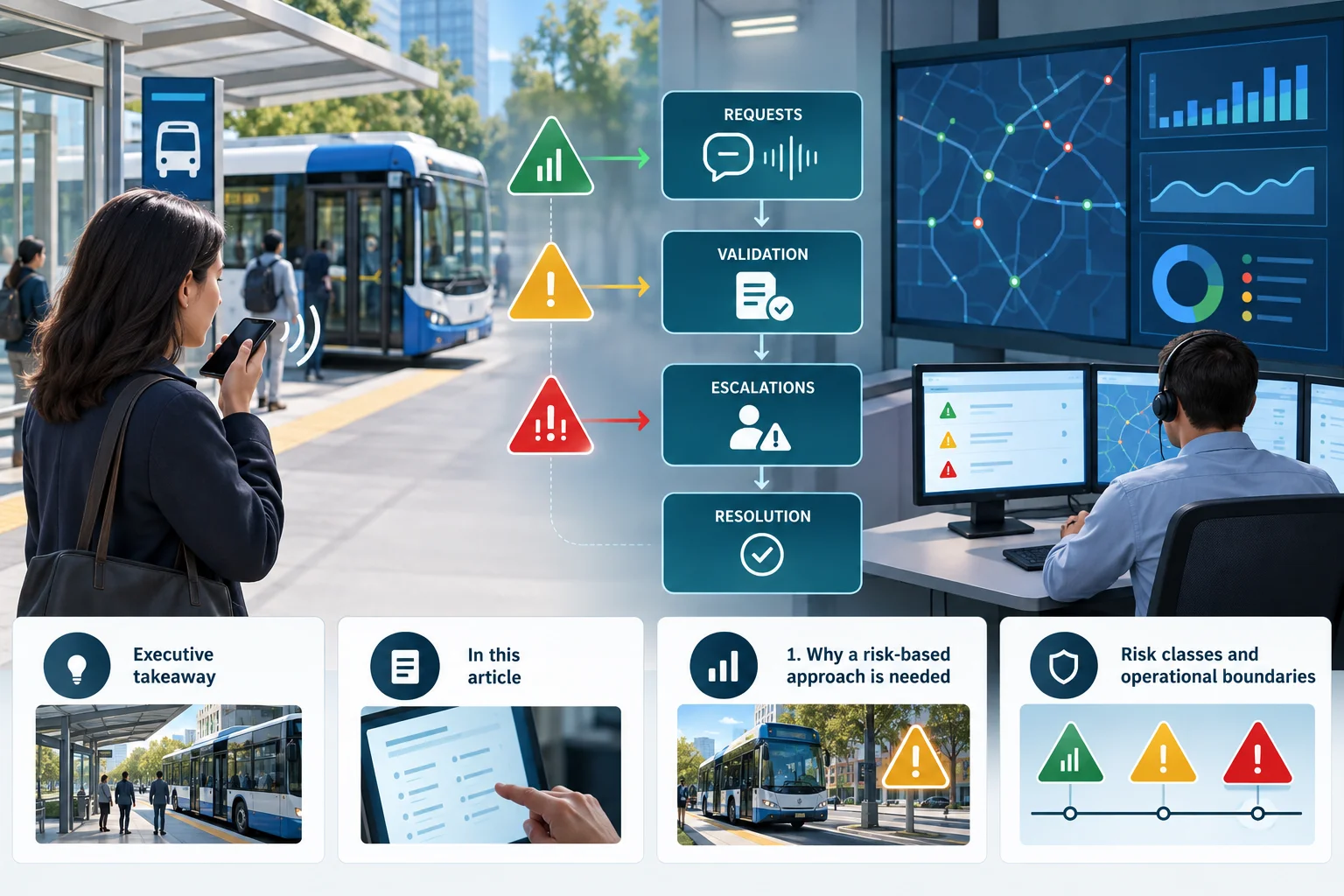
Start by classifying outcomes you will allow the Voice AI to handle autonomously and those that must escalate. Typical risk classes are: Informational (static schedules, route inquiries), Dynamic operational (delays, detours, stop-level service alerts), Safety-sensitive (on-vehicle incidents, medical or criminal emergencies), and Transactional/protected (payments, personal account changes). For each class define: allowed autonomy level, required data fidelity, verification sources, required audit trail, and maximum acceptable error modes. This classification underpins design, procurement, and monitoring decisions.
- Informational: allow automated answers from the controlled schedule knowledge base with standard confidence thresholds.
- Dynamic: require reconciliation with approved service-alert APIs and explicit user disclaimers; lower autonomy.
- Safety-sensitive & transactional: always route to trained human staff; do not permit automated emergency handling.
Separate scheduled knowledge from service-alert APIs
Operational correctness depends on treating scheduled timetable data and real-time disruptions differently. Store canonical schedules in a controlled knowledge base used for scripted informational responses. Route detours, delays, and other active incident data to a separate ingestion path sourced from approved service-alert APIs and operational feeds. The Voice AI should never conflate the two: a scheduled timetable response must be clearly identifiable and timestamped, and any dynamic alert-driven response must include source attribution and confidence metadata.
- Controlled schedule knowledge: curated, versioned, and human-reviewed; used for static queries and planned trip guidance.
- Service-alert APIs: high-priority ingestion pipeline with lower latency expectations, stronger validation, and conservative publishing rules.
- UX pattern: explicitly differentiate answers (e.g., “According to today’s timetable…” vs “Live alert: …”) and provide human handoff options for any conflict.
2. Architecture and data flows
A clear, minimal architecture reduces risk and simplifies audits. The following architecture enforces separation of concerns while enabling predictive capabilities where justified.
Reference architecture — Rider to resolution
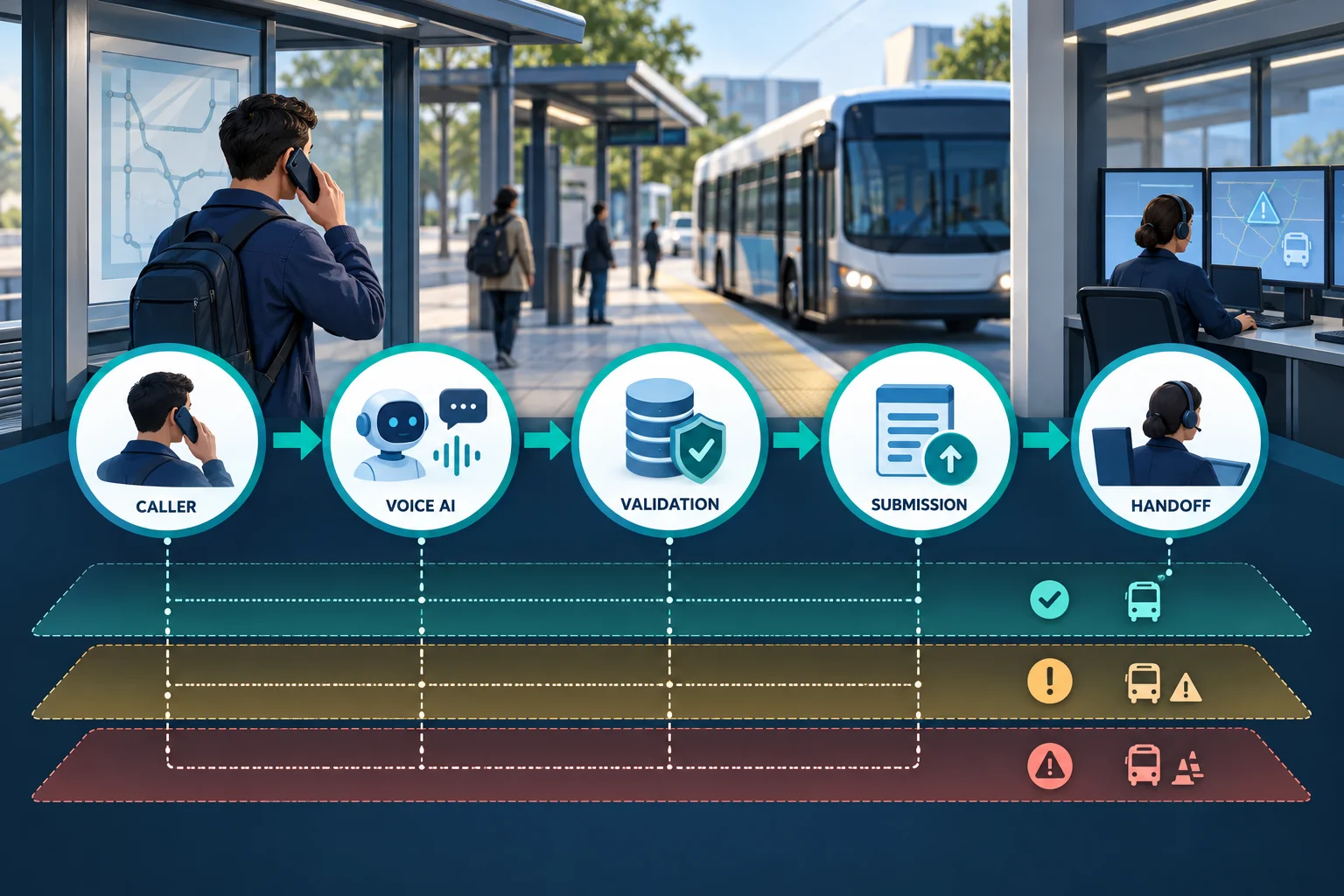
Design a linear, observable flow: Rider → Voice AI front end → controlled knowledge base (schedules) or approved service-alert APIs (detours/delays) → validation layer → outcome: automated response, case submission (service request), or human handoff. Include an orchestration layer that logs decisions, confidence scores, source attributions, and the precise query/response pairs for auditing. Predictive features should only consume short-horizon, high-confidence feeds (e.g., real-time vehicle-position APIs) and operate behind feature gates.
- Front end: telephony or web-voice stack that captures intent and metadata (caller location if consented).
- Decision router: selects knowledge store vs service-alert API based on intent and context.
- Validation layer: verifies feed freshness, cross-checks multiple sources, and enforces response policies.
- Outcome channels: automated voice response, dynamic service-request form submission, or queued human agent.
Integration patterns and validation
Integrations should be adapter-based with clear SLAs and retry policies. Use a canonical ingestion format and apply schema validation and provenance tagging on ingest. For dynamic feeds, implement a reconciliation job that flags inconsistencies between scheduled knowledge and service alerts. Example validation rules: freshness threshold (e.g., reject alerts older than configured window), feed-signature verification, and checksum/version matching for schedule uploads.
- Adapters: isolate vendor-specific connectors behind a standard API to simplify swap-out and auditing.
- Provenance tags: include source, timestamp, ingestion ID, and any transformation steps.
- Reconciliation: automated job that surface conflicts and prevents contradictory responses from being published.
3. Phased deployment and operational controls
Roll out predictive capabilities incrementally and enforce conservative safety gates. A staged program reduces surface area for failure and supports measurable decision-making.
Pilot and canary stages
Begin with a scripted intent pilot that answers informational queries from the controlled schedule knowledge base only. Next, run a limited canary that enables service-alert read-only responses for a subset of routes or a small rider cohort. Only after meeting predetermined KPIs and audit reviews, enable predictive features (e.g., short-term arrival guidance) behind feature flags and restricted to routes with authoritative real-time feeds.
- Scripted pilot: validate prompts, accessibility behaviors, and safe-handoff flows.
- Canary: instrumented live traffic with real users and fallback to human agents; run for a defined observation window.
- Feature-gated predictive rollouts: require feed health checks, monitoring, and rollback paths.
Human-in-loop and escalation workflows
Define clear triggers for human intervention: low confidence, conflicting sources, accessibility needs, and safety-sensitive intents. Create fast-path escalation channels from the Voice AI to trained agents with prefilled context (intent, source-attribution, confidence). Measure safe-handoff latency and require audit logging of each escalation and final resolution.
- Triggers: confidence below threshold, mismatched schedule vs alert, user requests human, or flagged intent category.
- Prefill: include caller metadata, relevant feed snippets, and suggested disposition to speed resolution.
- Audit: record timestamped agent handoffs and the agent's final disposition for post-incident review.
4. Procurement, contracts, and vendor controls
Procurement decisions must reflect the operational risks. Contract clauses should require transparency, observability, and remediation responsibilities.
Sourcing checklist
Require vendors to provide: a clear list of subprocessors, hosting region and backup region, remote-support access procedures, data retention policies, and an auditable decision-log export. Vendors should document how they separate training data from operational controlled knowledge stores and how they will respond to model drift, incidents, and data-subject requests.
- Subprocessors: full disclosure and contractual approval rights for critical subprocessors.
- Hosting and backup geography: declared primary and backup regions, plus retention and backup policies.
- Remote support & access: role-based controls, session recording, and minimum-necessary access rules.
SLA, observability, and audit requirements
Contractual SLAs should cover availability of knowledge and alert feeds, API latency, and time-to-remediate feed ingestion failures. Require: decision logs, confidence score distributions, feature-flag audit trail, and regular third-party or agency-led audits of alignment with policy. Include obligations for security incident notification, breach scope disclosure, and an agreed retention schedule for voice and decision logs.
- Observability: request metrics for intent accuracy, false escalations, and end-to-end latency.
- Audit: quarterly or event-triggered access to historical decision logs and model-change records.
- Remediation: defined RTO/RPO for critical feed failures and rollback commitments for model updates.

5. Measurable outcomes and monitoring
Define outcomes tied to safety, accessibility, operational efficiency, and rider satisfaction. Build a monitoring stack that supports continuous evidence-based rollouts.
KPIs and SLOs
Operational KPIs should include intent classification accuracy (by intent bucket), routing accuracy (correct case creation and assignment), safe-handoff latency (time from escalation trigger to agent answer), reconciliation error rate (conflicts between schedule and alert feeds), and uptime for the controlled knowledge and alert ingestion pipelines. Use statistical methods for drift detection and set SLOs that are actionable (e.g., thresholds that trigger rollback or retraining).
- Measure per-intent and per-route performance to locate weak pockets before scaling.
- Track false-positive escalations to reduce agent load and false negatives that risk rider harm.
- Instrument user satisfaction flows after handoff and for automated answers to close the feedback loop.
Governance, audits, and continuous improvement
Establish a governance board with representation from operations, accessibility, legal, and IT. Use regular audits (technical and policy) to validate that automated behaviors remain within approved boundaries. Document model changes, dataset updates to the controlled knowledge base, and policy changes. Require after-action reviews for incidents and feed them back into the training, scorecarding, and policy cycles.
- Board responsibilities: approve risk classifications, review canary results, and sign off major feature toggles.
- Audit cadence: operational metrics monthly, formal audits quarterly or post-incident.
- Continuous improvement: link findings to prioritized remediation and monitor closure rates.
6. Operational playbook and failure modes
Prepare concrete runbooks for common failure modes, and set absolute prohibitions to avoid unsafe automation.
Runbooks for common failures
Maintain short runbooks for: feed outage, contradictory alerts vs schedule, degraded confidence across a route, and user-accessibility incidents. Each runbook should list detection criteria, immediate mitigation (e.g., switch to read-only responses, disable predictive answers), contact list, rollback steps, and communications templates for riders and staff.
- Feed outage mitigation: route queries to last-known-good schedule and prominently flag that live alerts are unavailable.
- Contradictory alerts: fall back to human agent and log both sources with timestamps.
- Degraded confidence: disable predictive answers and require human confirmation for arrival guidance.
Privacy, residency, and legal boundaries
Document hosting region and backup region, subprocessors, remote-support access policies, retention windows, recording-consent flows, and breach-notification duties. Avoid blanket claims about jurisdictional law; instead require that legal counsel validate obligations for data residency, cross-border transfer, and public-records regimes applicable to your jurisdiction.
- Retention & recording: publish retention windows and consent prompts for recorded calls; separate transient logs from long-term audit stores.
- Data transfers: identify transfer mechanisms and subprocessors; require contractual protections for onward transfers.
- Legal checks: confirm disclosure and public-records duties with qualified counsel before enabling wide-scale recording or public publication of logs.
Related Peak Demand resources
Industry and AI sources reviewed
- OECD AI PrinciplesOrganisation for Economic Co-operation and Development
- Artificial Intelligence Risk Management Framework (AI RMF 1.0)National Institute of Standards and Technology (NIST)
- Transportation Systems SectorCybersecurity and Infrastructure Security Agency (CISA)
Transit safety, accessibility, privacy, cybersecurity, records, and service-information obligations vary by jurisdiction and operating authority. This article is operational guidance, not legal advice; organizations should confirm applicable requirements with qualified professionals.
Frequently asked questions
Good starting points include lost property, complaints and feedback, stop or shelter issues, fare-machine faults, non-emergency accessibility service requests, schedule information from approved sources, and structured routing to customer service or field teams.
Official reference: Artificial Intelligence Risk Management Framework (AI RMF 1.0)
Use GTFS Realtime only when the agency exposes suitable feeds and the workflow genuinely needs service alerts, trip updates, or vehicle positions. The integration should validate freshness and availability, and the agent should avoid presenting stale feed data as a guaranteed arrival prediction.
Emergency, security, injury, crime, and safety-critical reports should follow approved transfer or emergency-routing procedures. Voice AI may detect and route the call, but it should not make operational safety decisions or replace trained personnel.
Official reference: Transportation Systems Sector
Request realistic call testing, feed and system failure handling, service-request integration, transfer context, audit logs, accessibility channels, monitoring, change control, and evidence that the agent distinguishes scheduled information from dynamic service alerts.
Official reference: Artificial Intelligence Risk Management Framework (AI RMF 1.0)
Design the transit service workflow before automating it
Peak Demand helps transit teams connect Voice AI to rider information, service requests, approved live-data sources, escalation, confirmation, and analytics.
Schedule a discovery call


