Transit Voice AI Services: What Agencies Should Automate First
A practical, architecture-first guide for transit leaders. Prioritizes automations that preserve schedule accuracy, separate scheduled knowledge from alerts, and ensure safe human handoffs.
1. Decision logic: What to automate first
Begin with automation choices that reduce repetitive work, preserve rider trust, and keep safety-critical decisions with humans. The right first automations are high-frequency, low-risk, and well-bounded by authoritative data.
Prioritize predictable, data-backed tasks
Start with queries and actions that map to authoritative, fast-refresh data sources and require limited interpretation: scheduled arrivals and departures from the agency’s schedule snapshot, fare rules, stop amenities, holiday schedules, and basic account queries. These are high-value for riders and easier to model safely because they rely on deterministic inputs under agency control.
- Automate read-only lookups (e.g., next scheduled departure for a route/stop) using a controlled schedule snapshot, not a generative forecast.
- Use dynamic response templates for multilingual support and repeated phrases to maintain clarity and consistency.
- Avoid automating safety-critical or ambiguous tasks (incident triage, lost-person searches) until workflow and escalation controls exist.
Second wave: validated service intake, then orchestration
Once lookups are stable, add validated intake for non-emergency service requests: missed connections reports, cleanliness reports, lost-property claims that follow a defined form and validation rules. The system must validate essential fields, detect duplicates, and optionally create a case or hand off to agents.
- Implement dynamic service-request forms driven by the agent or API to capture minimal required fields before submission.
- Perform real-time duplicate detection against recent requests using a deterministic match (name, phone/email, stop, time window).
- Keep humans in the loop for ambiguous or potential safety incidents; define thresholds for automatic case creation versus escalation.
2. Architecture and data flows — separate schedule knowledge from alerts
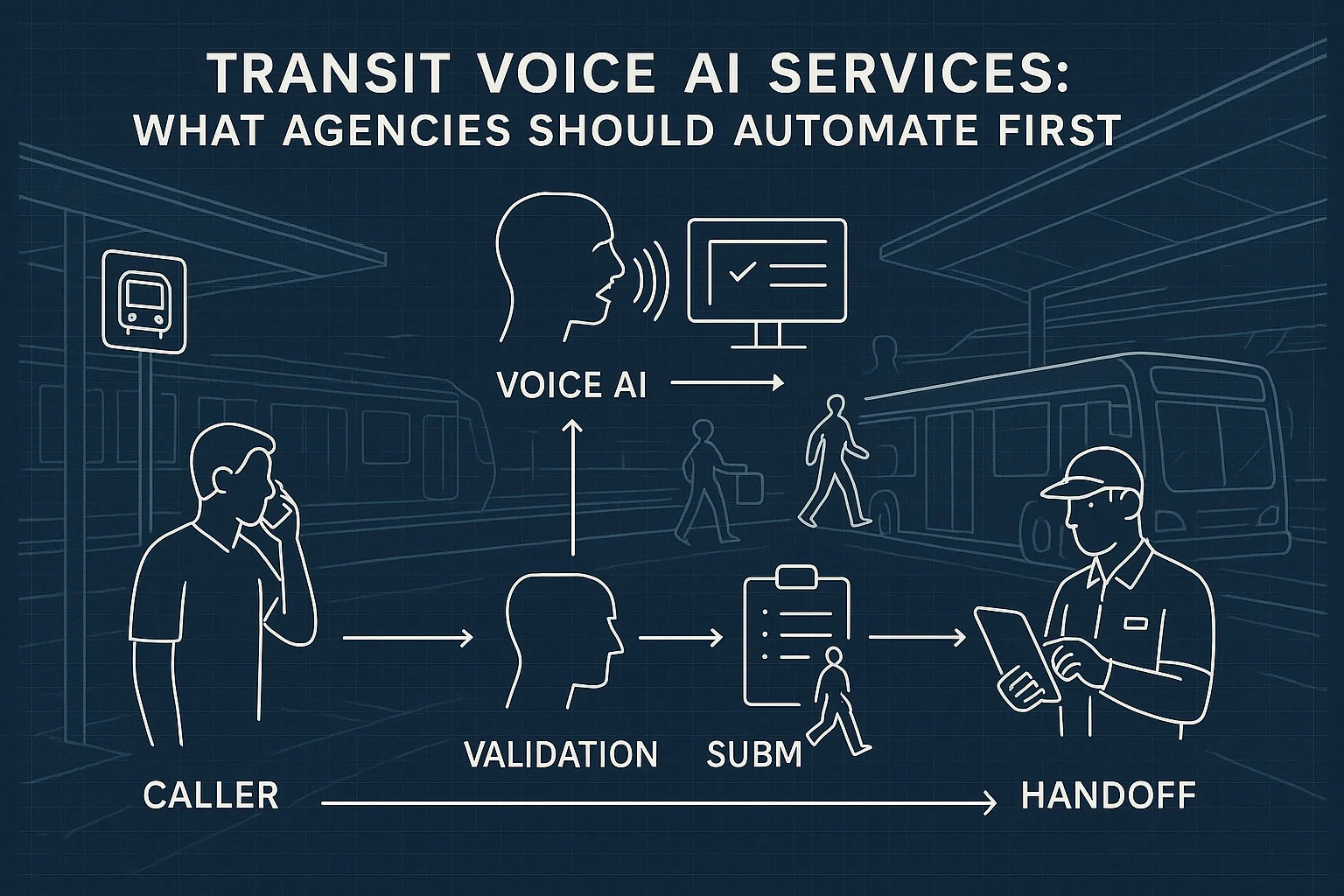
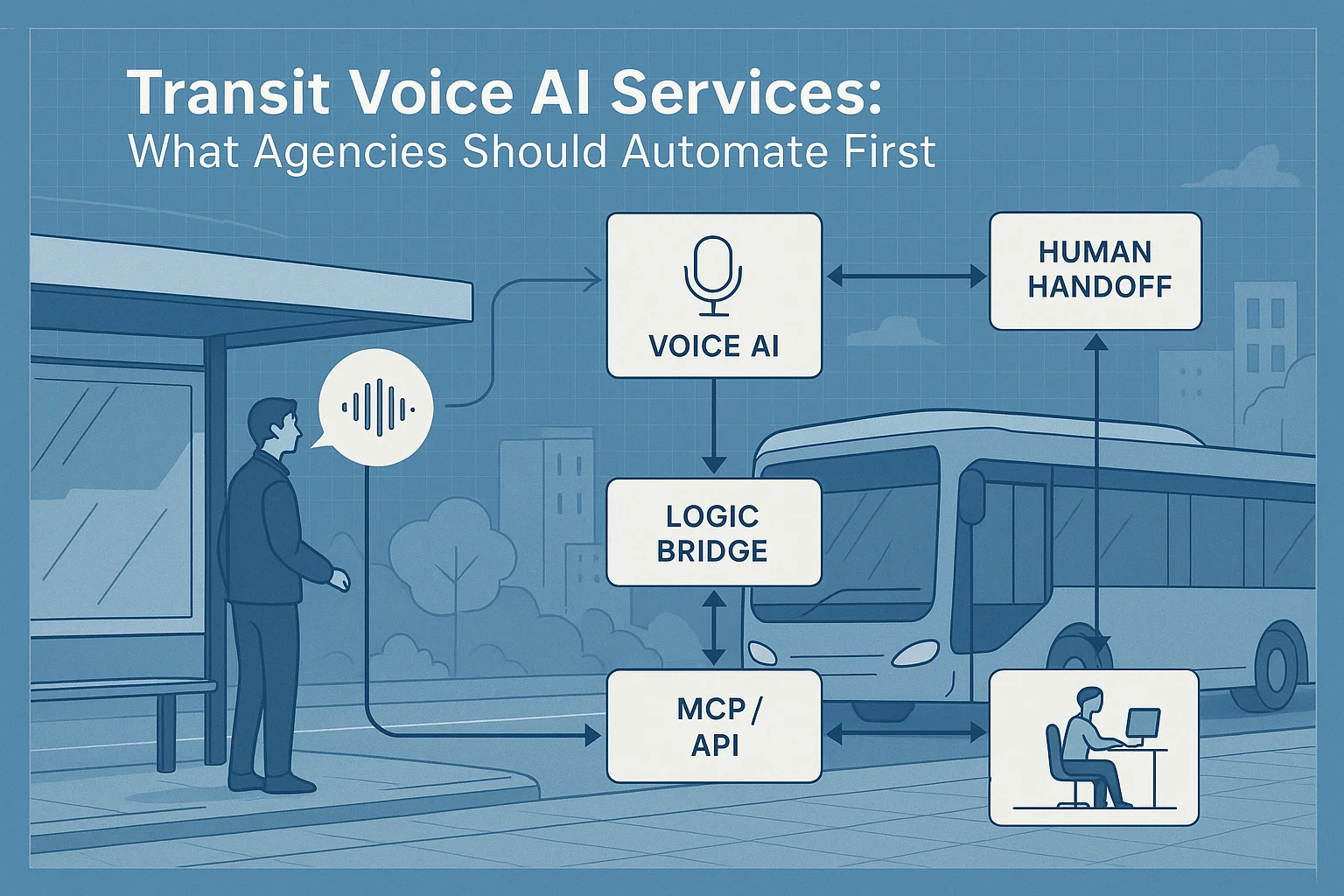
A clear reference architecture protects accuracy and makes behaviour auditable. The Rider → Voice AI → knowledge/API → validation → outcome pattern is the operational backbone.
Reference architecture: Rider → Voice AI → MCP/API → validation → outcome
Design the flow so that the voice model receives only curated, versioned context via a Model Context Protocol (MCP) and fetches live disruptions from a dedicated service-alert API. This separation limits hallucination, ensures traceability, and provides a clear audit trail for answers.
- MCP supplies the model with a signed snapshot of scheduled knowledge (schedule, holiday rules, stop names) and metadata (snapshot timestamp, source version).
- Service-alert APIs (alerts, detours) are fetched live and passed as structured payloads; treat them separately from MCP-provided schedule snapshots.
- Validation service confirms required fields and policy checks before creating a case, sending a notification, or handing off to staff.
APIs and data contracts: be explicit and versioned
Define JSON schemas and versioned contracts for every API the voice layer consumes or writes to: schedule snapshots, alert feeds, case creation, and identity tokens. Contracts should include freshness, provenance, and confidence metadata so the voice AI can decide when to present data or ask to escalate.
- Schedule snapshot contract: agency_id, feed_version, effective_from, effective_to, routes[], stops[], and canonical stop names with localization keys.
- Service-alert contract: alert_id, scope (route/stop/area), severity, start/end timestamps, alternatives, and authoritative_contact_id.
- Case creation contract: case_type, required_fields, validation_rules, duplicate_key, and retention_policy reference.
3. Identity, verification, and privacy controls
Voice systems should be stateless by default and escalate identity when required. Keep personal data minimised, explicitly consented, and managed according to your jurisdictional obligations.
Authentication and authorization models
Use layered identity: anonymous mode for read-only queries; session-linked identity for personalized views (account balances, pass status) using short-lived tokens; and strong account linking for transactions. Avoid relying solely on caller ID for authentication.
- Anonymous: no stored personal identifiers; only public schedule info or general fare rules.
- Session token: temporary, single-use tokens delivered by SMS or an app to elevate privileges for a single interaction.
- Account-linked: explicit OAuth/OpenID Connect linking for recurring personalized interactions; store minimal identifiers and token metadata.
Privacy, data residency and subprocessors
Document hosting region, backup geography, and subprocessors in procurement materials. Specify remote-support controls and transfer mechanisms for subprocessors. Agencies must confirm legal obligations (data residency, cross-border transfers, recording consent) with counsel in their jurisdiction.
- Contract must list subprocessors, their locations, and the transfer mechanism (standard contractual clauses, adequacy decisions) where applicable.
- Define retention and deletion policies for voice transcripts, account tokens, and case data; include explicit user consent flows for recordings.
- Limit personal data stored in model context (MCP). Prefer references (IDs) over PII inside the MCP payload.
4. Reliability, observability, and SRE patterns
Operational voice services must meet availability and latency expectations. Use SRE practices: SLIs/SLOs, error budgets, canaries, and comprehensive telemetry for voice-specific signals.
Define SLIs, SLOs and failure boundaries
Publish clear SLIs (intent recognition accuracy, API latency, end-to-end call success) and SLO targets with defined error budgets. Define deterministic failure boundaries: when model uncertainty exceeds a threshold, fall back to structured prompts or human handoff.
- SLIs to track: intent extraction success rate, MCP-context fetch latency, service-alert freshness percentage, and case creation success rate.
- SLOs: choose realistic targets and link them to error budgets that drive remediation windows and rollbacks.
- Failure boundary: if confidence < X% or API freshness > allowed window, escalate to human or provide a safe alternative (e.g., “I can connect.
Observability and testing
Instrument each layer with structured logs, distributed tracing, and metrics. Build synthetic tests that simulate real calls across routes, languages, and edge cases. Use canaries for model and integration changes.
- Trace a call: voice platform → model → MCP fetch → alert API → validation → case store, capturing timestamps and response codes at.
- Run nightly synthetic storms across critical routes and languages, validating correctness and latency.
- Monitor drift: track changes in intent coverage and increases in human handoffs to detect regressions.
5. Failure recovery, safe tool use, and human-in-the-loop
Plan for predictable failures: model hallucination, stale alerts, missing schedule updates, or infrastructure outages. Formalise safe handoffs and human escalation paths.
Failure modes and automated recovery
Categorise failures (data freshness, API outage, model uncertainty) and define automated recovery steps: retry with backoff, switch to cached schedule snapshot, or route to agent. Record the recovery path in the case metadata.
- Data freshness failure: present cached schedule snapshot with timestamp and offer agent handoff for live confirmation.
- API outage: notify ops and route critical intents to a human queue; mark affected downstream workflows as degraded.
- Model uncertainty: surface clarifying prompts; if still unresolved, create a provisional case with a 'needs verification' flag.
Human handoff, permissions, and training
Handoffs must include the conversation transcript, MCP snapshot ID, and alert payload that the model used. Train agents on the voice AI’s provenance model so they can validate or correct outputs quickly.
- Include the MCP snapshot ID in every handoff so agents can view the exact schedule context the model used.
- Provide agents a compact checklist: verify identity (if needed), confirm the schedule or alert, and close or escalate the case.
- Define roles and permissions for who may override model-created cases versus who may only append notes.
6. Procurement, vendor evaluation and operating model
Specify what to contract for, what to own, and what to expect from managed services in vendor agreements. Ask for measurable, testable deliverables—not claims.
Required contract terms and evidence
Request subprocessors, hosting regions, backup geographies, remote-support mechanisms, and a rollback plan in writing. Require evidence: synthetic-test results, observability dashboards access, and runbooks for typical incidents.
- Ask vendors for a list of subprocessors and the geography of backups and primary hosting.
- Require a push-button rollback for model or config changes and proof of canary testing.
- Demand real-world proof: access to a non-production environment, weekly synthetic test reports, and SLI dashboards during evaluation.
Managed service scope and Peak Demand differentiation
Define scope clearly: who owns voice prompts, who maintains MCP snapshots, who operates service-alert ingestion, validation rules, and human escalation. Peak Demand's approach emphasises controlled schedule knowledge, MCP and API service alerts, dynamic service-request forms, validation and safe submission, and documented human handoff.
- Separate responsibilities: agency owns schedule snapshot generation and alert feed integrity; vendor operates voice platform, MCP assembly, and integration adapters.
- Clarify acceptance tests: correct read-only lookups, validated case creation, duplicate suppression, and handoff fidelity.
- Include KPIs for adoption and operational impact (e.g., reduction in simple-agent transfers, proportion of validated case submissions) and require vendor reporting cadence.
7. Implementation checklist and next steps
A compact, actionable rollout checklist for program sponsors, product owners, and IT.
Minimum viable automation (first 90 days)
Deploy read-only schedule lookups and fare information with MCP snapshots, add one validated service-request type, and instrument SLIs and synthetic tests.
- Publish a versioned schedule snapshot and MCP schema.
- Integrate a single service-request API and enable dynamic form validation.
- Establish SLIs and run nightly synthetic tests across languages.
Operational rollout (90–365 days)
Expand validated request types, harden observability, formalise procurement terms, and codify handoff runbooks. Iterate using live telemetry and agent feedback.
- Add duplicate detection and escalation thresholds; run agent training sessions using real handoff transcripts.
- Complete subprocessors and data-residency clauses in contracts; test remote-support access and canary rollback.
- Review AI risk posture with stakeholders and align with internal governance.
Related Peak Demand resources
Industry and AI sources reviewed
- Artificial Intelligence Risk Management Framework (AI RMF 1.0)National Institute of Standards and Technology (NIST)
- Transportation Systems SectorCybersecurity and Infrastructure Security Agency (CISA)
- OECD AI PrinciplesOrganisation for Economic Co-operation and Development
Privacy, telecommunications, recording-consent, cybersecurity, consumer-protection, employment, and records obligations vary by jurisdiction and use case. This article is operational guidance, not legal advice; organizations should confirm applicable requirements with qualified professionals.
Frequently asked questions
Good starting points include lost property, complaints and feedback, stop or shelter issues, fare-machine faults, non-emergency accessibility service requests, schedule information from approved sources, and structured routing to customer service or field teams.
Official reference: Artificial Intelligence Risk Management Framework (AI RMF 1.0)
Use GTFS Realtime only when the agency exposes suitable feeds and the workflow genuinely needs service alerts, trip updates, or vehicle positions. The integration should validate freshness and availability, and the agent should avoid presenting stale feed data as a guaranteed arrival prediction.
Emergency, security, injury, crime, and safety-critical reports should follow approved transfer or emergency-routing procedures. Voice AI may detect and route the call, but it should not make operational safety decisions or replace trained personnel.
Official reference: Transportation Systems Sector
Request realistic call testing, feed and system failure handling, service-request integration, transfer context, audit logs, accessibility channels, monitoring, change control, and evidence that the agent distinguishes scheduled information from dynamic service alerts.
Official reference: Artificial Intelligence Risk Management Framework (AI RMF 1.0)
Turn Voice AI infrastructure into a managed enterprise operation
Peak Demand designs, integrates, deploys, monitors, and improves Voice AI systems across customer service, enterprise systems, governance, escalation, and reporting.
Schedule a discovery call


