
How Transit Agencies Can Use Voice AI to Handle Service Requests: An Operational Framework
A practical, operations-first framework for using voice AI to intake and route non-emergency transit service requests — from caller to confirmation number — with accessibility, validation, duplicate control and analytics.
1. Executive summary
This article explains a practical, jurisdiction-neutral operational framework for transit agencies to use voice AI for non-emergency service requests — for example, reporting a damaged shelter, a fare machine fault, a schedule discrepancy or an accessibility-related facility issue.
What this framework covers
We focus on intake, validation, duplicate detection, confirmation and human handoff. We assume agencies will continue to route safety-critical incidents and emergencies through established emergency channels. The architecture centres on a Model Context Protocol (MCP) that supplies the voice agent with up-to-the-moment forms and rules, and a Peak Demand logic bridge that enforces validation, duplicate controls and the final safe submission into the agency’s service-request system.
- Caller identification and minimal triage (non-emergency only)
- Dynamic question and field retrieval through MCP
- Field validation, missing-field recovery and duplicate-request detection
- Safe submission to the client service-request system, confirmation numbers and analytics
- Structured human handoff for exceptions and agent review
Who should read this
Senior operations, contact-centre leaders, IT, accessibility and digital transformation teams planning or operating voice AI for transit service requests. The guidance is jurisdiction-neutral and emphasizes areas that require local legal and accessibility review.
2. Why use voice AI for transit service requests — and what not to automate
Voice AI can reduce friction and answer routine questions, but the value comes from reliably creating structured, actionable service requests with clear confirmation and traceability. The design must limit use to appropriate request types and explicitly exclude emergency and safety-critical incident resolution.
Appropriate use cases
Common non-emergency use cases for transit agencies include reporting infrastructure defects (benches, shelters), equipment faults (ticket machines, validators), accessibility-related facility issues (ramps, lifts out of service), route/timetable feedback, and requests for lost property assistance. Voice AI works best where the request can be captured as a structured form that triggers a workflow or work order.
- Infrastructure and facility reports
- Equipment and fare system faults
- Accessibility maintenance requests
- Service feedback and customer account routing
Clear limits: non-emergency only
Automated voice intake should not be used as the primary channel for reporting emergencies, crimes, or safety-critical incidents. Design the dialogue to detect keywords that indicate an emergency and immediately transfer the caller to human staff or local emergency services. Agencies must document and test these transfer rules operationally.
- Detect and escalate any indication of injury, fire, criminal activity or other imminent danger
- Provide clear prompts and transfer to trained human operators
- Log transfers and record the rationale for QA and auditing
3. Core operational architecture
The architecture must guarantee that the voice agent behaves like a reliable intake clerk: present the right questions, validate responses, avoid duplicates, produce a safe submission to the agency’s system of record, and return a confirmation number.
Clear operating flow
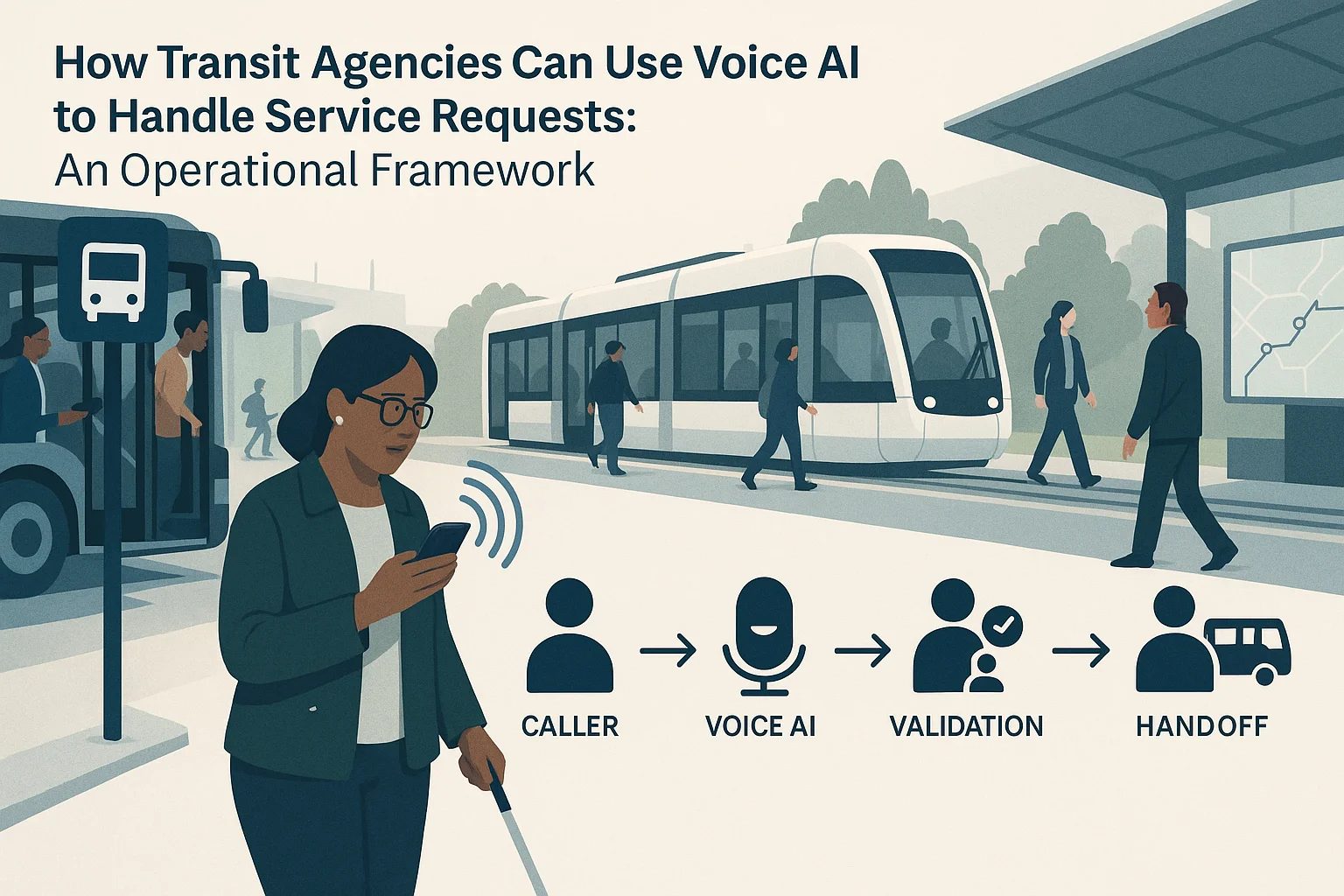
The operating flow should be explicit and auditable. At a minimum the sequence is: Caller → Voice AI agent → Peak Demand logic bridge → MCP (Model Context Protocol) server → dynamic form and field retrieval → validation and duplicate checks → client service-request system → reference number and analytics.
- Caller: provides spoken input or DTMF responses
- Voice AI agent: handles ASR/NLU and guided dialogue (ASR/NLU refers to automatic speech recognition and natural language understanding)
- Peak Demand logic bridge: centralised business rules, field validation, missing-field recovery and duplicate-request controls
- MCP server: holds dynamic forms and context used at runtime (Model Context Protocol)
- Client SoR: receives safe, validated submissions and returns a reference number for the caller and analytics records
Why MCP and a logic bridge are essential
A Model Context Protocol (MCP) provides a standard way to deliver the exact form, field-level rules, prompts and routing decisions to a voice model at call time. The Peak Demand logic bridge acts as a trusted gatekeeper between the conversational model and the client’s systems of record: it applies field-level validation, conducts duplicate checks, manages missing-field recovery, enforces safe-submission policies, and records metadata for analytics. Without both elements, voice-led intake risks producing incomplete, duplicate or misrouted requests.
- MCP keeps the voice model stateless while providing current operational context
- Logic bridge enforces business-critical policies and prevents unsafe submissions
- Together they enable dynamic question retrieval and accurate routing
Integration with real-time transit data
When an intake needs contextual data such as line identifiers, stop IDs, or vehicle telemetry, integrate the MCP or logic bridge with the agency’s real-time feeds. For agencies using GTFS Realtime or similar feeds, the system can present nearest-stop options or validate route IDs during intake to reduce friction and misreporting.
- Pre-populate route and stop fields from real-time feeds
- Validate reported vehicle IDs or trip IDs against live data where available
- Use contextual information to prioritise and route requests
4. Data and validation patterns that reduce friction and false work
High-quality service-request intake depends on structured data captured at the first contact. Key capabilities are dynamic forms, field validation, missing-field recovery, and duplicate-request controls.
Dynamic forms and field validation
Deliver question sets to the voice model at runtime via MCP so the agent asks only relevant questions. Enforce field validation rules in the logic bridge rather than relying on the conversational model alone. Examples include validating stop codes against a canonical list, requiring a minimum description length for defects, and accepting only certain date/time formats for availability windows.
- Runtime forms reduce irrelevant questions and shorten calls
- Field-level rules prevent malformed or ambiguous data entering work-order systems
- Validation should include list checks, format checks and contextual cross-field rules
Missing-field recovery and graceful retries
Design recovery patterns for when callers cannot provide a required field: accept a planned follow-up, collect an alternative identifier (e.g., nearest intersection), or provide an option to receive a call-back. Record the chosen recovery path in the submission metadata so back-office staff can follow up efficiently.
- Offer multiple identification paths (stop code, intersection, landmark, GPS share via SMS link)
- Allow caller to defer non-essential fields to a scheduled follow-up
- Log recovery choices and timestamps for service-level tracking
Duplicate detection and suppression
Duplicate requests waste crews and skew analytics. Use a combination of fuzzy matching on key fields (location, category, short description), time-window rules and unique object identifiers to detect probable duplicates. When duplicates are detected, inform the caller, link the submission to the existing case, and provide the active reference number. The Peak Demand logic bridge should make the final duplicate determination before safe submission.
- Run checks before submission to avoid creating redundant work orders
- Provide the caller with the existing reference number when a duplicate is found
- Record duplicate-resolution decisions for continuous improvement
5. Accessibility, privacy and compliance considerations
Voice AI implementations must be accessible, respect privacy and meet applicable legal requirements. Accessibility and content design also materially improve intake quality and reduce repeated calls.
Accessible design principles
Ensure voice dialogues and complementary channels meet widely recognised accessibility standards so people with disabilities can use the service effectively. Provide alternative channels (web form, SMS, TTY relay, human agent) and design voice prompts with plain language, repeat options and explicit confirmation steps. Agencies should assess obligations under the Convention on the Rights of Persons with Disabilities (UN CRPD) and the Web Content Accessibility Guidelines (WCAG) 2.2 and confirm local legal obligations with counsel or accessibility specialists.
- Offer alternative channels and human-assisted modes
- Use plain language prompts, repetition and confirmation of key fields
- Provide transcripts, multi-modal follow-up (SMS, email) and TTY support where required
Privacy, data minimisation and retention
Collect only the data needed to fulfil the request. Separate personally identifiable information (PII) from service-request metadata where practical, and document retention policies. Agencies should evaluate local data-protection law (for example, GDPR in the EU, PIPEDA in Canada, or equivalent rules) and design workflows that allow callers to request deletion or access to their data in accordance with applicable law.
- Minimise required PII and offer anonymous reporting where feasible
- Log metadata and redaction events for auditing
- Define retention windows and retention-of-records for compliance and operational needs
6. Handoff, confirmation and analytics
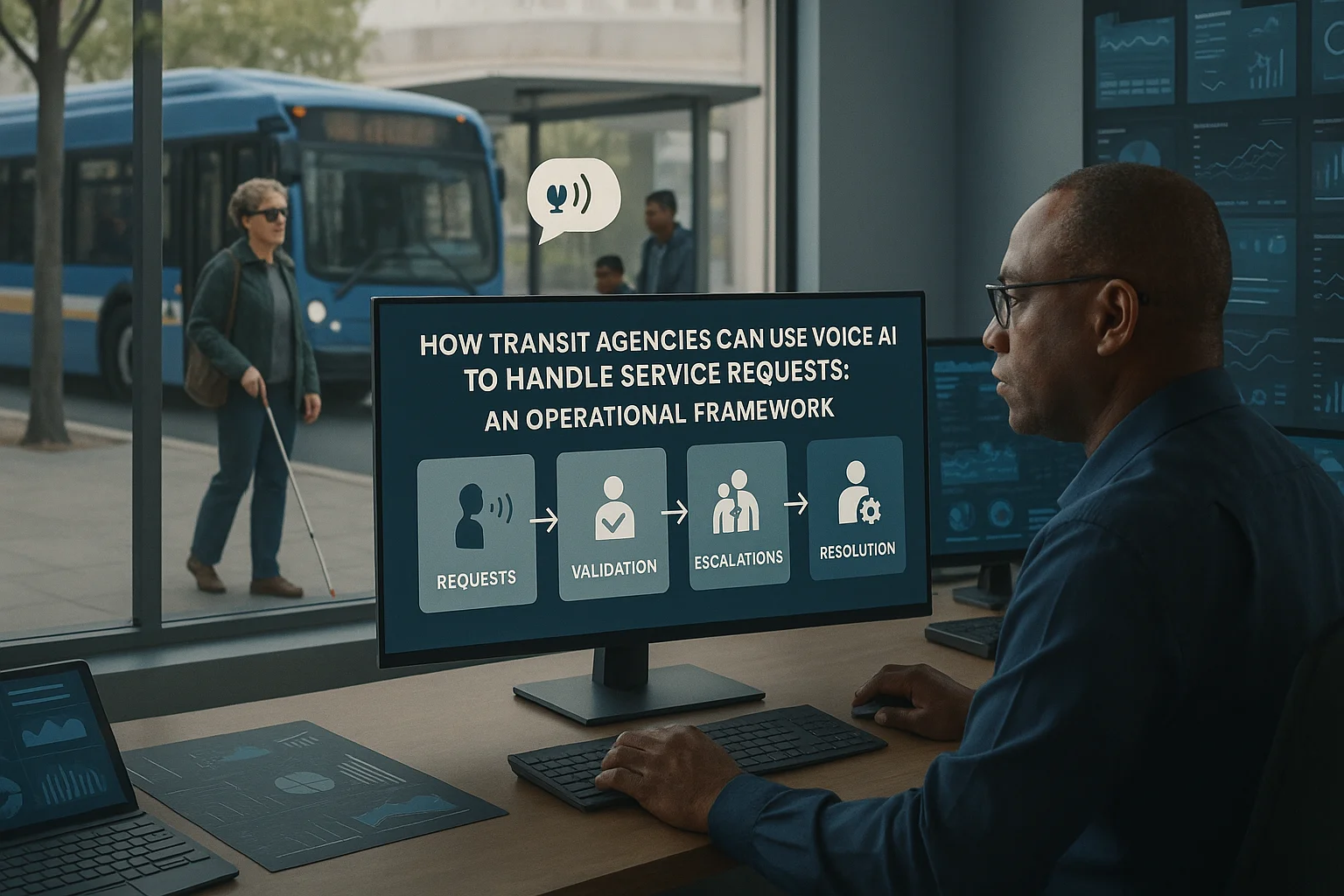
A central benefit of operational voice intake is delivering reliable confirmations and structured handoff to human staff or work-order systems. The result must be auditable and yield actionable analytics.
Structured human handoff and audit trails
When the logic bridge cannot confidently validate fields, or when an exception occurs, create a structured handoff to a trained agent that includes the captured data, the validation checks run, duplicate-detection results and the caller’s stated preference for follow-up. Keep all exchanges auditable and timestamped for QA, dispute resolution and continuous improvement.
- Bundle intent, field values and validation outcomes into handoff packets
- Include recommended routing and severity suggested by the logic bridge
- Record agent decisions and any changes to the original submission
Confirmation numbers and safe submission
Always provide a confirmation or reference number on successful submission. This number should map to the agency’s service-request system and to analytics records. The Peak Demand logic bridge should only mark a submission as complete when all required validations and duplicate checks pass and when the client service-request system acknowledges receipt.
- Return a human-readable confirmation number and options for SMS/email receipt
- Prevent double-submission by locking requests once submitted
- Log submission status and any downstream system errors
Analytics by request type and field
Collect structured analytics on request type, field-level completion rates, duplicate rates, recovery actions chosen by callers, validation failure reasons, and time-to-confirmation. These metrics support workforce planning, asset lifecycle management and targeted communication campaigns. The logic bridge should emit event-level telemetry mapped to request types and individual fields to facilitate operational dashboards.
- Measure field completion and recovery-route frequencies
- Track duplicate-detection rates and false-positive investigations
- Feed analytics to scheduling and asset-maintenance planning systems
Related Peak Demand resources
Industry and AI sources reviewed
- GTFS Realtime ReferenceMobilityData / GTFS
- Artificial Intelligence Risk Management FrameworkNational Institute of Standards and Technology (NIST)
- Transportation Systems SectorCybersecurity and Infrastructure Security Agency (CISA)
Transit safety, accessibility, privacy, cybersecurity, records, and service-information obligations vary by jurisdiction and operating authority. This article is operational guidance, not legal advice; organizations should confirm applicable requirements with qualified professionals.
Frequently asked questions
Good starting points include lost property, complaints and feedback, stop or shelter issues, fare-machine faults, non-emergency accessibility service requests, schedule information from approved sources, and structured routing to customer service or field teams.
Official reference: Artificial Intelligence Risk Management Framework
Use GTFS Realtime only when the agency exposes suitable feeds and the workflow genuinely needs service alerts, trip updates, or vehicle positions. The integration should validate freshness and availability, and the agent should avoid presenting stale feed data as a guaranteed arrival prediction.
Official reference: GTFS Realtime Reference
Emergency, security, injury, crime, and safety-critical reports should follow approved transfer or emergency-routing procedures. Voice AI may detect and route the call, but it should not make operational safety decisions or replace trained personnel.
Official reference: Transportation Systems Sector
Request realistic call testing, feed and system failure handling, service-request integration, transfer context, audit logs, accessibility channels, monitoring, change control, and evidence that the agent distinguishes scheduled information from dynamic service alerts.
Official reference: Artificial Intelligence Risk Management Framework
Design the transit service workflow before automating it
Peak Demand helps transit teams connect Voice AI to rider information, service requests, approved live-data sources, escalation, confirmation, and analytics.
Schedule a discovery call


