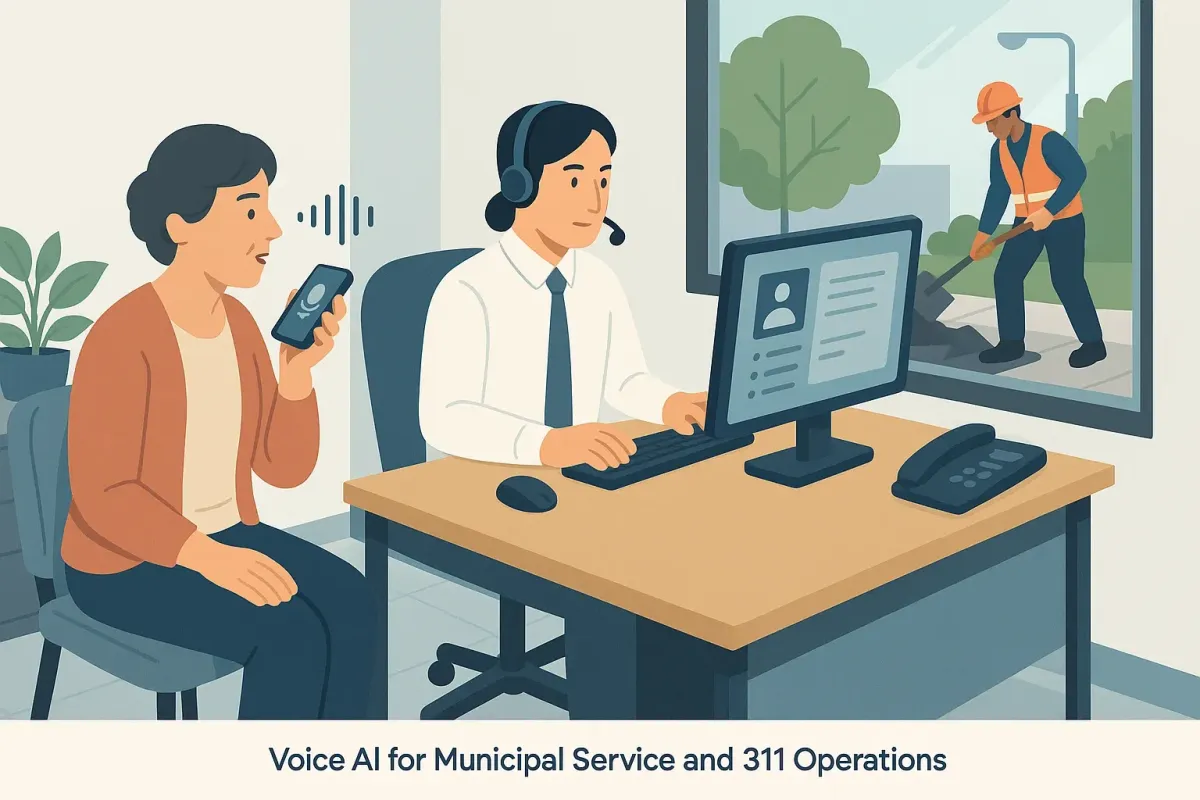
Voice AI for Municipal Service Requests and 311 Operations
A practical, jurisdiction-neutral operating model for deploying Voice AI in municipal 311 and service-request operations. Covers end-to-end workflows, validation, routing, escalation, exception handling, procurement considerations, and measurable operating boundaries.
1. Scope, goals, and safety boundaries
Define the program remit, primary outcomes, and non-negotiable safety boundaries before technical choices. This section sets the operating constraints for municipal Voice AI intake.
Program scope and outcomes
Begin by scoping Voice AI to intake-focused interactions: resident-initiated requests, status enquiries, and informational lookups. Exclude decision-heavy domains (eligibility determinations, enforcement actions, legal advice, and clinical/medical triage). Outcomes to measure should include case submission rate, first-touch resolution percentage (where the system can satisfy the request without human handoff), average time-to-case-creation, duplicate case reduction, resident confirmation issuance, and audit-log completeness.
- Approved uses: addressable service requests (potholes, graffiti, waste pickup, non-emergency repairs), status queries, scheduling an inspection or a follow-up call where permitted.
- Excluded uses: emergency response, enforcement actions, eligibility or benefits decisions, legal/adjudicative processes, and sensitive discretionary services.
Safety boundaries and human escalation
Safety boundaries must be explicit in the operating model. The Voice AI should immediately transfer calls to trained staff (or instruct residents to contact emergency services) when trigger phrases, acoustic cues, or intent classifiers flag emergencies, threats, or law-enforcement involvement. Maintain a documented list of escalation triggers and test these routinely. Where discretion or legal interpretation is required, the system should collect minimal context and create a routed case for human review rather than make decisions.
- Escalate immediately for smoke/fire, medical emergencies, immediate danger, and criminal activity.
- For ambiguous but potentially high-risk calls, gather only essential contextual fields, create a case with high-priority routing, and initiate human callback within defined SLA.
2. End-to-end operating model
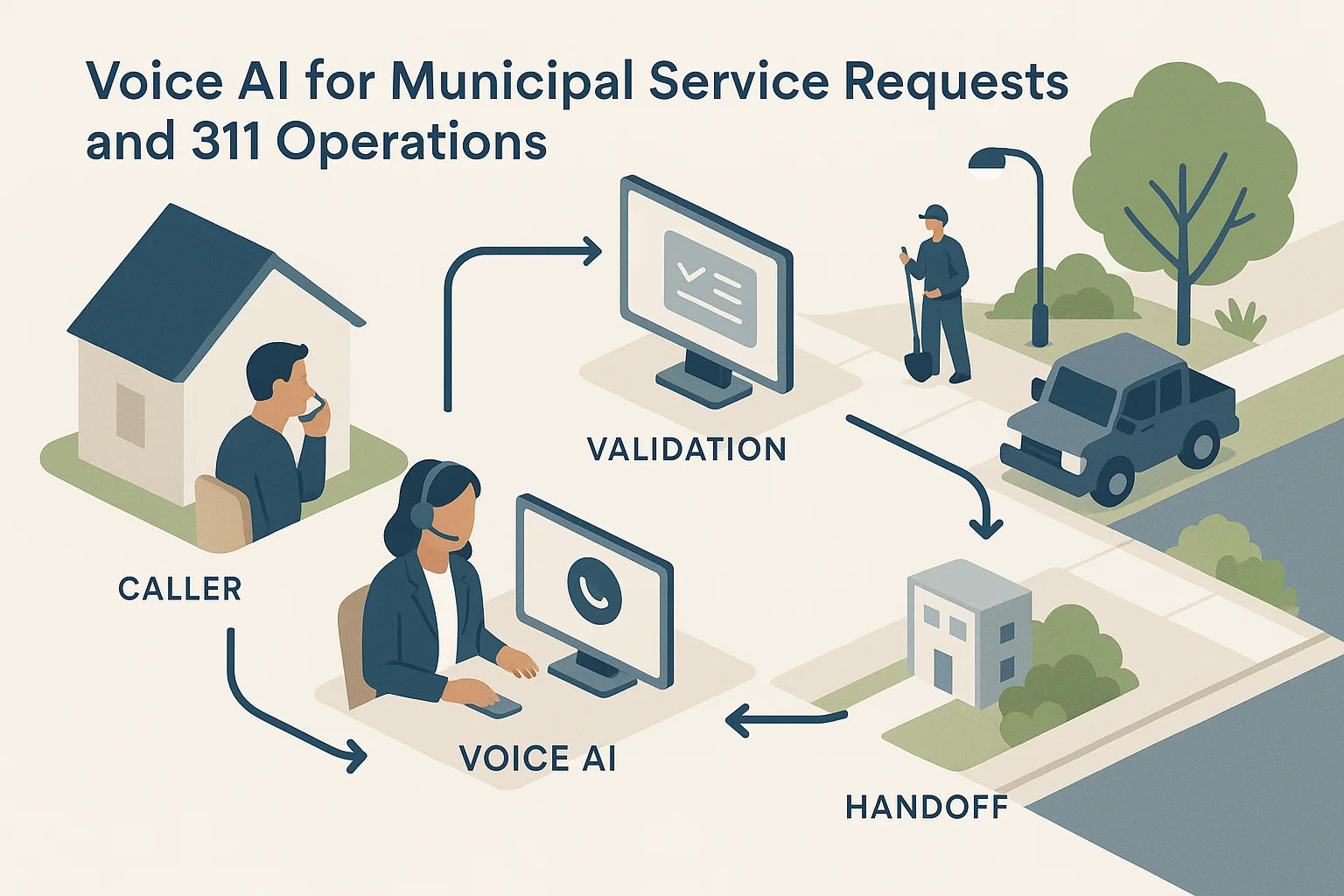
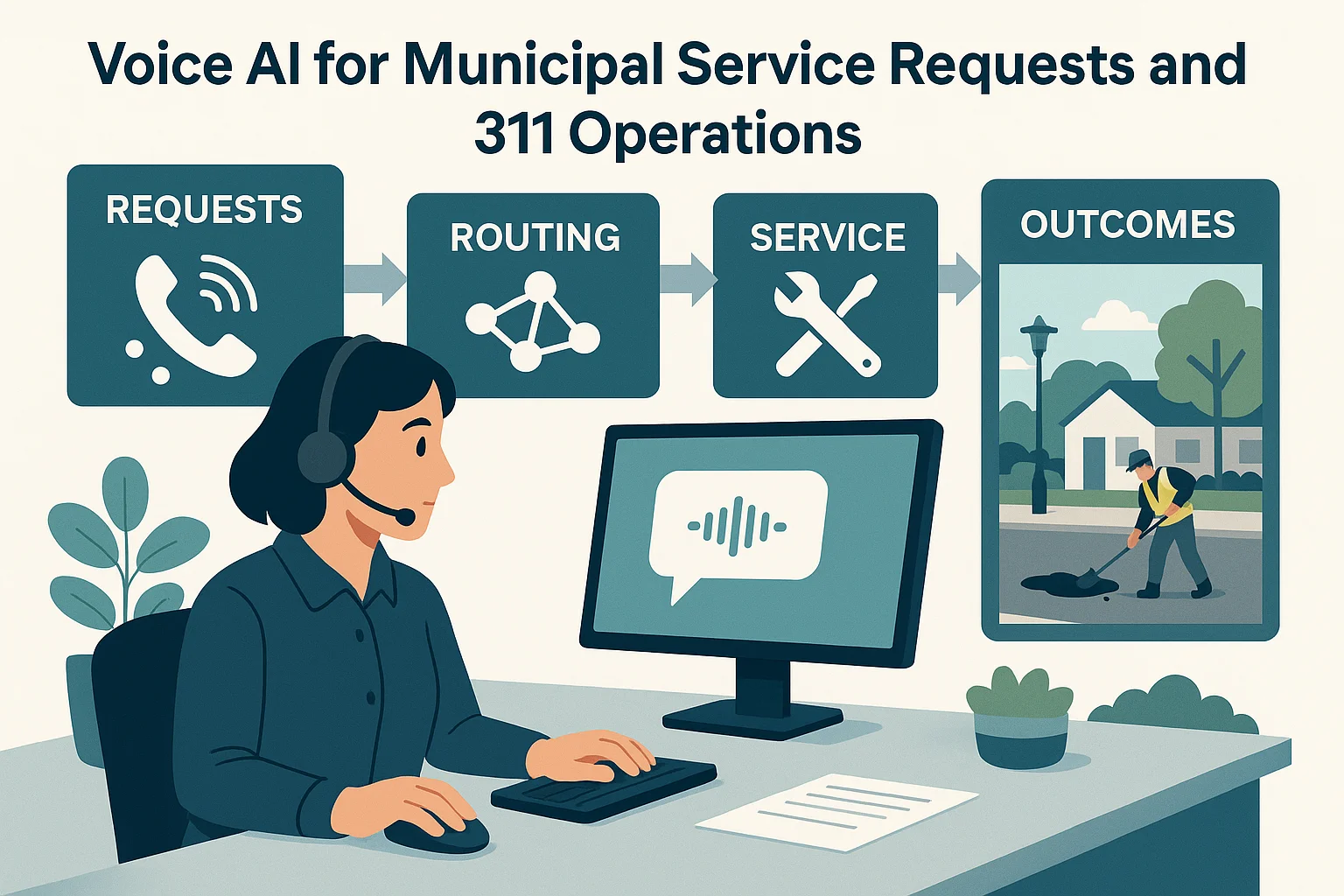
Translate the architecture into a practical intake pipeline that produces auditable municipal cases or hands off to staff. Use a consistent mapping: Resident → Voice AI → logic bridge → form/field retrieval → validation → municipal case system → confirmation or human handoff.
Canonical pipeline and roles
The canonical pipeline separates responsibilities across layers: Voice AI manages speech recognition, conversational flow, and initial slot collection; the logic bridge enforces rules, MCP context, API orchestration, duplicate detection, and validation; the municipal case system (CRM/CMS/Permitting/Work-order) is the authoritative record. Operational ownership should be split: IT/Integration owns the logic bridge and APIs; Service Operations owns business rules, routing and SLA definitions; Vendor or Managed Service owns voice models and telephony operations when contracted.
- Voice AI: ASR, intent classification, speaker prompts, basic validation, and accessibility controls.
- Logic bridge (Peak Demand differentiation): dynamic forms retrieval, MCP-driven context management, validation, duplicate controls, and API integration orchestration.
- Municipal case system: final case storage, downstream routing, field service dispatch, and records retention.
Model Context Protocol (MCP) and dynamic forms
Use an MCP to transmit context—resident language preference, prior interactions, partial-field values, and allowed intents—between the Voice AI and the logic bridge. Dynamic forms let the logic bridge retrieve field definitions from the case system in real time (field types, required flags, validation regex, enumerations). This avoids hardcoding forms and lets the municipal back office change data models without re-deploying voice flows.
- MCP transports minimal context, not raw recordings, and links transcripts to case identifiers.
- Dynamic form retrieval means the system validates against the same fields used by case handlers, reducing rework.
3. Concrete workflows: validation, routing, and duplicate handling
Operational clarity is required for field validation, routing decisions, duplicate avoidance, and when to create a human handoff. This section describes implementable workflows and decision rules.
Field and resident validation
Apply multi-layer validation: conversational-level validation (confirming an address verbally), logic-bridge schema validation (matching against address normalization or permit IDs via API), and downstream case-system validation (business-rule enforcement). When validation fails at any step, offer a short retry, fallback to collecting minimal required fields, and if still failing, create a case flagged for human verification.
- Use address normalization APIs at the logic bridge and require a single validated address or location ID before submission for location-sensitive services.
- When identity or account validation is needed (e.g., requests tied to accounts or private property), collect minimal PII and transfer to an authenticated channel.
Duplicate detection and suppression
Run duplicate checks at both the logic bridge and the case system. Logic-bridge duplicate controls should compare normalized fields (location, issue type, time window) and present a brief summary to the resident—'We may already have a report for this location from yesterday, do you want to update it or create a new one?'—to prevent duplicate case creation. If the resident insists or the situation differs materially, allow a new case but tag it for reconciliation.
- Define duplicate thresholds (e.g., same location + same issue within X days) and make thresholds configurable.
- Maintain reconciliation queues for human staff to merge or close duplicates with documented justification.
4. Exception handling and human-in-loop design
Design for practical failures: ASR errors, low-confidence intents, connectivity issues, and resident frustration. Define fallback flows and ownership.
Confidence thresholds and fallback
Set clear confidence thresholds for ASR and intent classification. For medium confidence, confirm key fields (address, phone). For low confidence, offer to transfer to a human or to receive a call-back. Log the confidence and the chosen fallback so that operations can tune model prompts and retrain models periodically.
- Example rule set: ASR confidence > 0.85 proceed; 0.6–0.85 confirm key fields; <0.6 offer human callback and record as low-confidence case.
- Track low-confidence rates over time as a QA metric.
Recording, privacy, and consent handling
Implement clear voice prompts for recording consent that are configurable by jurisdiction. If a resident declines recording, allow the interaction to proceed but limit what can be done automatically; for instance, create a case with minimal metadata and schedule a human callback to complete details. Log consent decisions in the audit trail.
- Provide alternatives for residents who cannot or will not consent to recording (e.g., SMS intake, manual entry via agent).
- Avoid routing cases containing sensitive personal data through voice-only automated processes.
Human takeover model and SLAs
Specify handoff points where a human must take over: emergency escalation triggers, low-confidence interactions, disputes, and eligibility or legal queries. Define response SLAs for human callbacks and measure compliance. Managed-service contracts should specify responsibilities and escalation matrices for vendor and municipal teams.
- Define tiers of urgency and target callback times (e.g., immediate transfer, <30 minutes, same-business-day) that are realistic and measured.
- Use the logic bridge to tag and route handoffs with all collected context to minimize repeat questioning by human agents.
5. Integration, security, and risk controls
Technical procurement and operations must address integration ownership, cybersecurity goals, and model-risk controls aligned to public-sector expectations.
Integration and ownership
Treat the Voice AI deployment as a systems-integration project. Contracts should specify ownership of the logic bridge APIs, data schemas, and error-retry semantics. Municipal IT should retain write access and authority over the case system’s API keys and production endpoints. Peak Demand’s approach separates voice-model operations from logic-bridge and case-system responsibilities so municipalities keep control over authoritative data.
- Require APIs that support idempotent submissions and field-level validation responses.
- Define rollback and emergency-disable procedures for the voice intake channel.
Cybersecurity and resilience
Align security controls with cross-sector cybersecurity goals: identity and access management for service accounts, network segmentation for telephony and integration layers, and logging/monitoring for anomalous spikes. Include backup geography and subprocessors in procurement documentation, and require evidence of secure remote-support practices. Implement observability for call volumes, error rates, duplicate rates, and low-confidence incidents.
- Document hosting region, backup region, subprocessors, and remote-access pathways in vendor agreements.
- Monitor for anomalous automated submissions and rate-limit to prevent abuse.
Model risk management
Apply the NIST AI RMF principles: map system risks, monitor model performance, version models, and maintain incident-response plans for model-related failures. Keep model context auditable via MCP—capture prompts, model version, confidence scores, and post-hoc human-review outcomes. Retain a retrain-and-deploy cadence and require vendors to disclose major model changes that could affect intake behavior.
- Implement model-version tagging in every submission and include it in audit logs.
- Define tolerances for model drift and retraining triggers based on validation and low-confidence rates.
6. Procurement, measurable outcomes, and rollout checklist
Procurement should focus on verifiable capabilities and operational performance, not just model brand names. Include a practical rollout checklist that clarifies responsibilities, acceptance tests, and metrics.
Procurement evidence and contract language
Require vendors to provide: a security and subprocessor list with hosting/back-up geography, sample audit logs, API documentation with idempotency, model-version disclosure, SLAs for availability and escalation handling, and test data for integration. Insist that vendors support configurable dynamic forms and MCP-compatible context exchange.
- Ask for a runbook that details remote-support access, backup/restore, and data-retention procedures.
- Include acceptance criteria for duplicate-control effectiveness, confirmation-number issuance, and audit log completeness.
Measurable operating outcomes
Define measurable KPIs for the pilot and steady-state: percent of fully automated submissions, average time-to-case-creation, duplicate-case rate, low-confidence rate, SLA compliance for human callbacks, accessibility/compliance test pass rates, and audit-log completeness. Use these indicators to gate phased rollout.
- Measure resident satisfaction for voice-intake interactions separately from downstream service satisfaction.
- Track operational load shifts to determine staff reallocation and training needs.
Rollout and acceptance checklist
Acceptance testing should include integration smoke tests, address-normalization accuracy, duplicate detection testing, emergency-handling simulation, low-confidence scenarios, and accessibility testing (TTY/relay, language coverage). Pilot in a limited set of low-risk services before expanding.
- Test human takeover handoff with end-to-end context transfer and confirmation issuance.
- Validate that the logic bridge enforces dynamic-form validation identical to the case system.
Related Peak Demand resources
Industry and AI sources reviewed
- Cross-Sector Cybersecurity Performance GoalsCybersecurity and Infrastructure Security Agency (CISA)
- Artificial Intelligence Risk Management Framework (AI RMF 1.0)National Institute of Standards and Technology (NIST)
- Algorithmic Impact AssessmentGovernment of Canada
Privacy, telecommunications, recording-consent, cybersecurity, consumer-protection, employment, and records obligations vary by jurisdiction and use case. This article is operational guidance, not legal advice; organizations should confirm applicable requirements with qualified professionals.
Frequently asked questions
Suitable workflows include structured resident inquiries, service-request intake, permit or program information, appointment scheduling, department routing, status updates from approved systems, and after-hours overflow. Adjudication, enforcement discretion, emergency response, and binding eligibility decisions should remain with authorized staff.
Official reference: Artificial Intelligence Risk Management Framework (AI RMF 1.0)
Use a controlled service catalogue, required fields, department ownership rules, validation, duplicate checks, confirmation numbers, and documented handoff paths. The system should create an auditable record and avoid silently dropping requests when a downstream system is unavailable.
Official reference: Algorithmic Impact Assessment
Municipal deployments should document purpose, affected services, data use, human oversight, complaint and appeal paths, accessibility channels, records handling, monitoring, and the process for approving material changes.
Official reference: Algorithmic Impact Assessment
Require workflow demonstrations, integration and security architecture, testing evidence, auditability, data-location and subcontractor details, incident response, accessibility support, human escalation, exit planning, and clear ownership of ongoing updates.
Official reference: Artificial Intelligence Risk Management Framework (AI RMF 1.0)
Turn Voice AI infrastructure into a managed enterprise operation
Peak Demand designs, integrates, deploys, monitors, and improves Voice AI systems across customer service, enterprise systems, governance, escalation, and reporting.
Schedule a discovery call


