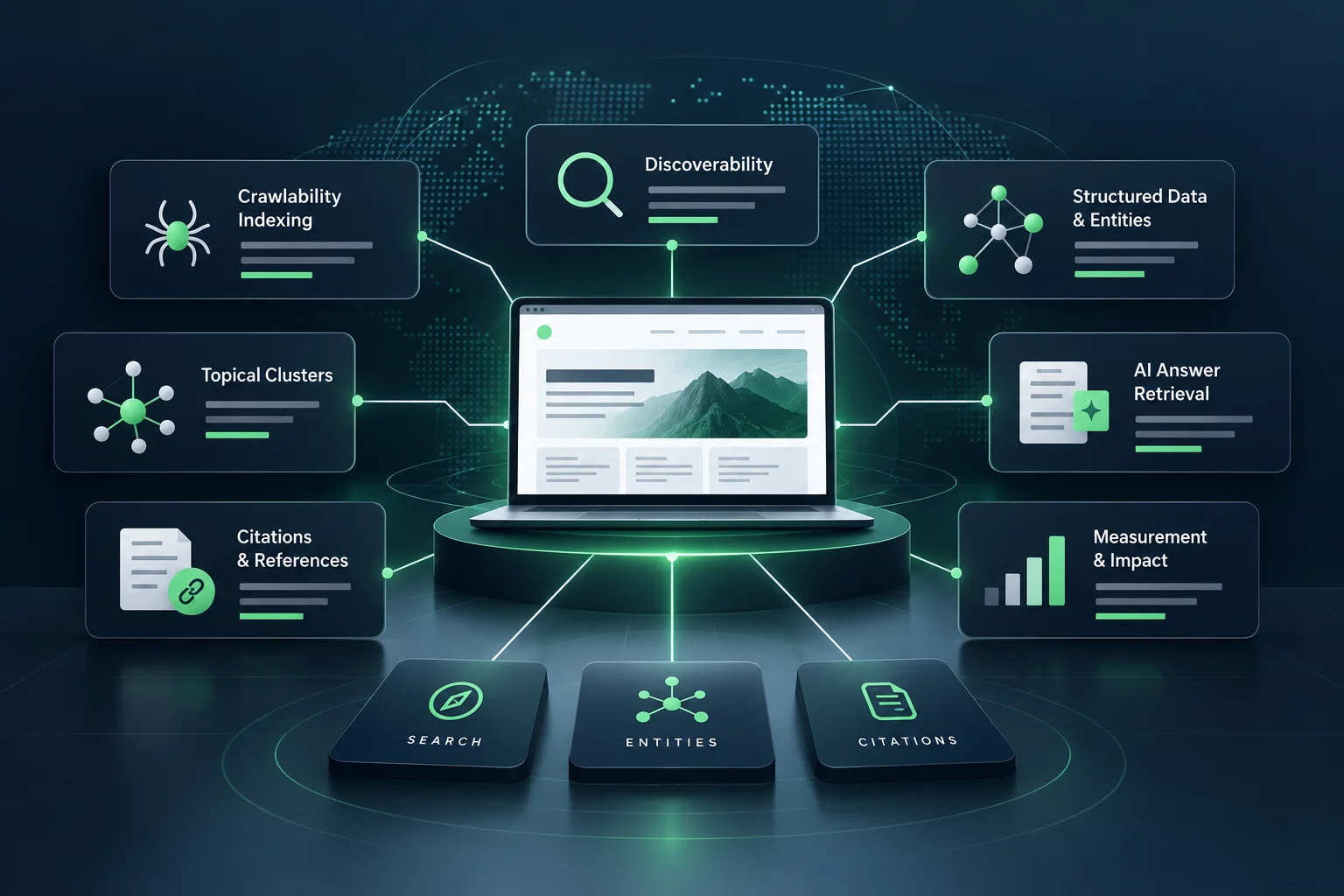
RFP Criteria and Pilot Acceptance Metrics for AEO, GEO, and Knowledge Graph Vendors
A practical, procurement-focused guide for evaluating vendors that deliver Answer Engine Optimization (AEO), Generative Engine Optimization (GEO), and knowledge-graph capabilities. Defines what to require in RFPs, which tests to run in pilots, and how to measure readiness without promising placements or citations.
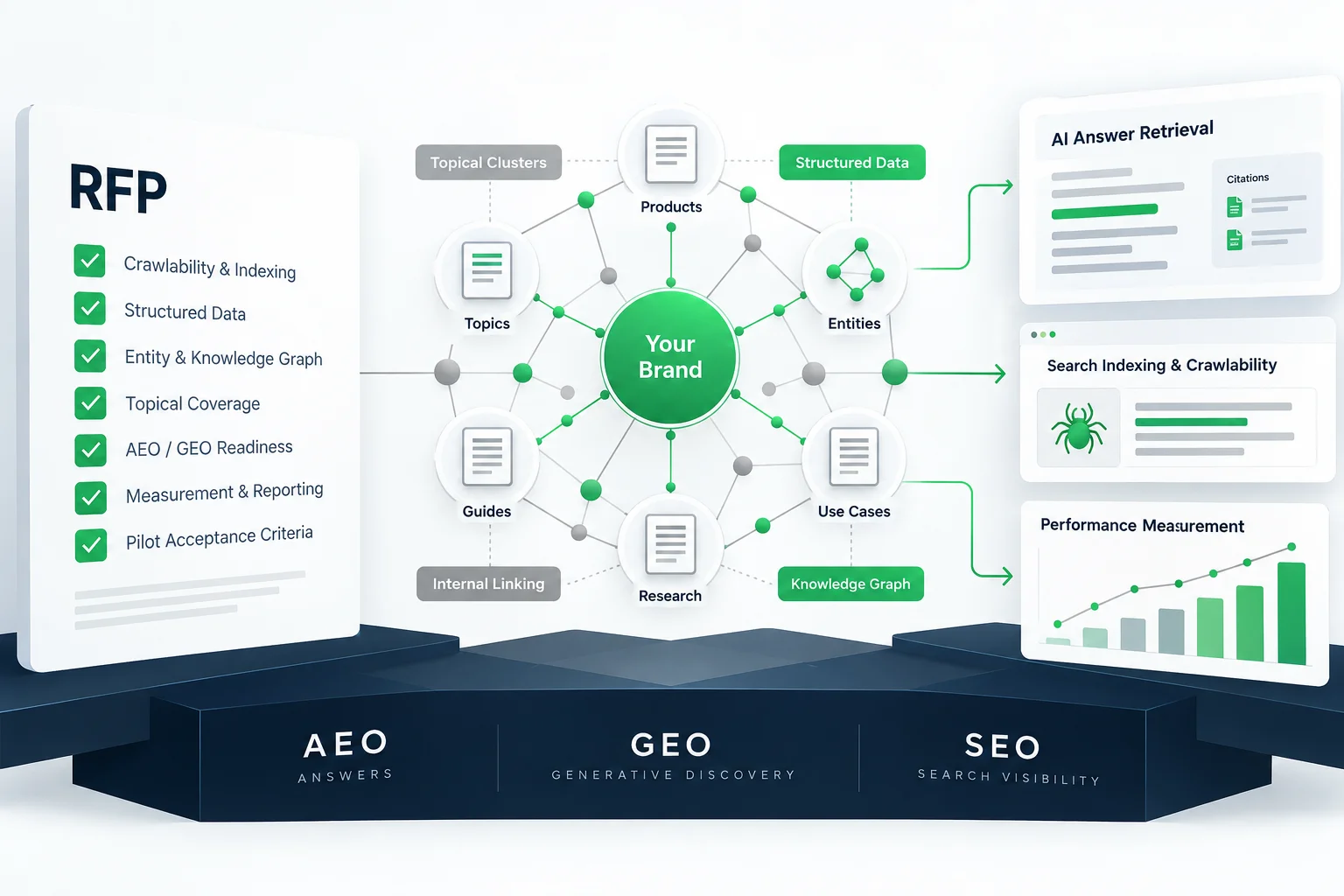
1) Short decision checklist for RFPs and pilots
Start with a short, actionable checklist in the RFP. This tells vendors which capabilities you'll score and reduces ambiguous proposals.
Mandatory RFP items (must-have)
Specify the non-negotiable deliverables up front so vendor responses are comparable.
- Canonical entity/data model and exportable knowledge graph (machine-readable export: JSON-LD, RDF, or NDJSON).
- Documented retrieval APIs with versioning and test endpoints, plus request/response examples.
- Structured-data strategy and page-level schema coverage plan (which schema types will be applied where).
- Data contracts and change-notification mechanics (webhooks, event logs, or diffs).
- Acceptance-test suite you can run locally or in CI with reproducible inputs.
Scored RFP items (how you’ll evaluate)
Define scoring categories and weights so vendors know how to prioritize features.
- Data fidelity (30%): entity completeness, canonical IDs, and mapping accuracy.
- Retrieval accuracy and relevance (25%): demonstrated via blind tests and precision/recall curves.
- Provenance & auditability (15%): structured citations, source anchors, revision history.
- Operational readiness (15%): SLAs for data freshness, API uptime, latencies, and support.
- Security & privacy (10%): subprocessors, hosting regions, access controls, and standard certifications.
2) Definitions and architectural primitives you must require
Define terms precisely in the RFP so bidders align their solutions to your needs rather than marketing language.
AEO, GEO, entities, and knowledge graph — practical definitions
Use short, procurement-friendly definitions.
- AEO (Answer Engine Optimization): optimizing content, metadata, and structured inputs to improve how search systems surface concise answers and citation-aware responses. Treat it as.
- GEO (Generative Engine Optimization): optimizing for retrieval and promptable summaries that generative systems may use, including entity clarity, structured data, canonical content, and provenance.
- Entity: a uniquely identified concept (organization, person, product, topic) with stable canonical attributes and identifiers used by retrieval systems.
- Knowledge graph: a machine-readable graph of entities and relationships intended for retrieval and citation by AI and search systems; must be exportable and auditable.
Architectural primitives to mandate
Require components that make the graph usable and testable.
- Canonical entity store with stable IDs and change history.
- Page-to-entity mapping and internal-linking map (the topic-to-page graph).
- Structured-data generator and validator (JSON-LD templates + CI checks).
- Retrieval layer with query logging, explainability hooks, and test endpoints.
3) Data contracts, provenance, and compliance clauses
Data fidelity and provenance are core procurement controls. Spell out what you will accept and how you will verify it.
Data contract essentials
Contracts should be machine-readable, versioned, and testable.
- Field-level schema, types, validation rules, and enumerations for each entity class.
- Publishing workflow: who can write, who can approve, and what triggers publishing events.
- Change notifications (push or pull) with delta payloads and timestamps.
Provenance and auditability
Require provenance metadata for every entity attribute and every generated answer or assertion.
- Per-attribute source pointers (URL, content ID, or crawl record) and timestamps.
- Revision history and user/action audit trails for the graph editing system.
- Exportable logs linking source content to generated outputs so you can reproduce the path from input to answer.
Privacy and hosting considerations
Demand transparency about subprocessors, hosting geography, retention, and access controls—but verify with legal and data-protection teams.
- List of subprocessors and their hosting regions, including backup/replication geography.
- Data retention rules, erasure workflows, and process for responding to regulatory obligations.
- Operational access controls, role-based permissions, and audit logs.
4) Pilot acceptance tests — what to require and how to score
Vendors should supply a reproducible pilot package. Acceptance requires objective, auditable evidence across data, retrieval, and operations.
Data-fidelity tests (acceptance criteria)
Validate that the vendor’s graph matches agreed canonical inputs.
- Schema validation: 100% of piloted entity types must pass automated schema checks (JSON-LD/RDF) with no critical errors.
- Field completeness: agreed key attributes present for X% of entities (define X; typical pilots use 90%).
- Delta reproducibility: given a test change payload, the graph applies the change and exposes the same revision through the export API.
Retrieval and answer-quality tests
Measure retrieval accuracy with reproducible queries and blind evaluation.
- Precision/recall on a defined query set using gold-standard relevance judgments.
- Top-k accuracy: the vendor must return a correct entity or source in top-1/top-3 responses for a specified percentage of queries.
- Answer plausibility: use a blinded panel (internal SMEs) to score candidate answers for correctness, clarity, and completeness.
Provenance, citation, and explainability tests
Confirm that answers include usable provenance and source anchors.
- Each pilot answer must include at least one authoritative source pointer and a timestamped reference to the graph revision used.
- Explainability hooks: vendor must provide the retrieval chain or scoring factors for a sample of outputs.
- Reproducibility: re-run the same query against the logged inputs and receive the same or explainably different result.
5) Operational acceptance — SLAs, security, and control plane
Operational readiness is not just uptime. Require publishing controls, rollback, observability, and well-defined support.
Service-level expectations
Define measurable operational SLAs and support obligations.
- API uptime and latency targets for pilot endpoints, plus realistic error budgets.
- Data freshness SLA (how quickly an approved edit becomes available in exports and retrieval).
- Support RTO/RPO expectations for incident response and data recovery.
Publishing control plane and safety
Require a secure publishing workflow and the ability to stage, preview, and rollback changes.
- Staging environment that mirrors production, with the same retrieval stack available for final acceptance tests.
- Role-based approvals, preview mode for human reviewers, and a documented rollback procedure.
- Logging and immutable audit trails for publication events.
Security & privacy verification
Demand proof points for security posture and data handling.
- Third-party audit reports or certifications if available (SOC 2 or ISO statements) and a summary of security controls.
- Penetration-test summaries for APIs used in the pilot and evidence of remediation for critical findings.
- Data access review and least-privilege controls for vendor staff and subprocessors.

6) Measurement, instrumentation, and reporting
Define the metrics and dashboards you will require during the pilot and in production; require access to raw logs for post-hoc analysis.
Minimum telemetry and logs
Telemetry must support root-cause analysis and KPI dashboards.
- Query logs with timestamps, request parameters, returned entity IDs, and latency per request.
- Change logs for entity mutations with actor, timestamp, and delta.
- Answer logs linking queries to returned text/snippets and provenance pointers.
KPI definitions and dashboards
Set clear, time-bound KPIs for pilot evaluation and ongoing governance.
- Data fidelity KPIs: schema-pass rate, completeness, and export correctness.
- Retrieval KPIs: precision@k, recall for the gold set, mean reciprocal rank (MRR), and latency percentiles.
- Operational KPIs: API availability, time-to-publish, and incident MTTR.
Blind evaluation and A/B testing
Use blind panels and controlled experiments to reduce bias in quality assessments.
- A/B or holdout tests for real traffic if feasible, with predetermined success criteria and statistical power calculations.
- Blinded SME panels for subjective quality scoring of answer text and provenance usability.
- Establish minimum sample sizes and acceptance thresholds before running tests.
7) Vendor selection risks, red flags, and negotiation levers
Know the typical vendor risk signals and what contractual levers to use to mitigate them.
Common red flags
Watch for vague answers, proprietary lock-in, and unsupported operational claims.
- Vendor refuses to provide exportable graph dumps or machine-readable change logs.
- No test endpoints or only production-level sandboxes that prevent realistic testing.
- Opaque provenance—answers without clear source pointers or revision links.
Negotiation levers to include
Use measurable acceptance gates and contractual remedies.
- Phased acceptance with milestone-based payments tied to objective test results.
- Short remediation windows and defined credits or termination rights if acceptance criteria fail.
- Right-to-audit clauses and required participation in incident postmortems.
When to walk away
If a vendor cannot demonstrate reproducible retrieval behavior, or refuses exportability and auditability, do not proceed.
- Inability to export owned graph data in machine-readable formats on demand.
- No demonstrable retrieval reproducibility or refusal to run blind tests.
- Excessive dependence on vendor-hosted black boxes with no explainability.
Related Peak Demand resources
Industry and AI sources reviewed
- Understand how structured data worksGoogle Search Central
- Schema.org DocumentationSchema.org
- AI features and your websiteGoogle Search Central
- ISO/IEC 27001 Information Security Management SystemsInternational Organization for Standardization
- ISO/IEC 27701 Privacy Information ManagementInternational Organization for Standardization
- SEO Starter GuideGoogle Search Central
Search-engine and AI-answer behavior changes over time. Google documentation can establish published requirements and guidance, but inclusion in rankings, AI Overviews, citations, or LLM answers is never guaranteed. Practitioner observations should be labelled as inference or testing rather than official ranking factors. This article is operational guidance, not legal advice; organizations should confirm applicable requirements with qualified professionals.
Frequently asked questions
SEO improves visibility in traditional search results. AEO focuses on making content easy for answer systems to extract and use. GEO focuses on visibility in generative search and AI answer experiences. In practice, the strongest strategy combines technical accessibility, useful content, clear entities, strong internal relationships, structured data, and credible source authority rather than treating them as isolated channels.
Official reference: SEO Starter Guide
No. Structured data can make page entities and relationships more explicit and can support eligible search features, but it does not guarantee rankings, AI Overview inclusion, citations, or mentions in generative answers. It should reinforce accurate visible content rather than replace it.
Official reference: Understand how structured data works
Search and answer systems need to understand what a brand, person, product, service, or concept is and how it relates to other entities. Consistent naming, authoritative pages, structured relationships, internal linking, and corroborating references can reduce ambiguity and make a site easier to interpret and retrieve.
Official reference: Schema.org Documentation
Track traditional search visibility alongside query coverage, indexed pages, non-brand discovery, AI referral traffic where available, observed citations or mentions, entity consistency, content-cluster coverage, internal-link depth, and lead quality. Treat AI-surface monitoring as directional because answer composition can vary by model, query, user, and time.
Official reference: AI features and your website
Build a search and AI visibility system that compounds
Peak Demand connects technical SEO, entity architecture, knowledge graphs, structured data, topical authority, internal linking, distribution, and measurement into a managed SEO/AEO/GEO operating system.
Explore Peak Demand AI SEO, AEO & GEO


