Portfolio Governance for Predictive, Cross-Channel Utilities Voice AI
A decision‑useful operational framework for utilities to govern high‑volume Voice AI across outage communications, service intake, validation, and field routing — with clear controls, failure boundaries, and vendor evidence.
1. Why portfolio governance matters now
Voice AI is no longer an experiment in many utilities; it is an operational surface that must behave predictably during routine service requests and high‑stress outage events. Governance frames what gets automated, how integrations behave, and when humans must take over.
Risk and operational objectives
Start by mapping business objectives (reduce time to answer, maintain accurate outage notifications, preserve field safety) to risk tolerances (incorrect account changes, misrouted crews, inconsistent outage messages). Treat AI components as risk domains in the enterprise portfolio and set acceptance criteria for accuracy, latency, and escalation thresholds. Use this structure to prioritize projects and instrument controls that are testable and auditable.
- Define acceptable action types for Voice AI (information, status queries, non‑destructive requests) versus prohibited actions (safety controls, remote switching).
- Set quantitative thresholds for false‑action rates and maximum acceptable time to human handoff during outages.
- Document failure boundaries: when the system must fall back to human agents or broadcast channels.
Scope: high‑volume service, outage, and field workflows
Frame the portfolio around distinct operational use cases: high‑volume customer service (billing, status), outage information and priority notifications, and service‑request intake that schedules field work. Each use case requires specific validation, routing, and auditability profiles. Peak Demand deployments emphasize high‑volume voice handling, account‑safe validation, integration with approved APIs, and event‑level analytics for reproducible outcomes.
- Classify services by criticality and expected concurrency (routine queries vs. outage surge).
- Map each service to required integrations: CIS/CRM reads, OMS status queries, field scheduling APIs.
- Assign measurable KPIs per use case (handled calls, escalation ratio, field dispatch accuracy).
2. Governance model and operating roles
Operational governance determines who decides scope, who approves integrations, and who executes runbooks during incidents. Define both strategic portfolio governance and day‑to‑day operational ownership.
Portfolio board and decision rights
Create a cross‑functional portfolio board with representatives from customer service, operations, IT, security, legal/regulatory, and field services. The board reviews use‑case classification, approves risk tolerances, signs off on procurement evidence, and prioritizes projects. Use a RACI model for decisions such as approving new API adapters, authorizing outbound notifications, and changing escalation thresholds.
- Board responsibilities: use‑case classification, risk limits, vendor acceptance, KPI thresholds.
- Decision approvals: production‑grade API access, access to live CIS/OMS data, and adjustments during storm events.
- RACI example: Customer Ops (R), IT Integration (A), Security (C), Field Ops (I).
Operational governance: runbooks, QA, and SRE
Operationalize governance through runbooks that define normal and incident workflows: call flows, validation checks, escalation steps, and rollback conditions. Embed a site reliability function for Voice AI to own observability, synthetic testing, and on‑call escalation. QA cycles should include event replays for outage scenarios and high‑volume synthetic loads aligned to peak events.
- Runbooks: validation steps, cutover and rollback, escalation contacts and SLAs.
- SRE responsibilities: observability dashboards, synthetic transactions, capacity planning.
- QA gates: staging acceptance tests, pre‑production outage simulations, periodic regression tests.
3. Integrations, data controls, and account validation
The integration layer is where Voice AI meets the utility’s authoritative systems. Controls here determine whether a Voice session returns passive information, creates a service request, or initiates an action requiring human approval.
Account and premise validation workflow
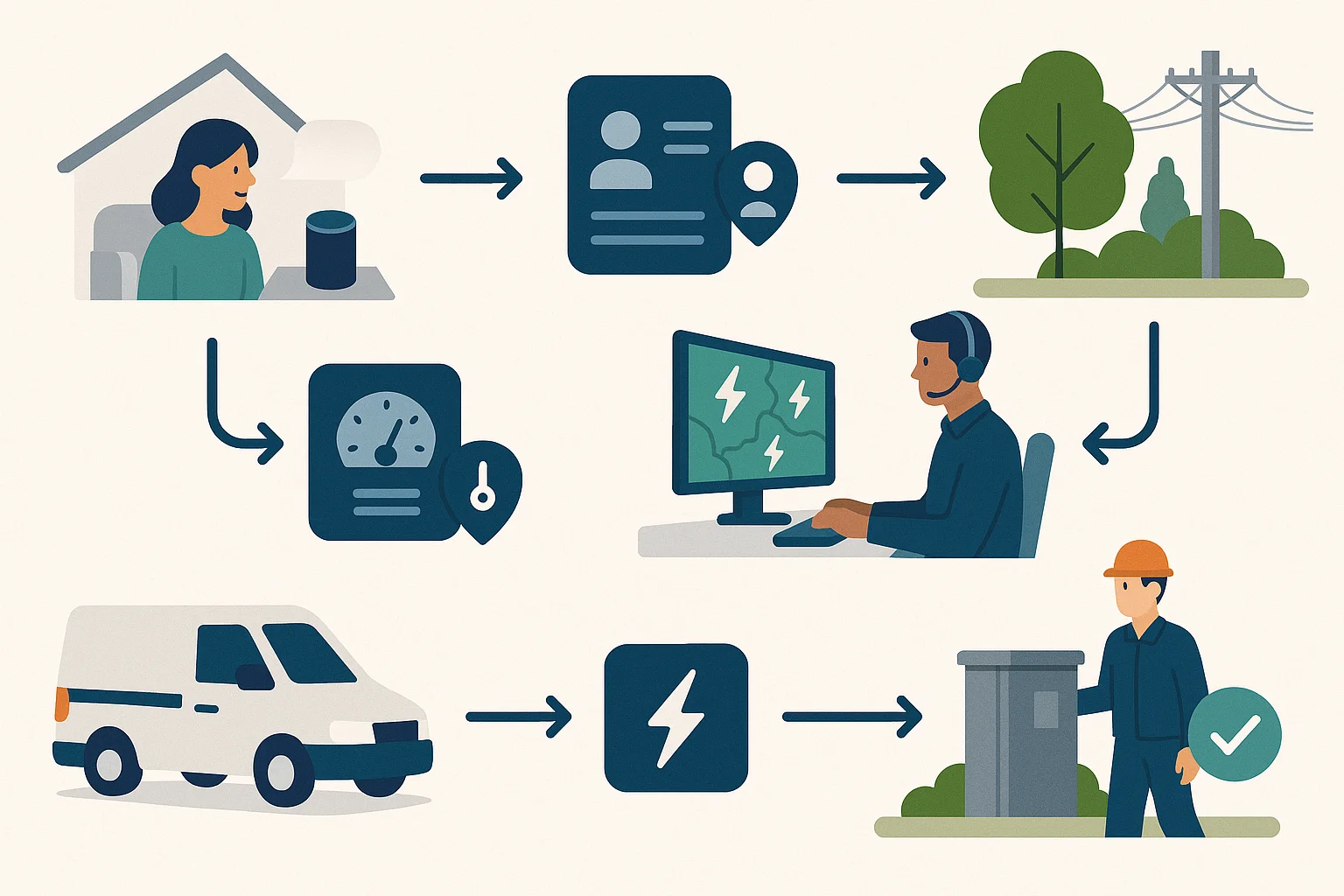
Use deterministic, minimally invasive validation. A practical workflow: call arrival → confirm account/premise using masked identifiers (last 4 of account number, service address partial, or tokenized account ID) via approved read‑only API → present options and allow only pre‑approved non‑destructive actions (status, outage report, meter reading intake). For actions that change accounts or schedule field work, require an additional verification factor or human handoff.
- Prefer read‑only API lookups for automatic status responses; limit write operations to confirmed, approved workflows.
- Verification options: knowledge‑based checks that avoid collecting additional sensitive PII, short OTP to registered phone/email, or in‑call human validation.
- For field scheduling, require cleared route validation and confirmation before creating dispatch orders.
Approved APIs, adapters, and orchestration
Govern the integration catalogue. Every adapter must be certified against your integration policy: authentication method, allowed scope, rate limits, and error semantics. The orchestration layer should enforce a strict API contract and perform defensive checks (schema validation, attribute whitelisting, and permission gates) before any outbound write to CIS/OMS/field systems.
- Certification checklist: agreed SLA, failover behavior, data schema, and monitoring hooks.
- Orchestration responsibilities: idempotency, retries, transaction logging, and compensating actions.
- Fail‑safe behavior: on adapter error, preserve customer acknowledgement but escalate to human workflows rather than attempt risky retries.
4. Predictive operations and cross‑channel orchestration
Predictive operations connect telemetry and customer signals to proactive communications. Cross‑channel orchestration ensures the same decision and message state is visible across voice, SMS, email, and field systems.
Predictive triggers, event‑level analytics, and routing
Feed outage telemetry (grid alarms, SCADA alerts, meter loss patterns) and historical call volumes into event‑level analytics that can predict communication demand. Governance must define which predictive triggers are allowed to initiate outbound notifications and which only generate internal alerts. Use deterministic rules for routing (e.g., priority by impacted critical customers or service class) and measurable thresholds for when automated notifications are allowed.
- Differentiate predictive triggers for informational vs. action‑required communications.
- Prioritize routing to reduce false positives: thresholded signals + corroborating system status.
- Ensure analytics outputs include confidence scores and explainable attribution for audit.
Cross‑channel state reconciliation
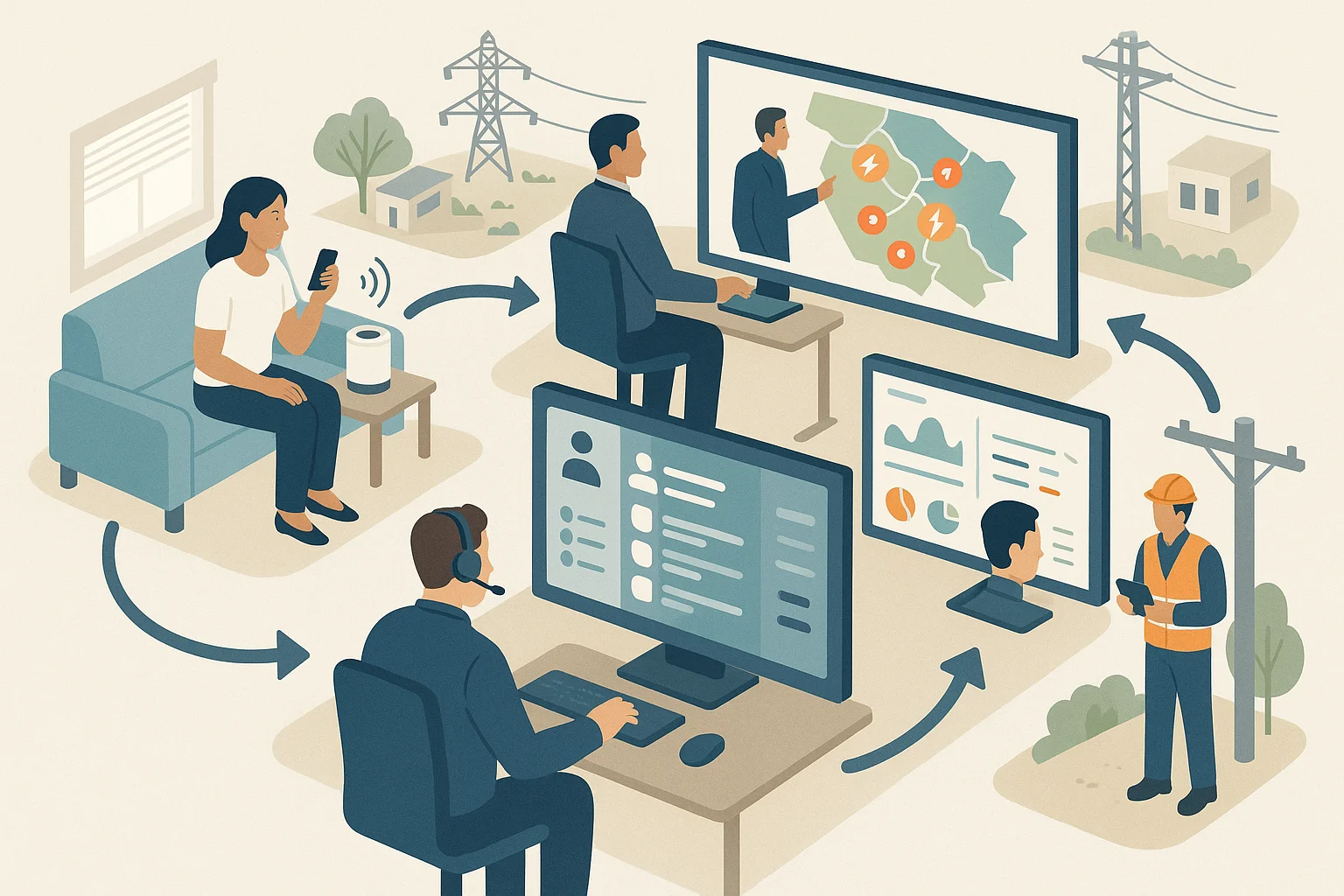
Maintain a single authoritative transaction state for each customer event. The orchestration layer must reconcile updates across channels to avoid inconsistent messages (e.g., voice agent says restoration imminent while SMS lists a later ETA). Use event sourcing or a transaction log to track state transitions and require all channels to read the same state before sending an outbound message.
- Implement a canonical event model for outage and service events with immutable timestamps and actor IDs.
- Enforce channel gating: do not escalate or send follow‑ups until confirmation of state change from authoritative systems.
- Log channel‑level deliveries and customer acknowledgements for audit and analytics.

5. Safety boundaries, failure modes, and incident playbooks
Define how the system fails gracefully and who acts when integrations or models degrade. Safety is operational and procedural: stop unsafe automation, escalate early, and keep customers informed consistently.
Human‑in‑loop escalation and safety boundaries
Explicitly list prohibited automation that requires human approval (e.g., switching, remote isolation, crew dispatch without human validation). Implement human escalation points in every customer flow and set guaranteed handoff SLAs during peak events. Voice AI must surface confidence metrics and clear invites to transfer to an agent when confidence is below threshold or when the customer requests help.
- Prohibit Voice AI from executing safety‑critical commands; require human validation and documented authorizations.
- Use confidence scores to gate automated actions and to trigger immediate human handoff at defined thresholds.
- Design handoff to preserve context so human agents can pick up without repeating verification steps.
Failure modes, surge capacity, and fallback
Plan for predictable failure modes: external API outages, model degradation, database latency, transcription errors, and sudden call surges during incidents. Define capacity thresholds that trigger progressive fallbacks: (1) degrade to read‑only responses, (2) use simple IVR scripts, (3) divert to overflow agents, and (4) publish channel‑level outage notices. Maintain a runbook that maps each failure signature to a set of actions and an owner.
- Surge handling: pre‑scale synthetic channels, rate limit non‑critical tasks, and prioritize emergency flows.
- Fallback tiers: read‑only status → scripted IVR → human overflow → public broadcast.
- Playbooks must include communication templates, estimated time to recovery, and post‑event root‑cause analysis steps.
6. Procurement, vendor evidence, and measurable outcomes
Procurement should demand operational evidence, not just feature lists. Vendors must demonstrate how they meet your controls, observability, and incident playbook requirements.
Evaluation criteria and contractual controls
Assess vendors on integration controls, logging granularity, human‑handoff latency, surge performance, and their onboarding proof points. Require contractual clauses for security, subprocessor disclosures, audit access, and change control. Insist on vendor commitments for synthetic test access and periodic independent QA reports.
- Ask for documented integration certification steps and runbook alignment during evaluation.
- Require subprocessor lists and hosting region disclosures, and define acceptable remedial timelines for incidents.
- Include SLOs for human handoffs, false‑action rates, and availability for outage notification flows.
Measurable KPIs and auditability
Define KPIs that map to operational risk. Useful measures: percentage of calls handled end‑to‑end without human touch for approved non‑destructive queries; escalation rate; false‑action rate (incorrect writes attempted); time to human handoff; and MTTR for integration failures. Require event‑level logs and replayable traces for a statistically significant sample for audits.
- Event‑level analytics: correlated call session → validation steps → adapter responses → final action.
- Quality gates: monthly QA sampling, continuous synthetic tests, and quarterly independent audits.
- Reporting cadence: daily during outages; weekly operational reviews otherwise.
Vendor evidence and references
Demand evidence beyond slideware: staged proofs with your data, live synthetic load tests, replayable outage scenarios, and documented human‑handoff tests. Request runbooks and incident response collaborations as part of the pilot and include acceptance criteria in the purchase order.
- Proofs required: staging with live APIs (read‑only), synthetic surge test report, and documented handoff latencies.
- Operational acceptance: signed checklist including security review, performance tests, and regulatory disclosure checks.
- Include clear termination and data extraction clauses to protect continuity.
Related Peak Demand resources
Industry and AI sources reviewed
- AI Risk Management Framework — Critical Infrastructure ProfileNational Institute of Standards and Technology (NIST)
- Cybersecurity Capability Maturity Model (C2M2)U.S. Department of Energy
- Cross-Sector Cybersecurity Performance GoalsCybersecurity and Infrastructure Security Agency (CISA)
Utility cybersecurity, critical-infrastructure, records, customer-protection, and emergency-communications obligations vary by jurisdiction and service type. This article is operational guidance, not legal advice; organizations should confirm applicable requirements with qualified professionals.
Frequently asked questions
Good starting points include billing and account questions, move-in or move-out intake, appointment scheduling, service-request capture, outage-status messaging from approved systems, payment-routing assistance, and structured escalation. Safety-critical and infrastructure-control decisions should remain with qualified utility teams.
Official reference: Cross-Sector Cybersecurity Performance Goals
Use the minimum approved identifiers needed for the workflow, validate them against the utility's system of record, limit data exposure, and provide a human-assisted path when verification fails. The Voice AI should not guess account, premise, or outage information.
Official reference: Cross-Sector Cybersecurity Performance Goals
Use controlled adapters, strict schemas, timeouts, retries, audit logs, safe failure states, and human escalation. The system should distinguish approved utility data from model-generated language and should never present stale or unverified operational information as fact.
Official reference: Cybersecurity Capability Maturity Model (C2M2)
Track containment by request type, successful validations, transfers, abandoned calls, integration errors, incorrect or stale responses, time to resolution, customer follow-up, and the percentage of cases completed safely without manual rework.
Official reference: Cybersecurity Capability Maturity Model (C2M2)
Build resilient utility customer-service automation
Peak Demand helps utilities connect Voice AI to approved customer-information, outage-communication, service-request, dispatch, escalation, and analytics workflows.
Schedule a discovery call


