
Operator‑in‑the‑Loop Controls for Autonomous Transit Voice AI Operations
A practical, operational framework for putting human operators back in the loop for Voice AI handling of scheduled transit information, detours and service alerts, and dynamic service-request forms. Concrete controls, workflows, failure boundaries, procurement considerations, and measurable outcomes for transit operations leaders.
1. Why operator‑in‑the‑loop matters for transit Voice AI
Transit agencies adopt Voice AI to reduce friction for common rider questions and to intake service reports. But public transit mixes predictable schedule information and unpredictable service alerts; treating them the same invites operational risk. This section sets the practical boundary conditions and the architecture used throughout the framework.
Predictable schedules versus real‑time alerts
Transit interactions fall into two distinct technical classes. Scheduled queries — e.g., published timetables, stop names, route descriptions — are best answered from a controlled, versioned schedule knowledge base. Service‑critical items — delays, detours, vehicle substitutions, temporary stop closures — must be sourced through approved service‑alert APIs and dynamic forms and treated as transient operational state. Operationally, Voice AI must never invent a service‑alert or override an agency’s published schedule without explicit, validated API confirmation.
- Answer schedule questions from a read‑only, versioned schedule knowledge base.
- Treat alerts and detours as transient; resolve through service‑alert APIs or an approved team workflow.
- Avoid predictive next‑bus commitments unless a validated, fast real‑time vehicle‑position or headway feed is authorised by operations.
Canonical operating model (Rider → Voice AI → controlled sources → validation → outcome)
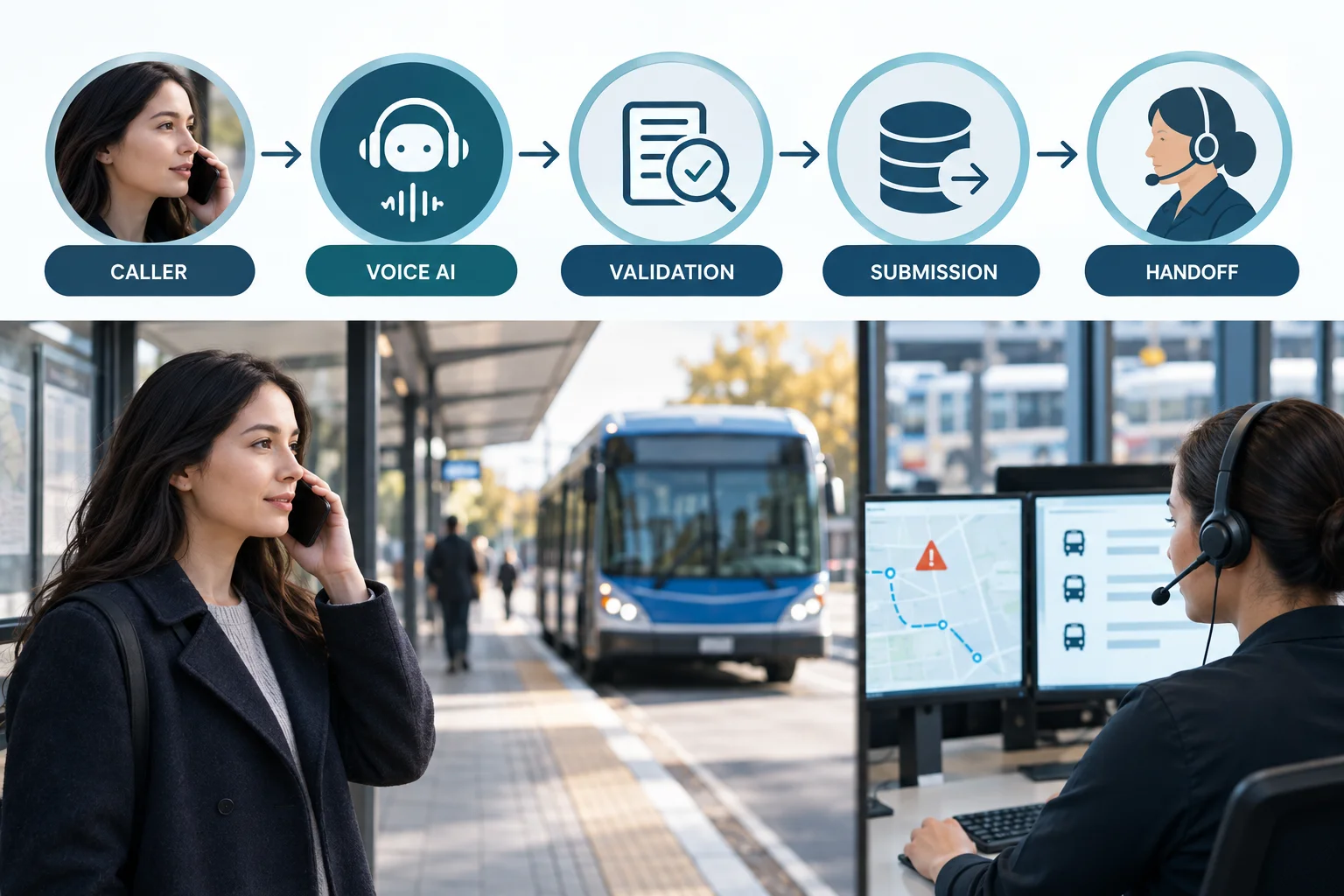
Use this deterministic flow for every interaction that could affect rider decisions or create operational records: Rider → Voice AI → controlled schedule knowledge base for published timetable answers OR approved service‑alert APIs and dynamic service‑request forms for detours/delays → validation layer (automated checks and operator review) → final outcome (automated response, case submission, or human handoff). This model keeps routine answers fully automated while placing an explicit decision boundary before any service‑impacting action.
- Controlled schedule knowledge base for static information.
- Service‑alert APIs and dynamic forms for transient operational state and intake.
- Validation layer enforces deterministic checks and queues human review when thresholds are exceeded.
2. Controls for scheduled‑knowledge responses
Controlled schedule knowledge is the safest domain for autonomous Voice AI. This section explains how to author, version, and operate the schedule knowledge base so responses remain auditable, accurate, and updatable by operations staff.
Content curation, versioning and single source of truth
Gate all schedule answers to a versioned content store that mirrors the agency’s authoritative timetable systems (GTFS static or an agency CMS). Content authorship must follow change control: edits trigger a publish job, a validation test, and a timestamped deployment. Keep a rollback path and an observable feed for QA teams to verify samples of daily utterances.
- Authoritative schedule content must be explicit: route names, stop names, first/last trip times, service calendars.
- Publish changes only after validation tests and a documented sign‑off from schedule operations.
- Log every published version and the mapping used by the Voice AI at call time for dispute resolution.
Answer templates and conservative phrasing
Configure Voice AI responses from templated, auditable sentences generated from canonical fields. Avoid open‑ended generation for any scheduled items: always render requested fields into preapproved templates. When a caller asks for timing near the edge of scheduled service (e.g., 'next bus now'), use conservative, time-to-call guidance that indicates data authority and potential latency.
- Use templates that include data provenance lines (e.g., 'According to the published timetable as of [date/time]...').
- If policy does not permit real‑time predictions, reply with the scheduled departure and advise callers to check live signage or an operator for confirmed.
3. Integration and validation for service‑alert APIs and dynamic forms
Detours, delays and incident-based changes require a different approach: rapid API validation, dynamic forms for structured intake, and rules to prevent unsafe automated actions. This section covers design patterns and failure boundaries.
API integrations and determinism
Integrate approved service‑alert APIs through an API gateway that enforces schema validation, TTLs (time‑to‑live) for cached alerts, and signature checks. Voice AI should query the gateway for service status and use deterministic rules to decide whether to present an alert, escalate, or create a case. Cache policies must balance latency and correctness: for rapidly changing incidents, prefer fresh API responses and fall back to a clearly labelled 'last confirmed' cache only when the API is unreachable.
- Validate incoming API payloads against a known schema and reject malformed alerts.
- Define explicit cache TTLs and stale‑data messaging for callers (e.g., 'The detour was last confirmed at [time]').
- Log API request/response pairs for every issued alert for later auditing.
Dynamic service‑request forms and safe submission
When a caller reports a non‑standard condition (obstruction, accessibility issue, lost property, or driver behaviour), Voice AI should collect structured fields using a dynamic form engine—location, time, severity, and contact consent. The system validates required fields, deduplicates similar open cases, and only submits a case to the back office after passing automated plausibility checks. If a submission changes service operations (e.g., requires rerouting a vehicle), the system requires operator approval before any onward operational action.
- Use dynamic forms with required fields and in‑call confirmation of critical data (stop name, time, severity).
- Perform automated duplicate detection against recent cases before creating new records.
- Do not trigger operational changes (dispatch, reroute, remove a vehicle from service) without validated human approval.
4. Operator‑in‑the‑loop workflows and SLAs
Design operator queues, decision gates, and SLAs that keep operators informed but not overwhelmed. This section provides concrete workflow patterns, handoff criteria, and performance targets that are practical for municipal and transit control centres.
Validation queue types and prioritisation
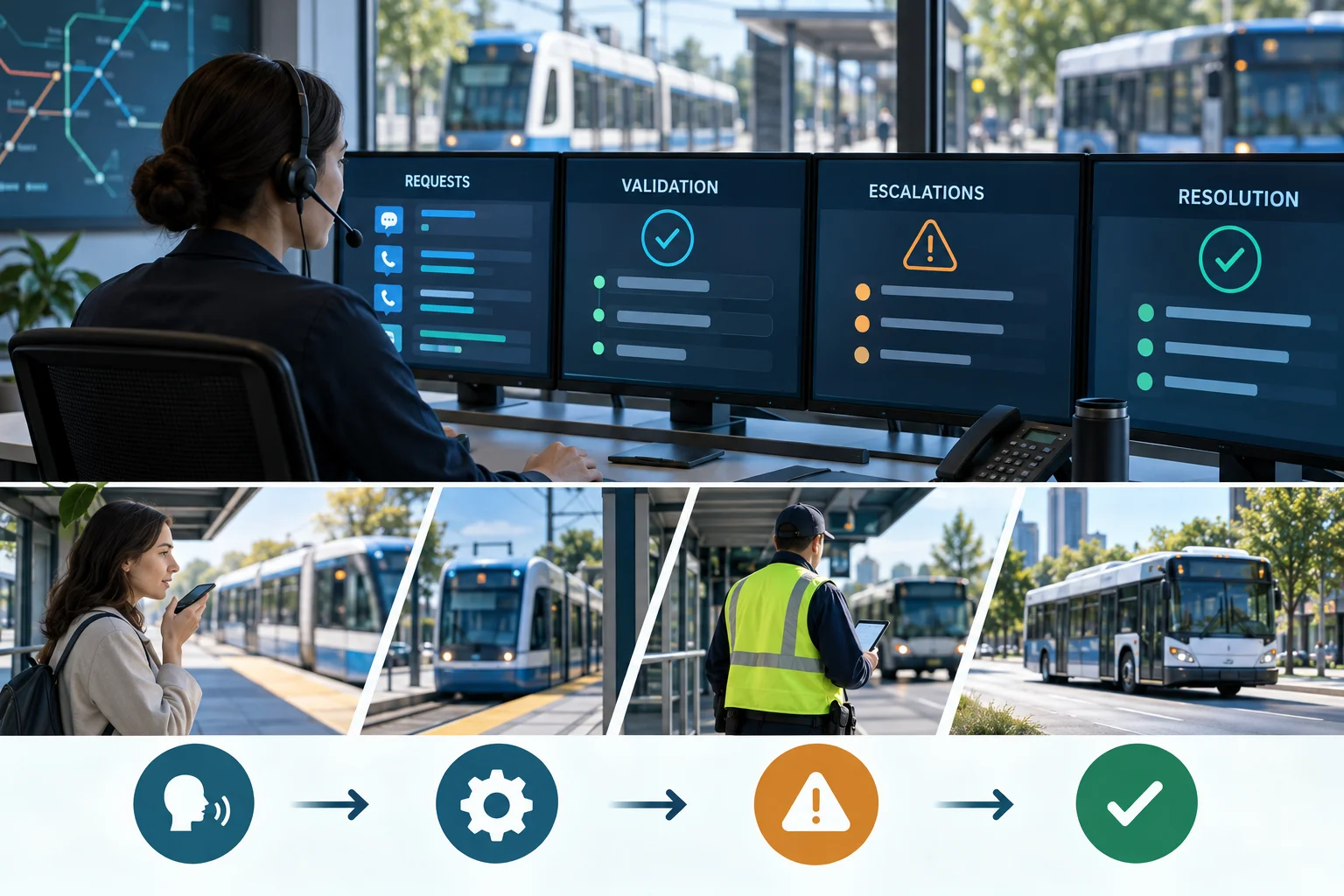
Create at least three validation queues: informational (low risk), corrective (requires action but not safety critical), and safety‑critical (requires immediate human attention). Classification occurs automatically from intent, confidence score, and content flags (e.g., incident severity field). Prioritise safety‑critical items for immediate routing to a staffed operations console; low‑risk items can be batched for next‑shift review.
- Confidence thresholds: if AI confidence is below an agreed threshold for the intent, route to operator review.
- Safety flags (injury, fire, roadway obstruction) must break any batching and route to a live dispatcher.
- Provide operators with contextual breadcrumbs: original audio transcript, form fields, recent API alert history, and relevant schedule snapshots.
Handoff UI, audit trails and operator actions
Operators need a concise, action‑centric handoff UI: a clear case summary, suggested actions, and buttons for approve, reject, escalate, or request more info. Every operator decision must be timestamped, associated with an operator ID, and recorded in the audit trail. Implement role‑based access so only certain operator roles can approve operational changes.
- Record operator inputs, edits to form fields, and the final disposition in an immutable audit log.
- Allow operators to attach comments and to re‑initiate a short call with the rider for clarification if consent and privacy policy permit.
- Expose queue and operator metrics (average time to decision, rejection rate) to governance dashboards.

5. Governance, risk management and cyber resilience
Operator‑in‑the‑loop is not just an operational pattern; it must sit inside governance and risk processes. This section maps practical governance controls and references established AI and infrastructure guidance.
Model and operational risk management
Apply a risk‑management lifecycle to the Voice AI components: identify potential harms (misinformation, privacy exposure, service disruption), assess likelihood and impact, implement controls (content templates, validation gates, operator review) and monitor outcomes through KPIs and post‑incident reviews. Maintain a model and content change register and perform periodic QA sampling to detect drift or content regressions.
- Maintain a risk register that maps intents to potential harms and existing controls.
- Schedule periodic red‑team or simulation exercises for incident types (e.g., multi‑stop detours).
- Run production sampling and manual review of denied or operator‑routed interactions to measure false positives/negatives.
Cybersecurity and infrastructure resilience
Protect integration points—service‑alert APIs, case submission endpoints, and dynamic‑form backends—with hardened API gateways, mutual TLS, and least‑privilege service credentials. Plan for degraded modes: when real‑time APIs are unavailable, the Voice AI should revert to a labelled ‘last confirmed’ message and route actionable reports directly to operator queues rather than making automated statements about service status.
- Authenticate and authorize all API calls; log and alert on unexpected schema or traffic patterns.
- Design explicit degraded‑mode messages and failover routes to operator review.
- Coordinate cybersecurity practices with agency IT and align resilience plans with transportation sector guidance.
6. Procurement, deployment and measurable outcomes
Finally, procure and operate with clear responsibilities, observable metrics, and a conservative rollout plan. This section lists procurement artifacts and pragmatic pilot success criteria.
Procurement checklist and vendor scope
When procuring vendors or managed services, specify responsibilities for: API adapter development, schema validation, logging and observability, operator UI, SLAs for uptime and latency of critical integrations, and the obligations for data residency and subprocessors. Avoid procuring black‑box assurances without contractual observability (logs, traces) and clear remediation commitments.
- Contract for access to raw logs and request/response traces necessary for operational post‑mortems.
- Define hosting region, backup region, subprocessors, remote‑support access rules, and any cross‑border transfer mechanisms.
- Require vendor participation in joint tabletop exercises and provide acceptance criteria for API adapters and validation rules.
Pilot metrics and scale gates
Pilot deployments should track operational KPIs that show safe automation: percentage of interactions handled without operator review, average validation queue time, operator rejection rates, duplicate detection rate, and caller satisfaction for routed intents. Scale only after meeting conservative quality gates for accuracy, safety triage, and operator workload.
- Suggested pilot gates: sustained low severity misclassification for scheduled queries and predictable operator queue lengths below staffed capacity.
- Measure system‑level outcomes: time saved per routine inquiry, case creation accuracy, and operator mean decision time.
- Use pilot learnings to tune confidence thresholds and refine validation rules before broader rollout.
Related Peak Demand resources
Industry and AI sources reviewed
- Transportation Systems SectorCybersecurity and Infrastructure Security Agency (CISA)
- Artificial Intelligence Risk Management Framework (AI RMF 1.0)National Institute of Standards and Technology (NIST)
- OECD AI PrinciplesOrganisation for Economic Co-operation and Development
Transit safety, accessibility, privacy, cybersecurity, records, and service-information obligations vary by jurisdiction and operating authority. This article is operational guidance, not legal advice; organizations should confirm applicable requirements with qualified professionals.
Frequently asked questions
Good starting points include lost property, complaints and feedback, stop or shelter issues, fare-machine faults, non-emergency accessibility service requests, schedule information from approved sources, and structured routing to customer service or field teams.
Official reference: Artificial Intelligence Risk Management Framework (AI RMF 1.0)
Use GTFS Realtime only when the agency exposes suitable feeds and the workflow genuinely needs service alerts, trip updates, or vehicle positions. The integration should validate freshness and availability, and the agent should avoid presenting stale feed data as a guaranteed arrival prediction.
Emergency, security, injury, crime, and safety-critical reports should follow approved transfer or emergency-routing procedures. Voice AI may detect and route the call, but it should not make operational safety decisions or replace trained personnel.
Official reference: Transportation Systems Sector
Request realistic call testing, feed and system failure handling, service-request integration, transfer context, audit logs, accessibility channels, monitoring, change control, and evidence that the agent distinguishes scheduled information from dynamic service alerts.
Official reference: Artificial Intelligence Risk Management Framework (AI RMF 1.0)
Design the transit service workflow before automating it
Peak Demand helps transit teams connect Voice AI to rider information, service requests, approved live-data sources, escalation, confirmation, and analytics.
Schedule a discovery call


