
Operating Model for Voice AI as Operational Technology in Utilities
A practical operating model for deploying Voice AI as operational technology across electric, water, gas, and municipal utilities—covering call flows, validation, integrations, escalation, governance, and measurable outcomes.
1. Introduction and operating premise
Voice AI is now a production-grade operational technology for many utilities when treated as a defined workflow engine for customer-service and outage communications. This section clarifies scope, boundaries, and the core workflow designers must enforce.
Scope and boundaries
Voice AI in utilities should be scoped to customer-facing, non-actuating tasks: intake of service requests, outage information, status checks, scheduling, and routing to field crews. It must not make safety-critical infrastructure decisions or initiate physical operations (switching, switching commands, or gas shutoffs). Explicit architectural separation, logging, and human oversight are mandatory.
- Primary uses: outage reports, service requests, account status, appointment scheduling, and basic billing inquiries.
- Explicit exclusions: remote actuation, protective relay control, gas valve activation, and emergency dispatch without human confirmation.
- Operational boundary: deterministic workflows with explicit human escalation for ambiguous or critical intents.
Core workflow (decision backbone)
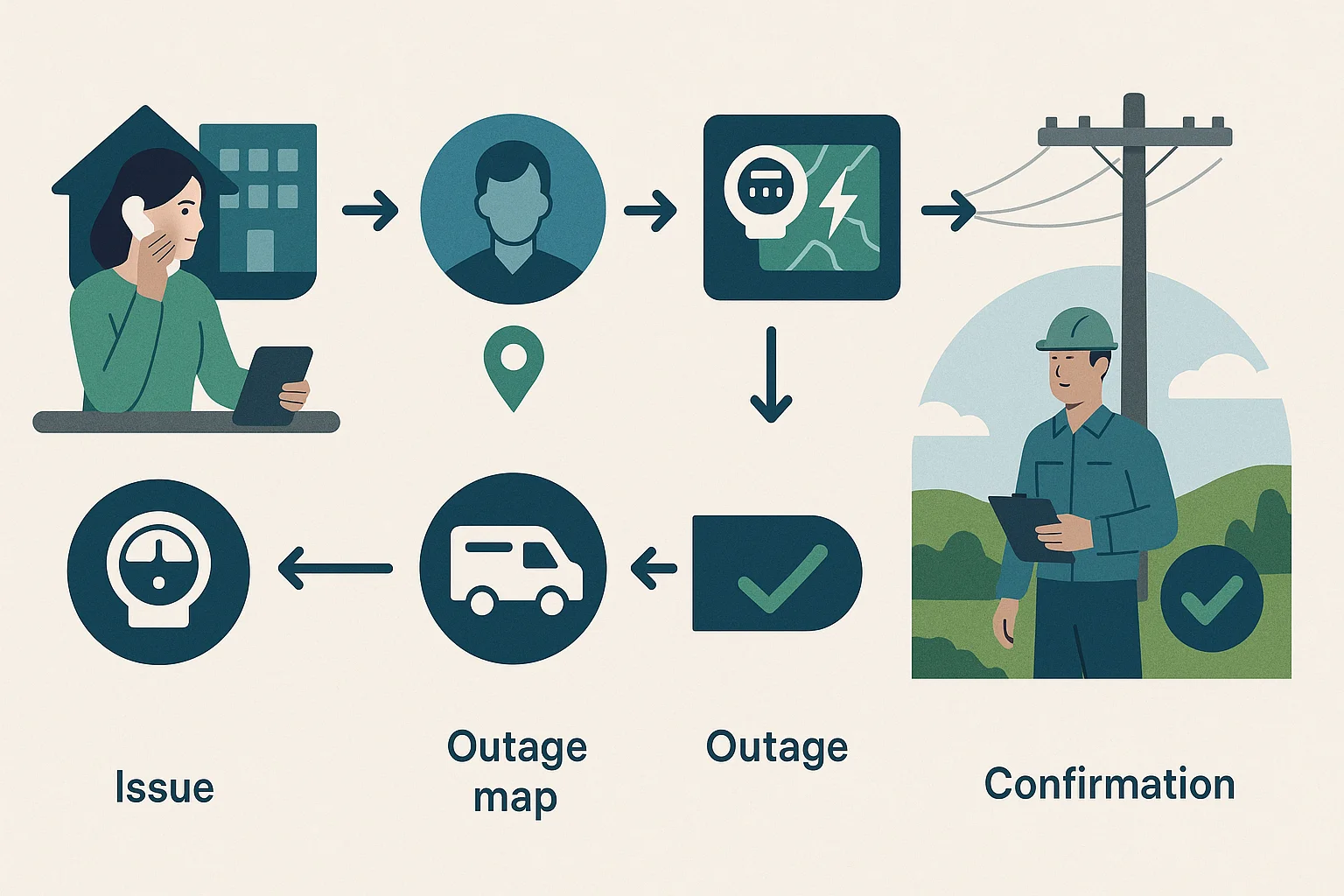
A reliable operating model formalizes a single, auditable workflow: Customer call → Voice AI intake → account or premise validation → query approved system/knowledge source via an approved API/adaptor → outcome (status response, create/modify service request, or human escalation). Each transition is an enforceable gate with observability and rollback.
- Gate 1 — Caller identification: ANI plus two-factor premise validation when required by policy.
- Gate 2 — Intent classification: deterministic NLP classifier with confidence thresholds that trigger human handoff.
- Gate 3 — Data retrieval: read-only queries to OMS/CIS/CRM via approved API; any write operation requires higher confidence and validated identity.
- Gate 4 — Action: status response, service-request creation with summary and ticket ID, or immediate escalation to a human agent.
2. Integration architecture and data contracts
Integration choices determine operational reliability. Define minimal, hardened integration points, data contracts, and an event architecture that preserves accuracy and traceability.
Approved APIs, adapters, and data contracts
Deploy Voice AI behind a controlled adapter layer that exposes only required read/write operations to underlying systems (OMS, CIS, CRM, workforce management). Data contracts must specify fields, types, validation rules, allowable operations, and failure semantics. Where possible prefer read-only calls for routine answers; require multi-factor validation and human approval for writes that change service state.
- Adapter responsibilities: authentication, rate-limiting, input sanitization, and canonical event emission.
- Data contract elements: schema, required fields (account ID, premise ID, timestamp), error codes, retry semantics, and idempotency keys.
- Failure semantics: explicit return codes for 'unknown account,' 'pending outage,' or 'write blocked' to drive deterministic Voice AI behavior.
Event architecture and observability
Emit a structured event at each workflow gate: intake, validation, API call, action decision, and handoff. Events feed real-time dashboards, QA sampling, and post-incident forensics. Design events to include minimal PII and link tokens to the canonical system-of-record for deeper audit when required.
- Event payloads: gate, timestamp, confidence score, API response code, action taken, and operator ID on human handoffs.
- Observability: latency, error rates, confidence score distribution, false-handoff rates, and end-to-end SLA for response creation.
- Analytics: per-circuit outage detection signals, call-source clustering, and event-level reconciliation against OMS updates.
Further reading
For technical patterns on data contracts and event architecture in utility Voice AI deployments, consult Peak Demand's guide on Data Contracts and Event Architecture.
- https://blog.peakdemand.ca/post/data-contracts-event-architecture-utility-voice-ai
3. Governance, risk controls and safety boundaries
Utilities must govern Voice AI as critical infrastructure software. Governance needs to bind the model lifecycle, labeling, human oversight, and cybersecurity posture to enterprise risk processes.
AI governance for critical infrastructure
Define policy that maps intents to permitted actions, confidence thresholds for automation, and explicit escalation patterns. Maintain an audit trail for model decisions, training-data provenance, and QA sampling. Regularly review model behavior against business rules and safety scenarios.
- Operate under a documented acceptance policy: what intents can be fully automated, which require human confirmation, and which are blocked.
- Continuous QA loop: periodic sampling, adversarial scenario tests, and metric-driven retraining controls.
- Auditability: store transcripts, event tokens, and decision metadata for post-incident review.
Cybersecurity and operational resilience
Segment Voice AI infrastructure from OT control networks and apply tiered cybersecurity controls. Include network segmentation, least-privilege API credentials, and monitoring aligned to cross-sector cyber-performance goals. Define backup regions, subprocessors, and remote-support access in procurement documents.
- Network and identity: segregated VLANs, strong mutual TLS for adapters, and scoped service accounts with short-lived tokens.
- Resilience: multi-region hosting, defined backup region, and documented restore objectives for the Voice AI platform and adapters.
- Supply chain: disclosure of subprocessors and remote-support access policies; contractual obligations for breach notification and data handling.
Account-safe validation and privacy
Account or premise validation is the primary guardrail. Use call-origin (ANI), account tokens, or two-step knowledge checks according to risk. Limit PII retention and classify transcripts by retention policy. Confirm recording consent where local law requires it and document cross-border data flows.
- Validation tiers: low-risk (ANI + service address match), medium-risk (partial account number or DOB fragment), high-risk (two-factor out-of-band confirmation).
- Data residency: specify hosting region and backup region; require vendor disclosure of processor locations and international transfers.
- Retention: define transcript and event retention windows aligned to audit and regulatory needs, and document breach notification duties.
4. Operations, human-in-loop design, and surge management
Operational reliability depends on clear handoff rules, staffing models, and surge-handling playbooks aligned to outage seasons or extreme events.
Human-in-loop routing and SLA design
Design escalation paths by intent and confidence. For example, safety-related intents and low-confidence classifications route directly to trained outage-communications staff. Define SLAs for handoff acknowledgement, queue wait times, and ticket resolution.
- Handoff metadata: include confidence score, summary, and recommended action to reduce triage time.
- Tiering: Level 1 (routine billing/service requests), Level 2 (outages, safety-adjacent), Level 3 (field coordination or emergency liaison).
- SLAs: define target handoff acknowledgement (e.g., 60 seconds for Level 2) and measurable queue-preservation behavior during surges.
Surge capacity, graceful degradation, and incident playbooks
Prepare explicit degradation modes: reduced-function Voice AI (status-only), outbound notification-only mode, and full human takeover. Maintain queue state so callers can be returned to context when systems recover. Practice the incident playbook with drills and maintain call-routing fallbacks.
- Degradation modes: limit write operations, switch to read-only, or route all calls to agents depending on severity.
- Queue preservation: preserve interaction state and idempotency keys to avoid duplicate service requests post-failover.
- Testing: regular scenario-based drills for mass-outage surges and supplier failures; document fail-open vs fail-closed behavior.
Incident response and business continuity
Operational incident response must include runbooks for Voice AI failures, API adapter outages, and degraded integrations. Define roles: platform operator, integration lead, communications lead, and incident commander. Ensure incident artifacts feed post-incident reviews and continuous improvement.
- Runbooks: immediate mitigation steps, escalation contacts, and communications templates for customers and regulators.
- Roles and responsibilities: clear RACI for platform restore, system-of-record reconciliation, and customer communications.
- Post-incident: root-cause analysis, corrective action plan, and validation checks before returning to normal operations.

5. Procurement, vendor evaluation, and contract controls
Procurement must move beyond feature lists to integration and operational risk. Contracts must allocate responsibilities for integration, observability, security, and incident response.
Vendor evaluation checklist
Evaluate vendors against operational criteria: high-volume call handling, outage routing experience, adapters for OMS/CIS/CRM, account-safe validation, and demonstrable observability. Request technical references that demonstrate integration at the required scale and domain.
- Ask for architectures showing adapter patterns, failure modes, and handoff flows.
- Require proof of integration with one or more utilities' OMS/CIS/CRM (anonymized reference) and evidence of outage-handling playbooks.
- Validate event-level analytics and the ability to export structured events for in-house dashboards and reconciliation.
Contract terms and acceptance tests
Contract language should specify SLAs, data residency, subprocessors, remote-support access, breach notification timelines, and a library of acceptance tests. Acceptance tests should include end-to-end scenarios: account validation failures, duplicate-call prevention, surge events, and human handoff quality.
- Define technical acceptance tests with pass/fail criteria and test data variants for edge cases.
- Specify observability outputs: raw events, latency histograms, and confidence score distributions for each API call.
- Include termination and transition clauses that cover data export formats, retention windows, and adapter handover.
Further reading
For operational vendor assessment and integration risk guidance, see Peak Demand's vendor evaluation guide and service pages on Voice AI for utilities.
- https://blog.peakdemand.ca/post/evaluate-voice-ai-vendors-integration-risk-utilities
- https://peakdemand.ca/voice-ai-for-utilities

6. Measurable outcomes and phased implementation roadmap
Define the metrics that matter and a realistic phased rollout that moves the organization from pilot to production while preserving service reliability.
Key metrics and dashboards
Measure operational reliability, quality, and business outcomes. Focus on traceable, event-driven metrics that drive governance decisions and procurement renewals.
- Reliability: API success rates, end-to-end latency, and mean-time-to-recover for adapter failures.
- Quality: intent accuracy at decision threshold, false-handoff rate, and transcription accuracy for QA sampling.
- Business outcomes: percent of calls resolved without human takeover, time-to-ticket-creation, and correct-service-request rate.
Phased rollout and acceptance gates
Adopt a staged rollout: sandbox → limited pilot (low-risk intents) → expanded pilot (outage read-only) → full production with controlled writes. Define acceptance gates at each stage with measurable pass/fail criteria tied to the metrics above.
- Sandbox: integration and event-validation tests without live customers.
- Pilot: real callers but limited intents and high-frequency QA sampling.
- Production: broaden intents and reduce QA sampling cadence, with continued monitoring and automated alarms.
Failure boundaries and rollback
Pre-define rollback conditions: repeated adapter failures, confidence-drop anomalies, or unacceptable false-handoff rates. Rollback should preserve call-state and avoid creating duplicate service requests.
- Conditions to pause automation and route to human agents.
- State-preserving rollback to ensure callers are routed back into the same interaction context after recovery.
- Reconciliation: compare Voice AI-created tickets against OMS records and reconcile duplicates or mismatches.
Related Peak Demand resources
Industry and AI sources reviewed
- AI Risk Management Framework — Critical Infrastructure ProfileNational Institute of Standards and Technology (NIST)
- Cross-Sector Cybersecurity Performance GoalsCybersecurity and Infrastructure Security Agency (CISA)
- Cybersecurity Capability Maturity Model (C2M2)U.S. Department of Energy
Utility cybersecurity, critical-infrastructure, records, customer-protection, and emergency-communications obligations vary by jurisdiction and service type. This article is operational guidance, not legal advice; organizations should confirm applicable requirements with qualified professionals.
Frequently asked questions
Good starting points include billing and account questions, move-in or move-out intake, appointment scheduling, service-request capture, outage-status messaging from approved systems, payment-routing assistance, and structured escalation. Safety-critical and infrastructure-control decisions should remain with qualified utility teams.
Official reference: Cross-Sector Cybersecurity Performance Goals
Use the minimum approved identifiers needed for the workflow, validate them against the utility's system of record, limit data exposure, and provide a human-assisted path when verification fails. The Voice AI should not guess account, premise, or outage information.
Official reference: Cross-Sector Cybersecurity Performance Goals
Use controlled adapters, strict schemas, timeouts, retries, audit logs, safe failure states, and human escalation. The system should distinguish approved utility data from model-generated language and should never present stale or unverified operational information as fact.
Official reference: Cybersecurity Capability Maturity Model (C2M2)
Track containment by request type, successful validations, transfers, abandoned calls, integration errors, incorrect or stale responses, time to resolution, customer follow-up, and the percentage of cases completed safely without manual rework.
Official reference: Cybersecurity Capability Maturity Model (C2M2)
Build resilient utility customer-service automation
Peak Demand helps utilities connect Voice AI to approved customer-information, outage-communication, service-request, dispatch, escalation, and analytics workflows.
Schedule a discovery call


