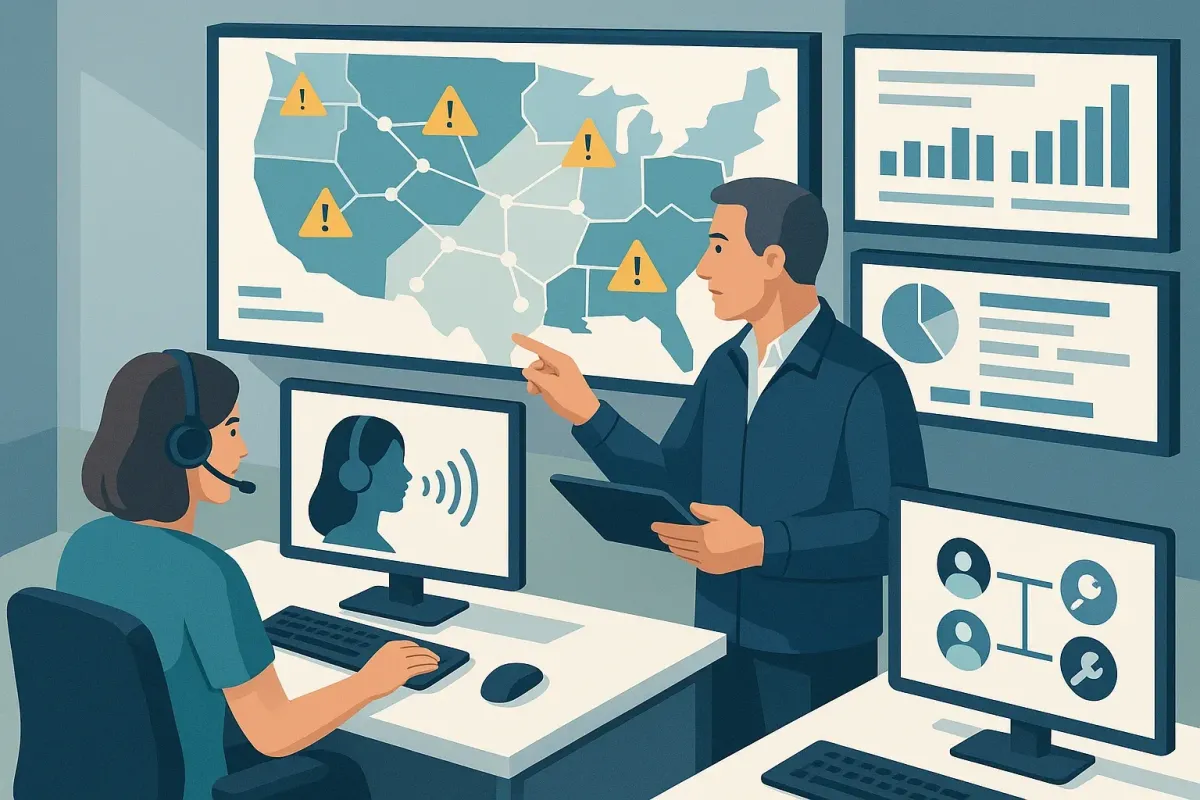
Measuring Voice AI Resolution Quality in Utility Contact Centres
A practical operational framework for utility leaders to measure and manage Voice AI resolution quality across outage communications, service requests, multilingual operations, and multi‑site scale.
1. Why operationalise Voice AI resolution quality for utilities
Voice AI is now an operational channel for outage information, service requests, status checks, and scheduling. Utility leaders must measure the quality of outcomes — not just ASR or intent scores — because poor outcomes affect safety perception, field workloads, regulatory scrutiny, and cost-to-serve.
What ‘resolution quality’ means in utility operations
Resolution quality is the degree to which a caller’s objective is properly and safely completed when routed through Voice AI. For utilities this includes: accurate outage communication, correct service‑request creation or status retrieval, validated premise or account actions, and escalation when required. It is an outcome metric aligned to operational goals (reduce manual handling during surges, reduce repeat contacts, preserve field-safety decisions for humans).
- Success is event‑level: the customer’s need is resolved, or an auditable human escalation occurs.
- Containment is necessary but insufficient: a contained call can still produce a misrouted work order or incorrect status.
- Escalation quality measures handoffs: correct routing, complete context, and minimal rework.
Why utilities must distinguish containment and escalation
Containment (Voice AI handles end-to-end) and escalation quality (Voice AI escalates when it cannot safely complete a task) are distinct operational properties. High containment with poor escalation can increase field rework and regulatory risk; low containment with reliable human handoff is preferable in safety‑critical contexts.
- Track them independently and cost them separately in cost-to-serve models.
- Design failure boundaries so that the Voice AI defaults to human handling for safety‑critical or ambiguous intents.
2. Core metrics and KPIs for resolution quality
Define a concise, operational KPI set. Metrics should be computable from event logs and linked to downstream system outcomes (OMS, CIS, work‑order systems).
Event-level KPIs (must-have)
Every call should produce an event record that supports these KPIs. The recorder must capture discrete stages: call start, ASR transcript, intent/path chosen, validation outcome (account/premise/location), API/knowledge lookup result, action outcome, and escalation status.
- Containment rate — % of calls resolved by Voice AI without human talk-time.
- Containment quality — % of contained calls that match QA ‘correctness’ criteria.
- Escalation success rate — % of escalated calls that require no re‑triage or missing context.
- First‑Contact Resolution (FCR) as observed in system state changes (work order created and confirmed, status updated).
- Repeat contact within X hours for same issue (surrogate for failed resolution).
Cost and operational KPIs
Translate operational outcomes into cost and capacity measures so leaders can evaluate tradeoffs between containment and escalation.
- Cost‑to‑serve per resolved call (voice AI processing + any downstream human minutes + field dispatch rates allocated).
- Escalation cost delta — average incremental cost when a call escalates versus being contained correctly.
- Surge handling index — containment and escalation performance under peak load (e.g., storm event).
- Multilingual parity score — KPI for equivalence across supported languages/sites.
3. Measurement architecture and data contracts
Reliable measurement depends on an event architecture and binding data contracts. Without consistent telemetry and schemas, QA and analytics are unreliable and downstream reconciliation is manual and error prone.
Event schema and minimum telemetry
Define a minimal, mandatory event schema for each call and store events in an immutable audit log. Each event should include stable identifiers (call ID, account/premise ID when validated), timestamps for each stage, transcripts, selected intent/path, validation proofs, API call IDs and responses, action IDs (work order, status response), escalation flags, and disposition labels.
- Persistent call ID to join recordings, transcripts, and downstream system events.
- Proof of validation: tokenised, minimal-proof statements (e.g., last 4 of account, premise ID, geo-fence confirmation) — avoid storing full PII where not required.
- API response capture and idempotency token for safely replaying or reconciling events.
- Audit-friendly recording of escalation handoff: agent ID, queue ID, and context payload.
Data contracts, adapters and approved APIs
Contractually define what your Voice AI provider can read, write, and store. Use controlled adapters and approved APIs between Voice AI and OMS/CIS/CRM. Contracts must specify field-level semantics, retention, error-codes, retry rules, and backout procedures.
- Define allowed write operations (create work order, update status) and required confirmation patterns (e.g., 2‑step confirmation for safety-affecting actions).
- Adapters should implement robust retry, idempotency, and dead‑lettering with clear human remediation paths.
- Production orchestration should include health-checks and circuit breakers to stop automated writes if downstream systems are degraded.

4. QA design: sampling, rubrics, and human escalation controls
A QA program turns telemetry into operational assurance. Design it to find both false positives (incorrect containment) and false negatives (missed containment opportunities) and to identify root causes for continuous improvement.
Sampling strategy and rubrics
Use blended sampling: random baseline samples, targeted samples (outage events, high-risk intents, failed validations), and negative-case mining (calls with high confidence but subsequent downstream correction). Each sample must be evaluated against a structured rubric that separates dialogue accuracy from business‑outcome correctness.
- Rubric axes: intent correctness, validation sufficiency, API/lookup correctness, action appropriateness, and escalation appropriateness.
- Severity coding: minor (UI/phrase), operational (incorrect status), critical (creates unsafe/outage-impacting action).
- Feedback loop: each sampled defect triggers a tagged remediation ticket with priority and owner.
Human escalation controls and handoff fidelity
Design explicit failure boundaries where Voice AI must escalate. Handoff fidelity metrics must ensure agents receive the full context so they need not re-collect critical data.
- Escalation triggers: ambiguous intent, failed or low-confidence validation, safety‑sensitive words or conditions, and mismatch between caller expectation and automated action.
- Context payload must include transcript snippets, validation tokens, API response snapshots, and recommended next steps.
- Handoff SLA and monitoring: measure time-to-agent, queue routing accuracy, and percent of escalations that required repeated collection.

5. Analytics, scale, and multilingual operations
Analytics must connect call-level events to operational outcomes and costs. Scale and multi-language support are frequent failure points that require explicit measurement and governance.
Event-level analytics for root-cause and outcomes
Use event joinability to map Voice AI events to downstream work orders, field dispatches, and billing entries. This enables precise measures of repeat contact, rework, and cost-to-serve attributed to automated flows.
- Join Voice AI event IDs with OMS/CIS/CRM transaction IDs for end-to-end lineage.
- Calculate rework rate: proportion of automated work-orders that required manual correction.
- Time-series analytics during incidents: monitor containment quality and escalation quality with minute-level granularity during storms.
Multi-site, multilingual and surge considerations
Measure parity across sites and languages. During storms or multi-site incidents, reallocate human capacity where Voice AI containment drops or escalation volume spikes.
- Language parity: track containment quality and error types per language; use targeted retraining and phrasebooks for locale-specific phrases.
- Surge capacity drills: test the full chain (ASR → intent → validation → API writes) under scaled load and measure degradation thresholds.
- Operational runbooks: pre-defined shunts (e.g., switch to status-only mode) when containment or escalation quality falls below safe thresholds.

6. Procurement, fail‑safe architecture and incident readiness
Procurement decisions set the boundary for your operational risk. Choose vendors and contractual terms that enable auditable, account‑safe operations and clear incident responsibilities.
Sourcing checklist and contractual controls
Include operational evidence and controls in RFPs: event schema commitments, API behaviour under error, data residency, subprocessors, remote support access, and breach notification SLAs. Require demonstration of high‑volume Voice AI integrations with OMS/CIS in similar regulated contexts.
- Require a documented data contract and test harness for integrations before production pilots.
- Define required telemetry retention, backup region, and acceptable remote-support mechanisms.
- Insist on runbook access and a shared incident response plan with RTO/RPO and escalation contacts.
Fail‑safe patterns and incident playbooks
Implement architecture patterns that limit blast radius: circuit breakers, read-only status modes, degradation to information-only flows, and clear human takeover procedures. Maintain a recorded audit trail to support RCA and regulatory reporting.
- Circuit breaker thresholds based on containment quality and escalation latency.
- Failover patterns: local agent fallback, status-lookup only mode, and manual ticketing with preserved context.
- Post-incident analysis: correlate event logs with downstream corrections to quantify operational impact and remediation priority.
7. Governance, continuous optimisation and measurable improvement
Governance ties measurement to action. Create a cadence where analytics drive triage, QA informs retraining, and procurement/architecture evolve with demonstrated needs.
Closed‑loop optimisation
Operationalise a loop: telemetry → QA → root cause coding → prioritised backlog → model/rule updates → targeted A/B tests → production rollout. Ensure all changes carry deployment notes, rollback criteria, and monitoring dashboards.
- Prioritise fixes that reduce critical failures and those that reduce repeat contacts per unit cost.
- Use targeted experiments (language, locale, storm-scenario) rather than broad model replacements where possible.
- Maintain a changelog and post-deploy QA window with rapid rollback capability.
Organisational roles and governance bodies
Assign clear ownership: product for customer outcomes, operations for runbook and staffing, IT for integration and security, and regulated-affairs/legal for compliance oversight. Convene a periodic review board for high‑impact incidents.
- Define ticket ownership and SLA for remediation of defects found in QA.
- Schedule incident post-mortems with cross-functional attendance and documented action items.
- Ensure procurement and vendor management review vendor performance against data contract KPIs quarterly.
Related Peak Demand resources
Industry and AI sources reviewed
- Cybersecurity Capability Maturity Model (C2M2)U.S. Department of Energy
- Cross-Sector Cybersecurity Performance GoalsCybersecurity and Infrastructure Security Agency (CISA)
- AI Risk Management Framework — Critical Infrastructure ProfileNational Institute of Standards and Technology (NIST)
Utility cybersecurity, critical-infrastructure, records, customer-protection, and emergency-communications obligations vary by jurisdiction and service type. This article is operational guidance, not legal advice; organizations should confirm applicable requirements with qualified professionals.
Frequently asked questions
Good starting points include billing and account questions, move-in or move-out intake, appointment scheduling, service-request capture, outage-status messaging from approved systems, payment-routing assistance, and structured escalation. Safety-critical and infrastructure-control decisions should remain with qualified utility teams.
Official reference: Cross-Sector Cybersecurity Performance Goals
Use the minimum approved identifiers needed for the workflow, validate them against the utility's system of record, limit data exposure, and provide a human-assisted path when verification fails. The Voice AI should not guess account, premise, or outage information.
Official reference: Cross-Sector Cybersecurity Performance Goals
Use controlled adapters, strict schemas, timeouts, retries, audit logs, safe failure states, and human escalation. The system should distinguish approved utility data from model-generated language and should never present stale or unverified operational information as fact.
Official reference: Cybersecurity Capability Maturity Model (C2M2)
Track containment by request type, successful validations, transfers, abandoned calls, integration errors, incorrect or stale responses, time to resolution, customer follow-up, and the percentage of cases completed safely without manual rework.
Official reference: Cybersecurity Capability Maturity Model (C2M2)
Build resilient utility customer-service automation
Peak Demand helps utilities connect Voice AI to approved customer-information, outage-communication, service-request, dispatch, escalation, and analytics workflows.
Schedule a discovery call


