
Utility Voice AI Integration: From Caller Intent to Work Order
A practical, jurisdiction‑neutral operational framework for integrating high‑volume Voice AI into utility customer service and outage workflows. Covers call flows, account‑safe validation, OMS/CIS/CRM integration patterns, governance controls, failure boundaries, procurement choices, and measurable outcomes.
1) Why this use case matters for utilities
Utilities routinely face volume spikes during storms, meter reads, and billing cycles. Getting caller intent translated accurately into either a status response, service request, or human escalation reduces customer frustration, shortens restoration cycles, and preserves scarce field capacity—if the implementation preserves account safety, integration fidelity, and operational observability.
Operational pain points Voice AI addresses
High call volumes and repetitive queries (outage status, service requests, billing question triage) create delays and expensive human effort. Voice AI, when integrated to authoritative systems, can answer status queries, create or update service requests, and schedule callbacks—freeing agents for exceptions and safety‑critical workflows. The value is realized only when the system reliably maps spoken intent to canonical service actions and preserves clear handoffs to human operators.
- Reduce average handle time for standard queries (status, simple service requests).
- Prevent unnecessary truck rolls by validating outage status before creating field work.
- Provide consistent, auditable call intake during surge events.
Why regulated industries require conservative boundaries
Electric, water, and gas utilities operate under safety, reliability, and privacy obligations. Voice AI must not make field safety calls, close or energize assets, or substitute emergency dispatch decisions. Instead, it should output structured intents and risk‑tagged service requests to downstream systems and human teams. This preserves human responsibility for safety‑critical decisions while automating high‑volume administrative and informational tasks.
- Do not allow Voice AI to change breaker status, open/close valves, or execute remote dispatch commands.
- Flag any ambiguous or safety‑sensitive intent for immediate human review and escalation.
- Maintain auditable transcripts and event metadata for regulatory review and post‑event analysis.
2) Core architecture: caller intent to work order
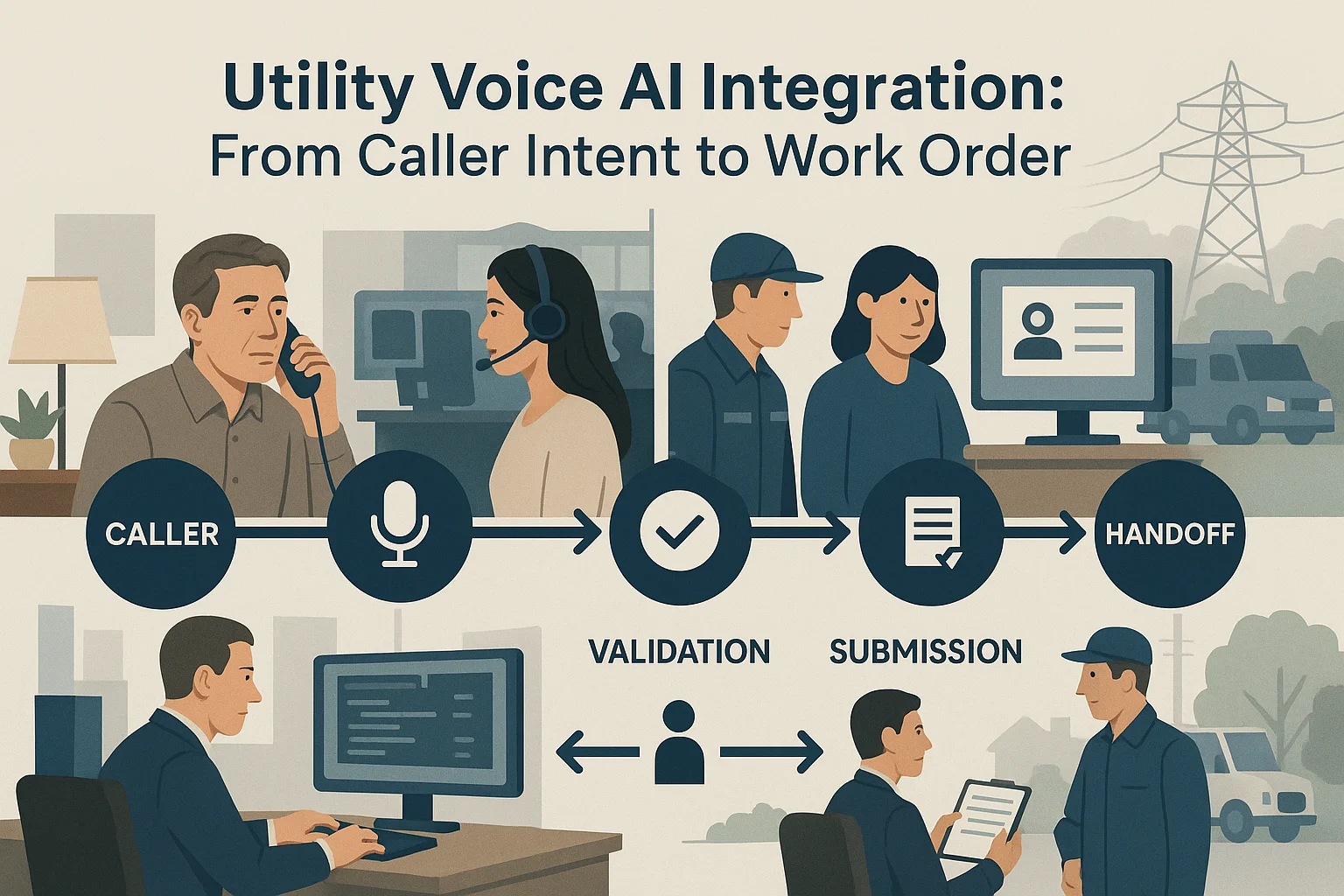
A minimal, reliable architecture keeps the decision surface small and authoritative data sources explicit. The canonical flow is: Customer call → Voice AI intent extraction → account/premise validation → authoritative API or knowledge lookup → action (status response, create/update service request) or human escalation.
Canonical call flow and data model
Implement a single, repeatable flow: 1) low‑latency ASR/NLU produces intent and entities; 2) the platform performs a non‑repudiable account or premise lookup (CIS/OMS/CRM) using caller ANI, account PIN, or two‑factor identifiers; 3) decision logic maps intent + validation to an action (status, SR creation, scheduling, or transfer). Each step produces structured events (intent id, confidence, validation status, API call id) that feed observability and QA.
- Intent extraction: classify outage, service request, billing, appointment, or general inquiry.
- Account/premise validation: minimal data required for action (account number, premise ID, service address, callback token).
- Action mapping: status query (read only), service request creation (write), or escalation (human).
- All events appended to a durable event stream for auditing and analytics.
Integration patterns to authoritative systems
Prefer direct, authenticated API calls to OMS, CIS, and CRM as authoritative reads/writes. Use read‑only queries where possible for status checks. For writes, implement a write‑proxy layer that enforces business rules, idempotency, and schema validation. When direct APIs are unavailable, use a small, immutable knowledge cache that is synchronized from authoritative systems and annotated with a TTL and provenance metadata.
- Read pattern: low‑latency GET to OMS/CRM for outage and account status.
- Write pattern: create SR via validated POST to the service layer with preflight checks and idempotency tokens.
- Cache pattern: fallback read cache with strict TTL and clear provenance for surge handling.
3) Account‑safe validation, privacy, and data handling
Account validation is the single biggest operational control for safely automating actions. Design minimal necessary validation, explicit consent for recordings, and documented data flows for cross‑border transfers and subprocessors.
Validation modes and what they allow
Define tiers of validation that map to permitted actions. For example: Level 0 (anonymous): status info using public outage maps only; Level 1 (soft‑verified): call matched to account via ANI or callback token — permits read‑only account info; Level 2 (verified): PIN or two‑factor verification — permits service request creation or appointment scheduling. Encode these tiers in the routing logic so the Voice AI only attempts writes when validation meets the required tier.
- Level 0: informational only—no account data returned or written.
- Level 1: read‑only responses tied to account context.
- Level 2: write capabilities and scheduling permitted.
Privacy, recordings, and cross‑border considerations
Document hosting region, backup region, subprocessors, and retention policy for recordings and transcripts. Obtain caller consent before recording when required. Ensure any cross‑border transfer mechanism (standard contractual clauses, adequacy, or equivalent) is documented and that teams confirm local obligations with qualified counsel. Do not assume regulatory equivalence between jurisdictions—privacy obligations and breach notification duties vary.
- Publish a clear retention schedule for audio and transcripts, with retention tied to operational and regulatory needs.
- Limit PII exposure: redact or tokenise sensitive identifiers in transcripts before feeding downstream analytics.
- Define subprocessors and remote‑support access with explicit contractual controls and audit rights.
4) Integration choices and operational controls
Choosing between direct API integrations, middleware proxies, and managed service options depends on internal capability, surge needs, and risk appetite. Match integration patterns to failure modes and observability requirements.
Direct APIs vs. proxy integration
Direct API calls provide the strongest data fidelity and simplest provenance when secure authentication and rate limits are available. A proxy service layer is advantageous when you need to centralize business rules, add idempotency tokens, or enforce data masking. Proxies also simplify vendor rotation—outbound contract endpoints remain stable while the proxy translates to backend APIs.
- Choose direct API when backend systems support secure token exchange and adequate SLA.
- Use a proxy when backend lacks write idempotency, when you need central policy enforcement, or when multiple downstream systems must be updated atomically.
Surge and offline patterns
During storms or mass outages, backends often rate‑limit or become unavailable. Implement an async intake queue with confirmed caller receipt, a best‑effort cache for status queries, and well‑defined escalation windows for synchronous intervention. For outage peaks, prefer read‑first experiences (status, estimated restoration) and queue writes for later processing with retry logic and caller callbacks.
- Async intake queue: durable events with acceptance acknowledgement and callback token.
- Read‑first UX: reduce write attempts during peak backend load to avoid duplicate SRs.
- Retry and reconciliation: idempotency and reconciliation jobs to merge duplicates and close transient SRs.

5) Governance, security, and capability maturity
Voice AI in utilities implicates AI risk management, cyber performance objectives, and operational maturity. Align governance to recognized critical‑infrastructure guidance and maturity models to make procurement and operating decisions defensible.
Aligning with AI and cyber guidance
Use the NIST AI Risk Management Framework — Critical Infrastructure Profile to evaluate AI risk across system design, data provenance, operational controls, and monitoring. Pair AI‑specific risk controls with CISA’s Cross‑Sector Cybersecurity Performance Goals (CPGs) to set baseline cyber hygiene for authentication, monitoring, and incident response. These documents help define minimal acceptable controls for Voice AI deployments serving critical infrastructure.
- Map system capabilities to NIST AI risk categories: governance, data, models, and monitoring.
- Use CISA CPGs to define required cybersecurity capabilities (identity, logging, MDE, asset management).
- Document residual risks and compensating controls in procurement and runbooks.
Maturity and operational readiness
Use the DOE Cybersecurity Capability Maturity Model (C2M2) to assess operational readiness for secure, repeatable Voice AI intake and integration. C2M2 helps utilities set measurable targets for incident response, change management, and third‑party governance—critical for high‑volume Voice AI scenarios where rapid vendor updates and event spikes are expected.
- Evaluate voice intake against C2M2 domains: risk management, incident response, and supply‑chain risk.
- Define a roadmap: pilot → surge test → limited production → full production, with maturity gates.
- Instrument event‑level telemetry for compliance and continuous improvement.
6) Procurement, failure boundaries, and measurable outcomes
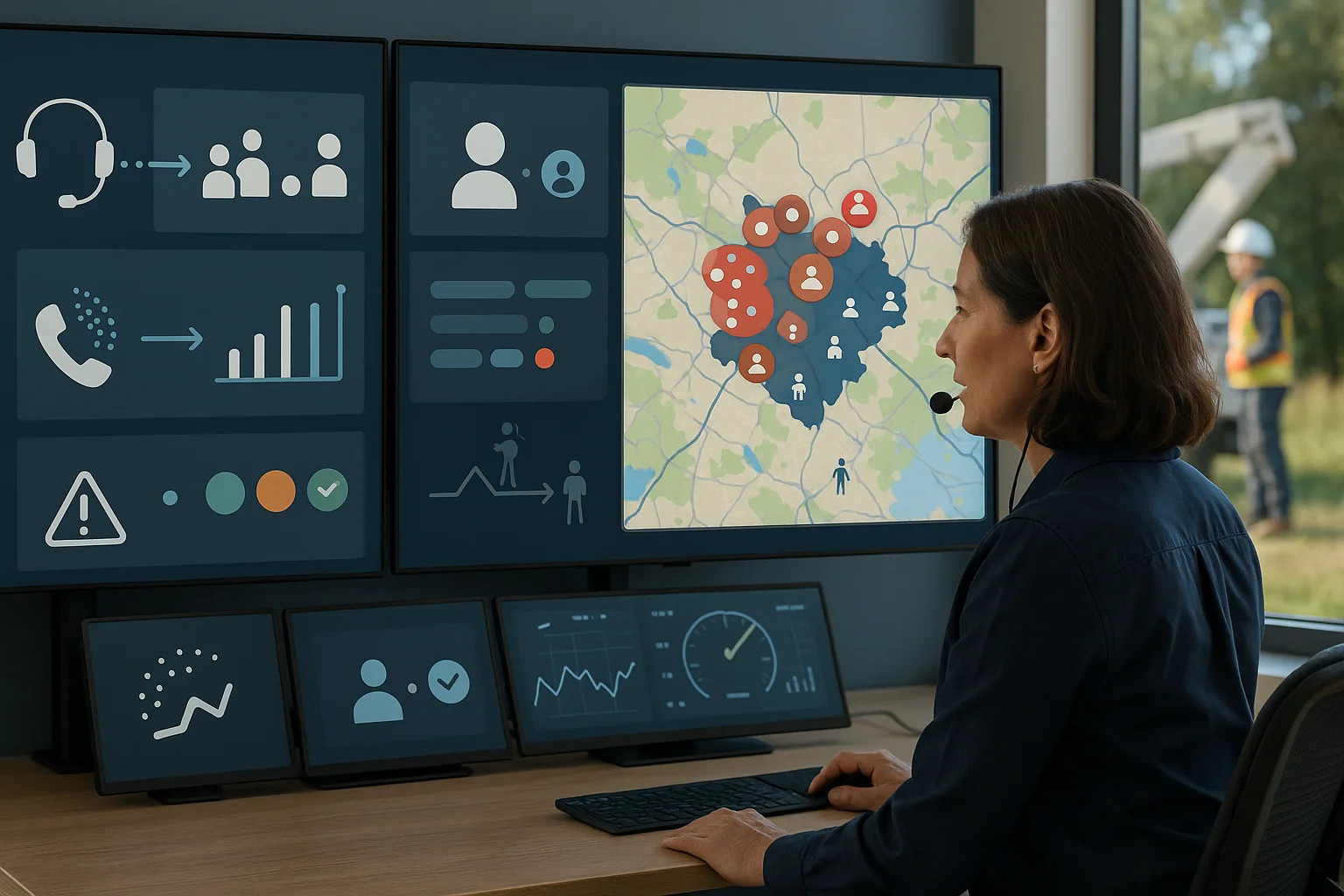
Procurement decisions should be based on clear scope, failure boundaries, SLAs, and measurable outcomes. Vendors should be evaluated on integration depth, operational controls, observability, and the ability to scale during outages without creating duplicate or unsafe actions.
What to require in RFPs and SOWs
Specify required connectors (OMS, CIS, CRM), validation tiers, idempotency behavior, data residency options, remote‑support subprocessors, and event‑level logging. Require vendor support for surge mode (queueing, cache TTLs), transparent model updates, QA datasets, and an agreed escalation pathway. Contractually require auditable trails for every write action and for the provenance of status responses.
- List specific APIs and the expected contract (read/write scopes, rate limits, idempotency).
- Require documented failure modes and rollback procedures for writes.
- Define performance and observability SLAs for peak and baseline traffic.
Failure modes and operational runbooks
Define explicit failure boundaries: backend unavailable, low NLU confidence, failed validation, or ambiguous intent. For each mode, encode the deterministic response (e.g., queue with acknowledgement, escalate to human, provide read‑only status). Maintain runbooks that include surge thresholds, escalation contacts, reconciliation jobs, and forensic steps to reconstruct decisions from event streams.
- Failure mode: backend 5xx — queue writes, provide caller receipt and ETA.
- Failure mode: NLU confidence below threshold — route to human with summary and transcript.
- Failure mode: failed validation — offer PIN/two‑factor or route to human authentication.
Related Peak Demand resources
Industry and AI sources reviewed
- AI Risk Management Framework — Critical Infrastructure ProfileNational Institute of Standards and Technology (NIST)
- Cross-Sector Cybersecurity Performance GoalsCybersecurity and Infrastructure Security Agency (CISA)
- Cybersecurity Capability Maturity Model (C2M2)U.S. Department of Energy
Privacy, telecommunications, recording-consent, cybersecurity, consumer-protection, employment, and records obligations vary by jurisdiction and use case. This article is operational guidance, not legal advice; organizations should confirm applicable requirements with qualified professionals.
Frequently asked questions
Good starting points include billing and account questions, move-in or move-out intake, appointment scheduling, service-request capture, outage-status messaging from approved systems, payment-routing assistance, and structured escalation. Safety-critical and infrastructure-control decisions should remain with qualified utility teams.
Official reference: Cross-Sector Cybersecurity Performance Goals
Use the minimum approved identifiers needed for the workflow, validate them against the utility's system of record, limit data exposure, and provide a human-assisted path when verification fails. The Voice AI should not guess account, premise, or outage information.
Official reference: Cross-Sector Cybersecurity Performance Goals
Use controlled adapters, strict schemas, timeouts, retries, audit logs, safe failure states, and human escalation. The system should distinguish approved utility data from model-generated language and should never present stale or unverified operational information as fact.
Official reference: Cybersecurity Capability Maturity Model (C2M2)
Track containment by request type, successful validations, transfers, abandoned calls, integration errors, incorrect or stale responses, time to resolution, customer follow-up, and the percentage of cases completed safely without manual rework.
Official reference: Cybersecurity Capability Maturity Model (C2M2)
Turn Voice AI infrastructure into a managed enterprise operation
Peak Demand designs, integrates, deploys, monitors, and improves Voice AI systems across customer service, enterprise systems, governance, escalation, and reporting.
Schedule a discovery call


