
Measurement Framework for Multisite Transit Voice AI: QA, Containment & Cost
A decision‑useful operating framework for transit leaders to measure QA, containment quality, escalation, cost‑to‑serve and scale across multilingual, multisite Voice AI deployments.
1. Framework overview: what to measure and why
Define measurable outcomes first. For transit Voice AI, the primary operational outcomes are containment (self‑service success), escalation quality (when and how humans take over), cost‑to‑serve, and safety/accuracy with respect to schedule and service alerts.
Core measurement axes
Organize metrics into four axes: Containment (percent of interactions resolved without human handoff), Escalation Quality (accuracy and timeliness of human handoffs), Cost (activity‑based cost per resolved interaction and per escalation), and Integrity (ASR and NLU accuracy, latency, and data governance). Treat these axes as primary KPIs for procurement, operations and IT.
- Containment = resolved_by_voice / total_interactions (track by intent and use case)
- Escalation Quality = accepted_handoffs_with_correct_resolution / total_handoffs
- Cost metrics include fixed (infrastructure, hosting, licensing) and variable (human handle time, QA labour, remediation)
- Integrity metrics: ASR WER, intent accuracy, slot F1, end‑to‑end functional success
Why separate scheduled knowledge from live alerts
Scheduled timetable information (static or near‑static) must come from a controlled knowledge base: validated GTFS/GTFS‑realtime snapshots, agency schedule stores, or authorised schedule APIs. Detours, delays and service‑alerts use a different, live pathway (service‑alert APIs or operator feeds). Keep these data pathways distinct in analytics and QA so you can measure where errors originate—knowledge drift versus live feed mismatch.
- Controlled schedule knowledge reduces hallucination risk and simplifies validation.
- Live service alerts require freshness, provenance, and tight latency SLAs.
- Instrumentation must tag responses by data source (schedule vs alert API) for root‑cause analytics.
2. Architecture and operating model that supports measurement
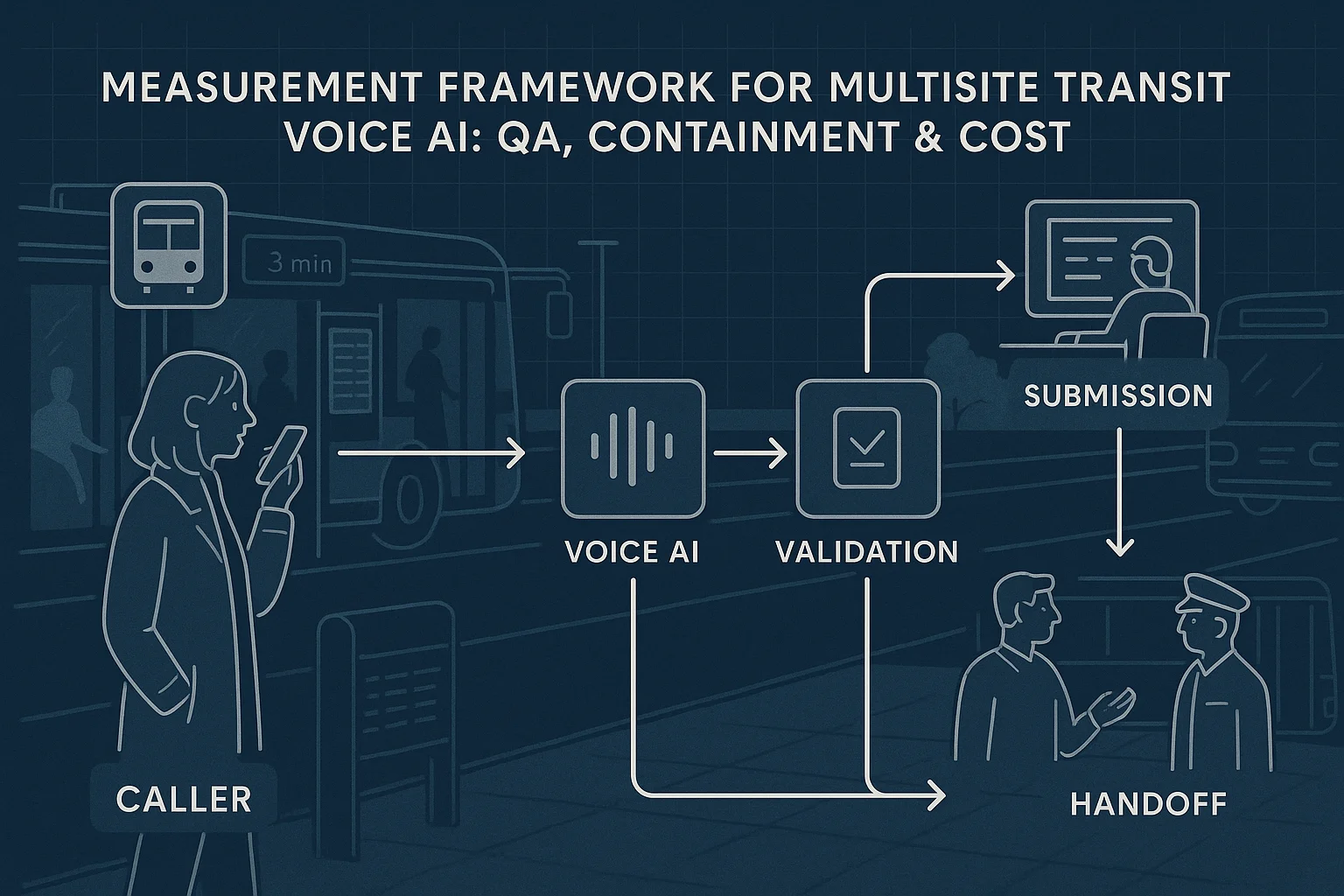
A concise, reproducible architecture helps standardize measurement across sites: Rider → Voice AI → Controlled schedule knowledge OR Service‑alert API → Validation → Outcome (answer, case submission, or human handoff).
Data flow and tagging for observability
Instrument every call with immutable metadata: site_id, language, channel, data_source_tag (schedule|service_alert|manual), interaction_id, and outcome_tag (resolved|escalated|abandoned). Use these tags in analytics to compute containment and escalation quality per site and per language. Capture timestamps for each stage to calculate intent detection latency, orchestration latency, and handoff latency.
- Include version_id for the knowledge base snapshot in event logs to measure drift.
- Record whether a dynamic service form was invoked and whether validation passed.
- Persist minimal transcripts for QA sampling with redaction controls for PII.
Validation gates and safe human handoff
Before submitting an automated confirmation or lodging a case, a validation gate must confirm identity (as required), data completeness, and rule compliance. If confidence thresholds fall below defined tolerances—or the call concerns emergencies—the system should escalate to trained staff. Document and measure the false‑escalation and false‑containment rates to tune thresholds.
- Confidence thresholds: define separate thresholds for readouts (informational) and action (case creation, schedule change).
- Safe handoff pattern: brief context summary + last system action + caller intent to the human agent to minimize cognitive load.
- Measure handoff latency and first‑response SLAs within agent dashboards.
3. QA pipelines and containment quality
QA is the measurement engine. Design pipelines to evaluate speech recognition, NLU, orchestration, and functional outcomes against ground truth and human labels.
Test suites and sampling strategy
Use stratified test sets across route types, times of day, languages, and call outcomes. Maintain a core regression set for deterministic checks and a rolling revenue‑period sample for real‑world drift detection.
- Regression tests: canonical intents, slot combinations, edge cases (e.g., transfer queries, disrupted services).
- Field sampling: sample 1–5% of real interactions stratified by site and language for human review.
- Adversarial tests: background noise, accented speech, and truncated inputs.
Metrics to compute containment and escalation quality
Measure containment at multiple levels: intent‑level containment, functional success (user received correct schedule or case id), and subjective satisfaction where feasible. Escalation quality must track salience—did the human resolve the issue, did the system provide accurate context, and was the escalation necessary?
- Functional success = interactions_with_correct_outcome / total_interactions (tagged by data source).
- Escalation necessity rate = escalations_where_voice_confidence_below_threshold / total_escalations.
- Human resolution rate post‑escalation and rework time.
Automated QA tooling and alerting
Automate detection of regressions using alert rules (e.g., sudden ASR WER spike, intent confusion matrix drift). Route alerts to a small ops rotation for triage and remedial model retraining or data fixes.
- Use rolling baselines and control charts for early detection of drift.
- Automate labeling workflows for quickly expanding failing cases into training data.
- Track remediation lead time and re‑test outcomes to measure QA throughput.
4. Cost‑to‑serve: measurement and levers
Measure cost‑to‑serve transparently so procurement can compare vendor proposals and internal build scenarios. Activity‑based costing gives precise levers to optimize.
Activity‑based cost model components
Break costs into fixed and variable components: hosting and model inference (fixed + per‑call compute), licensing, transcription and storage, QA and annotation labour, and human agent time for escalations. Include governance costs: security, legal reviews, and retention/records management.
- Per‑interaction cost = (monthly_fixed_costs / expected_calls) + variable_costs_per_call.
- Escalation premium = average_agent_handle_time × agent_cost_rate + case management overhead.
- QA and retraining costs should be amortised per release cycle.
Operational levers to reduce cost without harming quality
Containment is the primary lever, but so is precision: reduce unnecessary escalations and avoid repeated rework. Invest in forms/validation to reduce agent handle time and increase first‑contact resolution when escalation is necessary.
- Improve data‑source tagging to avoid repeated fetches and duplicate escalations.
- Use dynamic service request forms to collect structured data before human takeover.
- Automate low‑risk tasks (status readouts) while routing anything safety‑sensitive to staff.

5. Multisite and multilingual scale: strategies and failure boundaries
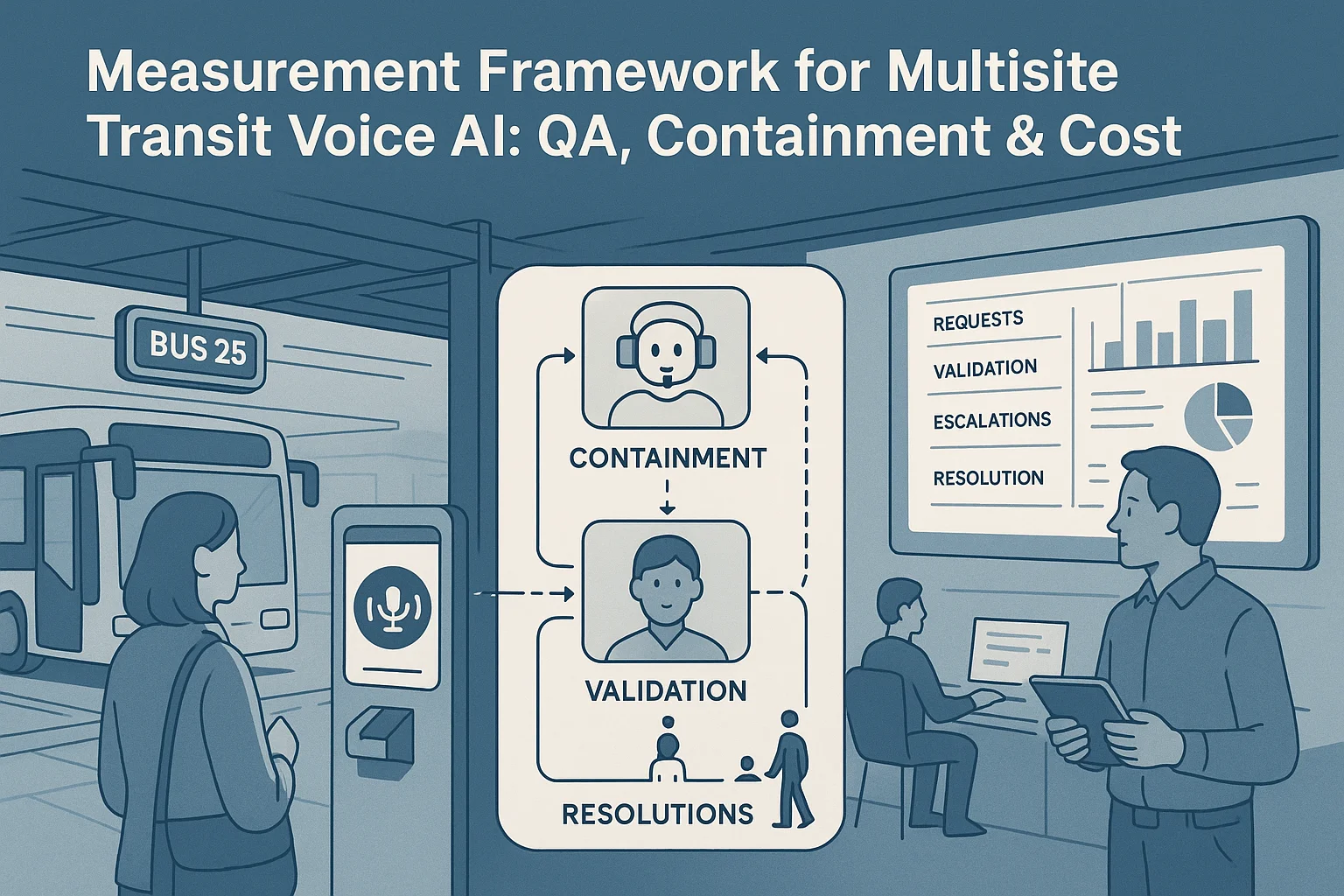
Scaling across agencies or depots requires a repeatable playbook. Define per‑site SLOs and language baselines, and codify failure boundaries so local operators know when to revert to human‑first workflows.
Replication strategy and per‑site SLOs
Decide whether to centralize knowledge and models or replicate site‑specific knowledge bases. A hybrid model—central language/machine models with localized schedule knowledge and site overrides—reduces duplication while preserving local accuracy. Define SLOs per site for containment, escalation latency, and functional success.
- Centralized models with localized KB snapshots: faster model ops, local governance of schedule snapshots.
- Per‑site SLOs: containment%, escalation latency (seconds), and functional success% measured weekly.
- Automate snapshot refresh and declare known periods of degraded coverage for special events.
Multilingual approach: language‑specific baselines
Treat each language as a quasi‑site for measurement. Build language‑specific test sets and baseline metrics (ASR WER, intent accuracy). Decide whether to use a single multilingual model or language‑specific models based on volume, dialect diversity, and procurement constraints.
- Lower volume languages may best be served by configurable prompts and human fallback paths rather than full model parity.
- Measure containment by language and route recurring failures into targeted collection/annotation projects.
- Document support scope in the SOW: which dialects and languages are covered, response latency expectations, and fallback workflows.
Failure boundaries and safe‑mode operations
Define explicit failure modes: visibility loss to live feeds, knowledge base corruption, high ASR WER, or security incident. For each mode, predefine a safe‑mode: read‑only schedule answers, triage with human agents, or a temporary message directing riders to staffed channels.
- Fail closed for actioning operations (no automated case creation when critical feeds are unavailable).
- Fail open for informational queries only when validated by secondary sources.
- Document and measure frequency and duration of safe‑mode activations.
6. Continuous optimization, governance and procurement controls
Tie measurement to governance: risk assessments, procurement evidence, and continuous improvement cycles. Apply sector‑aware AI risk principles and critical infrastructure hardening.
Governance and risk management
Use an AI risk management approach to identify, assess, and monitor risks specific to transit operations—service disruption, misinformation about schedules, privacy of recordings, and cybersecurity of integrations. Formalize roles: product owner, data steward, QA lead, security lead, and escalation manager.
- Run periodic risk assessments and record mitigation plans and residual risk.
- Maintain a documented chain of responsibility for model updates, knowledge base changes and release approvals.
- Ensure public‑facing messages are approved by communications teams when they involve service disruptions.
Procurement evidence and SOW clauses
Procure with measurable deliverables: attainable SLOs, sample‑level QA reports, audit logs, retention policies, subprocessors lists, and defined remediation SLAs. Require vendors to provide historical performance reports and to support independent measurement during pilots.
- Require test vectors and baseline metrics with proposals to compare vendors on equivalent datasets.
- Include change‑control requirements for production knowledge updates and rollback procedures.
- Specify data residency, export controls, and subprocessors; owners must validate local obligations with counsel.
Continuous improvement: experiments and failure learnings
Run controlled experiments: traffic allocation between model versions, threshold tuning, and alternate dialog flows. Use failback analysis (why did the system escalate) to prioritize training data collection and UX changes.
- Versioned deployments and canary rollouts reduce blast radius when updating models or KBs.
- Track remediation success rate and time to restore baseline after regression.
- Embed human‑in‑the‑loop labelling workflows to accelerate retraining for high‑impact failure modes.
Related Peak Demand resources
Industry and AI sources reviewed
- Artificial Intelligence Risk Management Framework (AI RMF 1.0)National Institute of Standards and Technology (NIST)
- OECD AI PrinciplesOrganisation for Economic Co-operation and Development
- Transportation Systems SectorCybersecurity and Infrastructure Security Agency (CISA)
Transit safety, accessibility, privacy, cybersecurity, records, and service-information obligations vary by jurisdiction and operating authority. This article is operational guidance, not legal advice; organizations should confirm applicable requirements with qualified professionals.
Frequently asked questions
Good starting points include lost property, complaints and feedback, stop or shelter issues, fare-machine faults, non-emergency accessibility service requests, schedule information from approved sources, and structured routing to customer service or field teams.
Official reference: Artificial Intelligence Risk Management Framework (AI RMF 1.0)
Use GTFS Realtime only when the agency exposes suitable feeds and the workflow genuinely needs service alerts, trip updates, or vehicle positions. The integration should validate freshness and availability, and the agent should avoid presenting stale feed data as a guaranteed arrival prediction.
Emergency, security, injury, crime, and safety-critical reports should follow approved transfer or emergency-routing procedures. Voice AI may detect and route the call, but it should not make operational safety decisions or replace trained personnel.
Official reference: Transportation Systems Sector
Request realistic call testing, feed and system failure handling, service-request integration, transfer context, audit logs, accessibility channels, monitoring, change control, and evidence that the agent distinguishes scheduled information from dynamic service alerts.
Official reference: Artificial Intelligence Risk Management Framework (AI RMF 1.0)
Design the transit service workflow before automating it
Peak Demand helps transit teams connect Voice AI to rider information, service requests, approved live-data sources, escalation, confirmation, and analytics.
Schedule a discovery call


