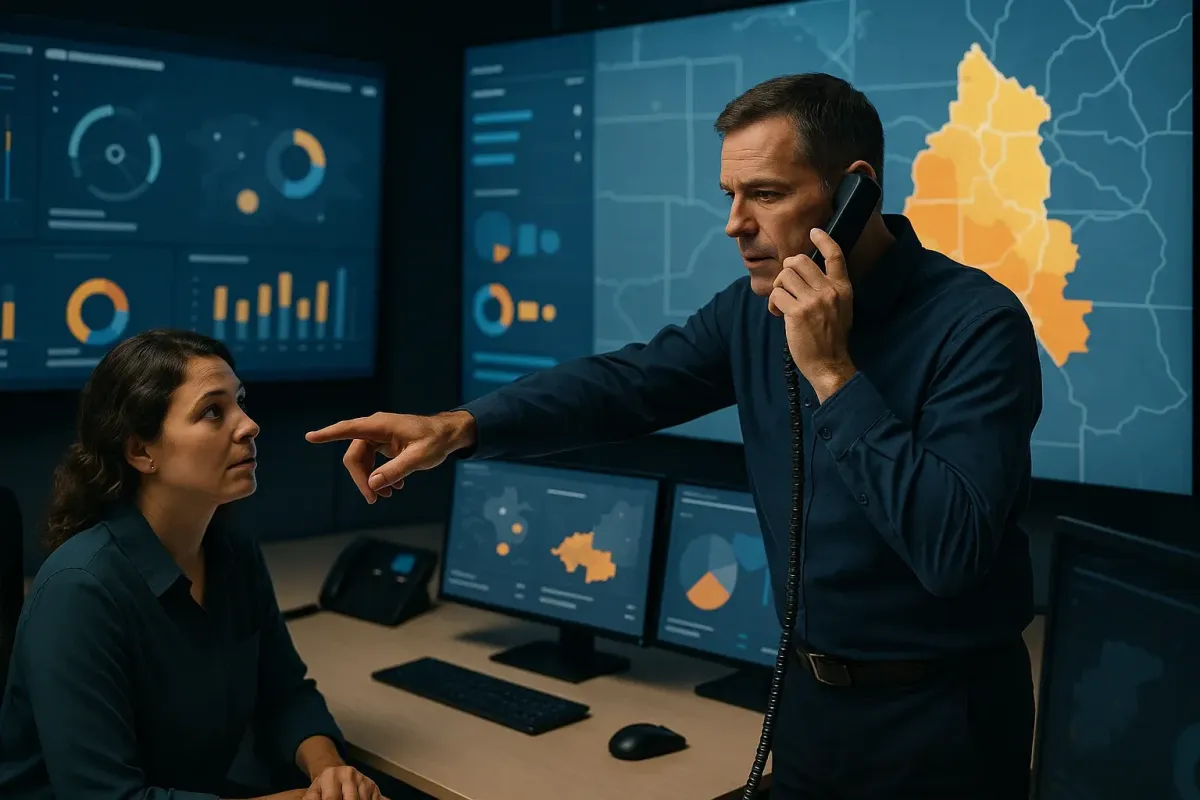
Labor, Union & Regulatory Collaboration Models for Voice AI in Utilities
Practical collaboration models for utilities deploying high-volume Voice AI: labor engagement, union negotiation points, regulatory evidence, integration safeguards, and operational controls for outage and service-request workflows.
1. Why a collaboration model is operationally essential
Voice AI is primarily a volume-mitigation and routing tool for utilities: it reduces routine touches, improves first-contact information, and standardizes outage communications. But deployment changes work, accountability, and evidence requirements. A written collaboration model aligns labor, unions, regulators, and vendor partners on who does what, how decisions are made, and how auditors and customers are protected.
Purpose and scope
Define the operational scope before technical design: which call types will Voice AI handle (balance inquiries, status checks, simple service requests), which will be informational only (outage status), and which will be routed to humans (safety reports, suspected meter tampering, infrastructure complaints). Document exclusions explicitly to prevent scope creep and to serve as a baseline for labor negotiations and regulatory review.
- List supported call types and excluded categories
- Identify downstream systems impacted (CIS, OMS, CRM, scheduling, field routing)
- State required human approvals for actions that alter service, billing, or field schedules
Operational outcomes and constraints
Translate business goals into measurable outcomes such as reduced average handle time for routine inquiries, increase in correctly routed outage reports, or improved customer wait time during surge events. Equally important: define operational constraints — safety boundaries, permissible data accesses, and escalation SLAs — that cannot be traded off for efficiency.
- Target metrics (e.g., automation rate for routine inquiries) tied to staffing plans
- Hard constraints: safety escalation time, human approval for service disconnection/orders, account verification standards
- Regulatory evidence: audit logs, QA transcripts, and governance meeting records
2. Core operating architecture and role responsibilities
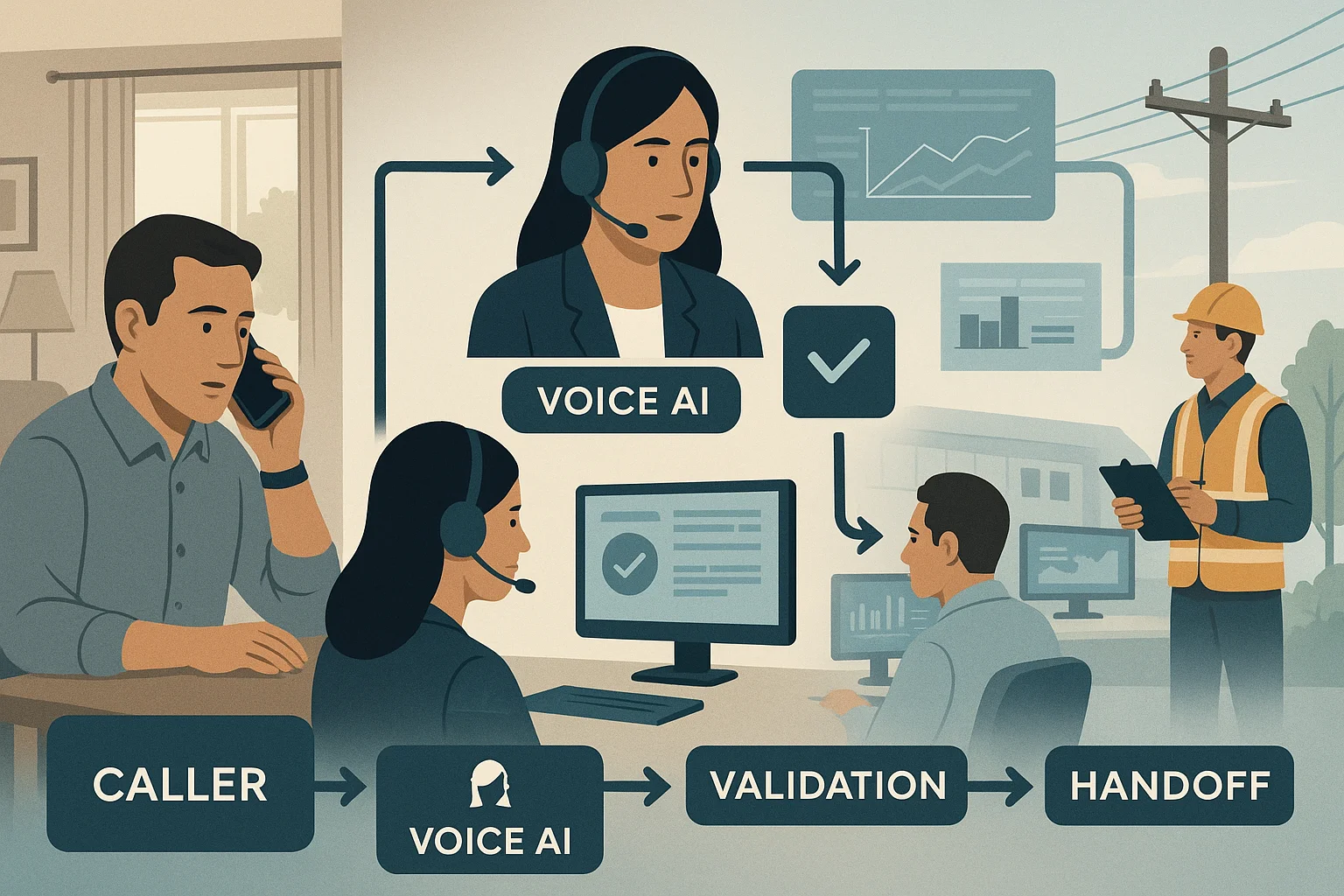
Translate the collaboration model into an explicit architecture and RACI for every interaction. Keep the architecture simple: Customer Call → Voice AI → account/premise validation → approved API/knowledge source → service request/status response or human escalation.
Call flow and system responsibilities
Design call flows to preserve human accountability for material actions. Voice AI should: perform preliminary intent classification; gather minimally sufficient validation data; query approved sources (CIS/OMS/CRM) via controlled adapters; present options; and either complete low-risk, pre-authorized transactions or route to a human. The utility must retain veto/override capability and clear ownership of integration adapters that write to enterprise systems.
- Intent classification and confidence thresholds with human-handoff triggers
- Account/premise validation as a discrete step using approved APIs
- Adapters that separate read-only from write-capable paths; writes require explicit authorization and logging
Staff roles and escalation pathways
Define roles: Voice AI operator (monitoring and prompts), human agents (full account actions), field dispatchers, and escalation specialists (safety, regulatory). Map handoffs: Voice AI → agent for complex issues; Voice AI → dispatcher for service requests with human verification; agent → supervisor for grievance or union-related disputes. Ensure staffing models allow immediate human pickup for high-priority categories.
- RACI table for each call type including who may approve a service change
- Escalation SLAs by category (e.g., safety‑critical < 5 minutes)
- Shift and surge staffing plans to preserve human availability during major events
3. Labor and union collaboration patterns
Early, transparent engagement with labor and unions reduces friction and builds durable operational controls. Collaboration models should be pragmatic: preserve core job protections, offer retraining and redeployment pathways, and establish joint governance over quality and escalation rules.
Negotiation and role-transition constructs
Use clear, time-bound agreements that define which tasks are automated, which remain duties of bargaining units, and how headcount or role changes will be managed. Typical constructs include: tiered automation (Phase 1: information-only; Phase 2: limited transaction automation with human verification), redeployment funds or training credits, and jointly defined competency frameworks for new hybrid roles (e.g., agent+AI supervisor).
- Phased automation with agreed evaluation gates
- Retraining plans with measurable curricula and timelines
- Job-impact assessments and redeployment pathways
Joint governance and QA
Establish a standing Joint Operations Committee (utility + union + vendor) that meets regularly to review QA metrics, escalation cases, and grievance evidence. Include representatives for workforce development and compliance. Use the committee to approve updates to intent classifiers, validation rules, and escalation thresholds so changes are jointly understood and recorded.
- Committee charter, membership, and decision-making rules
- Shared QA rubrics and periodic transcript audits
- Formal change-control processes for updates affecting agent work
4. Regulatory engagement and auditability
Regulators will focus on safety, nondiscrimination, outage transparency, and customer protection. Build evidence trails and governance documents that answer those concerns and are practical to produce during an inquiry or audit.
Evidence packages and audit artifacts
Prepare standardized packages: end-to-end call transcripts, API request/response logs with timestamps and actor identifiers, QA sampling reports, joint‑governance minutes, and system change logs for voice models or decision rules. Keep formats and retention policies aligned with utility records management and any applicable jurisdictional requirements. Where recordings are retained, document recording consent policy and retention durations.
- Immutable request/response logs (time, actor, confidence score, action taken)
- QA sampling methodology and results for regulator review
- Retention policy mapping (recording, transcript, event logs) and cross-border transfer notes
Cybersecurity and risk maturity
Adopt recognized practices to demonstrate cybersecurity and operational maturity. Use security controls for authentication, least privilege for adapters, segmentation between Voice AI and OT/ICS, and incident response processes that include Voice AI-specific playbooks. Where an organization needs maturity guidance, existing frameworks provide structured practices for critical infrastructure operators to adapt and reference during regulatory reviews.
- Network segmentation between customer-facing systems and critical OT/ICS
- Least-privilege adapters and per‑request authorization tokens
- Incident response playbooks that include Voice AI failure and integration degradation scenarios

5. Operational controls, failure boundaries and safety
Operational controls are the practical mechanisms that keep Voice AI within safe and auditable limits: validation steps, confidence thresholds, mandatory human approvals, and concrete failure modes and fallbacks.
Account-safe validation and decision boundaries
Use multi-factor validation appropriate to the risk of the action. For informational queries, a light validation may suffice; for service‑affecting actions, require strong validation and an explicit human confirmation. Maintain a policy that any decision that could change a service state, dispatch crews, or affect billing must be auditable and reversible.
- Validation tiers mapped to action criticality
- Human-in-loop confirmation for writes to CIS/OMS
- Automated rollback or quarantine procedures for suspect transactions
Outage communications and safety boundaries
During outages, preserve single authoritative sources (the OMS or outage management feed) and limit Voice AI outputs to that canonical data. Implement broadcast gating so corrective scripts or mass notifications require operator approval. Never permit Voice AI to issue instructions that would direct field crews or alter switching plans — human controllers and dispatch must retain command authority.
- Read-only canonical outage feed with explicit approval processes for any write actions
- Mass notification gating and operator signoff for public safety messages
- Clear prohibition on Voice AI controlling field equipment or issuing operational switching instructions

6. Procurement, pilot design, and measurable outcomes
Procurement and piloting are where operational models are tested and codified. Contracts should reflect runbooks, SLAs, ownership of adapters, data residency choices, and procedures for audits and breaches.
Contractual and procurement checklist
Include responsibilities for integration ownership, surge capacity, business-continuity objectives, subcontractor disclosure, data residency and subprocessors, breach notification duties, and evidence delivery for regulatory inquiries. Require vendors to demonstrate observability and explain how they will provide request/response logs, model change histories, and incident artifacts.
- Adapter ownership and change-control obligations
- Surge capacity and major-event staffing commitments
- Subprocessor list, data residency choices, backup region, and breach notification SLA
Pilot design, KPIs and rollout gates
Run pilots with measurable gates: automation precision/recall targets for intent routing, escalation accuracy, customer satisfaction, QA pass rates, and agent workload impact. Use short, iterative pilots that expand call types only after joint governance approves QA results and workforce transition outcomes.
- Pilot KPIs: automation accuracy, escalation error rate, customer hold time, agent satisfaction
- Rollout gates tied to QA sampling and union/governance approvals
- Observability instrumentation: call-level metrics, latency, adapter error rates, and model-confidence distributions
Related Peak Demand resources
Industry and AI sources reviewed
- AI Risk Management Framework — Critical Infrastructure ProfileNational Institute of Standards and Technology (NIST)
- Cross-Sector Cybersecurity Performance GoalsCybersecurity and Infrastructure Security Agency (CISA)
- Cybersecurity Capability Maturity Model (C2M2)U.S. Department of Energy
Utility cybersecurity, critical-infrastructure, records, customer-protection, and emergency-communications obligations vary by jurisdiction and service type. This article is operational guidance, not legal advice; organizations should confirm applicable requirements with qualified professionals.
Frequently asked questions
Good starting points include billing and account questions, move-in or move-out intake, appointment scheduling, service-request capture, outage-status messaging from approved systems, payment-routing assistance, and structured escalation. Safety-critical and infrastructure-control decisions should remain with qualified utility teams.
Official reference: Cross-Sector Cybersecurity Performance Goals
Use the minimum approved identifiers needed for the workflow, validate them against the utility's system of record, limit data exposure, and provide a human-assisted path when verification fails. The Voice AI should not guess account, premise, or outage information.
Official reference: Cross-Sector Cybersecurity Performance Goals
Use controlled adapters, strict schemas, timeouts, retries, audit logs, safe failure states, and human escalation. The system should distinguish approved utility data from model-generated language and should never present stale or unverified operational information as fact.
Official reference: Cybersecurity Capability Maturity Model (C2M2)
Track containment by request type, successful validations, transfers, abandoned calls, integration errors, incorrect or stale responses, time to resolution, customer follow-up, and the percentage of cases completed safely without manual rework.
Official reference: Cybersecurity Capability Maturity Model (C2M2)
Build resilient utility customer-service automation
Peak Demand helps utilities connect Voice AI to approved customer-information, outage-communication, service-request, dispatch, escalation, and analytics workflows.
Schedule a discovery call


