
How to Build a Machine-Readable Brand Entity Across the Web
A practical, enterprise-focused playbook for marketing leaders and SEO teams to create, distribute, measure, and scale a machine-readable brand entity for Google and AI visibility.
1 — What a machine-readable brand entity actually is (and why it matters)
Define terms clearly and separate documented search-engine guidance from practitioner inferences. Marketing leaders need a crisp, operational definition before investing in tooling and governance.
What 'entity' means for search and AI
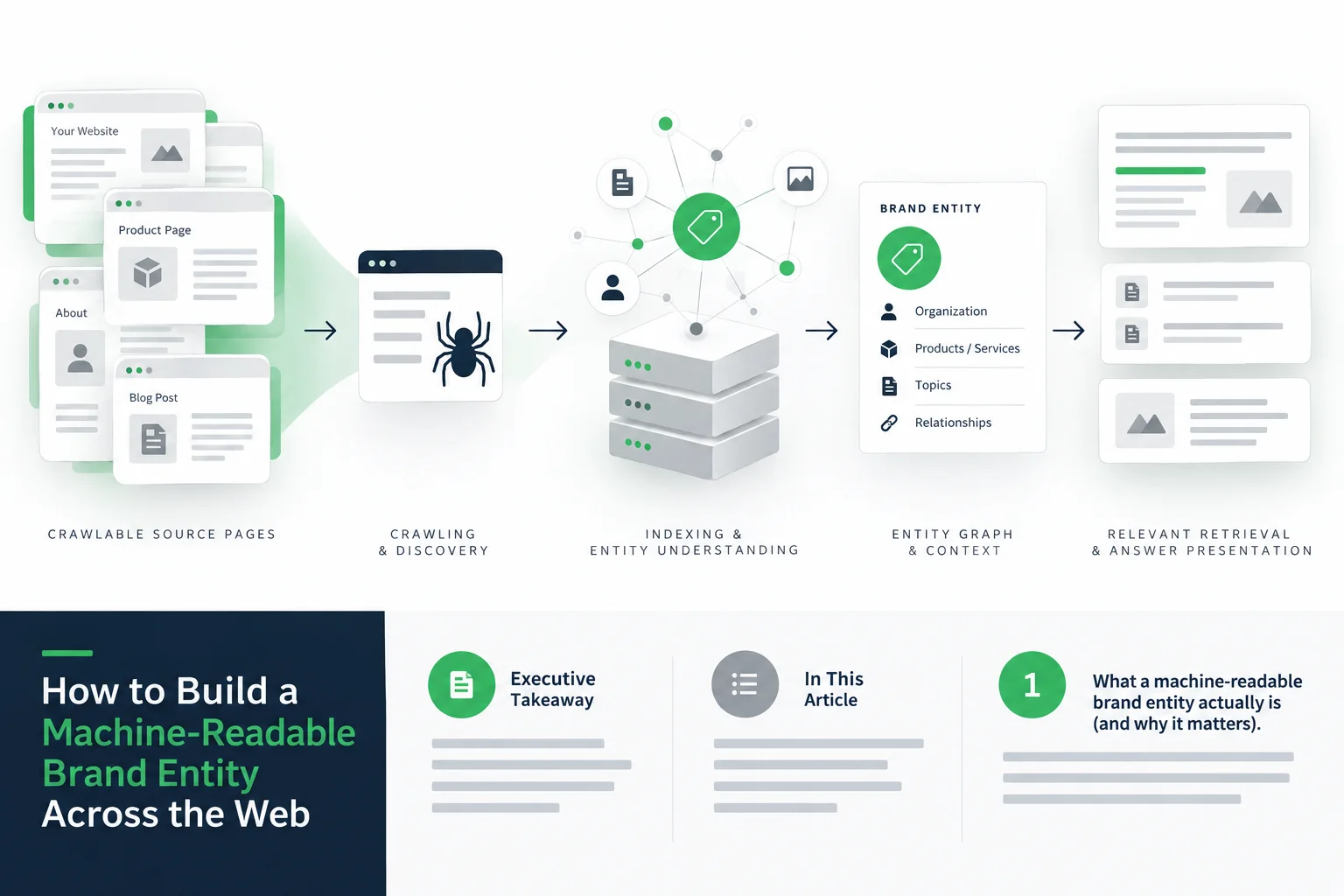
An entity is a discrete concept — a brand, person, product, place, or service — represented by identifiers (names, canonical pages, IDs) and attributes (description, logos, official contacts, social profiles). For search and AI systems, a machine-readable entity is a consistent, structured representation of those identifiers and attributes across the web so retrieval systems can resolve references reliably.
- Entities are disambiguation units: they help engines decide whether a mention refers to your brand or a similarly named organization.
- Machine-readability means the representation is available in parseable formats (HTML elements, structured data, canonical pages, knowledge graph entries, verified listings).
- Entity signals are used in retrieval and citation but engines do not publish exact ranking formulas or guarantee generative-surface inclusion.
Why this is an organizational problem, not just SEO
A machine-readable entity requires cross-functional coordination: legal (name variants), brand (visual assets), product (SKUs), IT (canonicalization and hosting), content, and search teams. Treat the entity as a product with owners, SLAs, and change control to avoid fragmentation, stale facts, and conflicting signals.
- Assign a single entity steward or steering committee to manage canonical names, primary landing pages, and structured-data policies.
- Document provenance and version control for entity attributes to support audits and QA.
- Plan for ongoing measurement and escalation when authoritative attributes diverge across source systems.
2 — The technical architecture: layers you must build
An effective machine-readable entity sits on a layered architecture. Each layer maps to operational responsibilities and measurable outputs.
Research and entity model
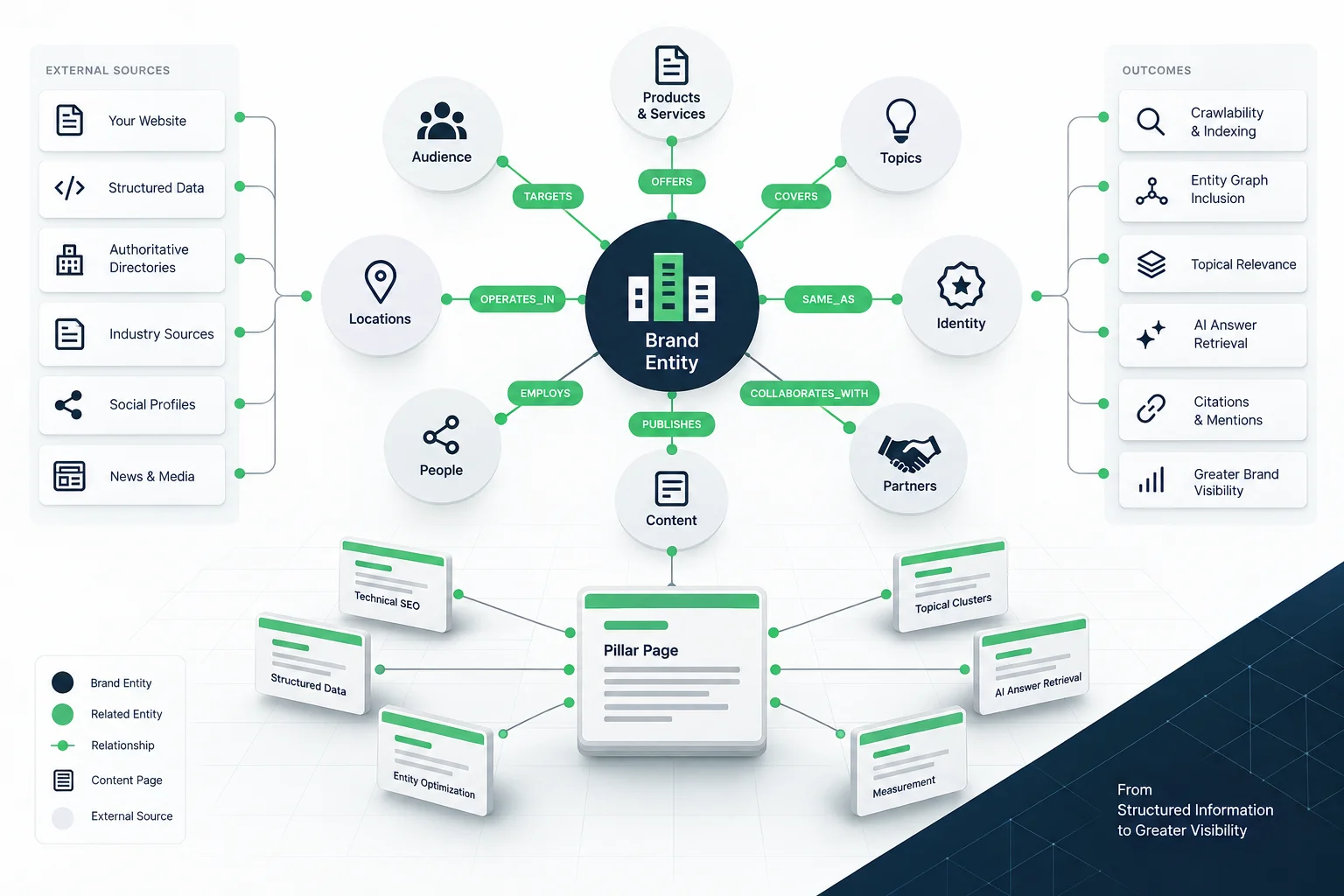
Start with entity discovery: inventory brand mentions, canonical pages, product SKUs, executives, locations, and partner relationships. Create a normalized entity model (unique IDs, canonical name, description, type, key attributes) that will be the single source of truth for downstream publishing.
- Use canonical URIs as primary identifiers for web retrieval systems.
- Map synonyms, legal names, common abbreviations, and languages to the same entity ID.
- Log provenance: where each attribute originates and last-update time.
Topic and page graph
Translate the entity model into a topic graph — pages mapped to entity attributes and topical clusters. Design internal linking and hub pages that reflect the entity topology so algorithms can traverse authoritative paths.
- Hub pages (brand, product collection, locations) act as authoritative anchors for retrieval.
- Ensure canonicalization and HTTP headers are correct to avoid split signals.
- Use link graph analysis to detect orphaned entity pages and weakly connected clusters.
Authoritative content and structured data
Produce authoritative pages that explicitly express entity facts. Where appropriate, embed structured data (Schema.org types) to make key attributes machine-readable. Structured data should mirror visible page content; avoid adding claims in markup that users can't see.
- Match page content and markup to prevent conflicting signals.
- Prioritize schema types that align to your entity: Organization, LocalBusiness, Product, Person, Service, Dataset, etc.
- Validate structured data regularly and monitor errors in Search Console or structured-data testing tools.
3 — Structured data and schema: practical rules and constraints
Google and Schema.org provide documented guidance. Apply these rules, and layer pragmatic controls for enterprise complexity.
Follow documented structured-data guidance
Use structured data as documented by Google and Schema.org: mark up facts that appear on the page, use correct types and properties, and keep markup up to date. Google explicitly advises structured data supports appearance in features, but does not guarantee it.
- Only mark up content that is visible to users and accurate.
- Prefer JSON-LD in the head for maintainability and render resilience.
- Monitor warnings and errors from Search Console and resolve failures quickly.
What structured data won’t do for you
Structured data clarifies facts for machines; it doesn't by itself create trust, topical authority, or guaranteed inclusion in AI-generated answers. Use markup to reduce ambiguity and improve retrievability, but pair it with content quality, backlink authority, and distribution.
- Structured data is a signal among many — not a magic key to generative surfaces.
- Avoid over-markup: incorrect or deceptive schema can trigger manual review or quality labels.
- Structured data does not replace the need for high-quality, people-first content.
4 — Retrieval, citations, and AEO/GEO realities
Separate documented retrieval mechanisms from practitioner techniques to increase the probability that your entity is found and used by AI and answer engines.
What search engines and AI features document
Google documents that structured data and high-quality content can enable AI features to better understand and present site content, but it does not provide a fixed pathway to inclusion. Treat Google’s AI features guidance as instructions for good practice rather than a placement contract.
- Follow Google's published guidance for AI features integration and content quality.
- Structured data helps machine-readability, which can aid retrieval by AI systems.
- Engage with documented feature-specific requirements where they exist (e.g., rich result eligibility).
Practitioner tactics for retrieval and citation-worthiness
Practitioners focus on creating citation-worthy pages: clear claims, sourced evidence, authoritativeness markers, and up-to-date facts. Retrieval systems favor pages that are unique, authoritative, and easy to parse (clean HTML, structured data, consistent canonicalization).
- Design pages that answer specific, scoped queries with concise facts followed by supporting detail.
- Use provenance marks (last-updated, editorial authorship, citations to primary sources) to increase trust signals.
- Optimize retrieval by reducing ambiguous redirects and ensuring canonical pages are indexable.
5 — Measurement, QA, and operational metrics
Operationalize continuous measurement and quality assurance: this is what converts a project into a managed system with predictable cost-to-serve and escalation handling.
Essential metrics and dashboards
Track both visibility metrics and containment/escalation KPIs. Visibility KPIs include entity-level impressions, clicks, suggested answers visibility (when available), and LLM surfacing tests. Operational KPIs include containment rate, escalation rate, QA pass-rate, structured-data error rate, and cost-to-serve per entity or site.
- Containment quality = percentage of inbound queries resolved by automated content without human escalation.
- Escalation quality = percentage of escalations routed correctly with necessary context for human responders.
- Cost-to-serve = total operational cost divided by contained interactions; use for prioritization across entities and languages.
QA playbook and sampling
Use systematic QA: weekly structured-data validation, monthly entity-attribute audits, and randomized user-journey testing. For multisite or multilingual programs, use stratified sampling across language, region, and site type to detect schema or content drift.
- Create test beds for LLM surfacing: synthetic queries, canonical prompts, and real-world logs.
- Maintain a change-control log for entity attributes and publish a rollback plan for erroneous updates.
- Measure time-to-correct for schema errors and content mismatches.

6 — Scaling across sites and languages
Scaling requires standardization, templates, and governance. Plan for local variation while preserving canonical identity.
Governance and templates
Create canonical templates for entity pages and a structured-data library that can be parameterized per market. The library should include language variants, local legal names, and contact/fulfillment differences while preserving canonical identifiers.
- Use template-driven JSON-LD with build-time injection from canonical attribute stores.
- Enforce a QA gate for localization that checks schema validity and factual parity with the source of truth.
- Document acceptable local variations and required invariant fields (canonical ID, canonical name, primary logo).
Cost, prioritization and risk
Prioritize entities by strategic value and cost-to-serve. Not every entity needs the same level of structure and distribution; use tiering to allocate engineering and editorial resources efficiently.
- Tier A: brand, flagship products, primary locations — high QA, real-time updates, full schema and provenance.
- Tier B: secondary products and support entities — scheduled refresh, template schema, sampled QA.
- Tier C: long-tail references — automated markup or minimal templates with periodic audits.
Related Peak Demand resources
Industry and AI sources reviewed
- Schema.org DocumentationSchema.org
- SEO Starter GuideGoogle Search Central
- Understand how structured data worksGoogle Search Central
- Creating helpful, reliable, people-first contentGoogle Search Central
- AI features and your websiteGoogle Search Central
Search-engine and AI-answer behavior changes over time. Google documentation can establish published requirements and guidance, but inclusion in rankings, AI Overviews, citations, or LLM answers is never guaranteed. Practitioner observations should be labelled as inference or testing rather than official ranking factors. This article is operational guidance, not legal advice; organizations should confirm applicable requirements with qualified professionals.
Frequently asked questions
SEO improves visibility in traditional search results. AEO focuses on making content easy for answer systems to extract and use. GEO focuses on visibility in generative search and AI answer experiences. In practice, the strongest strategy combines technical accessibility, useful content, clear entities, strong internal relationships, structured data, and credible source authority rather than treating them as isolated channels.
Official reference: SEO Starter Guide
No. Structured data can make page entities and relationships more explicit and can support eligible search features, but it does not guarantee rankings, AI Overview inclusion, citations, or mentions in generative answers. It should reinforce accurate visible content rather than replace it.
Official reference: Understand how structured data works
Search and answer systems need to understand what a brand, person, product, service, or concept is and how it relates to other entities. Consistent naming, authoritative pages, structured relationships, internal linking, and corroborating references can reduce ambiguity and make a site easier to interpret and retrieve.
Official reference: Schema.org Documentation
Track traditional search visibility alongside query coverage, indexed pages, non-brand discovery, AI referral traffic where available, observed citations or mentions, entity consistency, content-cluster coverage, internal-link depth, and lead quality. Treat AI-surface monitoring as directional because answer composition can vary by model, query, user, and time.
Official reference: AI features and your website
Build a search and AI visibility system that compounds
Peak Demand connects technical SEO, entity architecture, knowledge graphs, structured data, topical authority, internal linking, distribution, and measurement into a managed SEO/AEO/GEO operating system.
Explore Peak Demand AI SEO, AEO & GEO


