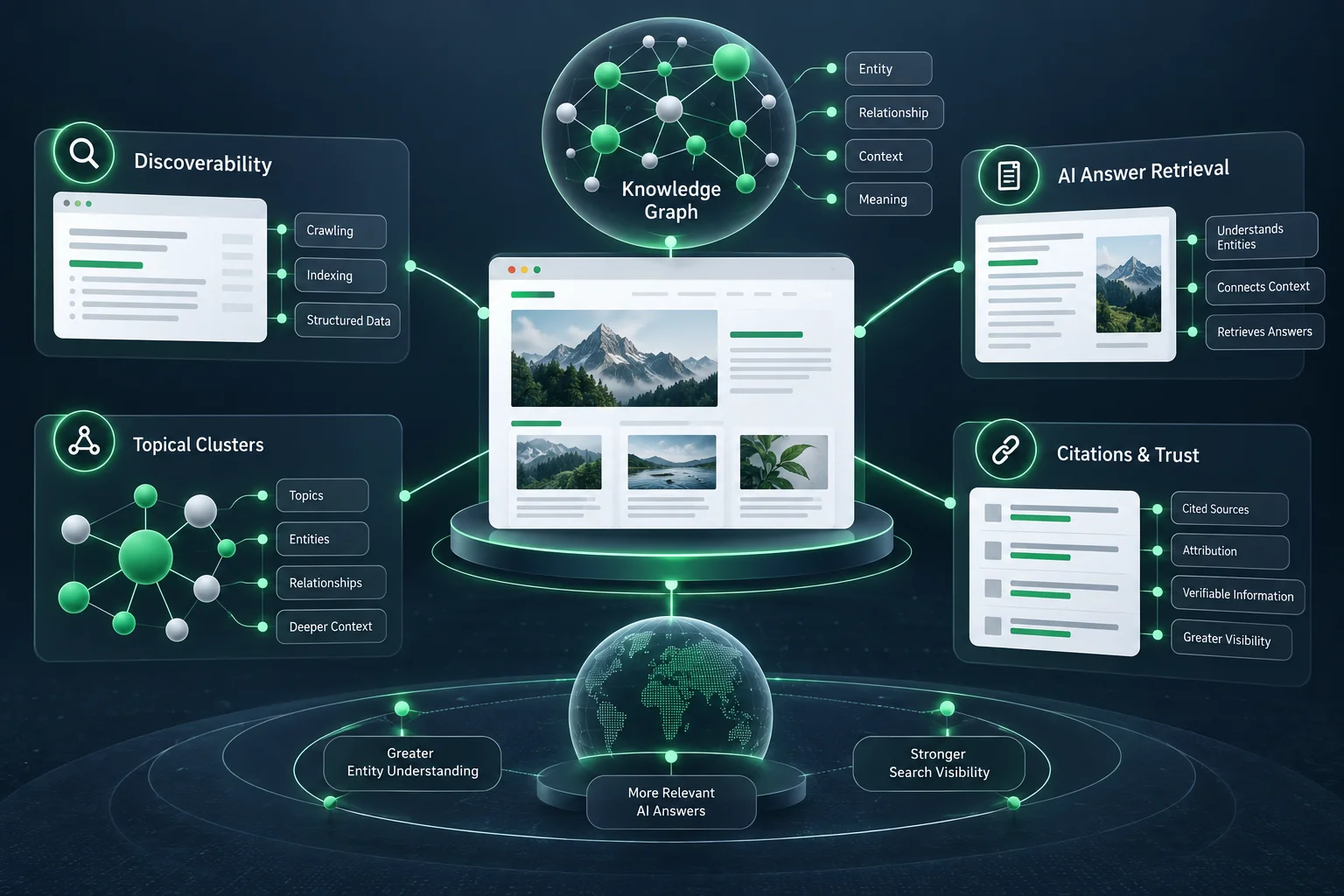
How Knowledge Graphs Strengthen Entity Understanding in AI Search
Knowledge graphs are a practical lever for improving entity understanding across Google and AI answer surfaces. This article explains what they do, how they fit with AEO/GEO, and the technical and operational path to measurable visibility.
1. Why knowledge graphs matter for AI search right now
For marketing and digital leaders seeking stronger visibility on Google, AI Overviews, and generative answer surfaces, knowledge graphs are an architectural response to two trends: search systems increasingly treat queries as entity- and intent-driven retrieval problems, and modern AI features rely on trustworthy, structured facts for grounding. This section states the problem and the practical role of graphs.
The problem: entities, ambiguity, and retrieval
Search engines and AI answer systems resolve user queries by identifying entities (people, places, products, concepts) and retrieving the most relevant, authoritative information about them. Without a clear, machine-readable model of your entities, retrieval systems can misidentify, conflate, or omit your content — especially for brands with multiple product lines, multisite footprints, or multilingual operations.
- Entities are distinct real-world things represented in search systems; controlling their canonical representation reduces ambiguity.
- AI systems prioritize retrieval of semantically relevant content and favor sources with clear provenance and structure.
- Poor entity modeling increases escalation rates for human follow-up, reduces containment (automated answer quality), and raises cost-to-serve.
The practical role of knowledge graphs
A knowledge graph is a machine-readable graph of entities, attributes, relationships and provenance. In practice for visibility, it helps canonicalize entity identifiers, expose relationships that retrieval systems use as signals, and provide a provenance layer that supports trust and versioning.
- Canonical identifiers let you unify content across domains, sub-brands, and channels.
- Relationship edges (e.g., product→feature, location→service) guide retrieval to contextually relevant pages.
- Provenance (who asserted what, and when) is essential for operational control and auditability.
2. Core definitions and what to optimize (AEO, GEO, entities, retrieval, schema)
Before you build, align on definitions. This section gives concise operational meanings for the terms you will see in briefs and technical specs.
AEO and GEO — disciplines not guarantees
AEO (Answer Engine Optimization) and GEO (Generative Engine Optimization) are optimization disciplines: structured content, entity models, and distribution practices intended to increase the chance that an answer engine or generative surface will retrieve and use your content. They are not guaranteed placement mechanisms; search engines document ranking and feature behavior in ways that can be optimized for, but not promised.
- Treat AEO/GEO as measurable workflows (content, schema, signals), not as guaranteed features.
Entities, retrieval and citations
An entity is a referenced real-world thing. Retrieval is the process that selects which content best answers an intent about an entity. Citations are the reference signals search/AI systems may use to attribute information; systems vary in how and whether they surface citations and how they select them.
- Design content and graphs to improve retrieval recall and precision for target intents.
- Understand that citation behavior is system-dependent; optimize for provenance and authoritative signals rather than promised attribution.
3. How knowledge graphs improve entity understanding in practice
Here are the concrete mechanisms that make knowledge graphs valuable for visibility and answer surfaces.
Canonicalization, identifiers, and provenance
Graphs let you assign stable, unique identifiers to each entity (internal IDs, canonical URLs, or well-known identifiers). These IDs reduce fragmentation across pages and feeds. Provenance metadata attached to facts (who asserted it, publication timestamp, version) reduces operational risk when content is updated or corrected.
- Canonical IDs enable reliable internal linking, feed generation, and API responses for retrieval systems.
- Provenance fields support debugging and controlled updates — crucial for multisite and multilingual environments.
Relationships and contextual retrieval
Relationship edges (e.g., product→compatible-accessories, location→services) provide the contextual graph that modern retrieval models use to expand or constrain results. When search systems evaluate relevance, explicit relationships increase precision for compound queries (e.g., 'XYZ product warranty in Toronto').
- Model common user intents as traversals in the graph so retrieval can match nested queries.
- Use relationship-driven canonical pages to consolidate signals and reduce duplication.
Disambiguation and multilingual coverage
Knowledge graphs encode alternate labels, language-tagged names, and regional variants — enabling disambiguation when a query term maps to multiple entities or when users search in different languages. That reduces incorrect retrievals and supports regionally accurate answers.
- Maintain controlled vocabularies for synonyms and abbreviations.
- Provide language-tagged labels and region attributes in both your graph and structured data.
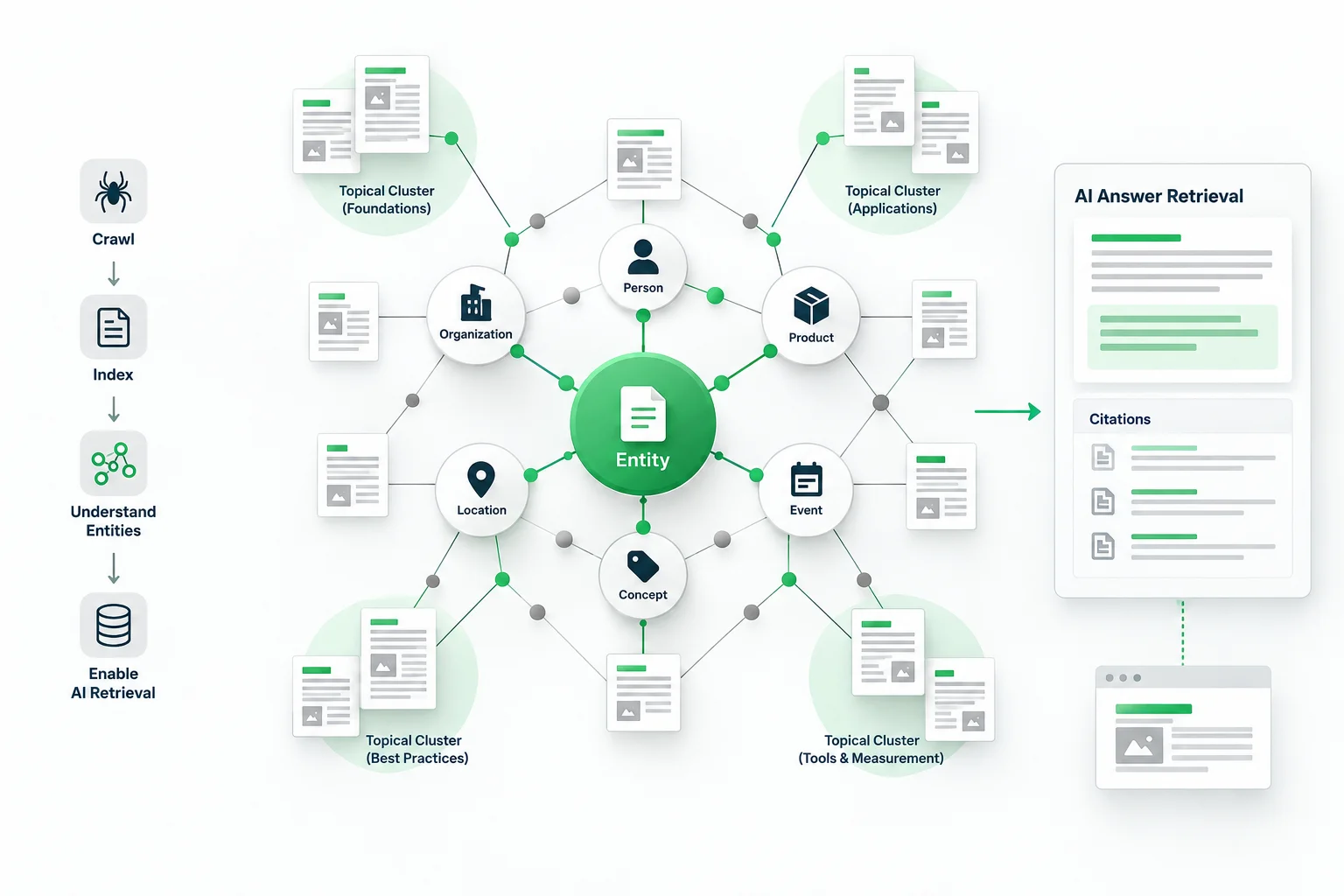
4. Architecture: from research to continuous publishing
A repeatable architecture turns graph theory into operational visibility. Use the following pipeline as a template for delivery and governance.
Research and entity model
Start with stakeholder interviews, SERP intent mapping, and canonical entity identification. Produce an entity model that lists types, properties, relationships, identifiers, and provenance policies. This model is the contract between content, product, and engineering teams.
- Document acceptance tests and data contracts for each entity type.
- Define ownership and update cadence for each data field.
Topic and page graph → authoritative content
Map entities and relationships to a topic/page graph: canonical pages, supporting pages, FAQs, and data endpoints. Prioritize pages that serve high-intent retrieval paths and ensure each page contains helpful, people-first content that matches documented guidance for quality.
- Avoid thin pages; each canonical page should aim to contain the authoritative answer plus links to supporting detail.
- Use editorial versioning and change log practices for content tied to entity facts.
Structured data, internal linking and distribution
Publish the entity facts using machine-readable structured data that matches the entity model. Use internal linking that mirrors the graph so retrieval systems see consistent signals. Distribute graph feeds and APIs to partners and internal systems for consistent downstream use.
- Ensure schema markup is accurate, visible in page content, and kept in sync with the authoritative graph.
- Provide stable JSON-LD endpoints or site-level feeds for downstream consumers.
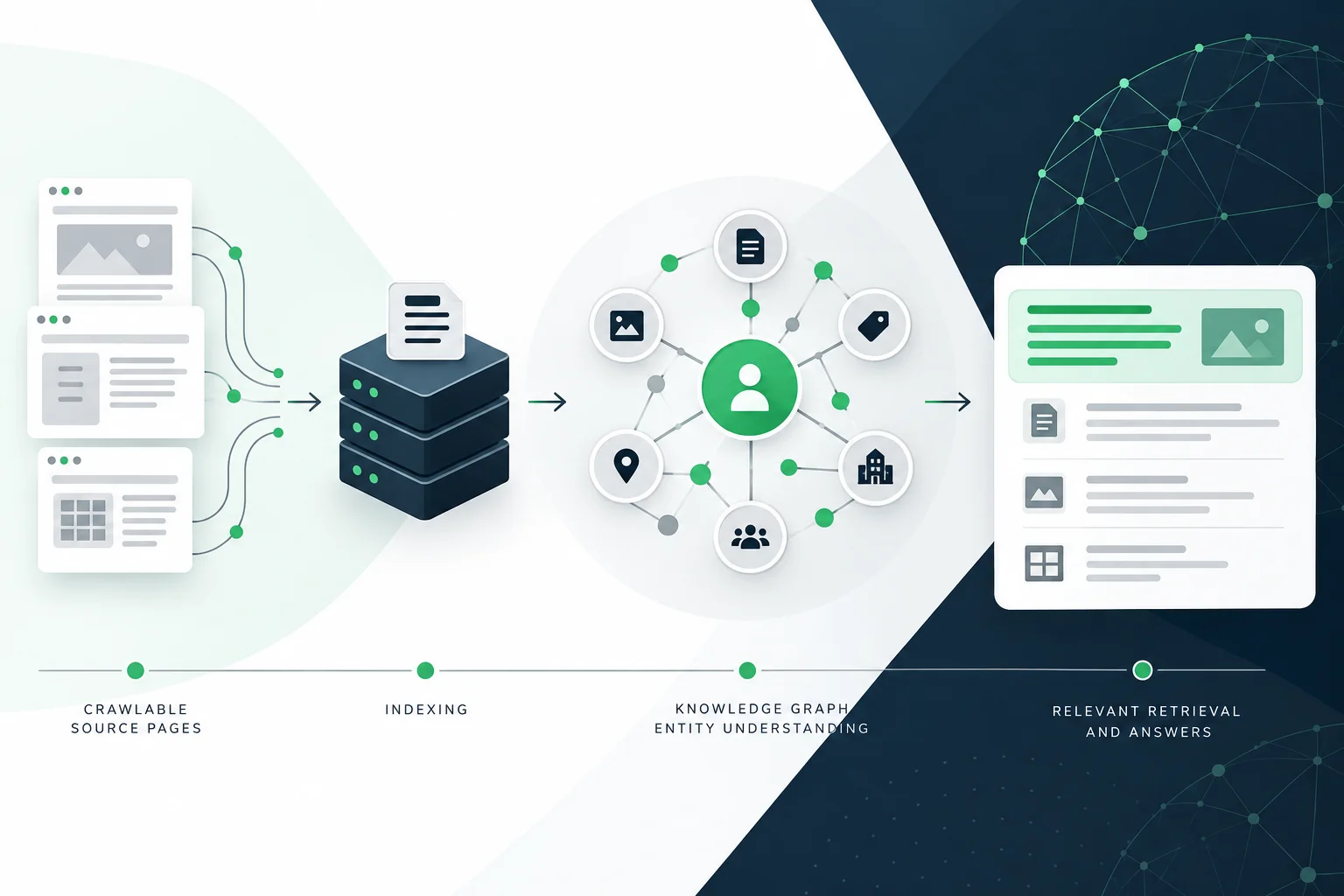
5. Operationalizing at scale: QA, QA playbooks and cost controls
Scaling knowledge graphs across many sites, languages, and product lines needs operational discipline. This section focuses on QA, containment and escalation quality, and cost-to-serve considerations.
QA playbooks, acceptance tests and version control
Implement automated acceptance tests that validate schema conformance, ID uniqueness, relationship integrity, and page-content parity. Add human review gates for high-risk entity types (legal, safety, product warnings). Keep an auditable change log and versioning for every entity update.
- Automate schema validation and runtime checks for all published JSON-LD.
- Use blue/green publishing or staged rollouts for major changes to reduce rollback risk.
Containment quality and escalation paths
Containment quality measures how often an automated answer surface resolves a user intent without human help. Track containment and also track escalation quality — when human follow-up is needed, how accurate and fast is resolution? Design escalation flows with clear ownership and feedback loops back into the graph.
- Instrument user journeys to measure containment rate, mean time to resolution, and escalation accuracy.
- Feed escalations into the graph change pipeline as prioritized corrections.
Cost-to-serve, multisite and multilingual operations
Monitoring cost-to-serve per query or per resolved issue is essential for prioritization. Multisite graphs require normalization of IDs and content templates; multilingual operations require translation workflows, locale-specific attributes, and region-based testing.
- Calculate cost per containment and cost per escalation to inform investment decisions.
- Maintain locale-aware entity attributes, and test retrieval behavior per region/language.

6. Measurement: what success looks like and how to test
Define measurable goals and the experiments you will run. Avoid vanity metrics; focus on retrieval, containment, escalation, and business outcomes.
Primary KPIs for graph-driven visibility
Track: retrieval recall for target intents (did the system retrieve your canonical page), containment rate (automated answer without human), escalation rate and accuracy, and cost-per-resolved-query. Combine these with traffic and conversion metrics for holistic business outcomes.
- Use query-level telemetry to measure retrieval matches against canonical entity IDs.
- Monitor containment and escalation trends by entity type and locale.
Controlled experiments and observability
Run A/B tests where possible: publish structured-data changes to a subset of pages, or expose a new or corrected relationship, and measure changes in retrieval/containment. Instrument logs with entity IDs to enable traceability from query to content to outcome.
- Tag test and control content in analytics so attribution is reliable.
- Use server-side logs and structured-data validators as part of observability.
Continuous optimization cadence
Set a regular cadence (weekly or biweekly) for small-iteration fixes and a quarterly cycle for structural changes to the entity model. Prioritize fixes by escalation volume, commercial impact, and retrieval importance.
- Close the loop: escalations inform graph fixes; fixes are regression-tested and measured in production.
Related Peak Demand resources
Industry and AI sources reviewed
- Schema.org DocumentationSchema.org
- Creating helpful, reliable, people-first contentGoogle Search Central
- Understand how structured data worksGoogle Search Central
- SEO Starter GuideGoogle Search Central
- AI features and your websiteGoogle Search Central
Search-engine and AI-answer behavior changes over time. Google documentation can establish published requirements and guidance, but inclusion in rankings, AI Overviews, citations, or LLM answers is never guaranteed. Practitioner observations should be labelled as inference or testing rather than official ranking factors. This article is operational guidance, not legal advice; organizations should confirm applicable requirements with qualified professionals.
Frequently asked questions
SEO improves visibility in traditional search results. AEO focuses on making content easy for answer systems to extract and use. GEO focuses on visibility in generative search and AI answer experiences. In practice, the strongest strategy combines technical accessibility, useful content, clear entities, strong internal relationships, structured data, and credible source authority rather than treating them as isolated channels.
Official reference: SEO Starter Guide
No. Structured data can make page entities and relationships more explicit and can support eligible search features, but it does not guarantee rankings, AI Overview inclusion, citations, or mentions in generative answers. It should reinforce accurate visible content rather than replace it.
Official reference: Understand how structured data works
Search and answer systems need to understand what a brand, person, product, service, or concept is and how it relates to other entities. Consistent naming, authoritative pages, structured relationships, internal linking, and corroborating references can reduce ambiguity and make a site easier to interpret and retrieve.
Official reference: Schema.org Documentation
Track traditional search visibility alongside query coverage, indexed pages, non-brand discovery, AI referral traffic where available, observed citations or mentions, entity consistency, content-cluster coverage, internal-link depth, and lead quality. Treat AI-surface monitoring as directional because answer composition can vary by model, query, user, and time.
Official reference: AI features and your website
Build a search and AI visibility system that compounds
Peak Demand connects technical SEO, entity architecture, knowledge graphs, structured data, topical authority, internal linking, distribution, and measurement into a managed SEO/AEO/GEO operating system.
Explore Peak Demand AI SEO, AEO & GEO


