
Google Search, AI Overviews, and Generative Engines: One Visibility Strategy
A decision-useful visibility strategy that integrates SEO, AEO, and GEO: entity models, knowledge graphs, structured data, retrieval design, and enterprise measurement for Google and generative answer surfaces.
Why unify SEO, AEO, and GEO now
Search results are no longer a single ranked list. Google Search, AI overviews, and third-party generative engines each use entity understanding, retrieval, and summarization. This section explains the distinctions and why a single strategy yields better visibility and operational efficiency.
Definitions that matter
Define the optimisation disciplines so stakeholders use consistent language. SEO (search engine optimization) remains the discipline of improving content and technical signals for search engines. AEO (answer engine optimization) focuses on concise, authoritative answers and supporting evidence for answer surfaces. GEO (generative engine optimization) concentrates on the broader requirements for being retrievable, cited, or used by generative answer systems. An entity is a discrete real-world thing (brand, product, person, location) that search engines represent in knowledge graphs. Retrieval covers how search engines select candidate documents or entities for an answer. Schema/structured data is machine-readable markup that helps engines understand page content. Topical authority is the breadth and depth of coverage a site or entity has.
- SEO → signals, indexation, ranking relevance.
- AEO → concise answers, evidence, and citation design.
- GEO → retrieval readiness for LLM-based or generative surfaces.
- Entity → canonical identity that ties content and signals across pages.
Documented guidance vs. practitioner inference
Separate what Google documents from reasonable industry inferences. Google explicitly recommends people-first content and correct structured data usage; it documents basics of crawling, indexing, and structured data formats. Google describes AI features and how your site may be used in those features, but it does not publish a guarantee or a ranking formula for inclusion in AI overviews. Practitioners add entity modelling, retrieval-aware content formats, and internal knowledge graphs to increase the probability of being selected by retrieval systems—these are operational best practices, not guarantees.
- Documented: content quality principles and structured data expectations (see Google guidance).
- Inferred: how retrieval models prioritise canonical entities and breadth of topical coverage.
- Operational stance: design for retrieval and evidence, measure outcomes, iterate.
Architecture: from entity research to retrieval
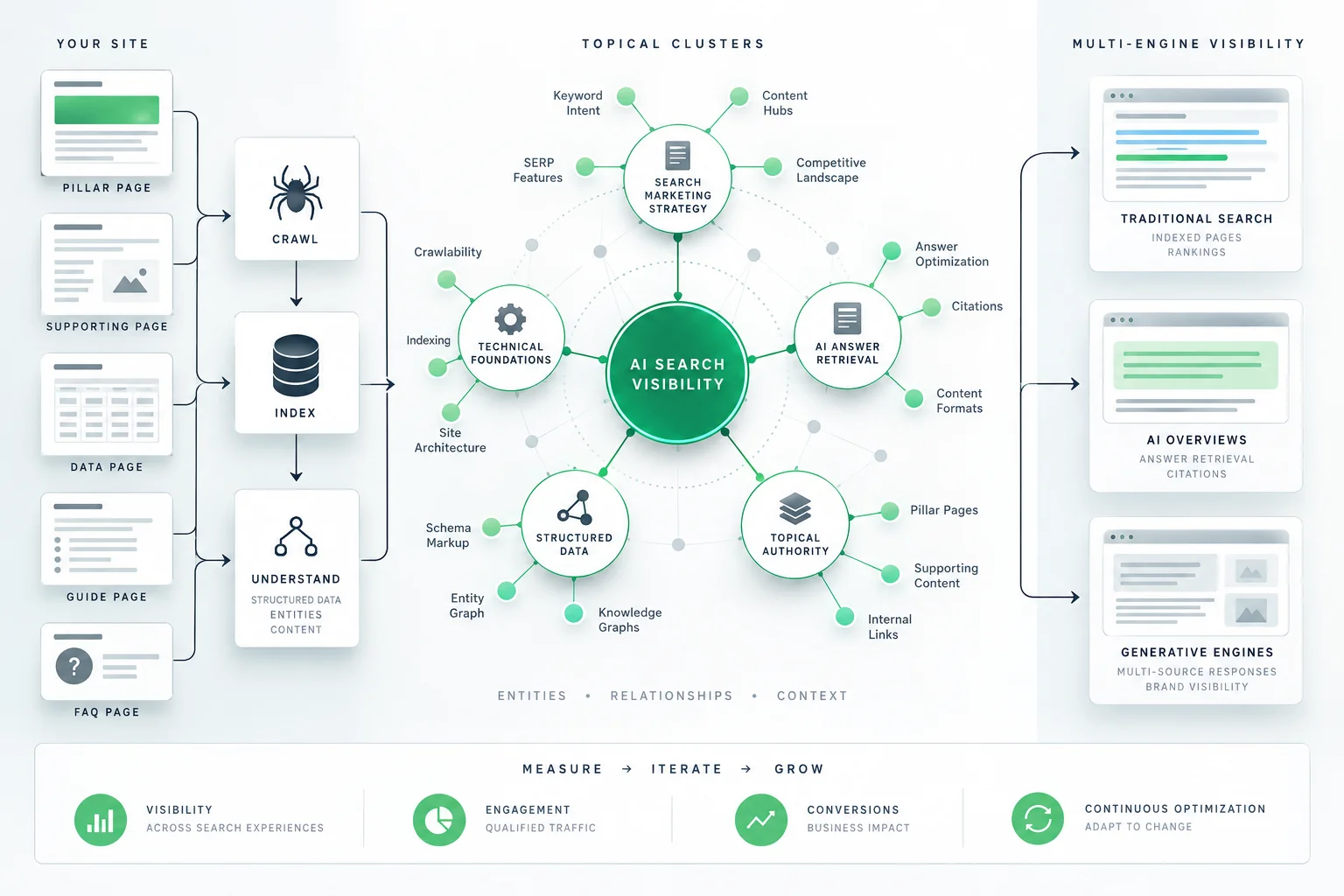
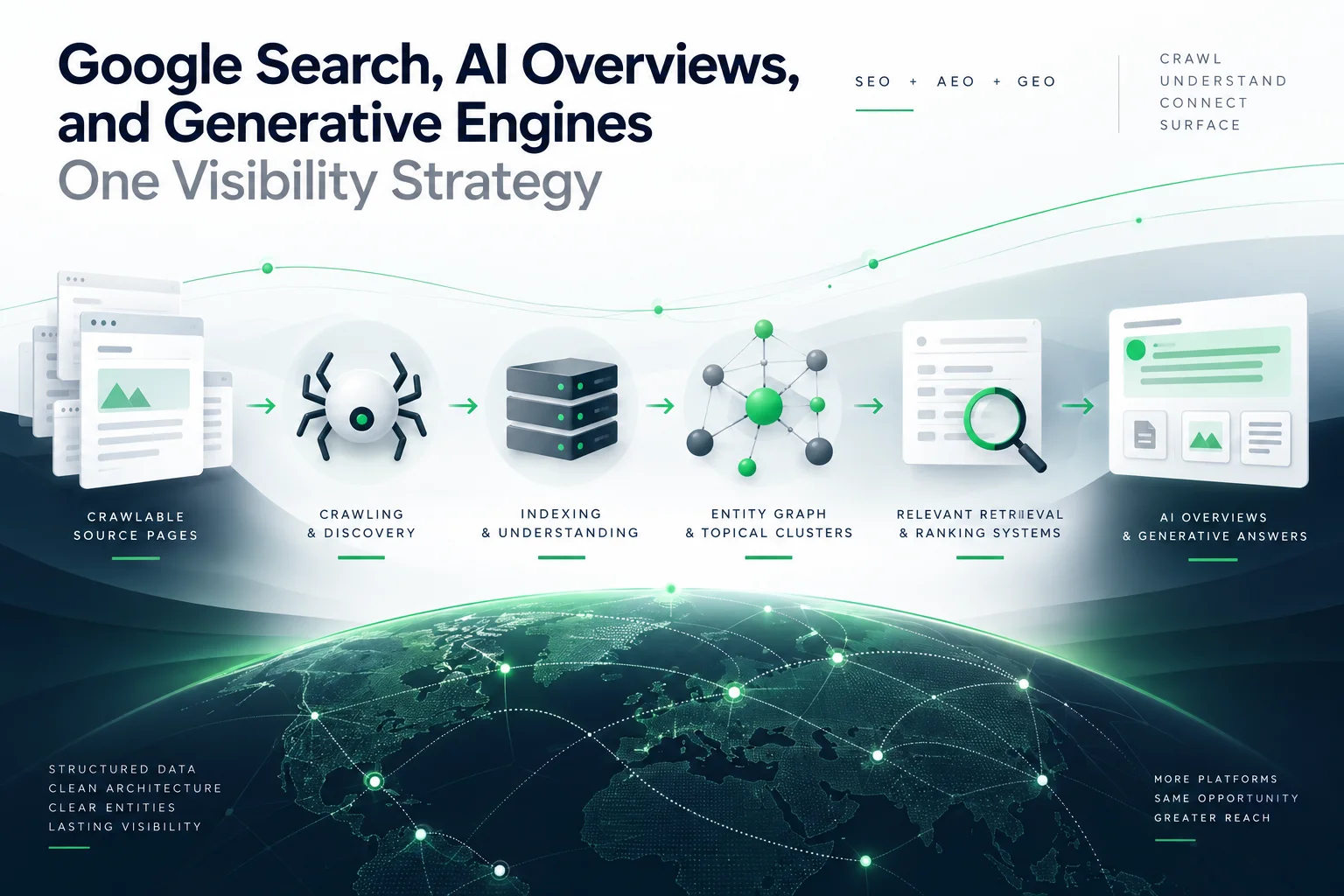
Implement a reproducible architecture so teams can scale. Peak Demand frames the stack as: research & entity model → topic & page graph → authoritative content → structured data & internal linking → distribution & brand signals → retrieval surfaces → measurement & iteration.
Research and entity model (foundation)
Start by mapping the canonical set of entities your organisation owns or should rank for: brands, products, services, locations, spokespeople, certifications. For each entity capture canonical identifiers, aliases, preferred names, relationships, target audience intents, and primary evidence sources (whitepapers, specs, regulatory documents). This entity registry is the single source of truth for schema, canonical URLs, and citation design.
- Create an entity registry with IDs, canonical URLs, and supporting docs.
- Map entity relationships (parent/child, product → SKU, organization → department).
- Use the registry to standardise schema output and internal linking targets.
Topic and page graph
Convert entity and intent maps into a topic-to-page graph: authoritative pillar pages, supporting explainers, data sources, FAQs, and API endpoints. The page graph clarifies which page is the canonical answer for a given query type (definitional, how-to, price/availability, regulatory). For retrieval systems, a clear canonical signal (consistent metadata, schema, and internal links) reduces ambiguity when models surface content.
- Design canonical pages per intent and tag them in the CMS.
- Ensure internal linking follows the page graph and surfaces canonicals for entities.
- Use structured data to mark canonical status and relationships (Product, FAQ, Organization).
Content and structured data: evidence-first publishing
Content must be both helpful for people and structured for machines. Use people-first writing as the editorial baseline and augment with carefully modelled structured data to expose entities and relationships.
Helpful, reliable content scaled
Follow Google’s people-first advice: produce content that answers real user needs, demonstrates expertise and utility, and avoids being primarily search-engine oriented. For AEO/GEO, prioritise clear answer leads, signalable evidence (citations to primary sources), and modular content blocks that retrieval systems can extract: short definitions, step lists, metrics, and tables.
- Lead with concise answers for common intents; expand with evidence and context.
- Publish modular blocks (definitions, FAQs, specs) to improve extractability.
- Avoid thin aggregation that offers no original value or trustworthy evidence.
Structured data and schema strategy
Use schema to declare what entities are on a page and their canonical relationships. Structured data does not guarantee a specific UI treatment, but it reduces ambiguity for machines. Prioritise canonical schemas (Organization, Product, FAQ, HowTo, Dataset) and ensure markup matches visible content. Validate with test tools and integrate schema generation into the CMS to ensure consistency at scale.
- Mark canonical entity properties and relationships with schema.org types.
- Keep visible content and schema consistent—discrepancies erode trust.
- Automate schema generation from your entity registry to reduce markup drift.
Internal linking, citations, and retrieval design
Retrieval systems rely on signals beyond page text—internal linking, inbound authority, and structured citations matter. Design links and citations so the engine sees a coherent signal for canonical entity pages and trustworthy evidence.
Internal linking as canonical routing
Internal links communicate canonical choices and content relationships. Use navigational, contextual, and hub links to direct both humans and bots to canonical entity pages. For large sites, generate hub pages and topic maps that centralise signals to the canonical answer pages.
- Prefer one canonical URL per entity/intent; route link equity through a small set of hubs.
- Use anchor text that reflects the entity and intent rather than generic phrases.
- Monitor internal-linking health in site audits to detect orphan or conflicting canonicals.
External citations and evidence pooling
Generative and answer engines value verifiable sources. Where possible, cite primary evidence—standards, official data, research reports—and ensure those sources are stable and accessible. Align press, developer docs, and product pages so they reference the canonical entity URL to concentrate citation signals.
- Consolidate external references to canonical pages to avoid signal fragmentation.
- Prefer primary sources and durable identifiers (DOIs, official standards).
- When distributing content, ensure syndicated copies point back to canonical sources via links and canonical headers.
Operationalizing at scale: QA, multilingual, and cost-to-serve
Enterprise visibility requires processes for quality, localization, and ongoing optimisation. This section covers QA, containment vs. escalation, analytics, and how to think about cost-to-serve.
Quality assurance and containment quality
Design QA workflows that focus on accuracy, evidence, and escalation rules for sensitive query classes (legal, medical, safety-critical). Containment quality measures how often your content answers queries fully without requiring human escalation. Use human reviewers to validate high-visibility pages and periodically re-review content that drives generative impressions.
- Classify queries by risk and define human review thresholds.
- Track containment metrics: percentage of sessions resolved by site content vs those that escalate.
- Use standardized checklists for factual accuracy, source quality, and schema correctness.
Multisite and multilingual operations
For multi-country or multi-brand deployments, normalise entity identifiers across sites and languages. Maintain a central entity registry and localized canonical pages mapped to language/regional variants. Localize not just language but evidence and citation preferences (local regulators, regional standards).
- Central registry with localized canonical URLs reduces duplication.
- Translate and adapt evidence; don’t merely machine-translate content without review.
- Maintain language-specific schema and hreflang signals to guide retrieval and indexing.

Measurement, iteration, and the governance loop
Visibility is a continuous governance problem. Build observability across content, schema, internal linking, and retrieval signals, then close the loop with prioritized remediation and content investments.
Essential KPIs and observability
Track a minimal set of KPIs that reflect retrieval performance: retrieval impressions (when available), queries leading to canonical pages, containment rate, escalation rate, AI-feature click-through and conversion, and schema validation errors. Combine Search Console, server logs, API telemetry, and internal CRM events to create a single visibility dashboard.
- Retrieval impressions (Search Console or engine telemetry), containment rate, escalations.
- Assisted conversion and downstream pipeline attribution.
- Schema error rate, canonical conflicts, and internal-linking density.
Prioritisation and iterative experiments
Use a test-and-learn cadence: run controlled experiments on answer formats, structured-data variants, and canonical routing, prioritizing high-volume and high-cost intents. Document hypotheses, instrumentation, and observation windows. Feed results back into the entity registry and page graph to reduce future retrieval ambiguity.
- Prioritise high-volume, high-cost intents for early tests.
- Instrument and timebox experiments; avoid changing multiple variables at once.
- Operationalize learnings into CMS templates and schema generation rules.
Related Peak Demand resources
Industry and AI sources reviewed
- Creating helpful, reliable, people-first contentGoogle Search Central
- Understand how structured data worksGoogle Search Central
- AI features and your websiteGoogle Search Central
- SEO Starter GuideGoogle Search Central
- Schema.org DocumentationSchema.org
Search-engine and AI-answer behavior changes over time. Google documentation can establish published requirements and guidance, but inclusion in rankings, AI Overviews, citations, or LLM answers is never guaranteed. Practitioner observations should be labelled as inference or testing rather than official ranking factors. This article is operational guidance, not legal advice; organizations should confirm applicable requirements with qualified professionals.
Frequently asked questions
SEO improves visibility in traditional search results. AEO focuses on making content easy for answer systems to extract and use. GEO focuses on visibility in generative search and AI answer experiences. In practice, the strongest strategy combines technical accessibility, useful content, clear entities, strong internal relationships, structured data, and credible source authority rather than treating them as isolated channels.
Official reference: SEO Starter Guide
No. Structured data can make page entities and relationships more explicit and can support eligible search features, but it does not guarantee rankings, AI Overview inclusion, citations, or mentions in generative answers. It should reinforce accurate visible content rather than replace it.
Official reference: Understand how structured data works
Search and answer systems need to understand what a brand, person, product, service, or concept is and how it relates to other entities. Consistent naming, authoritative pages, structured relationships, internal linking, and corroborating references can reduce ambiguity and make a site easier to interpret and retrieve.
Official reference: Schema.org Documentation
Track traditional search visibility alongside query coverage, indexed pages, non-brand discovery, AI referral traffic where available, observed citations or mentions, entity consistency, content-cluster coverage, internal-link depth, and lead quality. Treat AI-surface monitoring as directional because answer composition can vary by model, query, user, and time.
Official reference: AI features and your website
Build a search and AI visibility system that compounds
Peak Demand connects technical SEO, entity architecture, knowledge graphs, structured data, topical authority, internal linking, distribution, and measurement into a managed SEO/AEO/GEO operating system.
Explore Peak Demand AI SEO, AEO & GEO


