Continuous Measurement Pipelines for Multisite Multilingual Utility Voice AI
A practical operational framework for measuring, validating, and optimizing high-volume Voice AI across multiple sites and languages—focused on outage communications, service requests, account-safe validation, and reliable escalation.
1. Operating model and architecture: From caller to outcome
A concise operating model aligns people, APIs, and measurement. Keep the interaction sequence strict and observable so downstream analytics and QA are trustworthy.
Canonical event flow
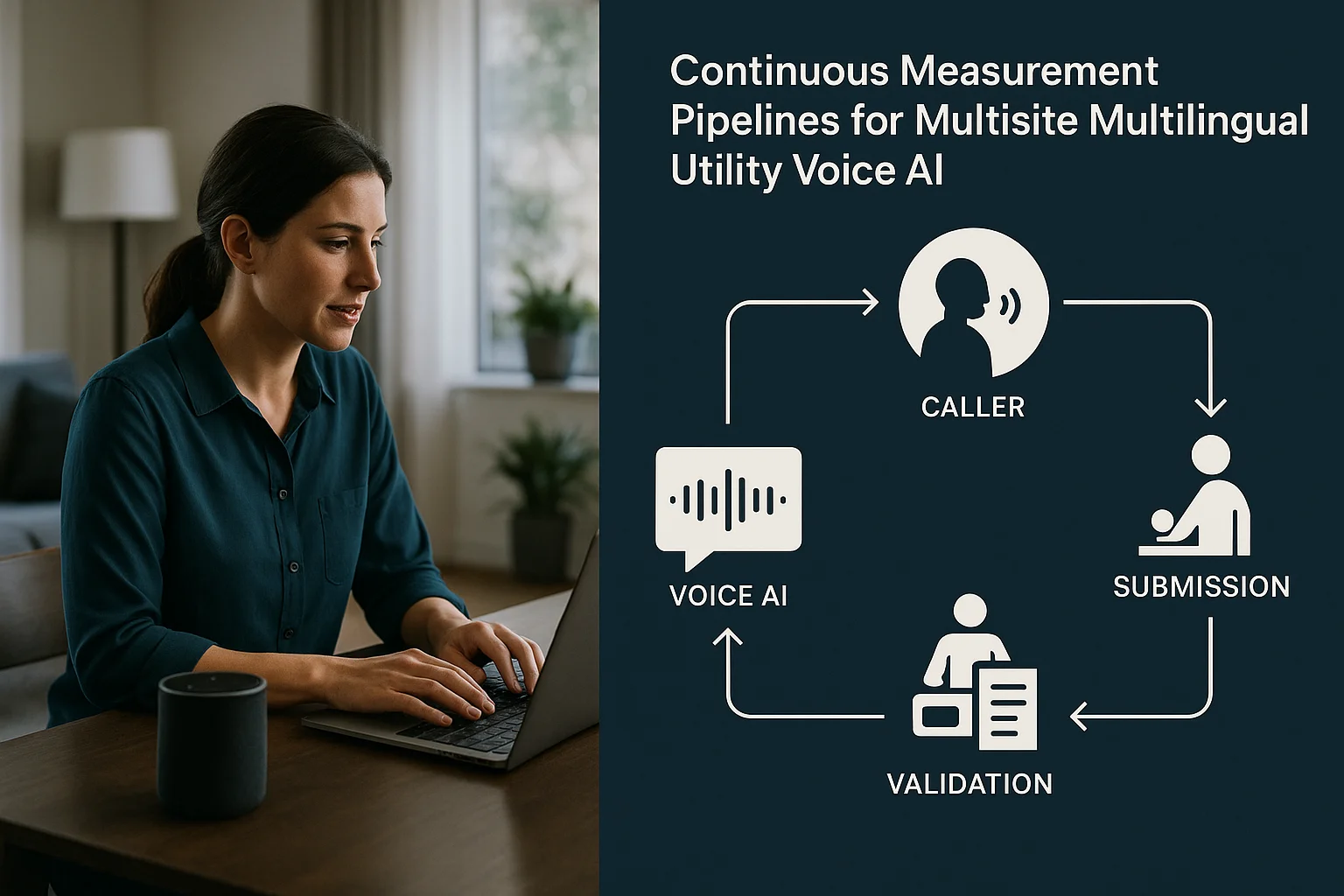
Design the interaction as a sequence of discrete, logged events: Caller → Voice AI intent resolution → account/premise validation → knowledge/API lookup → approved action (status response, service request creation, or scheduled visit) → routing to human escalation if required. Log each transition with timestamps, component IDs (voice NLP version, adapter, validation engine), and correlation IDs so you can reconstruct the entire call for QA or audit.
- Generate a unique event_id at call start and propagate through all systems.
- Timestamp: IVR entry, speech-to-text completion, intent decision, validation result, action invocation, escalation handoff.
- Record metadata: language, site/region, caller phone number hash, channel (PSTN/SIP), and feature flags.
Operational boundaries and safety constraints
Explicitly declare what Voice AI can and cannot do. Under no circumstances should Voice AI autonomously operate utility infrastructure, make safety-critical decisions, or substitute emergency response. Configure the system so any action that could materially affect safety or field operations requires human confirmation or pre-approved business rules. Define escalation triggers (ambiguous address, confirmed gas smell, medical emergencies) and treat them as immediate human-handback paths.
- Actions limited to read-only status responses, service-request creation, appointment scheduling, and routing decisions.
- Any request that could require on-site isolation, de-energization, or critical switching must escalate to human operators.
- Log the reason code for each escalation to support QA and regulatory reporting.
2. Core metrics: What to measure and why
Choose metrics that map directly to operational outcomes: containment and escalation quality determine cost-to-serve and customer experience; event-level analytics power continuous optimization.
Containment and containment quality
Containment rate is the share of calls fully resolved by Voice AI without human transfer. Measure not only the raw rate but containment quality—the percentage of contained calls that were correct (i.e., the caller’s objective was fulfilled and no recontact was required). Use downstream indicators such as follow-up calls within 48–72 hours and ticket reopens to verify containment quality.
- Containment rate = contained_calls / total_calls_handled_by_voice_AI.
- Containment quality = contained_calls_verified_correct / contained_calls_sampled.
- Track recontact rate and ticket reopen rate as negative indicators.
Escalation quality and human handoff effectiveness
Measure the proportion of escalations that were necessary, the accuracy of context passed to humans (context completeness score), and resolution time post-escalation. Escalation quality balances safety and containment—over‑escalation increases cost; under‑escalation increases risk.
- Escalation necessity rate = escalations_deemed_required / escalations_sampled.
- Context completeness: percent of escalations including validated account, location, transcript snippet, and reason code.
- Time-to-resolution after escalation: median and 95th percentile.
Cost-to-serve and event-level economics
Translate containment and escalation metrics into cost-to-serve per call by attributing unit costs (Voice AI processing, agent time, field dispatch). Track cost variance across languages and sites to prioritize optimization where ROI is highest.
- Cost-to-serve = (voice_AI_costs + agent_costs + field_costs) / resolved_calls.
- Calculate marginal savings from improvements in containment quality, not containment rate alone.
- Report per-site and per-language cost-to-serve for procurement and budgeting.
3. Continuous measurement pipelines and QA controls
Measurement pipelines must be reproducible, auditable, and integrated with QA workflows. Use data contracts and event architecture to ensure consistent telemetry across sites and vendors.
Data contracts, event schema, and observability
Define a compact, versioned event schema that each Voice AI component, adapter, and integration implements. The schema should include event_id, correlation_id, timestamps, component IDs, language, locale, input transcript, intent_id, confidence scores, validation outcomes, API response codes, and action outcomes. Enforce the schema with validation at ingestion and fail-safe behavior (log and route to human review) when schema violations occur. Use the schema as the basis for dashboards, SLA checks, and forensic reconstruction.
- Versioned schema ensures backward compatibility during rollouts.
- Schema validation at ingestion prevents silent data drift.
- Correlate events with OMS/CIS/CRM IDs for service-request-level analytics.
QA sampling, human review, and closed-loop remediation
Combine random sampling with risk-based sampling (high-impact intents, low-confidence scores, new languages, or post-deployment changes). Human reviewers should tag errors by root cause (ASR transcription, intent classification, validation failure, incorrect API mapping). Prioritize fixes: high-frequency failures that affect containment quality, then low-frequency high-severity failures.
- Stratified sampling: 70% random, 30% risk-based (configurable).
- Use targeted review quotas by site and language to maintain parity across operations.
- Feed reviewer tags back into training data and integration fixes with traceable tickets.
Synthetic and regression tests
Run synthetic test calls across languages and sites on every code, model, or integration change. Tests should simulate common and edge-case intents, validation failures, and API latency. Maintain a baseline suite to detect regressions in containment and escalation quality.
- Schedule lightweight synthetic tests continuously and full-suite tests on deploy.
- Automate alerting when key KPIs deviate beyond pre-defined gates.
- Log synthetic outcomes as part of the same event store for parity with production analytics.
4. Scale across sites and languages
Multisite multilingual deployments introduce variability. Treat language and site as first-class entities in measurement and controls.
Localization, language models, and performance baselines
Maintain per-language baselines for ASR accuracy, intent confidence distributions, containment quality, and cost-to-serve. Where possible, prefer locale-specific models or targeted fine-tuning rather than a single global model. Track per-language drift and maintain separate QA sampling quotas to catch issues early.
- Baseline metrics by language and site before scaling changes.
- Use pronunciation lexicons and local phrasing datasets for ASR tuning in high-volume locales.
- Monitor confidence score distributions; shifts may indicate concept drift or new vocabulary.
Regional hosting, data residency, and remote support
Align hosting and backup regions to legal and operational needs. Clearly document where recordings, logs, and PII-derived metadata are stored, which subprocessors have access, and the mechanism for cross-border transfers and backups. Limit remote-support access with just-in-time credentials and auditable sessions.
- Define primary and backup hosting regions per jurisdiction.
- List subprocessors and the scope of their access in procurement artifacts.
- Enforce least-privilege remote-support and log all sessions for audit.

5. Integration safeguards and escalation engineering
Integration with OMS, CIS, CRM, and field dispatch is the most operationally sensitive area. Adopt controlled adapters and account-safe validation to minimize erroneous actions.
Account-safe validation and API adapters
Never allow the Voice AI to submit write-actions without multi-factor validation when the action affects billing, access, or field operations. Use a controlled adapter layer that enforces business rules and produces an action token. The adapter verifies caller-authentication (token, PIN, or verified callback), checks for conflicting workorders, and returns structured outcomes and reason codes.
- Adapters mediate all write operations to OMS/CIS/CRM and return normalized response codes.
- Require a second verification factor for actions that modify service or billing.
- Record adapter decision rationale for later QA and audit.
Escalation routing and context handoff
Design handoffs to deliver a concise, verified context packet: caller metadata, transcript excerpt, intent, confidence, validation status, and the adapter’s recommended next steps. Route escalations based on intent, language, region, and required skillset. Instrument the handoff so that post-escalation resolution and feedback are captured and attributed to the originating event.
- Context completeness target: >95% of escalations include validated account and location.
- Route by concurrency and skill to limit latency.
- Capture agent notes and resolution codes back into the event store for closed-loop learning.
Audit trails and regulatory readiness
Keep immutable logs for all validation decisions, adapter responses, and human confirmations. Ensure logs are queryable by event_id and retention aligns with applicable jurisdictional requirements. Document retention policy, breach duties, and notification responsibilities in procurement contracts and runbooks.
- Immutable append-only event store for action and audit logs.
- Define retention by jurisdiction and include backup geography in contracts.
- Link logged events to ticket IDs in OMS/CIS for unified reporting.

6. Failure boundaries, surge capacity, and incident response
Plan for partial failures, burst traffic during storms or major outages, and security incidents. Define deterministic fallback behaviors to preserve safety and continuity.
Common failure modes and deterministic fallbacks
Anticipate failures: ASR degradation, integration timeouts, adapter errors, or malformed inputs. For each class define a fallback: route to IVR prompts with human callback option, route to human agents, or provide read-only status for high-latency integrations. Make fallback selection deterministic and logged so behavior is predictable.
- ASR/intent confidence below threshold → simplified IVR confirmation or human transfer.
- Adapter or OMS timeout → read-only response + scheduled callback or agent transfer.
- Malformed data or schema validation failure → drop to human review path and alert SRE/ops.
Surge handling and capacity planning
Model surge capacity for peak events (storms, large-scale outages) using historical call patterns and stress tests. Predefine modes: degraded-service mode (limited intents), emergency-info mode (outage-only content), and full-service mode. During surges, increase sampling rates for QA on top-priority intents.
- Run load tests with synthetic calls to validate upstream integrations and adapter throughput.
- Deploy reduced-intent menus when load exceeds thresholds to preserve core outage communications.
- Pre-warm human escalation pools and queue prioritization for outage-related intents.
Incident response and recovery
Integrate Voice AI into enterprise incident response and business continuity plans. Define roles (SRE, contact-center ops, vendor support), escalation matrices, and runbooks for common scenarios. Track incident post-mortems and ensure measurable remediation items are closed within agreed timelines.
- Maintain an incident runbook for ASR/model regressions and integration outages.
- Include specific procedures for restoring event ingestion and reconciling missed actions.
- Post-incident: rerun synthetic suites and targeted sampling to validate recovery.
Related Peak Demand resources
Industry and AI sources reviewed
- AI Risk Management Framework — Critical Infrastructure ProfileNational Institute of Standards and Technology (NIST)
- Cross-Sector Cybersecurity Performance GoalsCybersecurity and Infrastructure Security Agency (CISA)
- Cybersecurity Capability Maturity Model (C2M2)U.S. Department of Energy
Utility cybersecurity, critical-infrastructure, records, customer-protection, and emergency-communications obligations vary by jurisdiction and service type. This article is operational guidance, not legal advice; organizations should confirm applicable requirements with qualified professionals.
Frequently asked questions
Good starting points include billing and account questions, move-in or move-out intake, appointment scheduling, service-request capture, outage-status messaging from approved systems, payment-routing assistance, and structured escalation. Safety-critical and infrastructure-control decisions should remain with qualified utility teams.
Official reference: Cross-Sector Cybersecurity Performance Goals
Use the minimum approved identifiers needed for the workflow, validate them against the utility's system of record, limit data exposure, and provide a human-assisted path when verification fails. The Voice AI should not guess account, premise, or outage information.
Official reference: Cross-Sector Cybersecurity Performance Goals
Use controlled adapters, strict schemas, timeouts, retries, audit logs, safe failure states, and human escalation. The system should distinguish approved utility data from model-generated language and should never present stale or unverified operational information as fact.
Official reference: Cybersecurity Capability Maturity Model (C2M2)
Track containment by request type, successful validations, transfers, abandoned calls, integration errors, incorrect or stale responses, time to resolution, customer follow-up, and the percentage of cases completed safely without manual rework.
Official reference: Cybersecurity Capability Maturity Model (C2M2)
Build resilient utility customer-service automation
Peak Demand helps utilities connect Voice AI to approved customer-information, outage-communication, service-request, dispatch, escalation, and analytics workflows.
Schedule a discovery call


