
Content Architecture for SEO, AEO, GEO, and LLM Surfacing
A practical, evidence-led guide to designing content, entity, structured-data, and retrieval architecture that improves visibility across Google search, AI/answer surfaces, and LLM-based discovery.
1. Definitions and scope — what AEO, GEO, entities, and surfacing mean
Start with shared language. Clear definitions reduce ambiguity between product, content, engineering and legal teams.
Core definitions
AEO (Answer Engine Optimization): the discipline of shaping content and metadata for retrieval by answer engines and AI features so that concise, accurate snippets or structured answers can be produced. GEO (Generative Engine Optimization): the discipline of preparing content, structured data, and knowledge resources so generative LLM-based systems can find and reuse your brand’s factual, actionable knowledge. Entity: a discrete real-world thing (person, place, product, concept) represented by a stable identifier in your models or knowledge graph. Knowledge graph: a network of entities and relationships used to power retrieval and disambiguation. Retrieval: the process by which an engine selects candidate content or facts to answer a query. Citation (or source signal): visible references or opaque.
- Treat AEO/GEO as optimization disciplines, not guaranteed placements.
- Entity first: model entities before authoring pages.
- Structured data is a communication layer — use it to state facts consistently.
Documented engine guidance vs. practitioner inference
Documented guidance: Google publishes fundamentals on technical SEO and creating helpful, people-first content, and a public guide on structured data and on how AI features interact with websites. Practitioners infer operational best practices from experiments and signal behavior (for example, entity pages plus matching structured data often correlate with higher probability of being cited in answer surfaces). Distinguish the two in planning: treat documented guidance as policy constraints and practitioner inferences as testable hypotheses.
- Documented: follow Google's SEO Starter Guide and the structured data documentation for correct technical implementation.
- Documented: Google’s guidance on helpful content emphasizes people-first content quality as a primary site-level signal.
- Practitioner inference: structured, canonical entity nodes plus broad topical coverage tends to improve retrieval likelihood — test and measure this for your domain.
2. The architecture you need — from research to retrieval
Translate strategy into an operating model. The architecture below is pragmatic and repeatable for enterprises.
The seven-stage visibility system
Design content and systems around this sequence: (1) Research & entity model→ (2) Topic and page graph→ (3) Authoritative content→ (4) Machine-readable annotations and internal linking→ (5) Distribution and brand signals→ (6) Retrieval & citation surfaces→ (7) Measurement and iteration. Each stage maps to responsibilities: product/analytics for research, editorial/SMEs for content, engineering for structured data and APIs, and measurement for QA and attribution.
- Entity model reduces duplication and clarifies canonical facts.
- Topic-to-page graph prevents coverage gaps and overlapping pages that confuse retrieval.
- Structured data and internal links make relationships explicit for engines.
Operational implications
Move from ad-hoc publishing to a governed publishing control-plane that enforces templates, schema, canonical rules, and QA gates. Define SLAs and data contracts for knowledge graph feeds; implement acceptance tests that validate both content quality and machine-readable correctness before release.
- QA gates should include human fact-check, schema validation, and sample-answer generation tests.
- Data contracts define expected fields, update cadence, and error handling for downstream retrieval consumers.
- A publishing control plane limits accidental content churn that reduces topical authority.
3. Content and entity design — pages, templates, and topical graphs
How you model pages and entities determines retrieval quality, containment, and escalation behaviour.
Entity canonicalization and page role
Assign each core entity a canonical node (URL + ID + machine-readable profile). Map types of user needs to page roles: fact page (entity profile), how-to / task page (procedural), overview (topical hub), and transactional pages. Use templates with stable schema blocks for facts, attributes, and relationships so the knowledge graph can consistently ingest them.
- Avoid multiple semi-canonical pages that fragment signals.
- For multisite environments, centralize entity canonical records when possible and localize only the hub copy.
- Include stable identifiers (SKU, canonical entity ID) in structured data where applicable.
Containment quality and escalation quality
Containment quality measures whether an answer surface can satisfy a query fully (no human handoff). Escalation quality measures the clarity and handoff path when containment fails (contact options, next-best-steps, human-in-loop flows). Architect pages and knowledge-graph responses so that when a short answer is insufficient, the engine or conversational layer has clear, authoritative next steps to surface.
- Design concise, factual snippets that support containment for high-frequency queries.
- Provide clear escalation signals (canonical contact URIs, support articles, next-step links) baked into your structured output.
- Measure both containment ratio and escalation success (did the user convert or reach a human?).
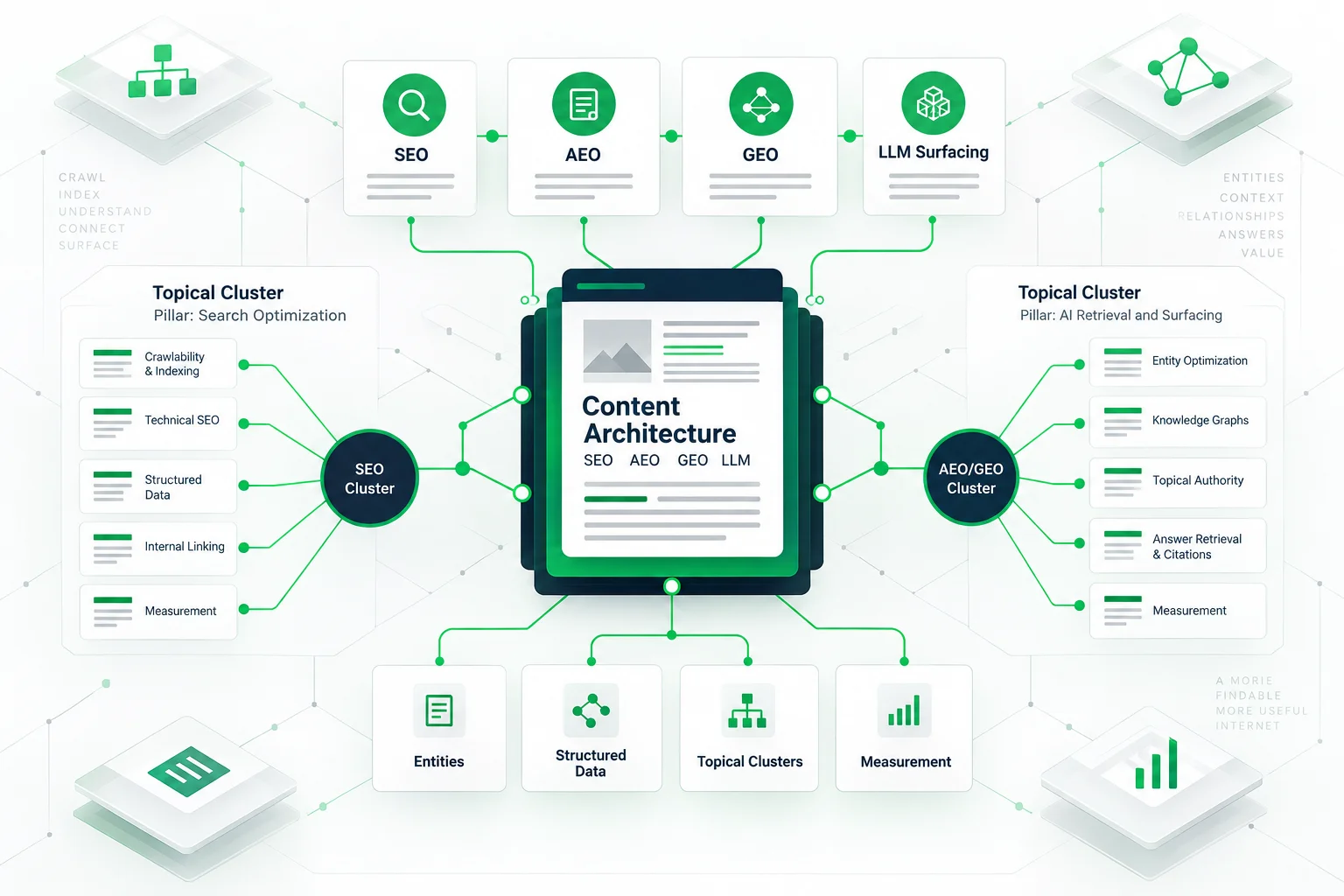
4. Machine-readable layer and knowledge graphs
Structured data and knowledge graphs are the lingua franca for engines and LLM retrieval. Implement for clarity and measurability.
Schema choices and best practices
Use JSON‑LD (or RDFa when required) according to documented guidelines. Publish entity profiles that include stable IDs, type declarations, relationships, and attributes. Validate markup with schema-aware tools and run automated tests as part of CI/CD. Do not use schema as a shortcut for poor content: schema annotates factual content, it does not replace it.
- Follow documented structured data patterns and avoid proprietary fields that engines don’t recognize.
- Keep machine-readable facts synchronized with page text to avoid mismatches that degrade trust.
- Include update timestamps and provenance fields in knowledge feeds where possible.
Feeds, graphs, and APIs
Expose knowledge-graph exports (RDF/JSON-LD feeds or Graph APIs) with stable, documented schemas and changelogs. Orchestrate a controlled adapter that converts internal records to public schema and enforces quality rules. For commercial implementations, consider integrating these feeds with LLM surfacing systems or search-to-pipeline conversion infrastructure.
- Define feed cadence and error levels in data contracts.
- Provide both human-readable pages and machine feeds; engines may access either.
- Keep a clear audit trail (who changed what and when) for governance and incident response.
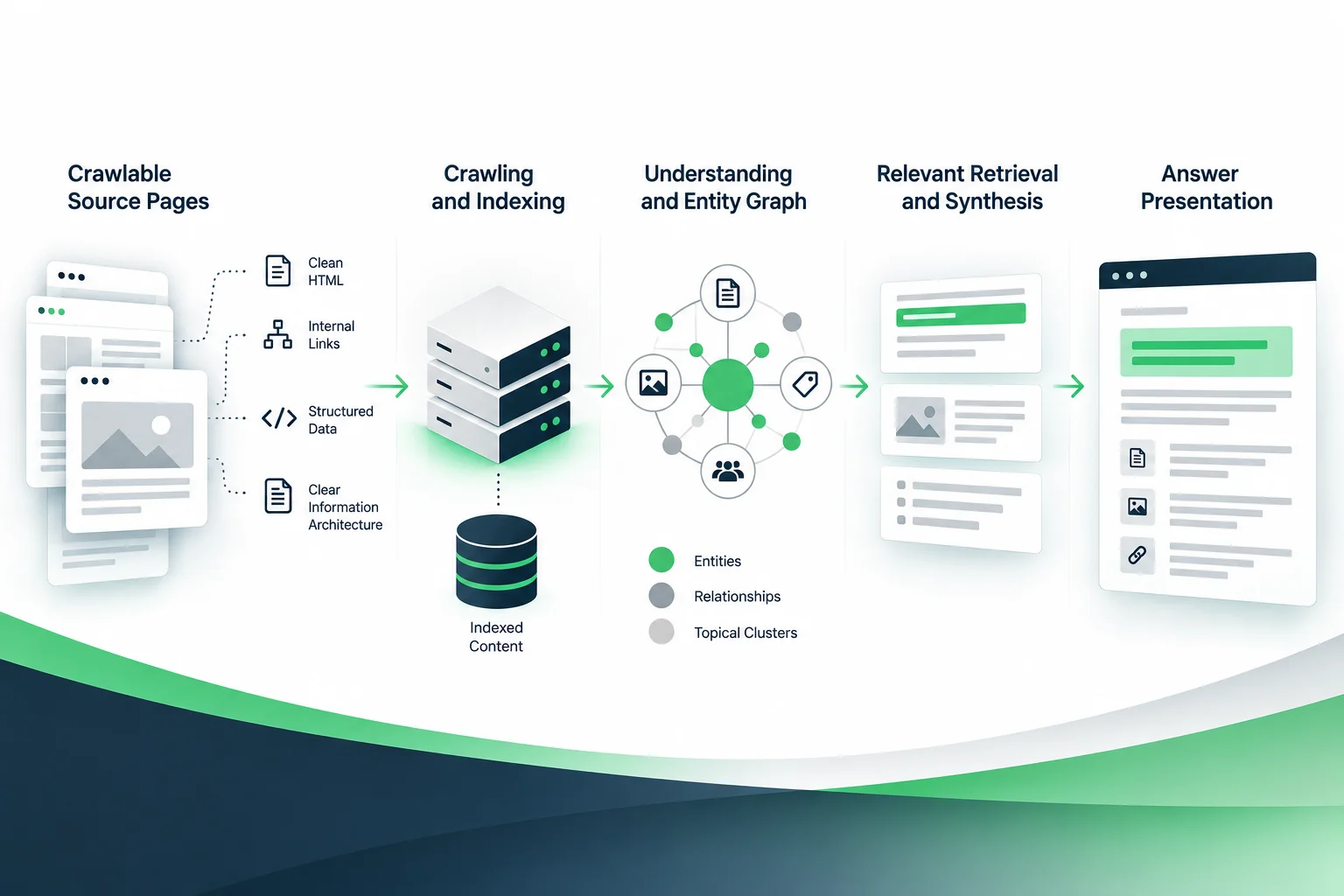
5. Retrieval, measurement and cost-to-serve
Measurement must link signals (queries, exposures, clips, follow-through actions) to business outcomes while controlling operating cost.
Core metrics to instrument
Instrument query-level telemetry and event traces so you can measure: retrieval rate (how often a page or entity is returned), containment ratio (how often the returned result answers the query), escalation rate (how often users move to human support), downstream conversion (leads, transactions), and cost-to-serve (engagement time, support cost avoided). Tie these events back to content IDs and feed versions for root-cause analysis.
- Log exposures (when an engine surfaces your content or fact) and link to session outcomes.
- Measure answer accuracy via sampled human review tied to content IDs.
- Compute cost-to-serve per query type to inform prioritization.
Attribution and observable pipelines
Because AI features often present answers outside traditional click paths, instrument server-side events and downstream pipeline hooks (webhooks, CRM events, lead captures). Build a search-to-pipeline analytics flow that connects surfaced answers to leads or conversions — Peak Demand’s AI SEO and Search-to-Pipeline Services help organizations design these measurement architectures.
- Prefer event-level attribution rather than last-click heuristics for AI exposures.
- Store feature context (snippet, feed version, query cluster) for debugging.
- Run regular sampling and human evaluation to validate automated metrics.

6. Governance, scale and multilingual operations
Enterprise rollout needs governance, acceptance tests, SLAs, and multilingual controls to avoid signal fragmentation.
Governance and control plane
Define role-based publishing flows, content ownership, schema-change approval processes, and incident playbooks that include rollback paths for knowledge feeds. Acceptance testing should include schema validation, sample-answer generation, and human QA for factual accuracy. Peak Demand’s Machine-Readable SEO Services and LLM Surfacing Services are designed to integrate these capabilities into delivery pipelines for multi-domain environments.
- Create a schema change log and require automated validation for all feed changes.
- Set SLAs for feed freshness and error resolution.
- Require a minimum QA sample pass rate before promoting content to production.
Multisite and multilingual scale
Centralize the entity graph where possible and localize copy and attributes only when legally or commercially required. Handle language variants with clear hreflang, localized structured data, and mirrored knowledge nodes rather than divergent canonical content. For multi-brand or multi-country setups, control duplication by per-entity canonical pointers and translation pipelines that preserve entity IDs.
- Local copies should reference a single canonical entity ID to preserve authoritative facts.
- Use translation QA to keep facts aligned and to prevent localized contradictions.
- Monitor per-market containment and escalation metrics to prioritize content investments.
Related Peak Demand resources
Industry and AI sources reviewed
- SEO Starter GuideGoogle Search Central
- Creating helpful, reliable, people-first contentGoogle Search Central
- Understand how structured data worksGoogle Search Central
- AI features and your websiteGoogle Search Central
- Schema.org DocumentationSchema.org
Search-engine and AI-answer behavior changes over time. Google documentation can establish published requirements and guidance, but inclusion in rankings, AI Overviews, citations, or LLM answers is never guaranteed. Practitioner observations should be labelled as inference or testing rather than official ranking factors. This article is operational guidance, not legal advice; organizations should confirm applicable requirements with qualified professionals.
Frequently asked questions
SEO improves visibility in traditional search results. AEO focuses on making content easy for answer systems to extract and use. GEO focuses on visibility in generative search and AI answer experiences. In practice, the strongest strategy combines technical accessibility, useful content, clear entities, strong internal relationships, structured data, and credible source authority rather than treating them as isolated channels.
Official reference: SEO Starter Guide
No. Structured data can make page entities and relationships more explicit and can support eligible search features, but it does not guarantee rankings, AI Overview inclusion, citations, or mentions in generative answers. It should reinforce accurate visible content rather than replace it.
Official reference: Understand how structured data works
Search and answer systems need to understand what a brand, person, product, service, or concept is and how it relates to other entities. Consistent naming, authoritative pages, structured relationships, internal linking, and corroborating references can reduce ambiguity and make a site easier to interpret and retrieve.
Official reference: Schema.org Documentation
Track traditional search visibility alongside query coverage, indexed pages, non-brand discovery, AI referral traffic where available, observed citations or mentions, entity consistency, content-cluster coverage, internal-link depth, and lead quality. Treat AI-surface monitoring as directional because answer composition can vary by model, query, user, and time.
Official reference: AI features and your website
Build a search and AI visibility system that compounds
Peak Demand connects technical SEO, entity architecture, knowledge graphs, structured data, topical authority, internal linking, distribution, and measurement into a managed SEO/AEO/GEO operating system.
Explore Peak Demand AI SEO, AEO & GEO


