
Operational Readiness Checklist and Accountability Matrix for AEO/GEO Rollouts
A pragmatic, evidence-led operational checklist and accountability matrix to evaluate vendors, scope pilots, test readiness, and run AEO (Answer Engine Optimization) and GEO (Generative Engine Optimization) rollouts that feed Google and AI answer surfaces.
1. What AEO, GEO and the underlying concepts mean for readiness
Define terms plainly, explain the difference between documented guidance and practitioner inference, and list the operational implications you must test during procurement and rollout.
Definitions and operational implications
AEO (Answer Engine Optimization) focuses on content, structure and signals that help answer engines — including search engines with answer/overview features — understand and surface concise answers. GEO (Generative Engine Optimization) focuses on signals and data that improve the chance a generative model or retrieval-augmented system will retrieve and reformulate an organization’s content. Key operational concepts: entity (a distinct concept or real-world thing with identifiers), knowledge graph (structured relationships between entities), retrieval (how systems find candidate passages), citations (how systems reference sources), schema/structured data (machine-readable markup that documents content semantics), and topical authority (breadth and depth of authoritative coverage). Documented guidance from Google covers structured data, helpful content, and AI features; many GEO-specific tactics remain.
- Entity: unique identifiers and canonical pages for each concept, product, person, location, or service.
- Knowledge graph: a controlled layer that maps entities, synonyms, relationships and provenance.
- Retrieval: search and RAG systems need reliable canonical text, passage boundaries, and freshness metadata.
- Citations: engines may cite; you must provide reliable metadata and accessible canonical sources, but citation inclusion is not guaranteed.
- Structured data: use schema.org-compliant markup to clarify pages for machines — Google documents this practice.
Documented guidance vs. practitioner inference
Separate what search engines publish from what practitioners infer. Google documents principles (use structured data correctly, write people-first content, and follow technical SEO fundamentals). It does not publish precise heuristics for AI inclusion, nor guarantees citations or LLM mentions. Practitioners infer strategies (entity canonicalization, dense internal linking, curated knowledge-graph feeds, and retrieval-optimized passages) from observed outcomes and experiments — these are reasonable engineering practices but are not promises.
- Documented: follow Google’s structured data rules and helpful content guidance to reduce misunderstandings and crawling issues.
- Inferred: building an internal knowledge graph and supplying it as structured, versioned data to a publishing control plane increases consistency but does not guarantee.
- Operational effect: design controls and test acceptance criteria that measure outputs (retrieval signals, citation-ready metadata), not speculative outcomes.
2. Readiness checklist: Procurement and vendor evaluation gates
Use these gates to compare vendors, scope pilots and verify capabilities before a procurement decision.
Capabilities checklist
Require vendors to demonstrate each capability with documentation, test data and references. Ask for a staged demo that uses your sample content or data.
- Entity model creation and management: can they import, normalise, and export entities with stable canonical IDs and provenance?
- Knowledge graph operations: versioning, change logs, and API endpoints for synchronized publishing.
- Schema/structured-data generation: produce schema.org-compliant markup, validate against Google’s Structured Data tools, and explain fallbacks.
- Publishing control plane: secure staging, review workflows, and rollback procedures.
- Retrieval testing: support for passage extraction, snippet boundaries, and retrieval-ranking logs.
Contractual and acceptance gate
Translate capabilities into contractual acceptance tests and SLAs. Expect to pay for pilot proof-of-work; require acceptance criteria that are testable and measurable.
- Define acceptance tests: structured-data validation results, entity export/import fidelity, API response SLAs, and pilot retrieval tests.
- Data contract: specify formats, update cadence, retention, subprocessors, and transfer mechanisms.
- Security and control: access controls, audit logs, and rollback windows for production publishing.
3. Entity and content readiness: modeling, canonicalization and editorial quality
Entities and content are the core input to any AEO/GEO system. This section provides concrete checks and test cases.
Entity model checks
A robust entity model is actionable and versioned. Test import/export, identifiers, aliases (synonyms), hierarchical relationships, and provenance fields.
- Canonical ID for every entity with stable URIs.
- Aliases and redirect rules mapped and testable.
- Relationships (parent/child, sameAs, relatedEntity) explicitly modeled.
- Provenance fields: source, lastUpdated, confidence, and editorial owner.
Editorial content and people-first tests
Content must be high quality, directly answer-focused, and aligned to the entity model. Use Google’s helpful content principles as baseline editorial constraints but enforce additional retrieval-focused tests: passage clarity, answer lead-in sentences, and answer metadata.
- Write concise answer passages (lead sentence + 1–2 supporting sentences).
- Ensure pages have dedicated canonical passages for specific queries (avoid burying facts in long prose).
- Measure usefulness with human judgement panels during pilot and validate against search analytics post-release.
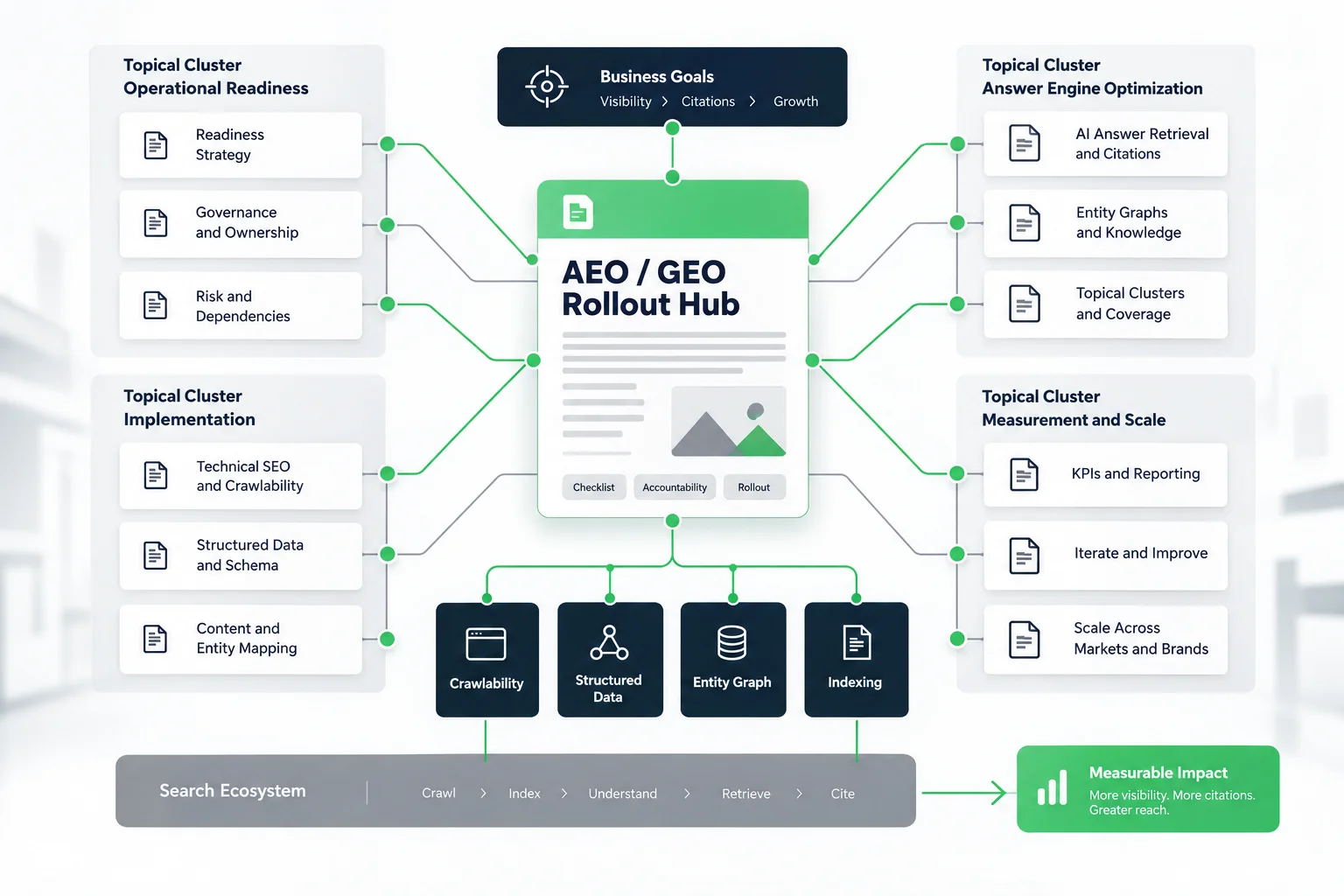
4. Technical and structured-data readiness
Structural signals and APIs feed retrieval systems. Verify correctness, coverage, and operational quality.
Schema and markup testing
Structured data should be complete, normalized, and validated. Use schema.org types appropriate to your content and run automated validation as part of CI/CD.
- Map entity fields to schema.org properties and document gaps.
- Automate structured-data validation in pre-prod using Google’s Structured Data testing guidelines.
- Ensure markup degrades gracefully if scripts or dynamic injection fail.
Publishing APIs, control plane, and access
Production publishing must be auditable, reversible, and permissioned. Verify APIs for push/pull, versioning, staging, and rollback.
- Secure API endpoints with scoped credentials and short-lived tokens.
- Role-based publishing UI: draft, review, approve, publish, rollback.
- Integration adapters for CMS/CRM/ERP with clearly defined failure modes and monitoring.
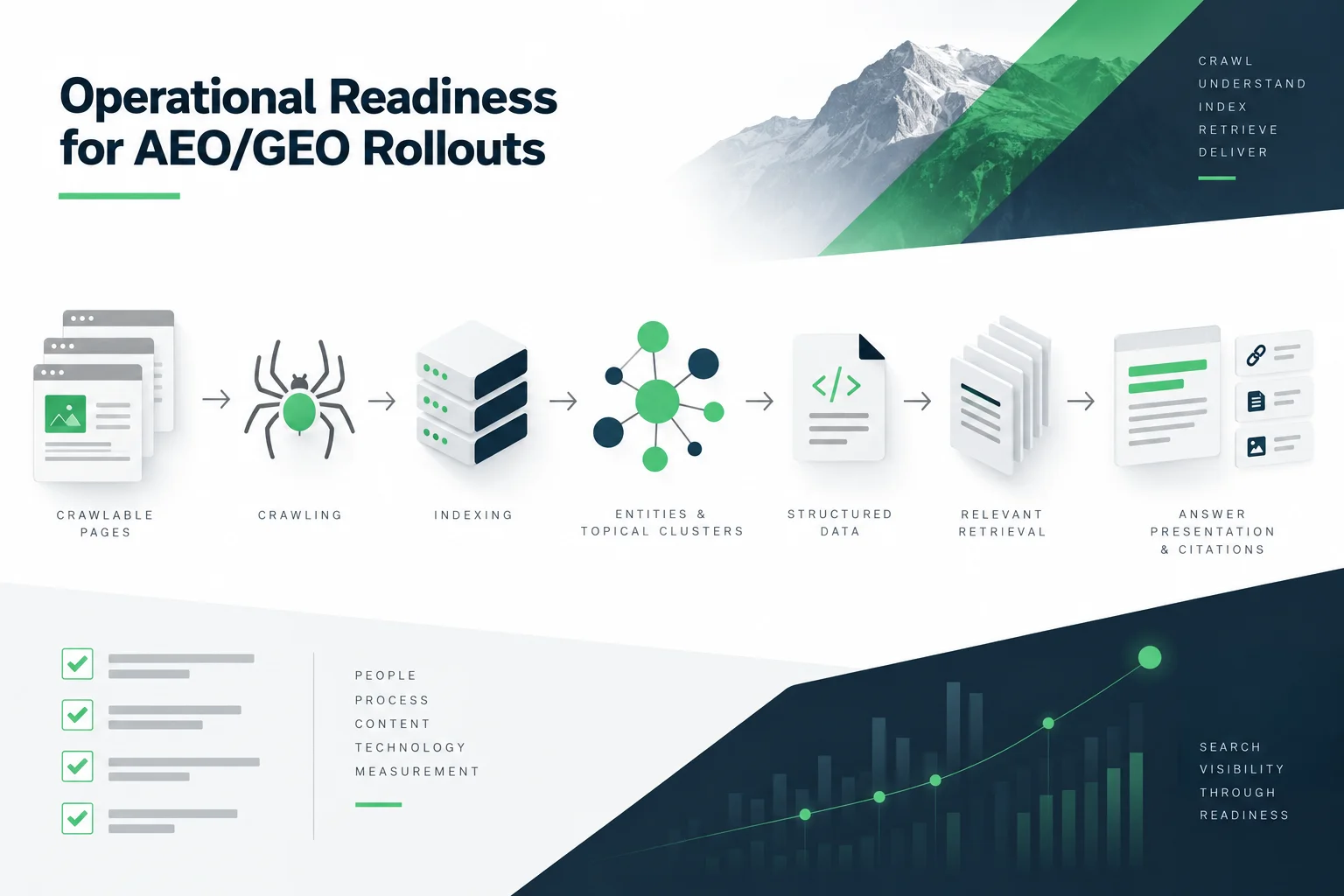
5. Internal linking, topical architecture and retrieval readiness
Retrieval systems rely on reliable passage boundaries and topical signals. Internal linking and page graphs are operational levers to surface authority.
Topic and page-graph validation
Create a topic-to-page graph that maps intents to canonical pages and supporting assets. Validate coverage gaps and ensure consistent hierarchical linking.
- Topic inventory: map queries/intents to canonical pages and supporting FAQs or microcontent.
- Hub-and-spoke internal linking for topical clusters with explicit canonical hub pages.
- Monitor crawl budget and internal link equity to ensure discoverability of deep entity pages.
Retrieval-specific preparation
Optimize passages for retrieval: clear headings, short paragraphs, and anchorable answer snippets. Tag passages in structured data where supported.
- Use HTML headings and ARIA landmarks for robust passage extraction.
- Provide canonical fragment URIs for long-form pages so retrieval can reference specific passages.
- Surface freshness and last-reviewed timestamps where relevant.

6. Measurement, logging and operational KPIs
Define the acceptance tests and ongoing KPIs you will use to measure technical health, visibility, and retrieval performance.
Pilot and acceptance metrics
Acceptance should be based on measurable outcomes from pilot tests using your data and queries.
- Structured-data validation pass rate across sample pages.
- Entity mapping fidelity (percentage of entities with canonical IDs and correct relations).
- Retrieval precision on a benchmark query set (internal test queries agreed in contract).
- Operational KPIs: API latency, publishing success rate, and rollback times.
Ongoing observability
Monitoring must include content telemetry and retrieval evidence. Combine search analytics, server logs and vendor-supplied logs for an end-to-end view.
- Search analytics: clicks, impressions, query-to-page mapping, and snippet performance.
- Retrieval logs: passage-level retrieval candidates and ranking signals (where vendor provides).
- Audit trails for publishing actions and data changes.
7. Pilot design, acceptance tests and the accountability matrix
A clear pilot with a RACI-style accountability matrix is essential. This section gives a practical template and acceptance tests you can use today.
Pilot scope and test cases
Start small, choose high-value topics, and run a controlled experiment with clear success criteria. Use your benchmark queries, a representative content set, and monitored retrieval runs.
- Select 20–50 high-priority entity pages and their supporting content.
- Run structured-data validation and retrieval precision tests weekly during pilot.
- Use control groups for pages not altered to measure delta in retrieval signals and search analytics.
Accountability matrix (roles and deliverables)
Define responsibilities upfront. Below is a concise RACI that you can adapt.
- Product/Owner: Accountable for pilot success, prioritization, and business acceptance.
- SEO/Content Lead: Responsible for editorial standards, topical mapping, and content submissions.
- Engineering/Platform: Responsible for structured-data implementation, API integration, and publishing controls.
- Vendor: Responsible for delivering entity modeling, knowledge-graph feeds, and retrieval logs per contract.
- Legal/Privacy: Consulted on data contracts, retention, subprocessors and transfer mechanisms.
Related Peak Demand resources
Industry and AI sources reviewed
- Understand how structured data worksGoogle Search Central
- Schema.org DocumentationSchema.org
- AI features and your websiteGoogle Search Central
- Creating helpful, reliable, people-first contentGoogle Search Central
- SEO Starter GuideGoogle Search Central
Search-engine and AI-answer behavior changes over time. Google documentation can establish published requirements and guidance, but inclusion in rankings, AI Overviews, citations, or LLM answers is never guaranteed. Practitioner observations should be labelled as inference or testing rather than official ranking factors. This article is operational guidance, not legal advice; organizations should confirm applicable requirements with qualified professionals.
Frequently asked questions
SEO improves visibility in traditional search results. AEO focuses on making content easy for answer systems to extract and use. GEO focuses on visibility in generative search and AI answer experiences. In practice, the strongest strategy combines technical accessibility, useful content, clear entities, strong internal relationships, structured data, and credible source authority rather than treating them as isolated channels.
Official reference: SEO Starter Guide
No. Structured data can make page entities and relationships more explicit and can support eligible search features, but it does not guarantee rankings, AI Overview inclusion, citations, or mentions in generative answers. It should reinforce accurate visible content rather than replace it.
Official reference: Understand how structured data works
Search and answer systems need to understand what a brand, person, product, service, or concept is and how it relates to other entities. Consistent naming, authoritative pages, structured relationships, internal linking, and corroborating references can reduce ambiguity and make a site easier to interpret and retrieve.
Official reference: Schema.org Documentation
Track traditional search visibility alongside query coverage, indexed pages, non-brand discovery, AI referral traffic where available, observed citations or mentions, entity consistency, content-cluster coverage, internal-link depth, and lead quality. Treat AI-surface monitoring as directional because answer composition can vary by model, query, user, and time.
Official reference: AI features and your website
Build a search and AI visibility system that compounds
Peak Demand connects technical SEO, entity architecture, knowledge graphs, structured data, topical authority, internal linking, distribution, and measurement into a managed SEO/AEO/GEO operating system.
Explore Peak Demand AI SEO, AEO & GEO


