
Closed‑Loop QA and Cost‑to‑Serve Optimization for Multisite Utility Voice AI
A practical operational framework for utilities to measure, QA, and optimize Voice AI across multiple sites—improving containment, safe escalation, multilingual scale, and cost‑to‑serve without compromising operational or safety boundaries.
1. Operational model: clear control points and failure boundaries
A dependable multisite Voice AI program must start with a concise, auditable operating model that preserves account safety, human oversight, and clear failure boundaries. Below is a compact architecture and the control points you will enforce.
Call flow and control points
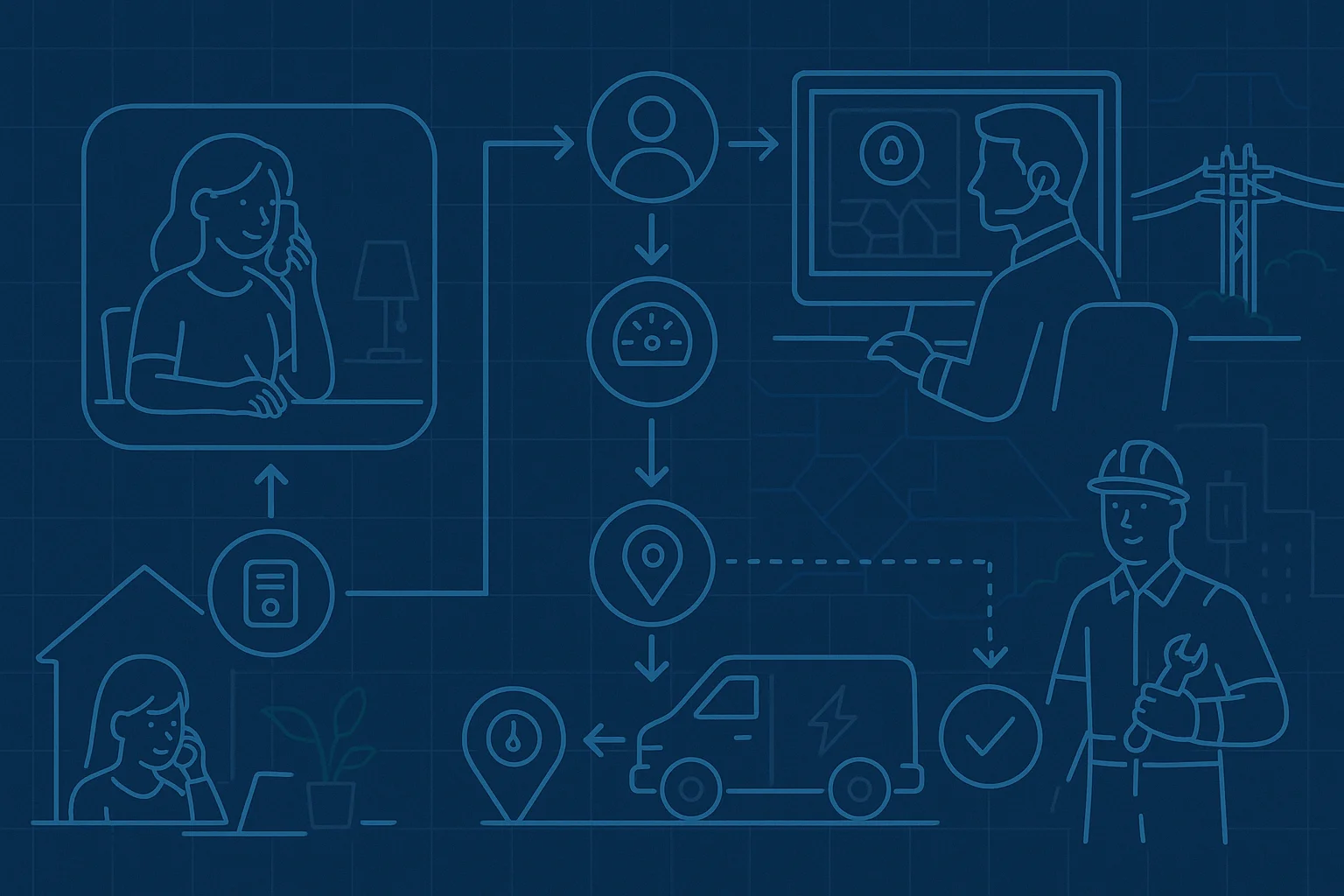
Use a canonical flow to avoid ambiguity between sites: Caller → IVR routing → Voice AI dialog → account or premise validation → approved utility API or knowledge source → decision node (self‑service, create/modify service request, deliver status, or human escalation). Each arrow is an integration and each decision node is a control point where policy and QA apply. Instrument events at each control point (request received, intent classified, validation succeeded/failed, API call made, action approved, escalation opened). This event trail is the backbone of closed‑loop QA and cost modeling.
- Event logging at every state transition (intent identified, confidence scores, validation results).
- Policy gate before any write action: only approved adapters may write to OMS/WRMS/CIS.
- Immutable audit trail linking caller identity or consent token to the event sequence.
Failure boundaries and safety constraints
Explicitly define what Voice AI can and cannot do. Voice AI should never be authorized to perform actions with safety implications (e.g., remote switching), to make emergency‑response decisions, or to bypass human review where policy requires site safety checks. Operationalize hard limits in both dialog design and integration adapters: a dialog may flag a work order but the adapter will refuse to execute without required fields and human sign‑off. Log reasons for every automated refusal to enable rapid remediation.
- Blacklist actions that affect physical infrastructure unless through human‑confirmed workflows.
- Require multi‑factor validation for high‑impact actions (account PIN + call metadata + human approval).
- Fail closed (transfer to human) on any uncertain validation or low confidence in caller identity.
2. Measuring containment, escalation quality, and service outcomes
Containment and escalation are measurable. Treat them as coupled metrics that together define your cost‑to‑serve profile and customer experience risk.
Containment quality (self‑service success)
Containment rate is the share of inbound calls the Voice AI resolves without human handoff. But raw containment is insufficient—measure containment quality by verifying outcome accuracy against backend actions and customer satisfaction signals. Adopt deterministic checks: were the correct account and location identified, was the requested action supported, and did the downstream system record the expected state change?
- Track containment rate alongside outcome accuracy (correct work order type, correct location, correct priority).
- Use automated post‑call status checks (API confirmation) rather than inferred dialog success.
- Sample resolved calls for quality review and correlate with customer callbacks and complaint rates.
Escalation quality (handoff fidelity)
Escalation quality measures whether calls that transfer to humans do so with sufficient context to avoid repeat collection and to enable rapid resolution. Define minimum metadata the Voice AI must attach to any escalation (intent, confidence, validation evidence, transcript snippet, caller expectations). Measure the percentage of escalations that meet metadata SLAs and the proportion that required re‑asking the caller.
- Require structured escalation payloads: intent code, confidence, validation tokens, suggested routing (billing, outages, safety).
- Measure repeat information capture and time‑to‑resolution for escalated calls.
- Track conversion: escalations that result in correct and timely field dispatch or customer resolution.
3. Integration and validation: data contracts, adapters, and auditability
Integrations are where containment either succeeds or creates risk. Operational guidance: use controlled adapters, durable data contracts, and an explicit approval layer for writes.
Account and premise validation
Design validation as a layered process: caller verification (PIN, token, knowledge‑based checks), cross‑system lookup (CIS/OMS/CRM), and runtime confirmation (recent usage or outage map). Prefer read‑only checks for information retrieval and require explicit approved adapters for any write‑action. Record the validation evidence with the event for later QA and dispute resolution.
- Keep validation logic centrally versioned and reuse it across sites to maintain parity.
- Log the validation decision and evidence for each call to support audits and appeals.
- Fail to manual path on any missing or contradictory validation evidence.
Approved APIs, adapters, and data contracts
Encapsulate system access behind controlled adapters that implement data contracts and authorization gates. Adapters translate Voice AI intents into canonical events (create_work_order, request_status, schedule_visit) and enforce business rules such as required fields and rate limits. Versioned contracts reduce downstream breakage and make QA traceable.
- Keep a single canonical event schema per action and require schema validation in the adapter.
- Use feature flags for incremental adapter behavior changes and observability hooks for failures.
- Record adapter execution logs separate from transcripts for tracing and root‑cause analysis.
4. Cost‑to‑serve levers and operational choices
Cost‑to‑serve is the operational metric executives care about. Closed‑loop QA makes cost drivers visible and actionable. Below are the levers and practical choices.
Containment versus escalation tradeoffs
Containment reduces human cost but increases risk if outcome accuracy is poor. Use staged containment bands: low‑risk intents (status checks, outage information) receive aggressive automation; high‑risk intents (safety reports, field actions) receive conservative automation with mandatory human confirmation. Measure the marginal cost difference and customer impact to set acceptable confidence thresholds.
- Map each intent to a risk band and a deployment band (pilot, regional, global).
- Set confidence thresholds tied to business risk and outcome cost.
- Reassess thresholds after each closed‑loop QA cycle.
Queue management and surge capacity
Plan for event‑driven surges (storms, boil‑water advisories). Use dynamic routing: scale Voice AI capacity first, throttle non‑critical self‑service features, and open prioritized escalation queues for safety issues. Instrumenting surge performance helps estimate incremental per‑call cost during peak events for budgeting.
- Define surge playbooks and test them via tabletop and live stress tests.
- Prioritize resources to maintain SLA for priority intents during surges.
- Track cost per handled call during normal and surge windows separately.

5. Multisite and multilingual scale: architecture and governance
Scaling Voice AI across regions and languages introduces operational complexity. Plan deployments with region‑aware hosting, localized models, and consistent governance.
Regional deployment and data residency
Decide hosting and backup regions based on policy, incident‑response needs, and data residency requirements. Define subprocessors, backup geography, and remote‑support access in contracts. Test cross‑region failover and the behavior of adapters under different locality constraints. Confirm legal obligations and retention rules with compliance—jurisdiction guidance varies.
- Document primary hosting region, backup region, and retention geography for recordings and logs.
- Control remote‑support access with just‑in‑time credentials and audited sessions.
- Design adapters to handle regional feature parity where APIs differ.
Multilingual NLU and monitoring
Treat each language as a configuration with its own QA plan: voice models, prompts, entity extraction, and validation. Monitor per‑language containment and escalation quality separately and rotate reviewers fluent in the language for closed‑loop updates.
- Keep per‑language training data and QA samples to detect drift or bias.
- Localize prompts and validation logic (address formats, account identifiers).
- Measure containment and escalation by language to detect localized regressions.
Operational governance across sites
Centralize policy, logging schema, and QA standards while allowing site‑level runtime configuration for local needs (hours, outage descriptors, language). Use a governance board with representatives from customer service, operations, field, IT, and legal to approve intent risk banding and rollout decisions.
- Deploy a gate‑review process for new intents and changes affecting dispatch or safety.
- Use consistent event schemas to enable cross‑site analytics.
- Maintain a prioritized backlog for fixes driven by closed‑loop QA data.
6. Closed‑loop QA processes and continual improvement
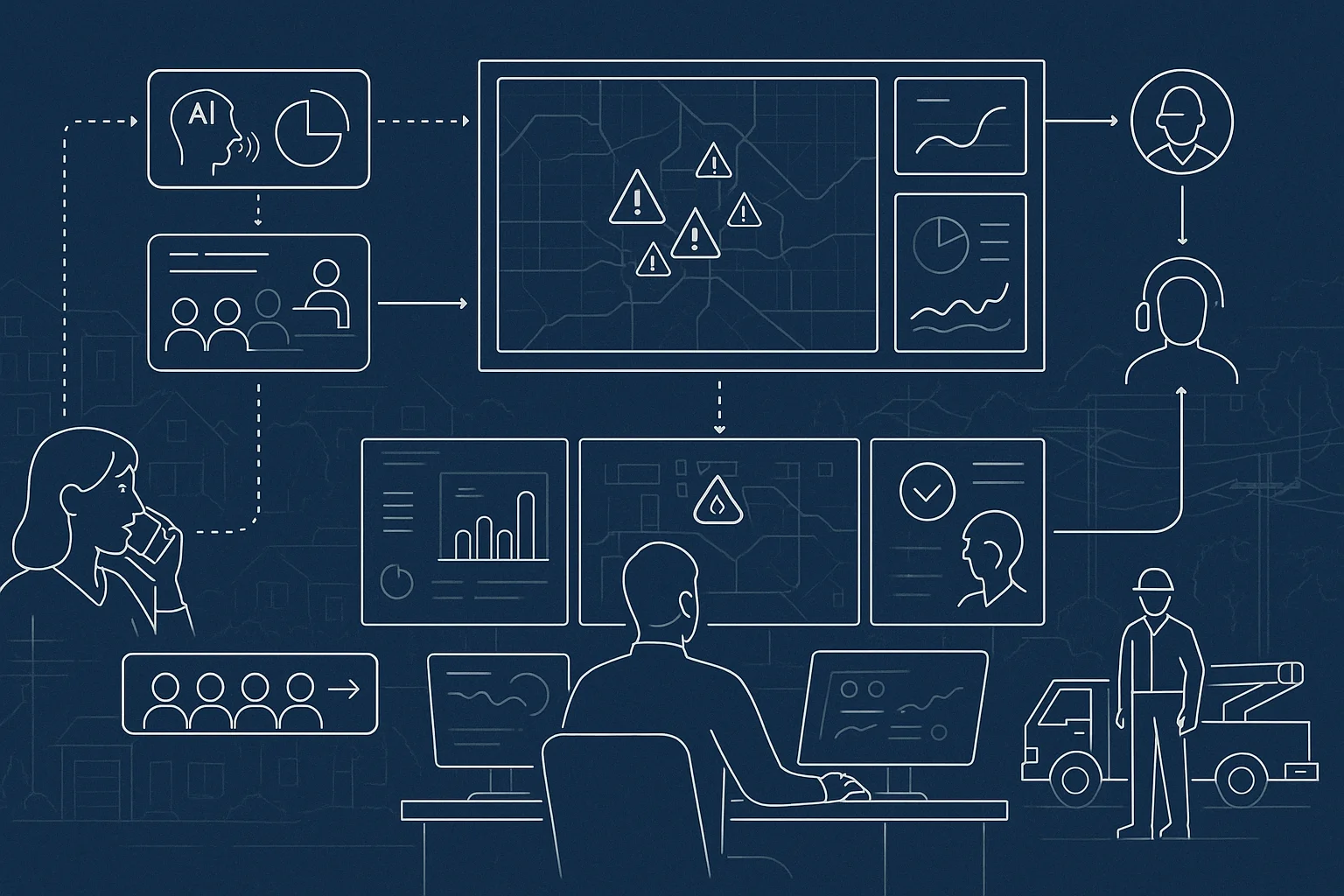
Closed‑loop QA is an operational cadence: sample, review, classify root causes, fix, deploy, and measure. Below are practical steps and tooling choices.
Sampling, human review, and root‑cause classification
Use stratified sampling to ensure high‑volume, high‑risk, and low‑confidence calls are reviewed. Review should capture whether the action was correct, why it failed (NLU, validation, adapter, or downstream system), and who should own the fix. Tag root causes in your analytics platform for prioritization.
- Automate sampling criteria (intent volume, confidence thresholds, repeat callers, escalations).
- Use a structured review form that captures intent correctness, validation status, adapter outcome, and customer impact.
- Feed labeled failures back into model or dialog updates with traceability to change requests.
Remediation playbooks and safe deployment
Create standard remediation playbooks for common failure modes (misrecognition, wrong account, adapter error). Changes should follow controlled deployment: canary releases, feature flags, rollback plans, and post‑deployment monitoring. Maintain immutable change records tying QA evidence to the deployed fix.
- Use feature flags for risky changes and keep automatic rollback criteria.
- Run holdout tests to validate remediation under production traffic.
- Document fixes and link them to QA tickets for auditability.
Event‑level analytics and continuous measurement
Event‑level analytics lets you quantify how changes affect cost, containment, and customer experience. Track intent‑level KPIs, per‑adapter failure rates, and per‑site cost‑to‑serve. Build dashboards that combine quality tags, cost buckets, and operational KPIs for weekly and monthly governance reviews.
- Create dashboards for intent performance, containment accuracy, escalation fidelity, and cost per resolution.
- Use anomaly detection to surface regressions quickly after deploys or environmental changes (e.g., storms).
- Keep an experiments registry to map A/B tests to observed KPI changes.
Related Peak Demand resources
Industry and AI sources reviewed
- AI Risk Management Framework — Critical Infrastructure ProfileNational Institute of Standards and Technology (NIST)
- Cybersecurity Capability Maturity Model (C2M2)U.S. Department of Energy
- Cross-Sector Cybersecurity Performance GoalsCybersecurity and Infrastructure Security Agency (CISA)
Utility cybersecurity, critical-infrastructure, records, customer-protection, and emergency-communications obligations vary by jurisdiction and service type. This article is operational guidance, not legal advice; organizations should confirm applicable requirements with qualified professionals.
Frequently asked questions
Good starting points include billing and account questions, move-in or move-out intake, appointment scheduling, service-request capture, outage-status messaging from approved systems, payment-routing assistance, and structured escalation. Safety-critical and infrastructure-control decisions should remain with qualified utility teams.
Official reference: Cross-Sector Cybersecurity Performance Goals
Use the minimum approved identifiers needed for the workflow, validate them against the utility's system of record, limit data exposure, and provide a human-assisted path when verification fails. The Voice AI should not guess account, premise, or outage information.
Official reference: Cross-Sector Cybersecurity Performance Goals
Use controlled adapters, strict schemas, timeouts, retries, audit logs, safe failure states, and human escalation. The system should distinguish approved utility data from model-generated language and should never present stale or unverified operational information as fact.
Official reference: Cybersecurity Capability Maturity Model (C2M2)
Track containment by request type, successful validations, transfers, abandoned calls, integration errors, incorrect or stale responses, time to resolution, customer follow-up, and the percentage of cases completed safely without manual rework.
Official reference: Cybersecurity Capability Maturity Model (C2M2)
Build resilient utility customer-service automation
Peak Demand helps utilities connect Voice AI to approved customer-information, outage-communication, service-request, dispatch, escalation, and analytics workflows.
Schedule a discovery call


