
Voice AI for Transit Detours, Delays, and Service Requests
An operational framework for integrating Voice AI into transit detour, delay, and service‑request workflows—covering architecture, APIs, identity, observability, failure recovery, and safe human handoff.
1. Architecture and core flow
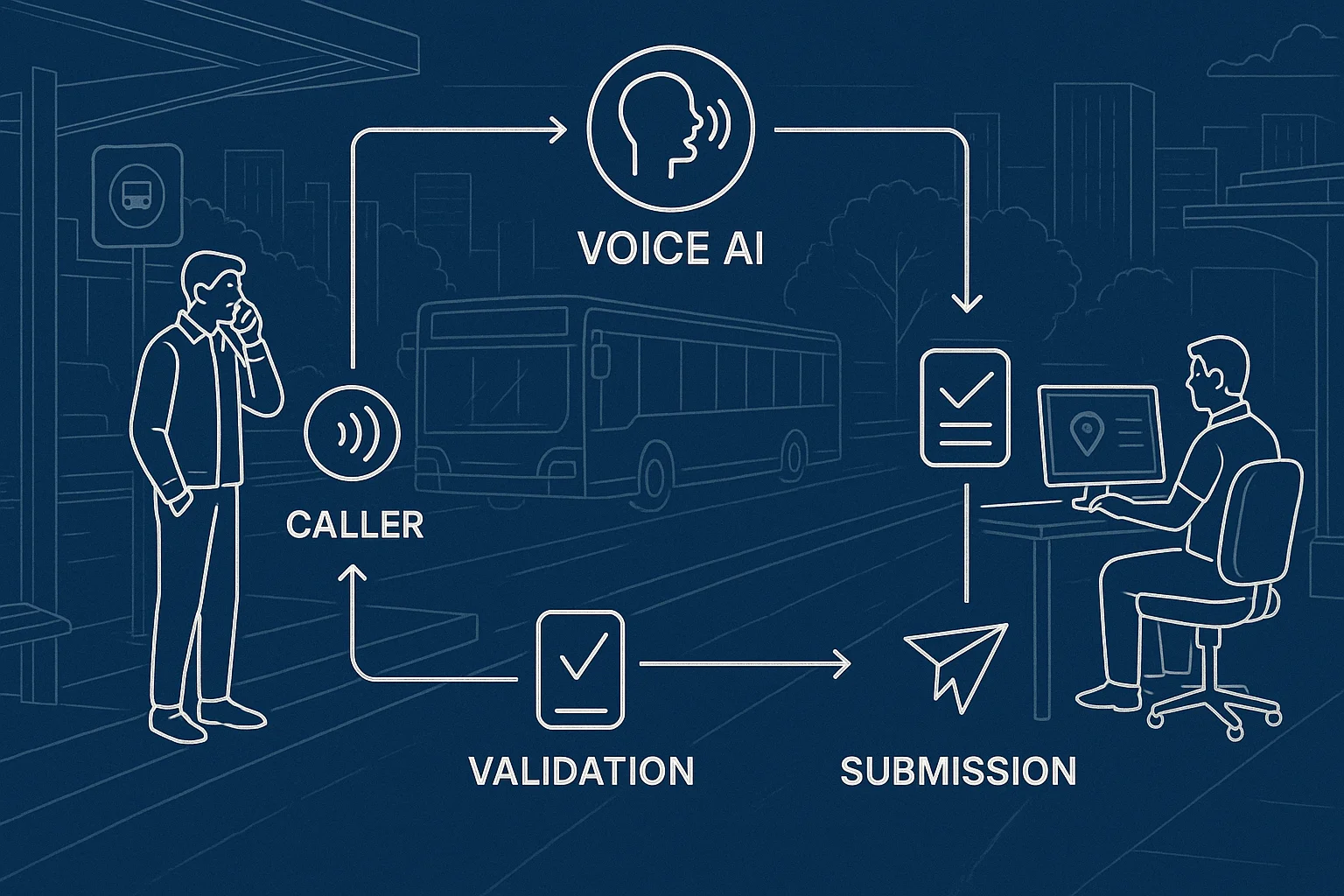
A concise, operational architecture clarifies responsibilities, reduces failure scope, and preserves safety. Use a deterministic Rider → Voice AI → controlled knowledge base / alert API → validation → response or human handoff flow.
Core flow and responsibilities
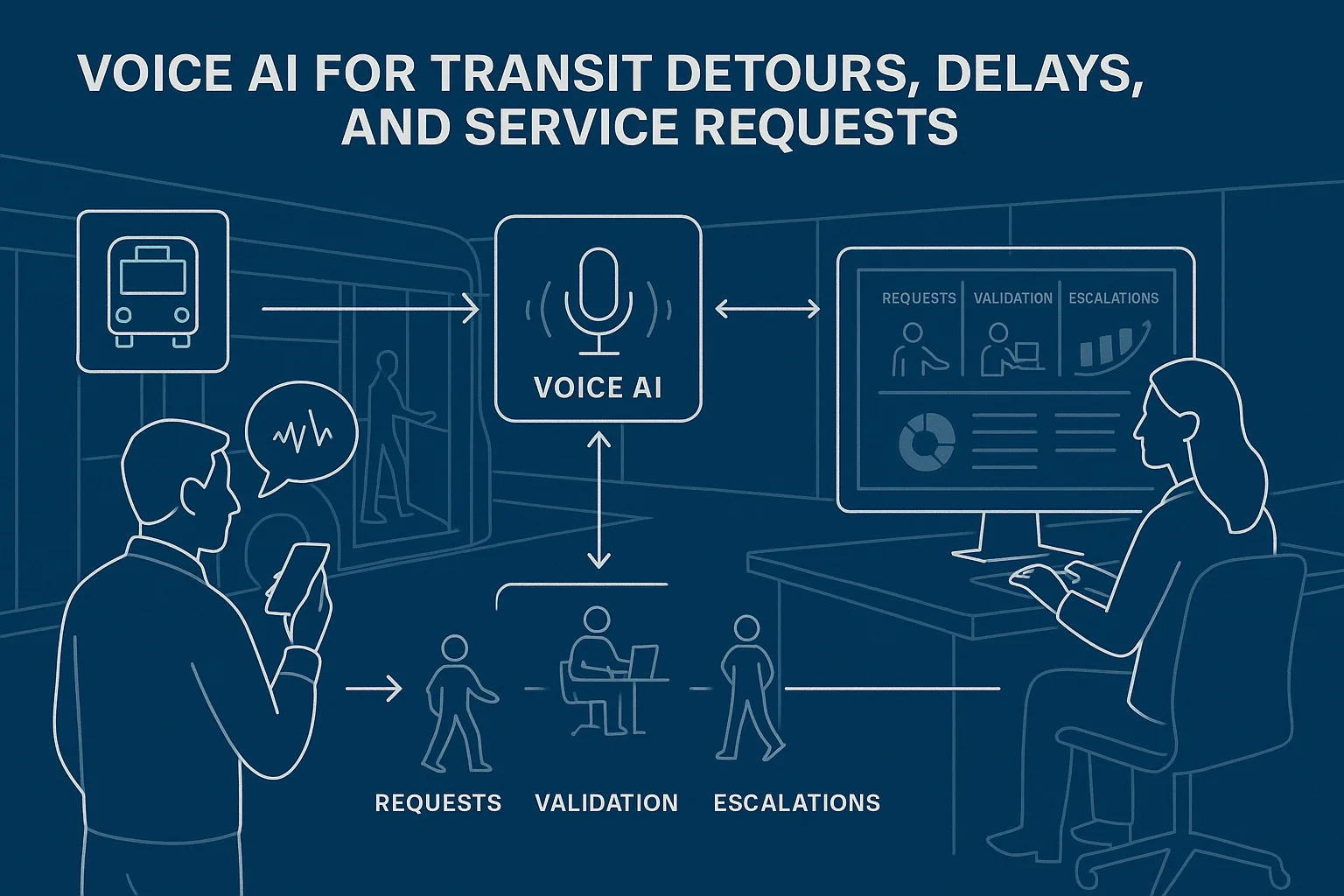
Implement a single, auditable flow: the rider interacts with the Voice AI, which reads from a controlled knowledge base for scheduled information and queries approved service‑alert APIs for detours or delays. If the use case requires human action—service request, safety incident referral, or ambiguous input—the voice system performs validation, attaches context, and opens a case in the agency business system or routes the caller to an agent. Keep the logic that decides what to ask and when to escalate in the orchestration layer, not in the language model.
- Rider invokes Voice AI (IVR or digital assistant).
- Voice AI checks controlled schedule knowledge for static queries (timetables, stop names).
- For detours/delays/alerts, Voice AI queries an approved alerts API and dynamic form system.
- Input is validated, duplicates checked, and either a response is returned or a case is submitted to the agency system with human handoff.
Separation of scheduled knowledge vs. real‑time alerts
Treat scheduled timetable data (stored, versioned, and curated) as read‑only knowledge for the assistant. Real‑time detours, delays, and other disruptions must be obtained from the agency’s approved alert APIs or a validated public feed. Do not infer or replace alert information from schedule knowledge. If next‑bus predictions are required, use only an approved, low‑latency vehicle‑position or prediction source and make conservative confidence statements to riders.
- Schedule knowledge: curated, versioned, and updated on a regular cadence.
- Alerts: served through authenticated, documented APIs intended for live operational information.
- Predictions: only when backed by high‑frequency, authoritative sources; otherwise indicate uncertainty.
2. API design and data contracts
Well‑designed APIs and data contracts reduce ambiguity across integrations and make validation deterministic.
Design principles for alerts and forms APIs
Use explicit, versioned REST or gRPC contracts with small, documented payloads. The alerts API should return structured fields: alert_id, scope (route|stop|network), start_time, end_time, status, cause, geometry or affected_stops, and confidence. The service‑request/form API should support dynamic field definitions (type, required, validation_regex), server‑side duplicate detection, and an operation status with request_id.
- Always version endpoints (e.g., /v1/alerts, /v2/forms).
- Include machine-readable cause codes and human‑readable descriptions.
- Provide a validation endpoint that the Voice AI invokes before case submission.
Contracts, validation, and idempotency
Implement two stages of validation: schema and business rules. Schema validation rejects malformed payloads at the edge; business validation checks for logical consistency (time windows, plausible location). Use idempotency keys and a request_id to prevent duplicate case creation when network retries occur. Log both submitted payloads and the validated version returned by the business system.
- Schema validation at the API gateway.
- Business validation with explicit error codes to drive voice prompts.
- Idempotency keys for safe retries and duplicate suppression.
3. Identity, authentication, and privacy
Voice interactions require precise identity and consent controls to protect riders, limit fraud, and meet jurisdictional obligations.
Caller identity and case linkage
Adopt tiered identity: anonymous, tokenized (session cookie or device token), and verified (account login). For routine detour and delay queries, anonymous access is acceptable. For service requests that create a record or require follow‑up, require tokenized or verified identity and collect minimal PII. Prefer short‑lived tokens and bind them to the session when possible. When moving to human handoff, surface the validated identity token to agents to avoid re‑asking sensitive questions.
- Allow anonymous query of schedule/alert info.
- Require tokenized identity for case creation and follow‑up.
- Use least‑privilege access for agent screens.
Privacy, consent, and data residency considerations
Document where voice recordings, transcripts, and case data are stored, processed, and backed up. Distinguish between processor location, backup geography, and remote‑support access. Obtain explicit consent before recording; provide an option to opt out and still use a non‑recorded flow (e.g., SMS confirmation). Confirm applicable retention, breach notification, and data transfer obligations with legal counsel because rules vary by jurisdiction.
- Recordings: explicit consent and easy opt‑out.
- Catalog subprocessors and cross‑border transfer mechanisms.
- Define retention windows and deletion workflows.
4. Reliability, observability, and failure recovery
Plan for degraded modes and measurable service targets. Observability is essential to detect API drift, high‑latency alert sources, and model hallucination.
SLOs, degraded modes, and explicit failure boundaries
Define SLOs for intent recognition, end‑to‑end latency, API success rates, and case submission confirmation. For example, specify the maximum acceptable time to confirm an alert query and the maximum time to create a case. Define deterministic degraded modes: fallback to a read‑only schedule response if the alerts API is unavailable, and immediate human transfer for ambiguous or safety‑sensitive inputs. Document failure boundaries so operators know when to suspend automated responses.
- Set SLOs for voice‑NLP intent accuracy and API response times.
- Fallback behaviors: schedule lookup, canned uncertainty messages, agent transfer.
- Automated suspension triggers (e.g., >5% alert API errors for 10 minutes).
Observability and detection of model drift
Instrument each component with structured logs and transaction IDs. Track: request_id, user_token, intents, confidence scores, API call latencies, and validation outcomes. Use dashboards and automated alerts for rising error patterns and degraded confidence. Keep a replayable audit trail for post‑incident review and model retraining data selection.
- Propagate a transaction ID end‑to‑end.
- Capture confidence scores and flag low‑confidence interactions.
- Retain an audit trail for human review and training datasets.

5. Safe tool use and human handoff
Safety boundaries limit harm and protect operational integrity. Define precisely when automation may act and when it must defer to humans.
Safety boundaries and prohibited actions
Do not let voice agents perform safety‑critical decisions: no dispatching, no remote vehicle control, and no emergency triage. For anything safety‑sensitive—accidents, medical emergencies, suspicious packages—prompt the caller to contact emergency services and transfer to a trained dispatcher. Automate only low‑risk tasks: routing a complaint, confirming a detour, or scheduling a non‑urgent follow‑up.
- Never automate emergency triage.
- Do not permit the assistant to modify schedules or operational directives.
- Escalate safety signals to trained staff with full context.
Human handoff: controls and context
When escalating, provide agents with a concise, validated packet: transaction ID, summary, confidence scores, raw transcript, alert payload, and suggested next steps. Implement agent controls to accept, amend, or cancel the suggested case. Require recorded agent justification for any deviation from validated data when it affects operations.
- Provide a validated case packet to the agent before transfer.
- Allow agents to overwrite or annotate system recommendations with accountability logging.
- Limit agent privileges based on role and training.
6. Procurement, vendor evaluation, and deployment choices
Procurement specifications should prioritize clear responsibilities, observable SLAs, and defined subprocessors. Favor modular contracts that separate voice front end from orchestration and agency back‑end.
Vendor selection criteria and contract clauses
Require vendors to disclose subprocessors, data residency, incident response times, and audit rights. Insist on open, documented API contracts and the right to export logs for instrumented observability. Contracts should include: uptime SLAs for critical endpoints, breach notification timelines, and transfer‑of‑service clauses for vendor offboarding.
- Subprocessor and data residency disclosure.
- Observable SLAs with clear remediation and penalties.
- Portability of logs and service data on contract end.
Deployment patterns and operational ownership
Consider three deployment patterns: agency‑hosted orchestration with vendor‑supplied voice models, vendor‑managed cloud with agency‑controlled APIs, or a hybrid where sensitive data remains on agency infrastructure. Align this choice with jurisdictional data‑transfer requirements and available operational expertise. Ensure remote support access is controlled and auditable.
- Agency‑hosted: greater control, higher ops burden.
- Vendor‑managed: faster time‑to‑value, requires strong contractual controls.
- Hybrid: tradeoffs between control and complexity; document remote support procedures.
7. Implementation checklist and measurable outcomes
A phased rollout reduces risk. Track a focused set of metrics to demonstrate operational value and safety.
Phased rollout checklist
Phase 1: internal pilot using synthetic voices and staff callers; verify API contracts and validation logic. Phase 2: controlled public pilot on a small set of routes with clear fallbacks. Phase 3: gradual scale with expanded languages and integration points. At each phase, run tabletop exercises for degraded modes and incident response.
- Pilot: API contract validation, acceptance tests, and staff‑only callers.
- Controlled public pilot: limited routes, explicit messaging, human oversight.
- Scale: multilingual support and continuous monitoring.
KPIs and operational metrics
Select metrics that measure both utility and safety: successful intent resolution rate, time‑to‑case creation, duplicate submission rate, transfer rate to human agents, API error rate, and percentage of low‑confidence interactions. Use these to make go/no‑go decisions and to tune prompts, validation rules, and escalation thresholds.
- Intent resolution and confirmation rates.
- Case creation latency and duplicate rates.
- Human transfer rate and post‑handoff satisfaction.
Related Peak Demand resources
Industry and AI sources reviewed
- Transportation Systems SectorCybersecurity and Infrastructure Security Agency (CISA)
- Artificial Intelligence Risk Management Framework (AI RMF 1.0)National Institute of Standards and Technology (NIST)
- OECD AI PrinciplesOrganisation for Economic Co-operation and Development
Privacy, telecommunications, recording-consent, cybersecurity, consumer-protection, employment, and records obligations vary by jurisdiction and use case. This article is operational guidance, not legal advice; organizations should confirm applicable requirements with qualified professionals.
Frequently asked questions
Good starting points include lost property, complaints and feedback, stop or shelter issues, fare-machine faults, non-emergency accessibility service requests, schedule information from approved sources, and structured routing to customer service or field teams.
Official reference: Artificial Intelligence Risk Management Framework (AI RMF 1.0)
Use GTFS Realtime only when the agency exposes suitable feeds and the workflow genuinely needs service alerts, trip updates, or vehicle positions. The integration should validate freshness and availability, and the agent should avoid presenting stale feed data as a guaranteed arrival prediction.
Emergency, security, injury, crime, and safety-critical reports should follow approved transfer or emergency-routing procedures. Voice AI may detect and route the call, but it should not make operational safety decisions or replace trained personnel.
Official reference: Transportation Systems Sector
Request realistic call testing, feed and system failure handling, service-request integration, transfer context, audit logs, accessibility channels, monitoring, change control, and evidence that the agent distinguishes scheduled information from dynamic service alerts.
Official reference: Artificial Intelligence Risk Management Framework (AI RMF 1.0)
Turn Voice AI infrastructure into a managed enterprise operation
Peak Demand designs, integrates, deploys, monitors, and improves Voice AI systems across customer service, enterprise systems, governance, escalation, and reporting.
Schedule a discovery call


