
Voice AI Routing, Escalation, and Validation Workflows for Property Management
Concrete, operational guidance for designing voice-AI intake, routing, escalation and validation workflows that preserve the human handoff, protect against regulatory risk, and measurably improve lead, leasing, and maintenance outcomes.
1. Operational architecture and design principles
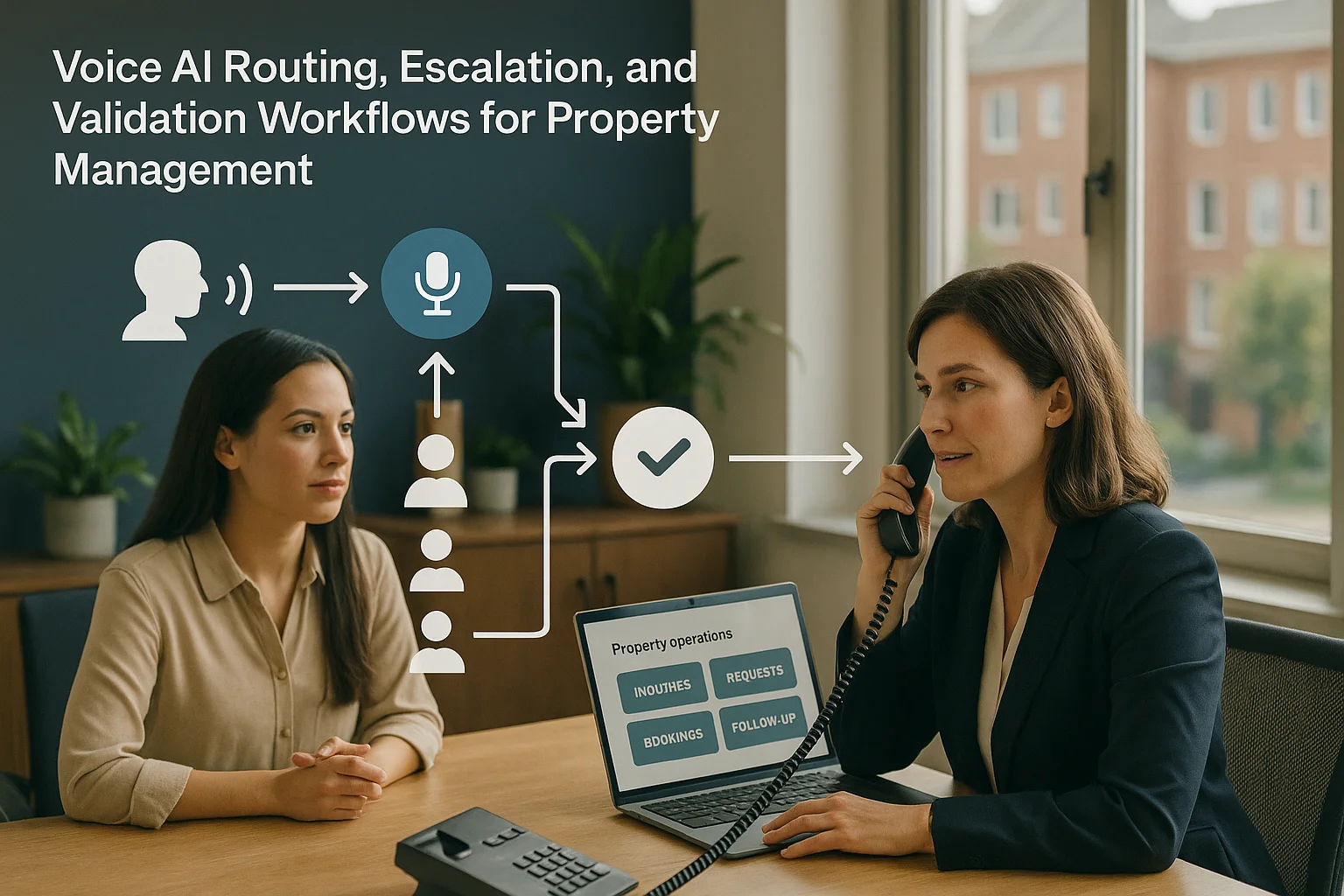
A concise operating model clarifies responsibility and risk. The recommended architecture is deliberately linear and auditable: Caller → Voice AI → intent & identity checks → CRM/property system → appointment, maintenance case, lead record, or specialist handoff. Make each arrow a controlled integration with observable events and owners.
Recommended architecture: orchestration, not replacement
Design voice AI as an intake and orchestration layer. It should capture caller intent, perform scripted identity checks and basic qualification, and route structured records into the property management system or CRM. Do not allow automatic closing of complex or liability-bearing actions—those remain human responsibilities.
- Canonical flow: Caller audio → ASR/transcript → intent classification → validation checks → record creation → human or automated routing.
- Every record a voice AI touches should carry provenance metadata: confidence score, timestamp, recording identifier, and responsible integration adapter.
- Keep human-in-the-loop gates for regulated, legally binding, or high‑risk outcomes (leases, evictions, emergency services).
Design principles for risk, visibility and ownership
Adopt principles that make operational ownership explicit: single-case ownership in the property system, observable handoffs, and SLAs tied to routing rules. Define failure boundaries up front (when the system should escalate to human agents) and instrument those boundaries for measurement.
- Assign a named owner for each workflow (e.g., Leasing Ops, Maintenance Triage, Resident Services).
- Define measurable routing SLAs (e.g., route maintenance emergent calls to on‑call within 5 minutes).
- Log decisions, confidence thresholds, and every human override for QA and audit.
2. Lead and tenant intake: identity, intent and CRM enrichment
Lead and tenant intake workflows must balance speed-to-contact with data quality and anti-discrimination controls. Design validation stages that progressively enrich records before human assignment.
Staged validation: minimal to full
Use a staged approach: initial capture (caller name, phone number, property/address, basic intent), rapid verification (OTP, callback confirmation), then CRM enrichment (match by phone/email, append property lease status). Only escalate qualified leads to leasing agents.
- Stage 1: Capture essentials and intent. Keep prompts short to minimize friction.
- Stage 2: Verify contact and identity using OTP or callback to reduce false leads and improve speed-to-contact.
- Stage 3: Sync to CRM/property system for enrichment and lead-scoring before human handoff.
Integration and data ownership
Integrations should be implemented through controlled APIs or adapters that write directly to the canonical property system or CRM. Avoid intermediate proprietary silos that create reconciliation overhead.
- Every integration should confirm successful write with a transaction ID and surface write failures to the routing queue.
- Maintain idempotency: duplicate calls from the Voice AI should not create duplicate tenant or lead records.
- Enforce field-level ownership: the property system remains the source of truth for lease status, availability, and assignments.
Speed-to-lead and human handoff rules
Prioritize serious prospects with rules that route warm leads immediately to live agents during business hours, or to scheduled callbacks otherwise. Track time-to-first-human-contact and include this metric in SLA reporting.
- Define routing tiers: Hot (route immediately), Warm (schedule callback within X hours), Cold (email nurture).
- Capture reason codes for routing decisions to aid QA and conversion analytics.
- Instrument outbound callback attempts and outcomes in the CRM for closed-loop measurement.
3. Maintenance triage: symptom capture, severity, and escalation
Maintenance intakes are the highest operational risk. Use structured symptom capture, severity scoring, and mandatory human escalation for emergencies.
Structured symptom taxonomy and severity scoring
Predefine a finite taxonomy of maintenance categories and a severity scale (e.g., Emergency, Urgent, Routine). Voice AI should map caller descriptions to taxonomy items and propose a severity score, but require human confirmation for anything labelled Emergency.
- Use short confirmatory scripts to reduce misclassification (e.g., 'Do you have active water in the unit? Yes/No').
- Associate each severity with a triage action (on-call dispatch, next-business-day appointment, vendor schedule).
- Store the suggested taxonomy mapping and confidence score on the case record for QA.
Emergency detection and mandatory human escalation
Do not automate emergency judgment. If the system detects keywords or severity indicators (gas leak, active flooding, structural failure), escalate immediately to a live dispatcher and provide clear scripts for agents and residents.
- Automated playback to on-call staff with recording ID and case metadata accelerates response.
- Include fail-open rules: if ASR confidence is low but caller indicates danger, escalate to human.
- Document every emergency escalation and the time to human contact for post-incident review.
Maintenance specialist routing and vendor orchestration
After triage, route work to the correct resolver: in-house technician, approved vendor, or property manager. Ensure the routing engine has access to vendor availability, SLA windows, and parts requirements if available.
- Use API calls to OMS/dispatch systems to create and update work orders; confirm accepted/assigned states.
- For vendor work, attach scope-of-work notes and photo/recording references to prevent scope creep.
- Track vendor acceptance times and completion SLAs as part of vendor performance analytics.
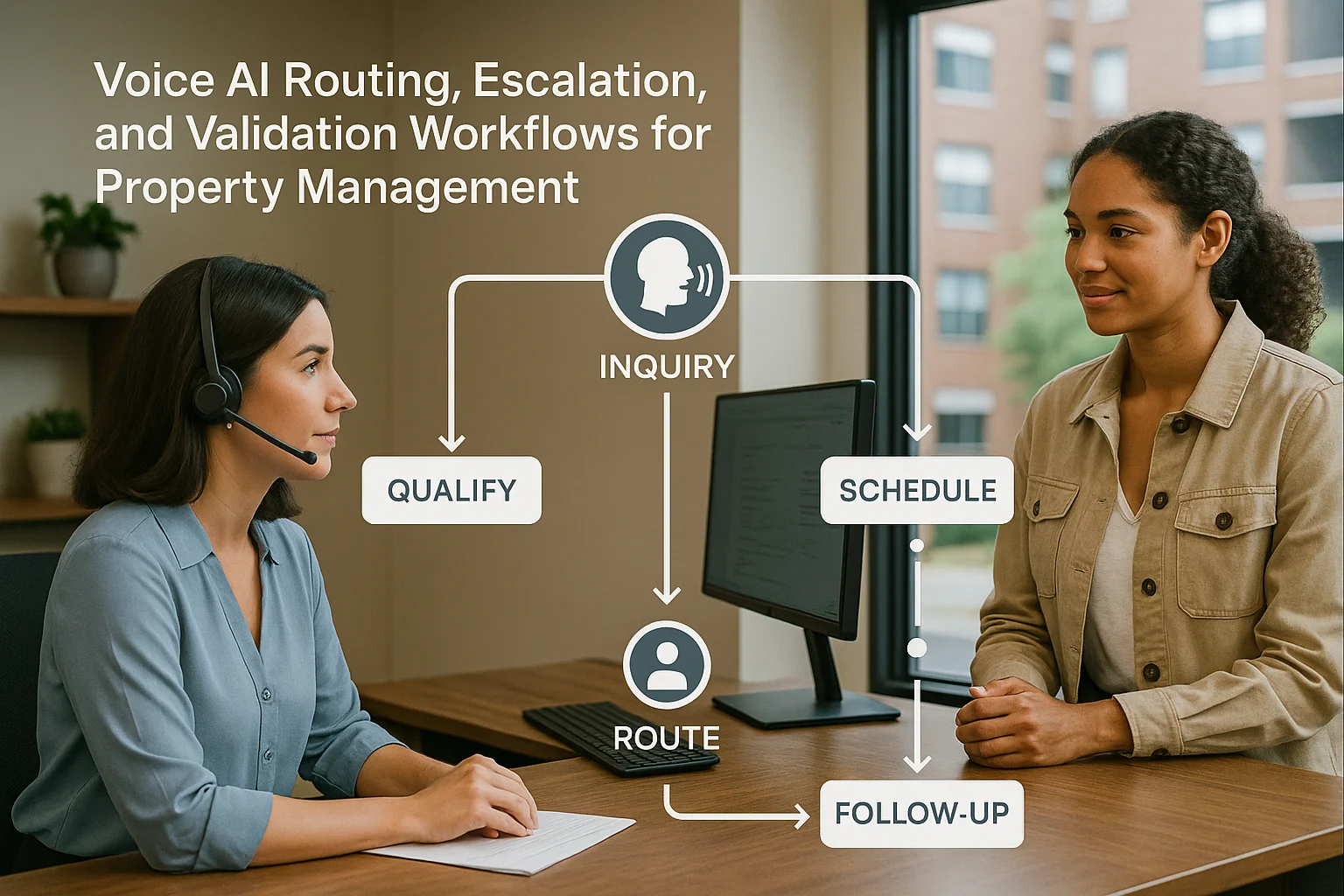
4. Appointment scheduling and routing policies
Appointment workflows must integrate calendars, availability rules, confirmation mechanics, and contingency plans. Route decisions should be auditable and measurable.
Calendar orchestration and double-book prevention
Connect voice intake to the calendaring system or operator console with two-way availability checks. Use conditional holds and short confirmation windows to reduce no-shows and double bookings.
- Place temporary holds on slots during voice sessions, then confirm with tenant or lead before finalizing.
- If third-party vendors are involved, maintain an availability cache to reduce latency in routing decisions.
- Log all callbacks and confirmations in the CRM for SLA and contact-rate analytics.
Allocation rules and human shifts
Define allocation logic based on geography, specialty, and workload. Include fallback rules for after-hours and holiday coverage that route to on-call teams or scheduled callbacks.
- Primary routing by geography or building, secondary by technician skillset or leasing specialist.
- Define overflow pools for peak times and automated nudges to redistribute work when thresholds are reached.
- Measure and report average time-to-appointment and successful first-visit rates.
Confirmation, reminders and SLA enforcement
Implement multi-step confirmations (call, SMS, email) and measure confirmation rates. Trigger human review when confirmation fails or when special access (keys, pets) is required.
- Automated reminders at 48/24/2 hours before appointment with a simple confirm/reschedule flow.
- Escalate to human agents for rescheduling when there is conflicting availability or low confidence in the contact data.
- Tie SLA penalties or vendor performance metrics to missed confirmations where contractually appropriate.

5. Validation, QA, analytics and outcomes
Measurement and auditability distinguish a reliable deployment from a brittle one. Build QA and analytics that validate both accuracy and operational outcomes.
Transcription confidence, sampling, and reconciliation
Use transcription confidence thresholds to route low-confidence cases to human review. Implement statistically valid QA sampling of recordings and compare transcript-CRM reconciliation rates to detect drift.
- Set confidence thresholds per intent; low-confidence intents require human validation before case creation.
- Sample calls for manual QA using stratified sampling: high-risk categories and low-confidence bins get higher sampling rates.
- Reconcile voice intake records with final CRM outcomes (e.g., appointment completed, maintenance resolved) to measure end-to-end accuracy.
Observability, logging and audit trails
Log every event: ASR output, intent classification, validation checks, API writes, routing decisions, and human overrides. Keep immutable audit trails for serious incidents and for post-issue root cause analysis.
- Include timestamps, actor IDs, confidence scores, and transaction IDs in each event.
- Store recordings and transcripts according to retention policy with searchable metadata.
- Make audit logs available to operations and compliance owners via role-based access.
Performance metrics and outcomes
Target metrics that tie Voice AI activity to business outcomes: speed-to-contact, contact rate, first-visit fix rate, case conversion, routing accuracy, and human override frequency. Use these for vendor governance and continuous improvement.
- Report monthly on routing accuracy (percent of cases routed correctly without human override).
- Track average time from intake to assigned technician or leasing specialist.
- Use human-override reasons as root-cause signals for retraining or script changes.
6. Procurement, implementation choices, and failure boundaries
Procurement should include operational acceptance criteria and concrete failure-playbooks. Ask for delivery details, not just headline features.
Vendor selection checklist
Evaluate vendors on integration adapters, observability, configurable routing rules, handoff controls, data residency and subprocessors, remediation SLAs, and proof of operations with references.
- Require documented API contracts and an implementation plan showing how Voice AI will write to your CRM/property system.
- Request evidence of observability features: event logs, audit export, and ability to stream events to your SIEM or analytics stack.
- Confirm the vendor’s subprocessors, hosting regions, backup geography, and ability to support your retention and deletion requirements.
Failure boundaries, playbooks and runbooks
Define concrete playbooks for common failures (ASR outage, API downtime, misrouted cases). Include escalation contacts, fallback routing (e.g., to cloud contact center), and reconciliation processes.
- Fallback: If CRM writes fail, queue cases in a durable store and notify owners with a summary and recording ID.
- If ASR degrades, route all calls to human agents until systems are restored and sample the backlog for recovery.
- Maintain runbooks for incident owners and test them quarterly.
Contracts, claims and vetting vendor statements
Validate vendor performance claims. Require performance SLAs with measurable KPIs and remediation terms. Avoid sole reliance on vendor marketing statements about 'accuracy' without seeing supporting evidence and testing in your environment.
- Insist on baseline acceptance tests using your audio, accents and dialects rather than vendor demo data.
- Define remediation steps and credits for missed SLAs, and require a documented training cadence for model updates.
- Document responsibilities for data export, backups, breach notification, and subprocessors in the agreement.
Related Peak Demand resources
Industry and AI sources reviewed
- Artificial Intelligence Risk Management Framework (AI RMF 1.0)National Institute of Standards and Technology (NIST)
- Artificial Intelligence and the FTCU.S. Federal Trade Commission
- Fair Housing Act OverviewU.S. Department of Housing and Urban Development
Housing, privacy, anti-discrimination, consumer-protection, records, and licensing obligations vary by jurisdiction and workflow. This article is operational guidance, not legal advice; organizations should confirm applicable requirements with qualified professionals.
Frequently asked questions
Common starting points include lead intake, showing and appointment scheduling, tenant and resident service requests, maintenance routing, listing questions from approved data, after-hours overflow, and structured escalation to leasing or property teams.
Official reference: Artificial Intelligence Risk Management Framework (AI RMF 1.0)
Do not delegate discriminatory screening, legal advice, binding transaction decisions, emergency-maintenance judgment, fair-housing determinations, or decisions that require licensed or authorized professionals. The agent should gather information and route the matter appropriately.
Official reference: Fair Housing Act Overview
Use approved fields and actions, validate identities and property records, limit permissions, log changes, and provide human review for exceptions. The agent should not invent availability, pricing, eligibility, lease terms, or maintenance status.
Official reference: Artificial Intelligence Risk Management Framework (AI RMF 1.0)
Require fair-housing safeguards, integration and data controls, testing, audit logs, escalation paths, emergency-routing rules, monitoring, change control, and clear ownership of listing, property, tenant, and maintenance knowledge.
Official reference: Fair Housing Act Overview
Build a controlled property-service workflow
Peak Demand helps real-estate and property teams connect Voice AI to lead intake, showing requests, resident service, maintenance routing, CRM workflows, and human escalation.
Schedule a discovery call


