
How Real Estate Companies Can Use Voice AI Without Losing the Human Touch
Practical guidance for brokerages, property managers, leasing teams, and IT on deploying Voice AI for lead intake, booking, maintenance triage, and specialist handoffs while preserving compliance and human oversight.
Why Voice AI Matters — and Where Human Touch Still Wins
Real estate operations are staff‑intensive and time‑sensitive: missed calls, slow lead follow‑up, and delayed maintenance intake reduce conversions and tenant satisfaction. Voice AI can improve availability and speed‑to‑lead without replacing the relationship-driven parts of brokerage and property management work—if you design for human handoff.
Buyer, Tenant, and Leasing Problems Voice AI Solves
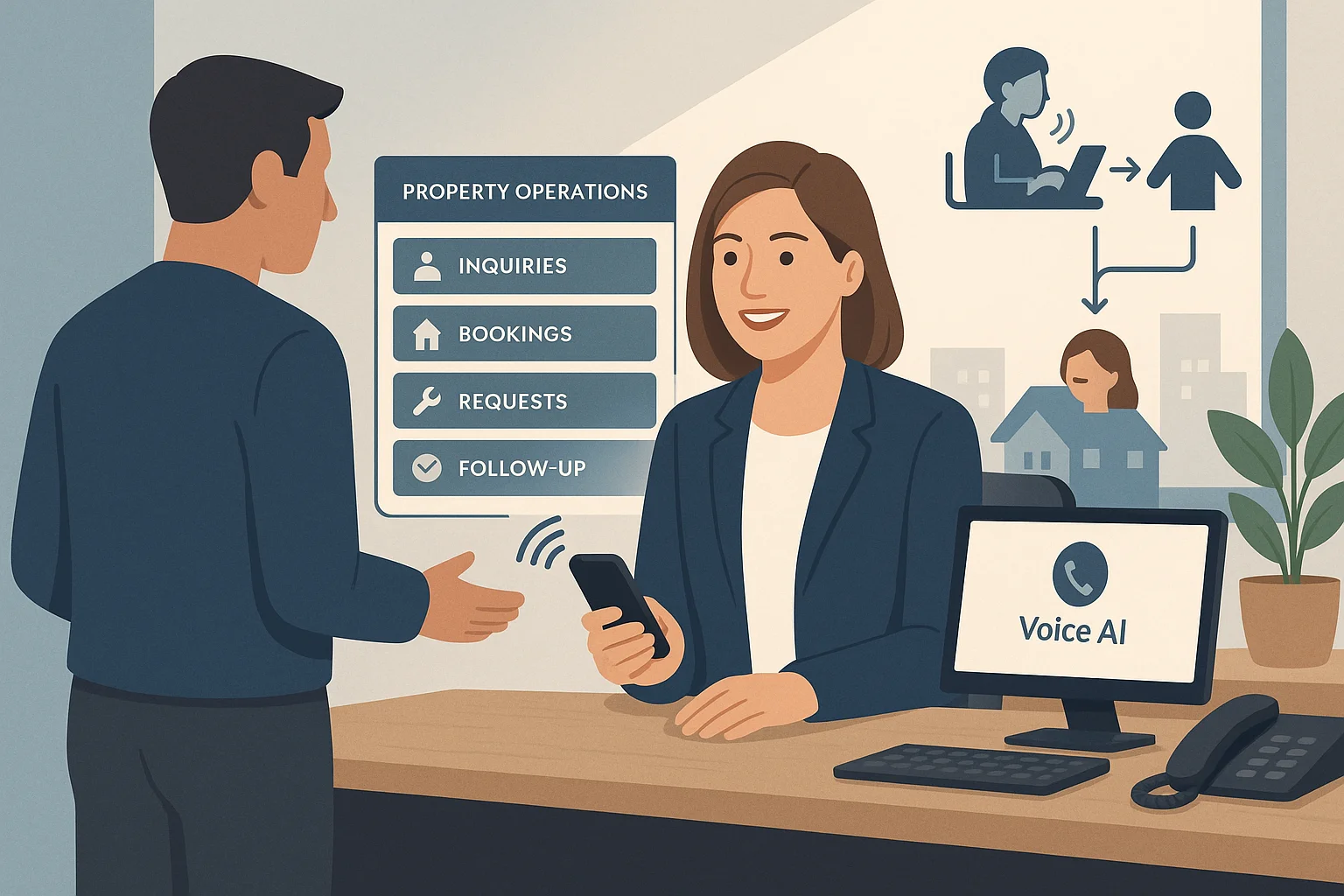
Voice AI solves availability gaps (after‑hours capture), routine intake (basic qualification and appointment booking), and predictable triage (maintenance categorization and vendor dispatch). For sales leaders, it reduces the time between first contact and scheduled viewing by capturing intent and calendar preferences. For property operations, it provides structured fault data and initial troubleshooting steps so on‑call teams arrive better prepared.
- 24/7 first contact capture and structured intake.
- Speeded lead qualification and automated booking workflows.
- First‑level maintenance triage with vendor assignment triggers.
Where the Human Touch Is Non‑Negotiable
Human agents must remain central for relationship building, negotiation, dispute resolution, sensitive tenant conversations, and any decision with legal or safety consequences. Design systems to escalate to humans for appointment confirmation, final rental offers, lease‑term negotiation, emergency maintenance, and anything that could lead to discriminatory outcomes.
- Negotiating offers, discussing lease terms, or giving legal interpretations.
- Handling complaints, evictions, and sensitive tenant communications.
- Making emergency safety judgments (e.g., structural failure, gas leaks).
Architecture & Operating Model: A Practical Pattern
A repeatable architecture clarifies responsibilities and reduces integration risk. Use a small set of explicit components and outgoing connectors to your CRM and property systems.
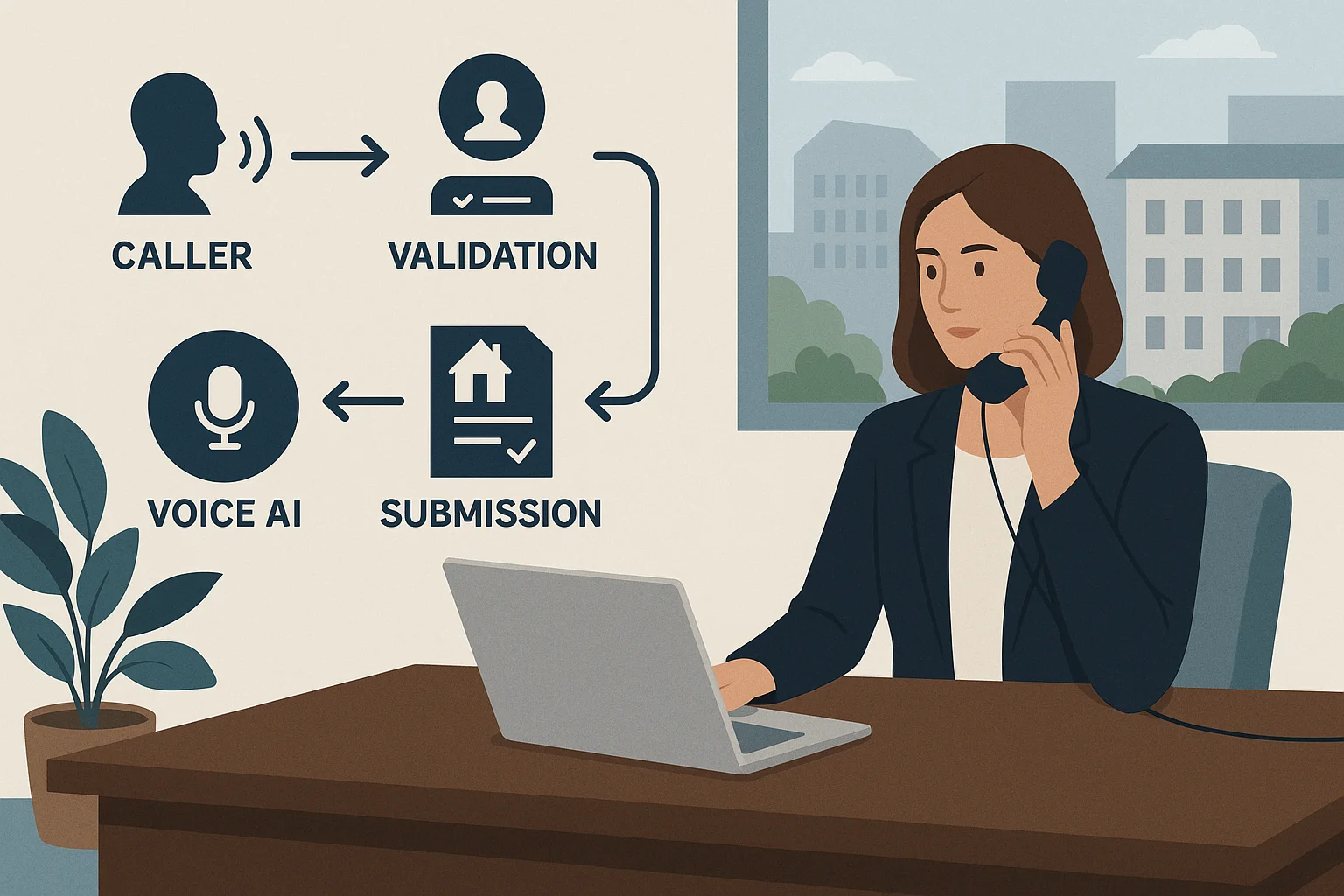
Caller → Voice AI → Verification → System Actions
A compact operating model looks like: Caller → Voice AI reception (24/7) → intent and identity checks → business-system adapter (CRM/property system/maintenance platform) → action (create lead, book appointment, create maintenance case) → human specialist or kiosk handoff. Record every handoff and decision point so the human receiving the case has a complete transcript and structured data.
- Intent detection for: tour request, maintenance report, availability check, or general inquiry.
- Identity and basic validation (unit number, name, last four of tenant ID) with clear consent and logging.
- Controlled API or adapter writes to CRM or property platform and creates a human task when needed.
Integration & Adapter Strategy
Integrate via approved APIs and a small set of adapters: one for CRM/lead capture, one for property/maintenance platforms, and one for calendar/booking. Adapters isolate business systems so you can update connectors without retraining voice models. Peak Demand’s practice is to manage these adapters and orchestration layer so voice transcripts map to structured fields in existing property systems and to ensure handoff artifacts (calendar invites, case IDs) are created atomically.
- Use stateless adapters where possible to reduce data residency concerns.
- Maintain a single source of truth for appointment and maintenance case status.
- Log adapter requests and responses for audit and reconciliation.
First Workflows to Deploy (Foundation & Priority Use Cases)
Choose two priority workflows that deliver immediate operational value and are easy to audit: lead qualification + appointment booking, and maintenance triage. Each workflow must include a documented handoff and minimal list of fields to capture.
Workflow A — Lead Qualification and Appointment Booking
Design the Voice AI script to capture intent, basic qualification, and booking details, then create a CRM lead and either confirm appointment automatically or route to a human for approval.
- Voice AI captures: caller name, contact method, property of interest, preferred times, and readiness to view (timeline).
- Validate caller identity at a low level (name + contact); never request sensitive identity documents on call.
- System creates a CRM lead record, tentatively books a calendar slot, and sends a confirmation text/email. If the prospect indicates negotiation or requires a.
Workflow B — Maintenance Triage and Vendor Handoff
Use voice intake to classify urgency, capture unit and contact details, record a short description, and run guided troubleshooting. For non‑emergency issues, create a maintenance case with structured categories that feed vendor dispatch; for potential emergencies, escalate immediately to a human dispatcher or call emergency services.
- Collect: unit number, contact, symptom checklist, photos or video link prompt, and basic troubleshooting (reset breakers, water shutoff).
- Automatically create a case in the maintenance system with priority, required skillset, and attachments.
- Human verification required before approving high‑cost dispatches or vendor selection that could create contractual obligations.
Controls, Safety, and Compliance Boundaries
Voice AI changes how you capture and act on information. Define clear boundaries: what the AI must not decide, how you mitigate bias, and what you must log. These controls should be part of vendor contracts and internal SOPs.
Fair‑Housing and Non‑Discrimination
Do not rely on Voice AI for tenant screening decisions or any actions that could produce discriminatory outcomes. Keep sensitive qualification decisions and subjective judgments with trained humans and design intake prompts that avoid eliciting protected‑class information. Regularly review prompts and decision outputs for disparate impact.
- Avoid questions that solicit protected characteristics or that could be interpreted to screen on those bases.
- Escalate any uncertain qualification outcomes to a human reviewer for compliance review.
Risk Management & Operational Controls
Implement risk management controls aligned to an AI risk framework: model performance monitoring, retraining governance, incident response, and retention policies for call recordings and transcripts. Use human‑in‑the‑loop guards on high‑impact decisions and maintain audit logs for all automated actions.
- Monitor intent accuracy and false positives/negatives for priority workflows.
- Define retention, access controls, and subprocessors; be explicit about hosting region and backup geography in vendor contracts.
- Require vendor change control for model updates and prompt changes.
Truthful Marketing and Claims
When marketing your Voice AI capability, avoid overstating automation or guarantees about outcomes. Vendors and buyers must be careful with public claims about model capabilities and business impacts.
- Document and verify any performance claims used in marketing materials.
- Require vendor attestation for key claims and keep evidence for procurement records.

Procurement, Vendor Selection, and Implementation Choices
Choose a vendor or managed service that matches your operational maturity and compliance needs. Ask for operational evidence, not marketing slides.
What to Require in RFPs and SOWs
Include operational acceptance criteria: adapter inventory, observability stack, QA cadence, escalation SLAs, audit logging, subprocessors list, hosting/backup regions, and proof of secure API integrations. Require a staged pilot with acceptance metrics prior to production rollout.
- Adapters for current CRM and property systems; documented API contracts.
- Logging and observability for intent, confidence scores, and latency.
- QA and retraining schedules with documented human review cycles.
Managed Service vs In‑house
A managed service is appropriate when you want operational ownership—24/7 monitoring, prompt engineering, and adapter maintenance—without hiring deep voice‑AI staff. In‑house makes sense if you already operate middleware and have strict residency or integration demands. Peak Demand typically recommends managed adapters plus a documented handover plan for customers that retain internal IT ownership of CRM workflows.
- Managed services should include QA, updates, and defined escalation paths.
- In‑house deployments require staff for model updates, observability, and incident response.
Integration Evidence and References
When evaluating suppliers, request sample adapters and a short integration plan showing how Voice AI writes records and produces handoff artifacts. Look for vendors that publish an integrations hub or adapter catalog.
- Example resources: integration hub and managed‑service documentation to verify approach.
Implementation Checklist, KPIs, and Failure Playbooks
A tight implementation plan reduces risk. Define a pilot, acceptance criteria, and a playbook for anticipated failures.
Pilot Scope and KPIs
Run a time‑boxed pilot focused on one property type or a single region. KPIs should be operational and measurable: speed‑to‑lead (time from call to CRM create), booking completion rate, maintenance case accuracy, handoff latency, and human escalation rate. Use the pilot to refine prompts, increase confidence thresholds, and tune routing rules.
- Pilot elements: script library, adapter tests, human handoff verification, and SLA definitions.
- Measure both automation metrics (intent accuracy) and business metrics (appointments kept, vendor dispatch resolution).
Common Failure Modes and Escalation
Plan for the predictable: transcription errors, incorrect intent detection, connector failures, and unexpected caller behavior. For each failure mode, have a deterministic fallback: replay to a human operator, route to voicemail with guaranteed callback, or open a maintenance ticket with a human check.
- Fallbacks: low‑confidence intents go directly to human queue; API errors trigger retry with human notification.
- Maintain a human override for any booking or vendor authorization over a defined threshold.
Training, Feedback Loops, and Continuous Improvement
Use annotated call transcripts for supervised retraining and measure drift. Maintain a continuous QA loop where a percentage of automated handoffs are reviewed by humans for quality and compliance. Log changes and results so you can trace the impact of prompt or adapter updates.
- Establish a feedback cadence between operations, leasing agents, and the Voice AI team.
- Retain transcripts and annotations as part of your QA evidence for audits.
Related Peak Demand resources
Industry and AI sources reviewed
- Fair Housing Act OverviewU.S. Department of Housing and Urban Development
- Artificial Intelligence Risk Management Framework (AI RMF 1.0)National Institute of Standards and Technology (NIST)
- Artificial Intelligence and the FTCU.S. Federal Trade Commission
Privacy, telecommunications, recording-consent, cybersecurity, consumer-protection, employment, and records obligations vary by jurisdiction and use case. This article is operational guidance, not legal advice; organizations should confirm applicable requirements with qualified professionals.
Frequently asked questions
Common starting points include lead intake, showing and appointment scheduling, tenant and resident service requests, maintenance routing, listing questions from approved data, after-hours overflow, and structured escalation to leasing or property teams.
Official reference: Artificial Intelligence Risk Management Framework (AI RMF 1.0)
Do not delegate discriminatory screening, legal advice, binding transaction decisions, emergency-maintenance judgment, fair-housing determinations, or decisions that require licensed or authorized professionals. The agent should gather information and route the matter appropriately.
Official reference: Fair Housing Act Overview
Use approved fields and actions, validate identities and property records, limit permissions, log changes, and provide human review for exceptions. The agent should not invent availability, pricing, eligibility, lease terms, or maintenance status.
Official reference: Artificial Intelligence Risk Management Framework (AI RMF 1.0)
Require fair-housing safeguards, integration and data controls, testing, audit logs, escalation paths, emergency-routing rules, monitoring, change control, and clear ownership of listing, property, tenant, and maintenance knowledge.
Official reference: Fair Housing Act Overview
Turn Voice AI infrastructure into a managed enterprise operation
Peak Demand designs, integrates, deploys, monitors, and improves Voice AI systems across customer service, enterprise systems, governance, escalation, and reporting.
Schedule a discovery call


