
Voice AI as the Operational Control Plane for Predictive Utility Operations
A practical operating model for using high‑volume Voice AI as the control plane that orchestrates account-safe validation, outage communications, service requests, and escalation across utility systems.
1. The control-plane model: what Voice AI does and does not do
Define the role of Voice AI as an operational control plane for customer interactions. Clarify capabilities and explicit safety boundaries utilities must enforce.
Operational role and standard call flow
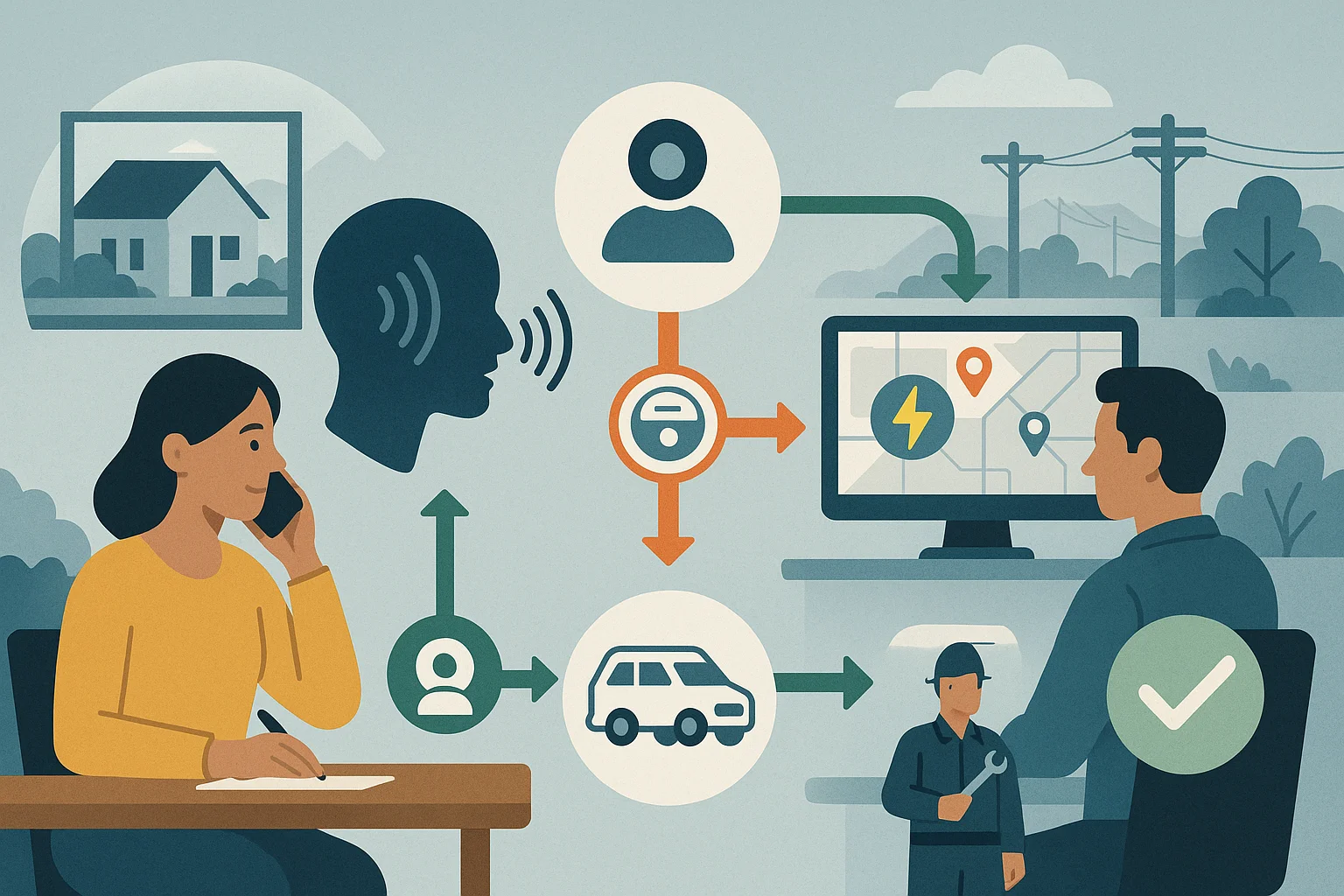
Voice AI should be deployed as a control-plane orchestrator that receives inbound customer contact and converts intents into validated actions or structured information for downstream systems. The canonical flow is: Customer call → Voice AI front end → account or location validation → query to an approved API or knowledge source (for outage status, meter status, or account details) → produce a structured response, create a service request, schedule a field job, or escalate to a human agent. This flow keeps authoritative systems (OMS, CIS, CRM, workforce management) as source-of-truth while using Voice AI for routing, normalization, and front-line automation.
- Voice AI standardizes caller intents into event-level payloads for downstream processing.
- Validation gates ensure actions (create request, cancel request, schedule visit) are tied to authenticated accounts or verified premises.
- Human escalation is a defined outcome, not an exception.
Clear safety boundaries
Voice AI must never be authorized to operate or command physical infrastructure, make safety-critical determinations, or replace emergency response protocols. Operational controls should explicitly prevent Voice AI from issuing work-arounds that could change switch orders, circuit configurations, or field crew safety instructions. Instead, the system should produce discrete, auditable records that human operators or approved control systems act upon under existing procedures.
- Block any Voice AI pathway that could produce automated network commands.
- Define mandatory human confirmation for actions that affect public safety or require field isolation.
- Log all interactions with timestamps and immutable event IDs for post-incident review.
2. Core use cases and deterministic call flows
Utility operations commonly prioritize outage communications, service requests, status inquiries, and field-service scheduling. For each, Voice AI must produce deterministic outcomes with well-understood fallbacks.
Outage intake and status delivery
Primary objectives are to reduce load on human agents during events and provide fast, accurate status. The Voice AI flow should: identify outage-related intent, validate caller location or account, check OMS event state via an approved API, and deliver an appropriate status message or estimated restoration window if available. If the OMS lacks a mapped event for the caller, the Voice AI should create a structured outage report for operator review or queue into an event-deduplication workflow.
- Prefer authoritative OMS queries for status instead of inferred estimates.
- When status is unavailable, the system should escalate to an operator or record a validated report for triage.
- Provide callers with explicit human handoff options and expected SLAs for follow-up.
Service requests, scheduling, and confirmations
Service requests (connect/disconnect, meter exchange, leak reports) require account validation and alignment with workforce schedules. Voice AI should validate account/premise, check CRM/OMS business rules (eligibility, safety hold), and either create a draft service request or present next-available scheduling windows pulled from a sanctioned scheduling API. Always surface any safety holds or prerequisites (e.g., site access, permits) and require human confirmation where required by operational rules.
- Maintain an authoritative pre-check against safety holds and billing flags before scheduling.
- Create requests with immutable, traceable payloads and reference IDs for inbound field crews.
- Confirm bookings and provide callers with transaction IDs and expected visit windows.
3. Integrations and data contracts: guaranteeing operational reliability
Reliable programmatic integration is the foundation of a Voice AI control plane. Define data contracts, event schemas, and failure semantics before going live.
Event architecture and immutable payloads
Design voice-generated events as immutable payloads with a strict schema: event ID, event type, caller identity hash, validated account/premise reference, timestamp, intent classification, confidence score, and proposed action. Downstream systems must accept and process these payloads deterministically. Version the schema and support backward compatibility to avoid runtime failures during upgrades.
- Include confidence and intent metadata so downstream systems can apply routing rules.
- Track source of truth for every field (e.g., caller provided vs verified via API).
- Use idempotency keys for repeat submissions to prevent duplicate jobs under retries.
Approved API adapters and failure semantics
All integrations to OMS, CIS, CRM, and workforce management systems should use approved adapters or controlled middleware. Define synchronous and asynchronous interaction paths: synchronous for read-only status queries, asynchronous for request creation and job dispatch. For failed integrations, define clear retry policies, circuit-breakers, and fallback workflows that escalate to human agents when automation confidence or integration health drops below thresholds.
- Synchronous reads: short timeout, deterministic fallback message to callers.
- Asynchronous writes: durable queueing with delivery receipts and operator alerts on delayed processing.
- Circuit-breakers: open after defined error thresholds and route all calls to human agents.
4. Governance, safety and cybersecurity controls
Operational deployment must be governed by risk controls that address AI-specific risks, cybersecurity performance, and the energy sector's maturity expectations.
AI risk management and human oversight
Adopt risk-management practices aligned with critical-infrastructure AI guidance: define acceptable failure modes, required human approvals, and monitoring plans for model drift and incorrect responses. Establish QA sampling and thresholds for automated acceptance versus required human review. Maintain auditable logs showing why the system chose an automated path versus a handoff.
- Define roles and responsibilities for model updates, QA, and escalation policy.
- Document acceptable confidence thresholds and automatic fallback behaviors.
- Retain samples for QA and regulatory review with clear retention rules.
Cybersecurity performance and maturity
Supply chain and integration security are essential. Use cross-sector cybersecurity goals as a baseline for secure operations: limit access to production APIs, enable multi-factor controls for human overrides, and apply network segmentation for Voice AI infrastructure. Evaluate the maturity of cybersecurity controls in vendors and internal teams, and include those findings in operational readiness assessments.
- Apply least-privilege access for adapters to OMS/CIS/CRM systems.
- Monitor anomalous traffic patterns and set operator alerts for suspicious API usage.
- Conduct regular tabletop and incident-response exercises that include Voice AI failure scenarios.

5. Procurement, implementation patterns, and failure boundaries
Choose implementation patterns and procurement models that align with operational priorities: managed service, co-managed, or in-house. Specify failure boundaries and measurable service levels before launch.
Implementation patterns and ownership
Managed services reduce operator overhead and are appropriate when the utility lacks in-house AI operations maturity; co-managed models suit organizations that want control over integrations and data contracts while outsourcing model operations. In-house builds give maximum control but require investment in model ops, observability, and security expertise. Define ownership for integrations, adapters, and incident response up front.
- Clarify who owns each adapter and who is responsible for queue processing and retries.
- Include vendor obligations for escalation, observability, and regular QA reports.
- Use service pages such as Voice AI for Utilities and Energy Providers and Managed Voice AI Services to set procurement expectations and deliverables.
SLA, surge capacity, and performance under stress
Outages generate burst traffic. SLAs must specify surge handling, concurrency, and graceful degradation policies. Define clear handoff rules for surge conditions: when the Voice AI will throttle automated actions and route to human pools, how caller queueing is communicated, and maximum acceptable latency for status queries.
- Define surge thresholds that trigger human-only routing or abbreviated IVR.
- Include performance tests for peak scenarios and validate adapter behavior under retries.
- Document acceptable data-loss risk and recovery RTO/RPO for queued events.
Failure boundaries and incident response
Every action that Voice AI can request should have documented failure boundaries: what is retried, what is rolled back, and when human intervention is required. Maintain an incident playbook that includes scenarios such as erroneous service-request creation, duplicate job dispatch, or unauthorized data exposure.
- Keep operator-reversible actions and irreversible actions separated by explicit validation gates.
- Run periodic drills using the Voice AI incident-response playbook.
- Reference Voice AI Incident Response and Business Continuity for recovery patterns and escalation.
6. QA, observability, and measurable outcomes
Establish measurable KPIs and QA processes that demonstrate operational reliability and customer experience improvements without overclaiming outcomes.
Operational KPIs to track
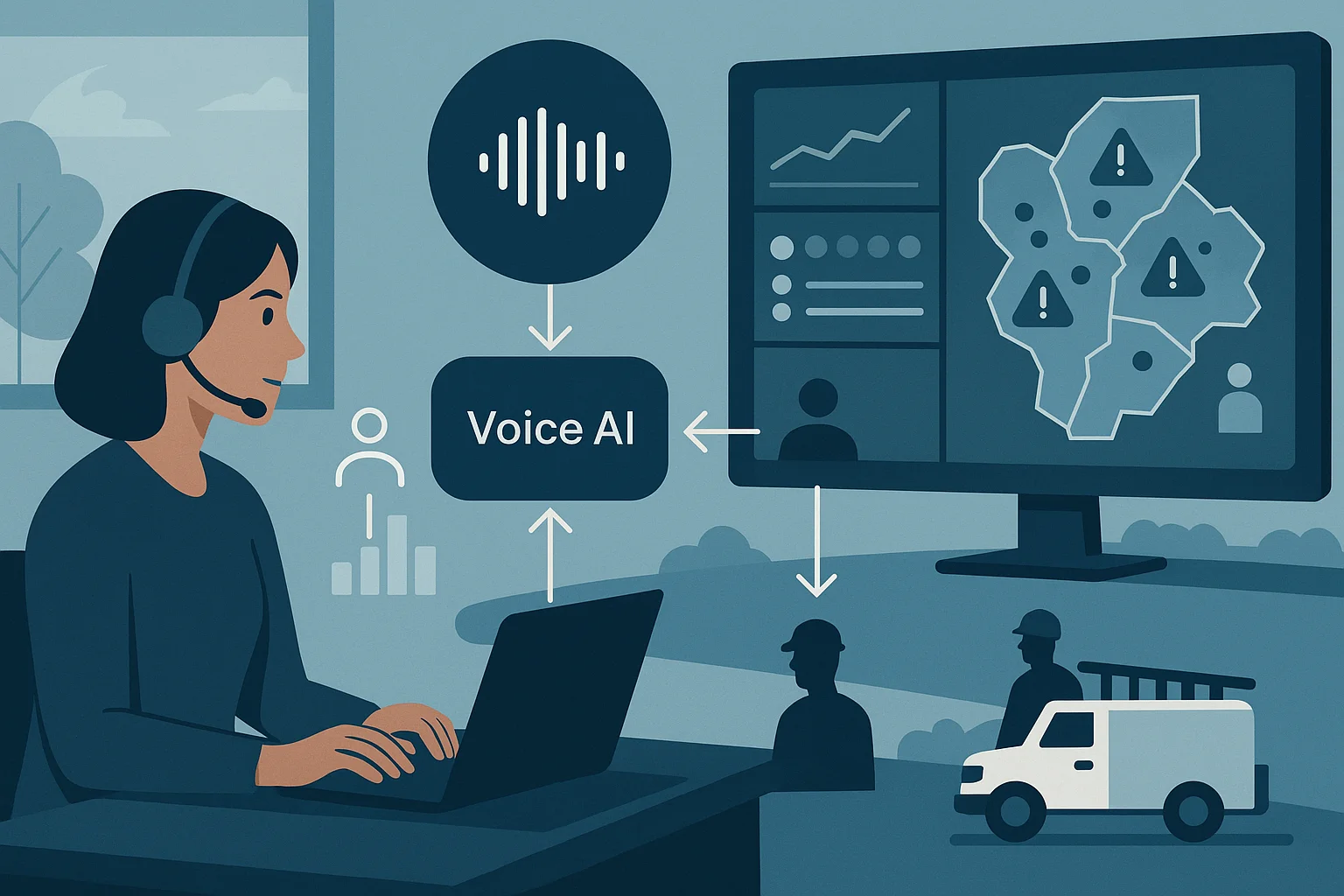
Track metrics that connect Voice AI behavior to operational outcomes: successful automated transactions (with audit trail), false positive escalations, time-to-first-status for outage calls, average human handle time when escalated, percentage of calls routed correctly by intent, and failure rates for API adapters.
- Include event‑level success rate with traceable IDs from Voice AI through to OMS/CRM.
- Monitor percent of calls converted to validated service requests versus manual agent creation.
- Track surge performance metrics separately from steady-state baselines.
Quality assurance and sampling
Implement continuous QA by sampling automated interactions, reviewing edge cases, and maintaining a feedback loop with contact centre QA teams. Use auditable transcripts tied to call IDs and redacted where required. Set explicit acceptance criteria for automated fulfillment and require human review when criteria are not met.
- QA sampling should prioritize low-confidence intents and high-impact actions.
- Automate extraction of disagreement cases between Voice AI classification and human adjudication.
- Schedule regular model and rulebook reviews informed by sampling results.
Analytics and continuous improvement
Instrument event-level analytics that connect interaction patterns to operational costs and field outcomes. Use these analytics to refine intent models, improve routing rules, and reduce unnecessary human handoffs. Maintain a small set of high-value experiments (e.g., scheduling automation) and measure lift using pre-defined guardrails.
- Measure downstream outcomes: completion of scheduled jobs, on-time arrival, escalations from field crews.
- Correlate interaction confidence with downstream manual work to prioritize model improvements.
- Publish regular operational dashboards for leadership and regulators as needed.
Related Peak Demand resources
Industry and AI sources reviewed
- Cybersecurity Capability Maturity Model (C2M2)U.S. Department of Energy
- AI Risk Management Framework — Critical Infrastructure ProfileNational Institute of Standards and Technology (NIST)
- Cross-Sector Cybersecurity Performance GoalsCybersecurity and Infrastructure Security Agency (CISA)
Utility cybersecurity, critical-infrastructure, records, customer-protection, and emergency-communications obligations vary by jurisdiction and service type. This article is operational guidance, not legal advice; organizations should confirm applicable requirements with qualified professionals.
Frequently asked questions
Good starting points include billing and account questions, move-in or move-out intake, appointment scheduling, service-request capture, outage-status messaging from approved systems, payment-routing assistance, and structured escalation. Safety-critical and infrastructure-control decisions should remain with qualified utility teams.
Official reference: Cross-Sector Cybersecurity Performance Goals
Use the minimum approved identifiers needed for the workflow, validate them against the utility's system of record, limit data exposure, and provide a human-assisted path when verification fails. The Voice AI should not guess account, premise, or outage information.
Official reference: Cross-Sector Cybersecurity Performance Goals
Use controlled adapters, strict schemas, timeouts, retries, audit logs, safe failure states, and human escalation. The system should distinguish approved utility data from model-generated language and should never present stale or unverified operational information as fact.
Official reference: Cybersecurity Capability Maturity Model (C2M2)
Track containment by request type, successful validations, transfers, abandoned calls, integration errors, incorrect or stale responses, time to resolution, customer follow-up, and the percentage of cases completed safely without manual rework.
Official reference: Cybersecurity Capability Maturity Model (C2M2)
Build resilient utility customer-service automation
Peak Demand helps utilities connect Voice AI to approved customer-information, outage-communication, service-request, dispatch, escalation, and analytics workflows.
Schedule a discovery call


