
System Integration Patterns for Real Estate Voice AI: APIs, Identity, and Reliability
Practical integration patterns for Voice AI in brokerages and property operations: architecture, API contracts, identity checks, reliability, observability, failure recovery, and safe human handoffs.
1) Architecture: Clear boundaries and the canonical path
Start with a simple, enforceable architecture that maps clearly to business outcomes. A recommended canonical flow gives each system an owner, a failure boundary, and a measurable contract.
Canonical flow and ownership
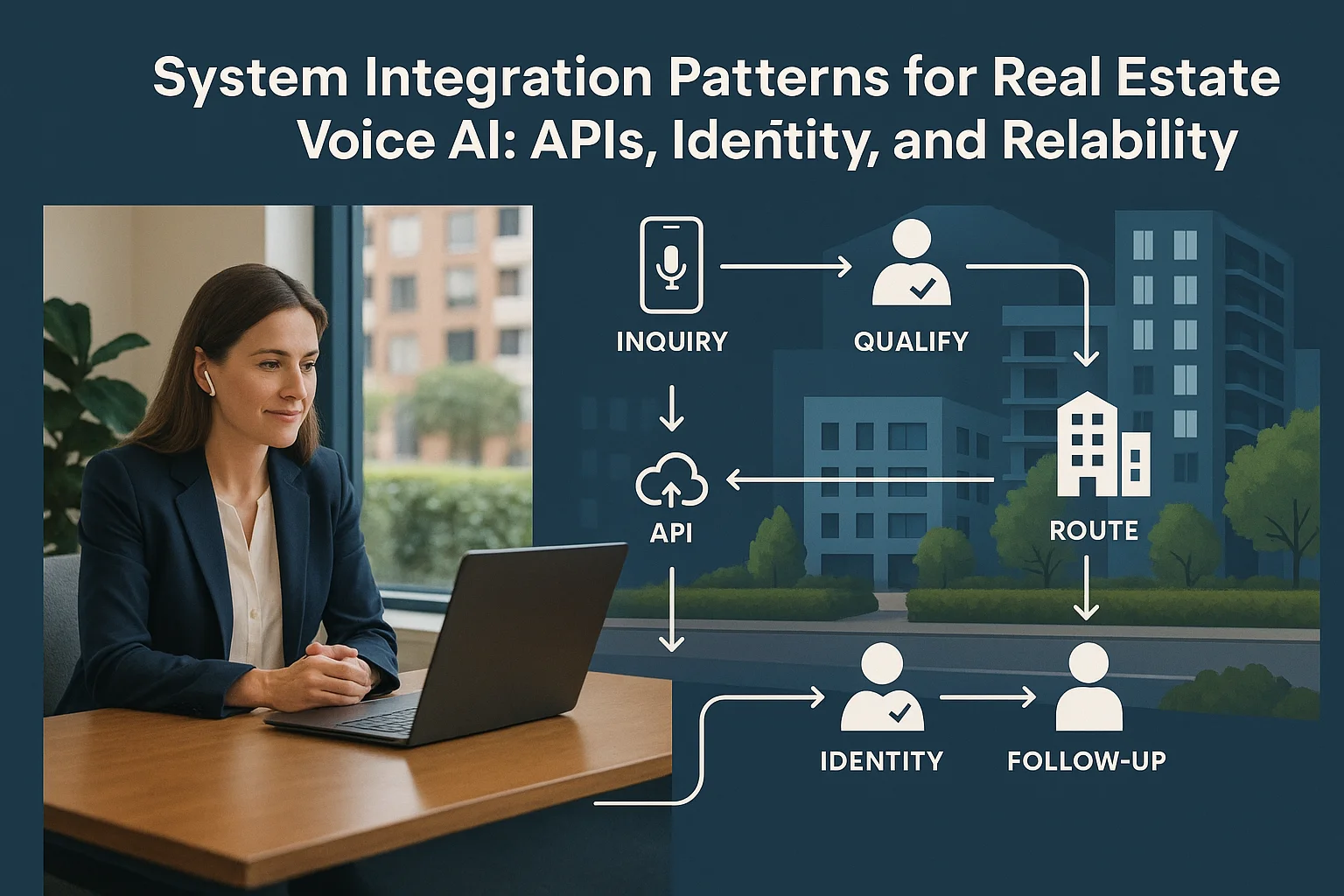
Design the caller flow as a sequence of responsibility zones: Caller → Voice AI (NLP + dialog state) → Intent & Identity Checks → Canonical Backend (CRM / Property System) → Action (appointment, maintenance case, lead record) → Human Handoff. Assign a single system owner for each arrow: Voice AI vendor for audio capture and intent extraction, platform engineering for API adapters, and operations (leasing or maintenance) for queueing and specialist handoff. This reduces ambiguity during failures and clarifies SLA recipients.
- Canonical identifier: use property ID, unit ID, or lead ID as the primary key in all exchanges to avoid mismatches.
- Single source of truth: persist final actions (appointments, tickets, offers) in the canonical backend, not in intermediate voice sessions.
- Owned failure boundaries: each component should declare what it will retry and when it will escalate to human support.
Patterns for synchronous and asynchronous outcomes
Leasing and sales workflows often require synchronous outcomes (appointment booked now), while maintenance intake can be asynchronous (ticket created, technician scheduled later). Use two patterns: 1) Synchronous API orchestration: the Voice AI calls the backend API and returns success/failure in the session for immediate confirmation. 2) Asynchronous event-first: the Voice AI emits a validated event to a message bus (or webhook) that the backend consumes and then updates the caller by SMS or callback. Choose the pattern by business expectation — time-to-confirmation and SLA for live agent escalation.
- Synchronous: use for appointment booking and qualification where immediate confirmation affects customer experience.
- Asynchronous: use for work-orders, vendor scheduling, or multi-party approvals where downstream processing is expected.
2) APIs and data contracts: minimal, explicit, and versioned
APIs are the operational contract between Voice AI and property systems. Keep contracts small, strongly typed, and version-controlled to simplify integrations and audits.
Minimum viable contracts for real estate flows
Define focused API resources: /leads, /appointments, /maintenance-tickets, /identity-verification. Each resource should include canonical identifiers (property_id, unit_id, person_id), timestamped events, and provenance metadata (session_id, call_recording_ref, confidence_scores). Avoid large, optional payloads — prefer predictable required fields plus an extensible metadata map for vendor-specific values.
- Leads: required = name or caller_id, contact_method, property_id, intent_code, intent_confidence, created_by=voice_session_id.
- Appointments: required = property_id, unit_id (if applicable), datetime_range, booker_id (agent or system), confirmation_token.
- Maintenance tickets: required = property_id, location_desc, severity_code, immediate_hazard_flag, reporter_contact, ticket_id.
Versioning and backward compatibility
Publish API versioning rules and deprecation windows. Use semantic versioning for breaking changes and keep a stable v1 for at least 12–18 months in enterprise contexts. Provide an adapter layer for older property systems rather than forcing rip-and-replace on business tenants.
- Maintain changelogs and migration guides tied to endpoint versions.
- Provide a transformation adapter to map older CRM schemas to the canonical contract in-flight.
3) Identity, authentication, and caller verification
Identity is both a business problem (known prospect vs anonymous reporter) and a regulatory one (privacy, access to records). Implement layered checks and define clear handoffs when confidence is insufficient.
Layered identity checks and tokens
Combine Automatic Number Identification (ANI) with CRM-linked identifiers and session-scoped tokens. For returning callers, match ANI + hashed device id to a CRM profile and surface linked preferences and permissions. For new callers, use low-friction verification (SMS OTP or email token) when the caller’s requested outcome needs verified identity (e.g., lease signing, sensitive account changes). Store only hashed or tokenized identifiers in logs where possible.
- Known contact flow: ANI match → pull CRM profile → present agent with enriched card; use tokenized session to authorize API updates.
- Unknown contact flow: ANI absent or mismatch → optional OTP flow for verification; fallback to agent handoff if caller declines verification.
- Recording consent: capture and persist consent flags per-jurisdiction before relying on recorded audio for downstream evidence.
Limits: what Voice AI must never decide
Define hard policy gates: do not allow Voice AI to perform binding lease signatures, perform legal or tax advice, make emergency judgments, or execute discriminatory screening. When the caller requests an action that falls within these gates, escalate to a named human role and attach the full session transcript and confidence scores to the task.
- Escalate any request that changes tenancy status, authorizes debt collection, or waives nontrivial deposit amounts.
- Route emergency or safety-related reports to live dispatch or on-call human operators with a secure, documented handoff.
4) Reliability: SLOs, retry behaviour, and failure boundaries
Plan for inevitable failures. Specify service levels for each integration point, codify retry and circuit-breaker behaviour, and guarantee deterministic fallback paths to humans.
Operational SLOs and error budgets
Define measurable SLOs for latency and accuracy tied to business outcomes (e.g., lead capture rate, appointment booking success). Example SLOs: 99% of intent-to-api calls complete within 1.5 seconds; 95% of high-confidence booking intents result in a confirmed appointment. Maintain an error budget and escalation path if SLOs are breached.
- Track business KPIs: leads captured per 100 calls, booking-confirmation rate, maintenance triage accuracy.
- Use error budgets to authorize safe feature rollouts or trigger rollback to previous configurations.
Retry, queueing, and human fallback
Implement idempotent APIs and deterministic retry policies to avoid duplicate bookings or tickets. When the backend is unavailable, queue validated events to durable storage (message bus or persistent queue) and present the caller with a human confirmation option: immediate transfer, scheduled callback, or SMS confirmation once resolved.
- Idempotency keys: generate a stable key per logical transaction (session_id + intent + timestamp) and require servers to deduplicate.
- Circuit breaker: after N consecutive backend failures, route calls to a lightweight agent workflow for manual intake.
- Durable queueing: ensure queued events persist across outages and are replayable with audit trails.

5) Observability, auditability, and QA
Operational visibility should map to both technical traces and business outcomes. Instrument for traceability, not just debugging.
Telemetry aligned to business KPIs
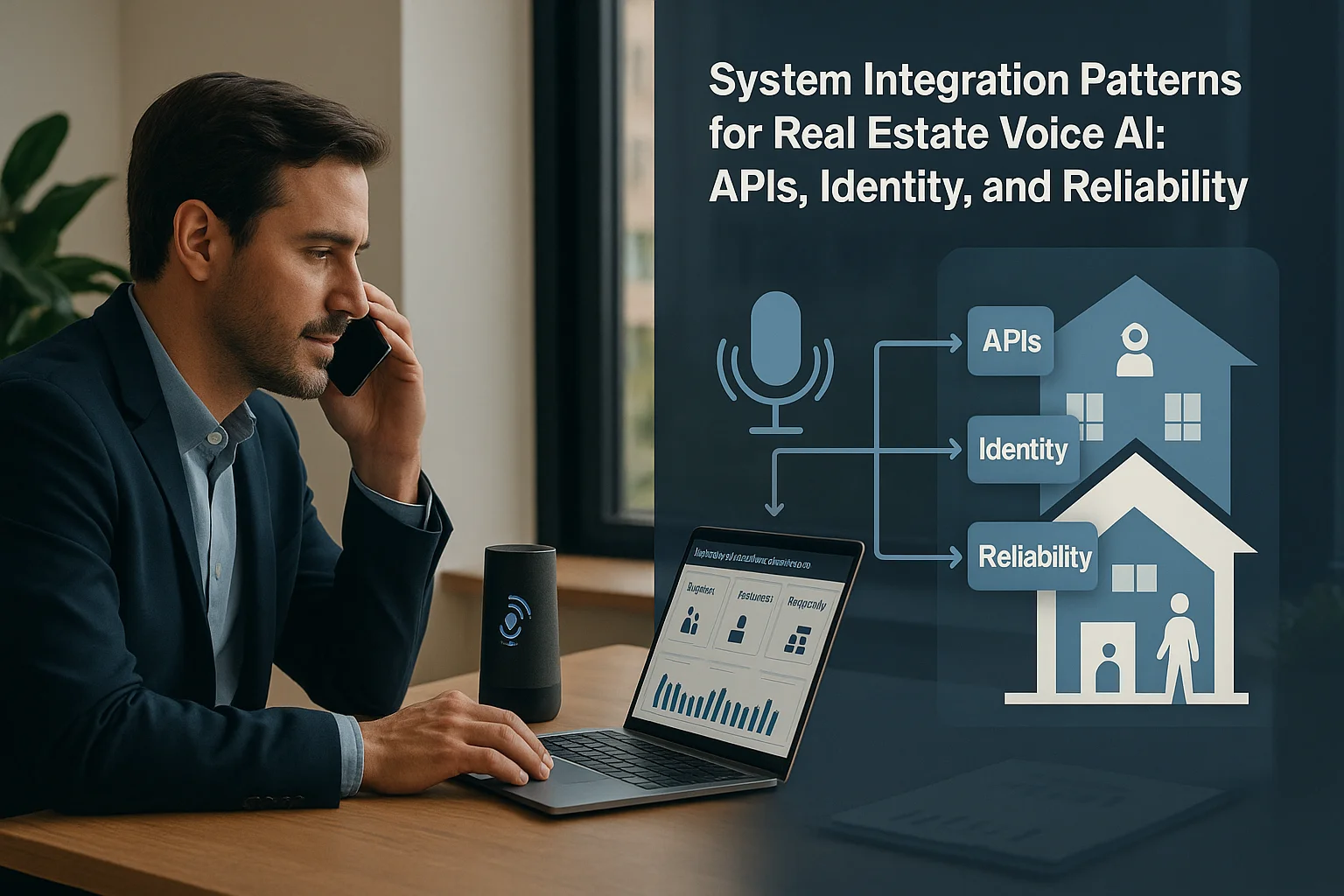
Collect structured telemetry: request/response latency, intent confidence distribution, conversation duration, human-handoff frequency, and booking conversion. Link telemetry to canonical IDs so operators can trace a KPI failure back to a call session, the associated recording, and the exact API payload.
- Distributed tracing: propagate session_id and transaction_id across Voice AI and backend calls.
- Metrics: expose lead capture rate, false-intent rate, booking timeout rate on dashboards used by Ops and Leasing managers.
QA, explainability, and audit trails
Retain transcripts and confidence scores for a documented window and make them available for QA sampling. Use human review on a representative sample to measure intent accuracy and fairness signals. Maintain immutable audit trails for regulated actions and ensure the chain of custody for recordings is documented (storage location, subprocessors, retention).
- QA cadence: weekly sampling of low-confidence calls and monthly sampling of escalations.
- Retention policy: declare recording retention, backup region, subprocessors, and on‑demand access procedures to compliance teams.
6) Safe use, fairness, and regulatory boundaries
Voice AI must operate within fair-housing and consumer protection constraints. Build policy gates that prevent discriminatory outcomes and guard against overclaiming AI capabilities.
Fair housing and content controls
Prohibit automatic responses or prompts that could lead to discriminatory steering. Train and QA dialogs against a policy checklist that matches fair-housing guidance: avoid asking about family status, race, religion, or other protected classes and never use inferred attributes to alter routing or offers. When a caller’s request raises a fair-housing risk, escalate to a trained human reviewer.
- Blocklist model outputs that suggest preferences or exclusions tied to protected classes.
- Surface a compliance warning and transfer calls to an agent for any ambiguous candidate-sorting or showing-schedule decisions.
Vendor claims and consumer protection
Require transparency clauses in vendor agreements: vendors must not make unverified accuracy claims about the system and must provide test evidence for intent accuracy metrics. Verify vendor marketing with documented test suites and require removal or retraction of unsupported claims. Maintain a policy for how the system describes its capabilities to callers (avoid overstating automation).
- Include FTC-aligned representations in procurement docs that restrict deceptive or unsubstantiated claims about automated decision-making.
- Require vendors to provide reproducible test harnesses for validation prior to go-live.
Related Peak Demand resources
Industry and AI sources reviewed
- Fair Housing Act OverviewU.S. Department of Housing and Urban Development
- Artificial Intelligence Risk Management Framework (AI RMF 1.0)National Institute of Standards and Technology (NIST)
- Artificial Intelligence and the FTCU.S. Federal Trade Commission
Housing, privacy, anti-discrimination, consumer-protection, records, and licensing obligations vary by jurisdiction and workflow. This article is operational guidance, not legal advice; organizations should confirm applicable requirements with qualified professionals.
Frequently asked questions
Common starting points include lead intake, showing and appointment scheduling, tenant and resident service requests, maintenance routing, listing questions from approved data, after-hours overflow, and structured escalation to leasing or property teams.
Official reference: Artificial Intelligence Risk Management Framework (AI RMF 1.0)
Do not delegate discriminatory screening, legal advice, binding transaction decisions, emergency-maintenance judgment, fair-housing determinations, or decisions that require licensed or authorized professionals. The agent should gather information and route the matter appropriately.
Official reference: Fair Housing Act Overview
Use approved fields and actions, validate identities and property records, limit permissions, log changes, and provide human review for exceptions. The agent should not invent availability, pricing, eligibility, lease terms, or maintenance status.
Official reference: Artificial Intelligence Risk Management Framework (AI RMF 1.0)
Require fair-housing safeguards, integration and data controls, testing, audit logs, escalation paths, emergency-routing rules, monitoring, change control, and clear ownership of listing, property, tenant, and maintenance knowledge.
Official reference: Fair Housing Act Overview
Build a controlled property-service workflow
Peak Demand helps real-estate and property teams connect Voice AI to lead intake, showing requests, resident service, maintenance routing, CRM workflows, and human escalation.
Schedule a discovery call


