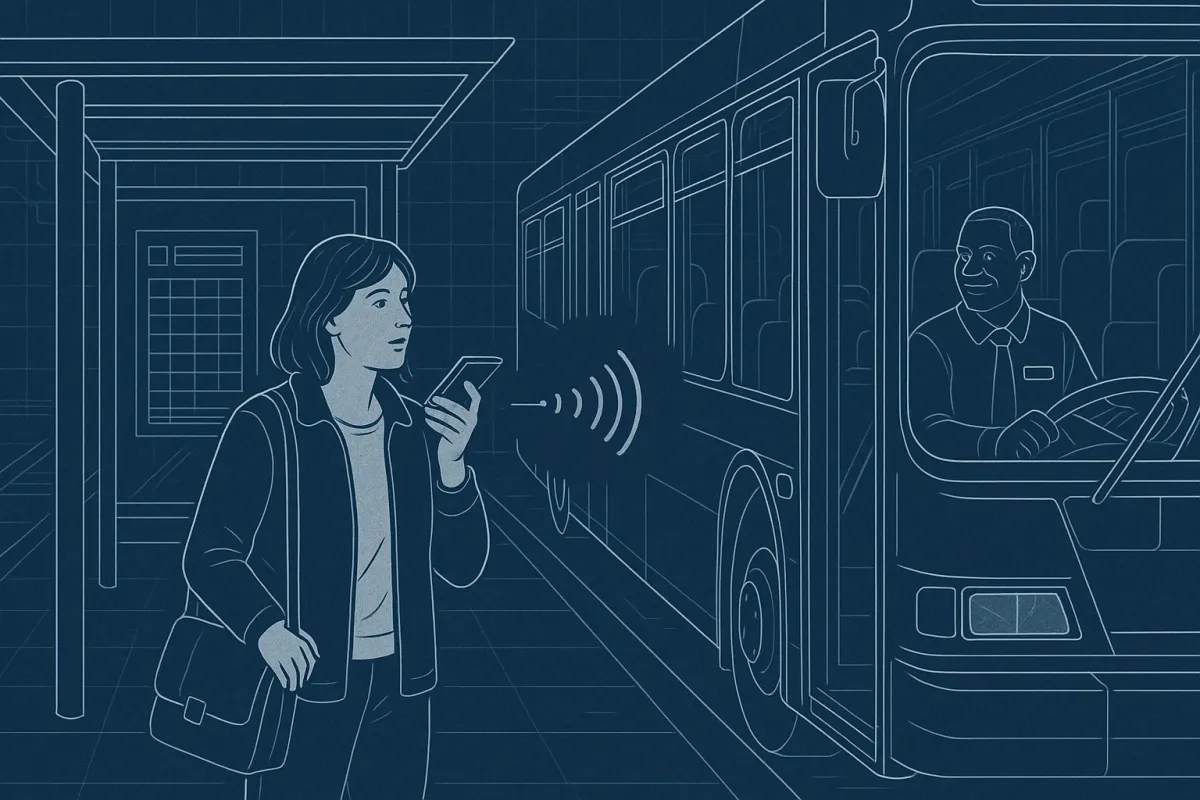
Reskilling Transit Workforces for Voice AI: Union Engagement & Ops
A practical operational framework for transit leaders to reskill customer‑service and operations staff for Voice AI: union engagement, role redesign, integration patterns, procurement, and pilot metrics.
1. Scope, audience, and operational boundaries
This framework targets transit customer‑service, operations, accessibility, IT, and digital transformation leaders evaluating Voice AI programs that will change frontline work. It assumes regulated public‑sector constraints, bargaining with employee representatives, and integration with authoritative schedule and service‑alert feeds.
Audience & assumptions
Intended readers: transit directors, head of customer experience, union representatives, operations managers, workforce development leads, and procurement. Assumptions: the agency maintains authoritative schedule data and publishes service alerts through approved APIs; emergency response and safety‑critical incident handling remain manual; agencies will confirm local legal, privacy, and labour obligations with qualified counsel.
- Focus on non‑emergency customer information, trip planning, fare and policy guidance, and service‑request intake.
- Avoid claims of automated safety decisions or unsupervised operational control without documented, approved data sources and controls.
- Differentiate scheduled knowledge (static timetables, stop locations, fare rules) from dynamic service alerts (detours, delays) that require approved APIs.
Operational boundaries and safety
Define hard boundaries before retraining: what the Voice AI may communicate from controlled schedule knowledge, which updates require verified service‑alert APIs, and which interactions return an immediate human handoff. Keep emergency response, on‑vehicle incident reporting, and law enforcement referrals as staff‑only responsibilities.
- Controlled schedule knowledge is read‑only for the Voice AI unless a verified change arrives from an approved alert source.
- Service alerts (detours, delays) must be fetched from the agency’s service‑alert APIs and validated before customer‑facing statements.
- Ambiguous or safety‑sensitive dialogs must escalate to trained staff with explicit handoff protocols.
2. Strategic objectives and measurable outcomes
Set measurable workforce and operational goals that reflect service quality, labour partnership outcomes, and system reliability. Avoid vendor promises; define KPIs you will own and measure.
Workforce objectives
Translate automation into concrete outcomes for staff: reduced repetitive call volume, higher-value escalation work, career pathways, and measurable training completion. Objectives should be codified in labour agreements and project charters.
- Percent reduction in routine query handling time (targeted, interim milestones agreed with unions).
- Share of staff reskilled to new roles (operator, verifier, analyst) within defined windows.
- Time-to-competency metrics for each role tier.
Operational KPIs and service quality
Define KPIs that align with rider experience and risk management: first‑contact resolution, fallbacks to humans per 1,000 calls, validation failure rate for dynamic forms, accessibility test pass rate, and mean time to human‑handoff.
- Set maximum acceptable fallback rates for critical interactions; use pilot data to calibrate.
- Measure duplicate and false submissions for service‑request forms and implement suppression thresholds.
- Track SLA adherence for human responses after handoff (e.g., acknowledgment within X minutes).
3. Reskilling framework and curriculum design
Design a practical reskilling program with role maps, competency tiers, learning modalities, and credentialing tied to procurement and staffing documents.
Role maps and competency tiers
Create precise role definitions that map old tasks to new responsibilities. Typical roles: Voice Agent Operator (monitors and takes over conversations), Verifier/Escalation Specialist (validates dynamic submissions and ambiguous claims), Conversation Analyst (QA, transcripts, bias review), and Integration Engineer (system adapters and monitoring). Define competencies, core assessments, and on‑the‑job tasks.
- Competency tier 1: monitor and basic takeover (2–4 weeks supervised practice).
- Tier 2: verification and safe submission control (3–6 weeks, includes form validation training).
- Tier 3: analytics and continuous improvement (ongoing, evidence‑based projects).
Training modalities and credentialing
Use blended learning: scenario labs, shadowing, synthetic call simulations, and live supervised handoffs. Training must include accessibility procedures, privacy basics, and a strict protocol for service‑alert validation. Issue role credentials, and link them to bargaining agreements and procurement deliverables.
- Scenario labs must include scheduled data vs. alert discrepancies and explicit handoff triggers.
- Simulations should capture audit trails to feed QA and credentialing decisions.
- Maintain retraining cycles tied to model or policy updates.
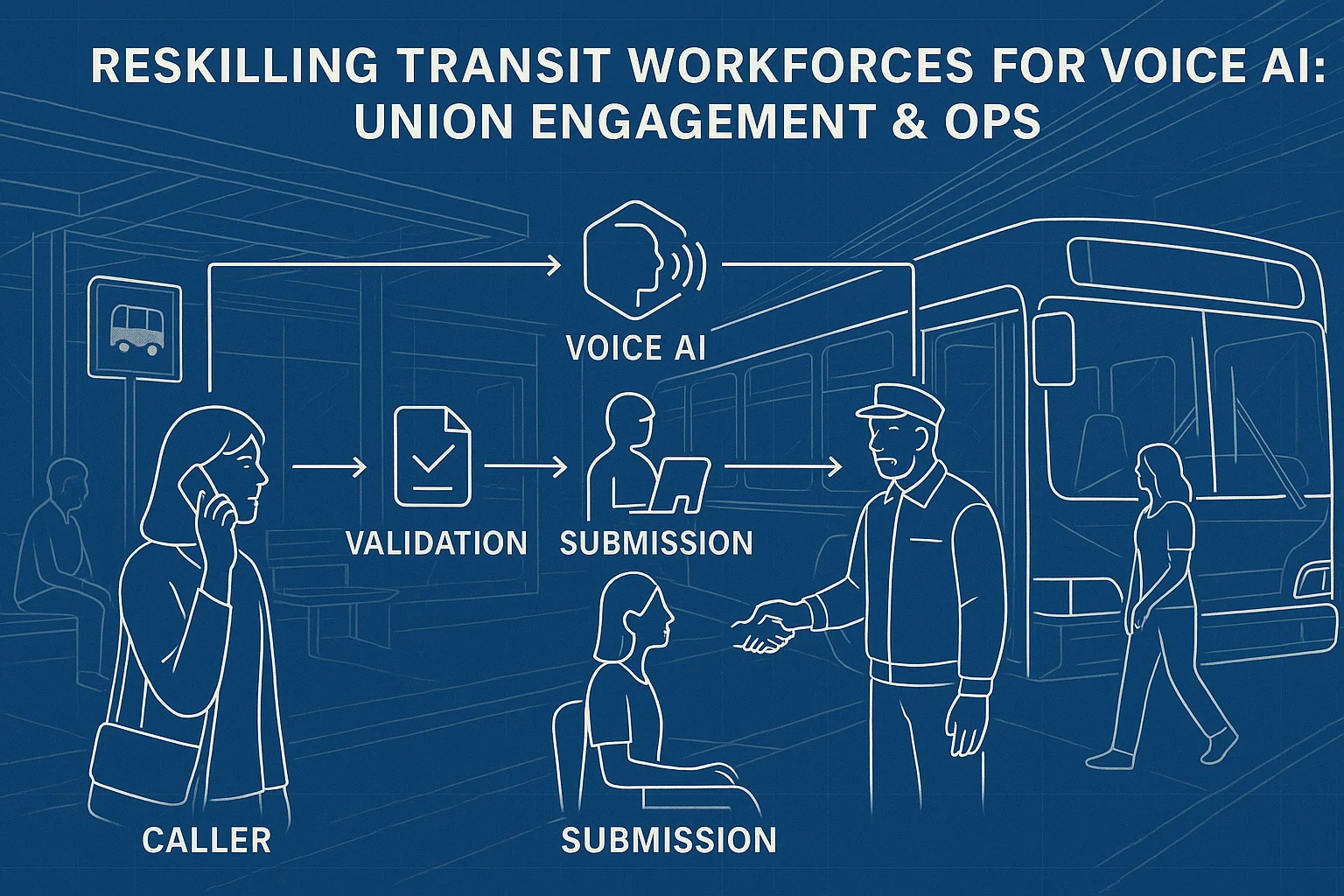
4. Union engagement and negotiated work design
Early, transparent, and tactical union engagement converts risk into predictable transition plans. Structure negotiations around timelines, retraining support, reassignment pathways, and oversight.
Bargaining touchpoints and co‑design sprints
Establish formal touchpoints: policy briefs, co‑design workshops, and a standing technical review committee with union representation. Use short co‑design sprints to validate job maps, escalation protocols, and the human‑handoff experience. Document every change in scope, expected savings timelines, and reallocation plans.
- Publish a living matrix of tasks retained by staff vs. automated by Voice AI.
- Agree on pilot durations, performance thresholds, and job protection measures during pilots.
- Include rights to audit transcripts and QA decisions for a designated union representative.
Staffing models and phased role transitions
Negotiate phased transitions with explicit role guarantees and retraining allowances. Use blended staffing during rollout: maintain a floor of live agents, scale up Voice AI capacity incrementally, and map outage fallback staffing in agreements.
- Define minimum live‑agent coverage during peak hours and for high‑risk interaction types.
- Create explicit recall and redeployment clauses for displaced roles.
- Fund a transition pool for training stipends, overtime for shadowing, and certification bonuses.
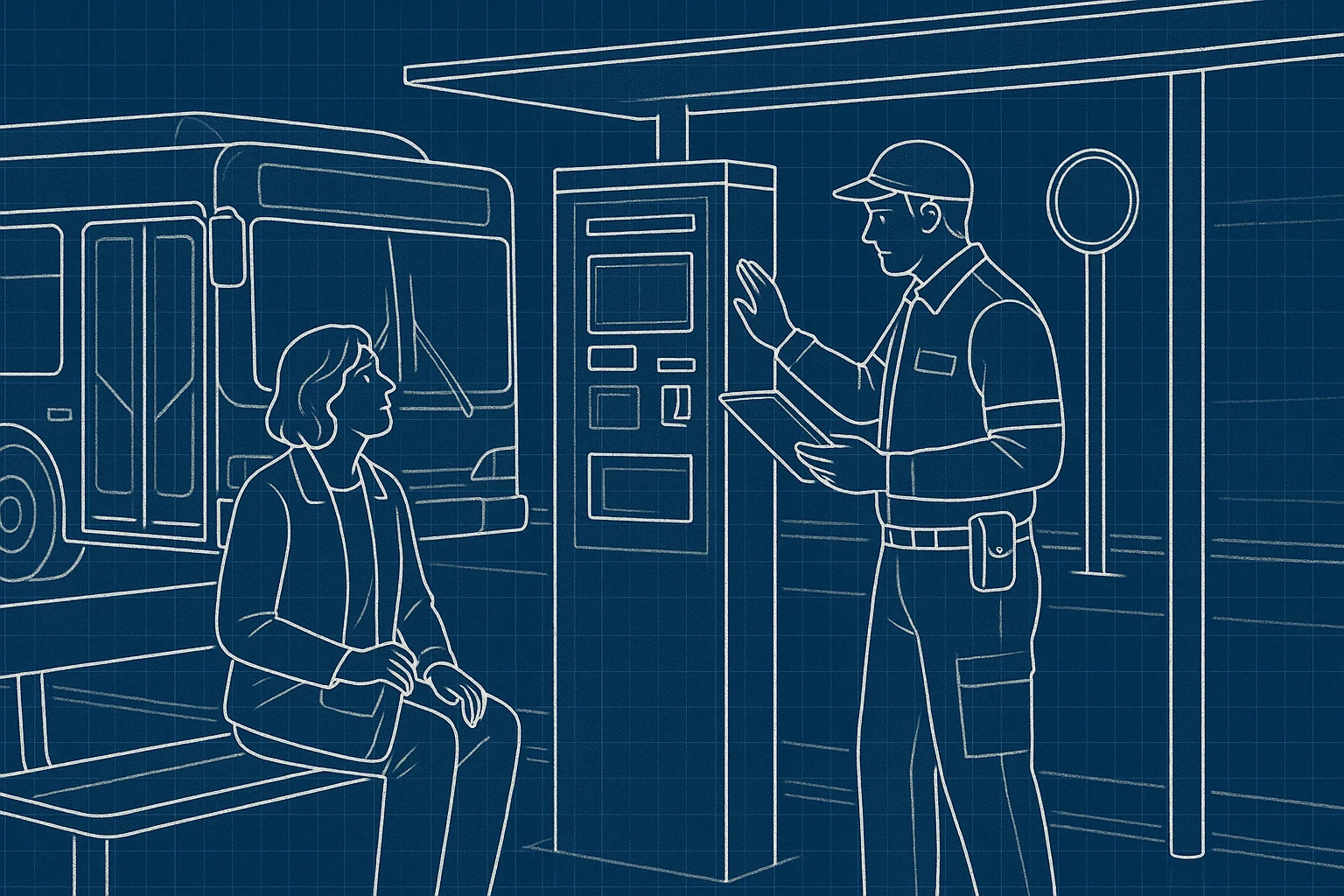
5. Integration patterns, validation, and failure boundaries
Operational reliability is a mix of correct integrations, strict validation, transparent observability, and well‑defined failure boundaries. Architect for readable, auditable handoffs.
Architecture and data flows
Adopt a clear data flow: Rider → Voice AI → controlled knowledge base for scheduled information or approved service‑alert APIs and dynamic forms → validation layer → response, case submission, or human handoff. Keep scheduled knowledge in a controlled content store and require service‑alert APIs to carry signed change metadata before public statements. Record every decision in an auditable event log.
- Treat schedule knowledge as authoritative until an approved alert marks a change.
- Dynamic forms should include front‑end validation, duplicate detection, and server‑side verification before case creation.
- Log transcript anchors, confidence scores, and the validation path for every escalation.
Observability, QA and fallback handling
Instrument observability across the stack: call quality, intent classification drift, validation failure rates, and handoff latencies. Define deterministic fallback states (read‑only answers, forced handoff, and 'no‑commitment' responses) and configure SLOs. Human operators must be able to take over with context and a compact incident summary.
- Implement QA sampling tied to role credentials; escalate recurring errors to retraining or model rollback.
- Set explicit 'do not assert' templates for uncertain service‑alert states.
- Ensure a single button takeover with prefilled context for human agents.
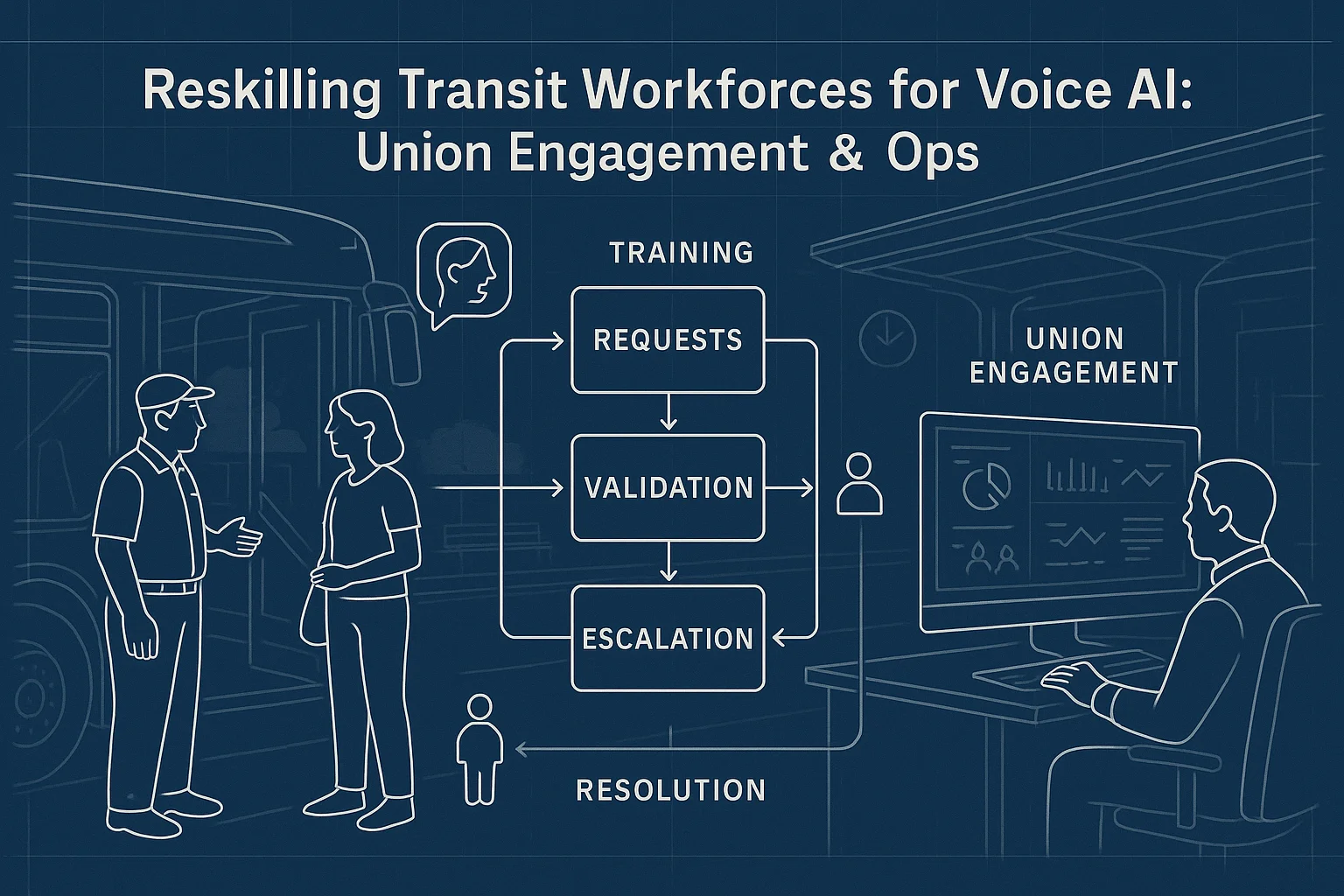
6. Procurement, governance, and staged pilots
Procure with governance baked in: contract language for access, audit, SLAs, change control, and human‑oversight obligations. Use staged pilots to de‑risk operational rollout.
Contract language and vendor SLAs
Require vendors to deliver: transparent model documentation, role‑based access controls, logging and exportable audit trails, and mechanisms for on‑prem or region‑bound hosting. Include SLAs for accuracy on scheduled knowledge answers, validation throughput for dynamic forms, maximum time-to-handoff, and obligations for security incidents. Avoid language that transfers governance or rights to unreviewed automated decisions.
- Mandate exportable logs and transcript access for agency and designated union auditors.
- Specify hosting region, backup region, subprocessors, and remote‑support access for any hosted component; define transfer mechanisms and retention periods.
- Include termination clauses tied to failure to meet safety or accessibility SLOs.
Pilot design and staging
Run pilots that measure agreed KPIs: controlled user cohorts, synthetic and live call mixes, and strict cutovers. Staging should include a discovery phase, co‑design sprints with unions, shadow mode (staff observe outcomes), supervised live mode (staff intervene), and ramp to operational mode with rolling governance reviews.
- Start with low‑risk, high‑volume interaction types (e.g., fare policy questions, schedule lookups) and exclude safety‑critical or enforcement queries.
- Use measurable acceptance criteria and a documented rollback plan.
- Document lessons in a public‑facing pilot report to support procurement and transparency obligations.
7. Transition operations: sustainment, continuous learning, and scale
After pilot acceptance, formalize sustainment: recurrent training, analytics loops, continuous accessibility testing, and governance cadence.
Operational sustainment and analytics loop
Institutionalize conversation analytics, performance reviews, and retraining triggers. Conversation analysts and union delegates should meet regularly to examine audit trails, edge cases, and bias or accessibility gaps. Link analytics to curriculum updates and procurement change orders.
- Define retraining triggers (drift, confidence erosion, increased fallback rate).
- Maintain a cross‑functional steering committee for quarter‑over‑quarter KPIs.
- Use A/B testing under controlled rollouts to validate conversational changes.
Scaling and cross‑channel orchestration
Extend Voice AI learnings to digital channels (chat, IVR) using the same controlled knowledge stores and validation mechanisms. Maintain common audit logs and a single source of truth for schedule content and alert state. Continue negotiated staffing floors and audit rights as the system scales.
- Keep identical failure boundaries across channels to avoid inconsistent guidance.
- Coordinate accessibility tests across voice and digital touchpoints.
- Plan procurement renewals with observed performance metrics and union‑approved change logs.
Related Peak Demand resources
Industry and AI sources reviewed
- Transportation Systems SectorCybersecurity and Infrastructure Security Agency (CISA)
- Artificial Intelligence Risk Management Framework (AI RMF 1.0)National Institute of Standards and Technology (NIST)
- OECD AI PrinciplesOrganisation for Economic Co-operation and Development
Transit safety, accessibility, privacy, cybersecurity, records, and service-information obligations vary by jurisdiction and operating authority. This article is operational guidance, not legal advice; organizations should confirm applicable requirements with qualified professionals.
Frequently asked questions
Good starting points include lost property, complaints and feedback, stop or shelter issues, fare-machine faults, non-emergency accessibility service requests, schedule information from approved sources, and structured routing to customer service or field teams.
Official reference: Artificial Intelligence Risk Management Framework (AI RMF 1.0)
Use GTFS Realtime only when the agency exposes suitable feeds and the workflow genuinely needs service alerts, trip updates, or vehicle positions. The integration should validate freshness and availability, and the agent should avoid presenting stale feed data as a guaranteed arrival prediction.
Emergency, security, injury, crime, and safety-critical reports should follow approved transfer or emergency-routing procedures. Voice AI may detect and route the call, but it should not make operational safety decisions or replace trained personnel.
Official reference: Transportation Systems Sector
Request realistic call testing, feed and system failure handling, service-request integration, transfer context, audit logs, accessibility channels, monitoring, change control, and evidence that the agent distinguishes scheduled information from dynamic service alerts.
Official reference: Artificial Intelligence Risk Management Framework (AI RMF 1.0)
Design the transit service workflow before automating it
Peak Demand helps transit teams connect Voice AI to rider information, service requests, approved live-data sources, escalation, confirmation, and analytics.
Schedule a discovery call


