
Operating Model for Utilities Voice AI: CoE, Field Dispatch & Regulatory Controls
A practical operating model for deploying high-volume Voice AI in electric, water, gas and municipal utilities. Defines CoE roles, field-dispatch integration, account-safe validation, regulatory controls, incident boundaries and measurable outcomes.
1. Operating model overview: CoE, field dispatch, and control plane
An operating model describes who owns Voice AI, who executes, and how regulatory controls are enforced. For utilities, structure reduces risk while scaling high-volume interactions during normal operations and incidents.
Center of Excellence (CoE): charter and core responsibilities
The Voice AI CoE is a small cross-functional team that owns policy, intent libraries, model-change governance, and runbooks. Typical CoE roles include a head of Voice AI (policy and vendor liaison), an operations architect (integrations and orchestration), an escalation ops lead (human-in-loop policies and contact-centre routing), a data steward (privacy, retention and record keeping), and a QA lead (call sampling and accuracy metrics). The CoE sets SLAs with contact centre and field-service stakeholders and maintains the runbooks for outage and surge modes.
- Define allowed transaction types (status queries, outage reporting, service requests) and disallowed actions (safety-critical switch operations, remote asset control).
- Maintain intent and slot taxonomies mapped to OMS/CIS/CRM actions.
- Approve integration adapters and production change management schedules.
Field-dispatch integration: adapters and routing rules
Field dispatch must remain operationally deterministic. Build controlled adapters that translate Voice AI intent into service requests or status responses using approved APIs. Routing rules should consider technician skill, territory, job type, priority, and safety constraints, and they must be auditable. Where permitted, allow Voice AI to create or update non-safety-critical work orders; require human confirmation for any field work that affects customer premises safety, infrastructure isolation, or emergency repair prioritisation.
- Use an orchestration layer to mediate all writes to OMS/Work Order systems to provide an audit checkpoint and rollback capability.
- Record the routing decision and include the human verifier ID for any work order that triggers field dispatch.
- Ensure adapters validate owner/asset identifiers (account, meter, premises ID) before any write.
2. Call-flow architecture: validation, approved APIs and failure boundaries
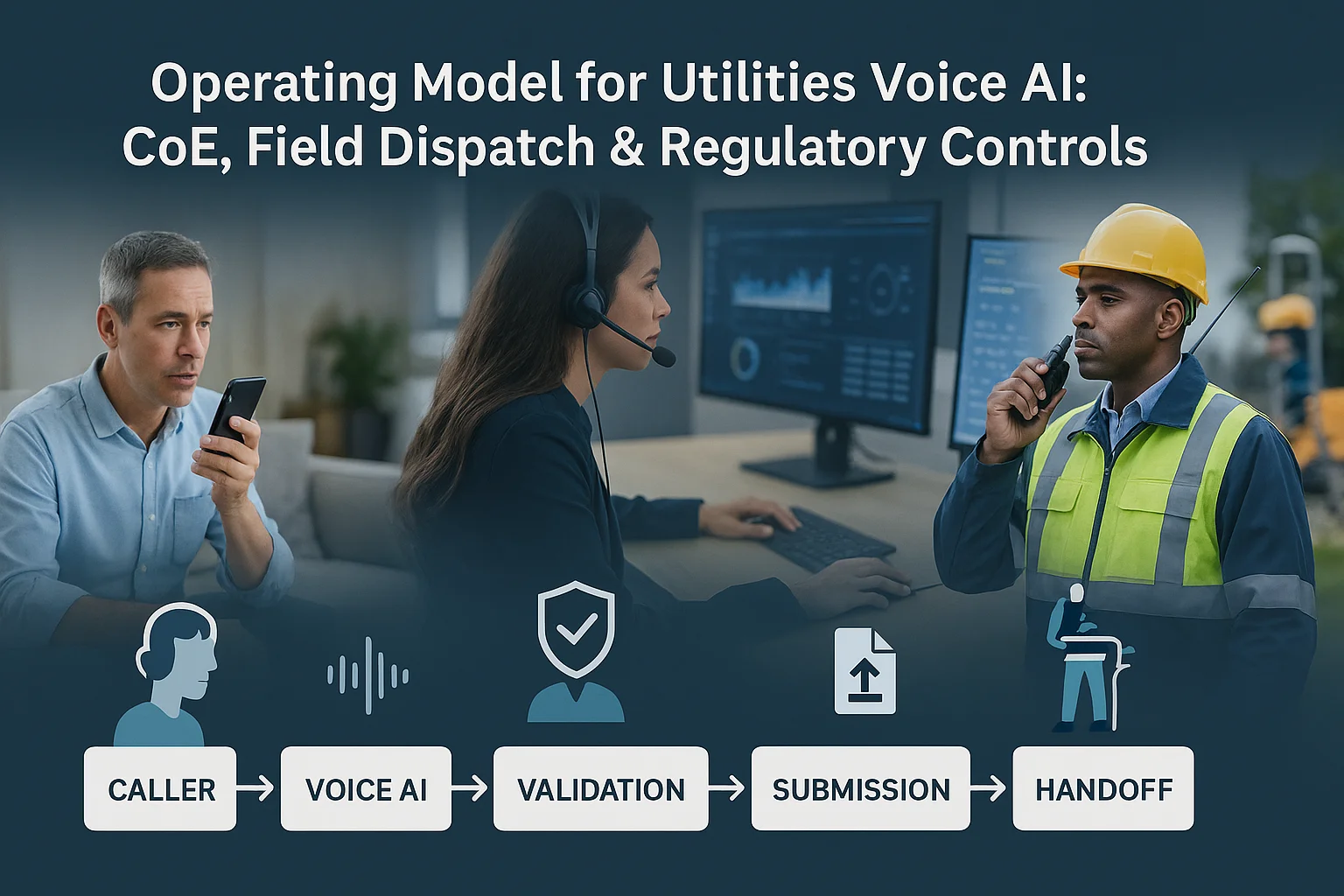
Define deterministic, auditable call flows. The fundamental architecture is Customer call → Voice AI → Account/Premise validation → Approved API/knowledge source → Service request, status response, or human escalation.
Canonical call flow and transaction gates
Every transactional path must include explicit validation gates before a write or service-affecting action. Simple queries (outage status, estimated restoration) can be answered from read-only knowledge sources. Any create/update to OMS/CIS must pass identity and premise validation steps and pass through a controlled adapter that records the change.
- Read-only path: identify outage ID or premise → query knowledge source → return templated status.
- Write path: collect account/meter/premise identifier → validate against CIS/OMS → create SR in staging → surface SR ID and summary to caller.
- Escalation path: if validation fails or confidence threshold unmet, escalate to human agent with context payload.
Validation and account-safety controls
Account-safety means the system never acts on incomplete or low-confidence identity signals. Use a layered validation approach: caller ANI matching, caller-provided token or account number, verification of premise attributes (address, meter ID), and transaction-specific challenge-response where required. Retain a configurable confidence threshold for automated actions and require human confirmation for sensitive updates.
- Define minimum evidence for auto-creation of a non-emergency service request (e.g., ANI match plus meter ID), and stricter evidence for any schedule or access-related.
- Record the validation outcome and confidence score in the SR metadata.
- Reject or escalate voice transactions that attempt to change account ownership, payment methods, or safety-related work without in-person verification.
3. Governance, security, and regulatory alignment
Governance must link AI risk, cybersecurity, and operational maturity. Use established cross-sector guidance to shape control baselines and maturity roadmaps.
Risk and control alignment using established frameworks
Map Voice AI controls to critical-infrastructure AI risk guidance and cybersecurity performance goals. Use these frameworks to define minimum controls for exposure, access, logging, and change management while tailoring specifics to local legal obligations.
- Use the NIST AI Risk Management Framework — Critical Infrastructure Profile to identify high-consequence failure modes and required mitigations for customer-impacting services.
- Apply the CISA Cross-Sector Cybersecurity Performance Goals to define baseline cyber hygiene for integration endpoints and administrative access.
- Use maturity models like DOE C2M2 to plan capability improvements across detection, response, and recovery for AI-enabled operational tech stacks.
Operational separation: admin, developer and run roles
Separate privileges for model development, orchestration, and run-time admin. Limit write-capable credentials to the orchestration layer and audited service accounts. Maintain immutable deployment artifacts for production model versions and require pre-production testing windows with representative contact-centre traffic before production pushes.
- Use role-based access controls and session auditing for any operator or vendor access to production systems.
- Require documented change approvals and rollback plans for model updates that alter intent routing or transactional behaviour.
- Keep a signed and timestamped policy record of who approved each change for regulatory review.
4. Procurement, vendor evaluation and contract evidence
Procurement should be evidence-driven and focus on integration risk, operational continuity, and auditability. Request concrete deliverables, not marketing claims.
Mandatory procurement evidence and contract clauses
Ask vendors for written evidence: data-subprocessor lists, hosting regions and backup geography, incident response SLAs, documented change-control processes, and sample audit logs. Contracts should include defined service-level objectives for availability, integration latency, and restoration time for failed writes.
- List of subprocessors and hosting/backup regions, including cross-border transfer descriptions and retention policies.
- Detailed incident and business-continuity playbooks specifying notification timelines and communications duties.
- Right-to-audit clauses and exportable transaction logs for regulatory review.
Integration risk checklist for OMS/CIS/CRM adapters
Evaluate how the vendor handles adapter failover, transactional idempotency, observability, and rollback. Review test harnesses that simulate high-concurrency outage loads and confirm how data integrity is preserved when the orchestration layer is unavailable.
- Require test reports for write idempotency and recovery sequencing when an adapter reconnects after an outage.
- Validate that adapters separate read and write scopes and that writes can be paused without losing inbound calls.
- Inspect monitoring dashboards and event-level analytics to ensure visibility into failed or delayed transactions.

5. Incident response, surge operations and field handoff
High-volume outages are the defining use case. Playbooks must define surge handling, human escalation thresholds, and field handoff protocols to preserve safety and service reliability.
Outage-mode routing and surge capacity
Define an outage mode that reduces interaction complexity and prioritises safety and report ingestion. Switches include simplified prompts, prioritised queues for outage reports and safety flags, and thresholds to pause non-critical scheduling features. Surge capacity should be defined as a combination of autoscaling, overflow IVR, and manual callback lists.
- Predefine outage-mode prompts and templates to ensure consistent public messaging.
- Establish capacity tiers and activation criteria (e.g., percentage of network affected or call volume thresholds).
- Provide operations staff a single control to toggle write permissions or to redirect calls to human agents.
Field handoff and safety boundaries
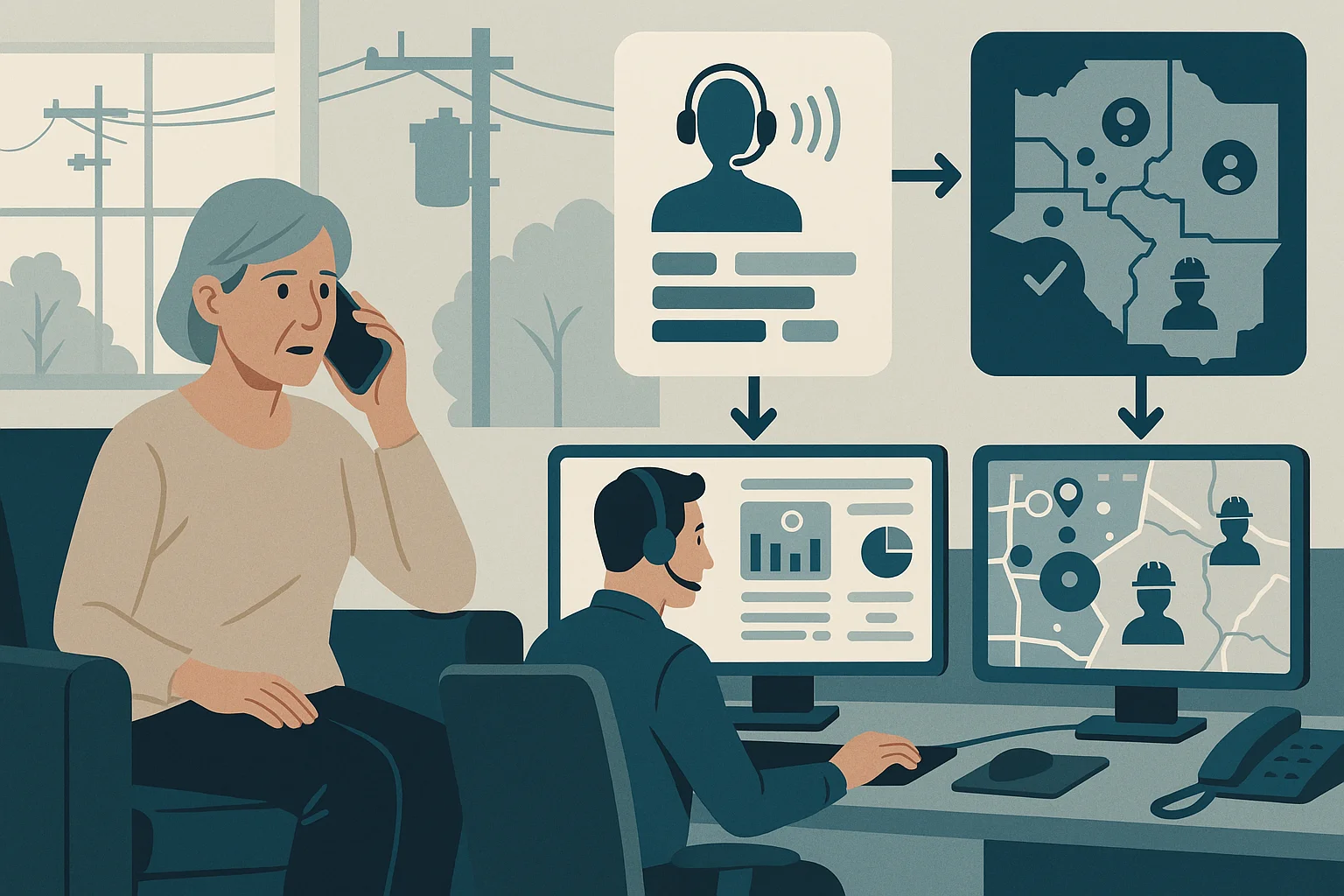
When a voice interaction results in a work order, include the rationale, validation artifacts, and safety notes in the dispatch payload. Require an explicit human acceptance step for jobs that involve live-line access or customer premises entry. Document the decision chain so field crews can rely on the SR metadata during triage.
- Attach validation artifacts (caller validation, call recording consent status, confidence scores) to the SR.
- Include a safety tag schema for field crews: 'safety-check required', 'isolation required', 'emergency priority'.
- Maintain a manual reconciliation path for misrouted or duplicated jobs.
6. Measurement, QA and continual improvement
Operational metrics, QA sampling, and analytics drive safe scale. Focus on measurable outcomes and closed-loop improvement.
Key operational metrics and event-level analytics
Track containment (percentage of calls resolved without human agent), validation-failure rate, write-failure rate, time-to-dispatch for Voice-AI-created SRs, escalation rate, and manual-reconciliation volume. Use event-level analytics to correlate Voice AI decisions with downstream field outcomes (e.g., repeat visits, incorrect assignments).
- Containment rate as a service-level indicator for customer-service efficiency.
- Write-failure and pending-write reconciliations to measure integration reliability.
- Escalation and false-positive rates to tune intent thresholds and validation logic.
Quality assurance and sampling regime
Implement stratified QA sampling: normal traffic, outage-mode traffic, escalations, and post-write reconciliations. QA should validate accuracy of intent detection, correctness of SR creation, and sufficiency of validation evidence. Feed QA results back into model-intent updates and CoE governance reviews.
- Monthly QA reports to stakeholders with sampled transcripts, validation scores, and exception categories.
- Closed-loop defect tracking between QA, CoE, and vendor for prioritised fixes.
- Performance gates for model updates informed by QA and production A/B testing.
Related Peak Demand resources
Industry and AI sources reviewed
- AI Risk Management Framework — Critical Infrastructure ProfileNational Institute of Standards and Technology (NIST)
- Cross-Sector Cybersecurity Performance GoalsCybersecurity and Infrastructure Security Agency (CISA)
- Cybersecurity Capability Maturity Model (C2M2)U.S. Department of Energy
Utility cybersecurity, critical-infrastructure, records, customer-protection, and emergency-communications obligations vary by jurisdiction and service type. This article is operational guidance, not legal advice; organizations should confirm applicable requirements with qualified professionals.
Frequently asked questions
Good starting points include billing and account questions, move-in or move-out intake, appointment scheduling, service-request capture, outage-status messaging from approved systems, payment-routing assistance, and structured escalation. Safety-critical and infrastructure-control decisions should remain with qualified utility teams.
Official reference: Cross-Sector Cybersecurity Performance Goals
Use the minimum approved identifiers needed for the workflow, validate them against the utility's system of record, limit data exposure, and provide a human-assisted path when verification fails. The Voice AI should not guess account, premise, or outage information.
Official reference: Cross-Sector Cybersecurity Performance Goals
Use controlled adapters, strict schemas, timeouts, retries, audit logs, safe failure states, and human escalation. The system should distinguish approved utility data from model-generated language and should never present stale or unverified operational information as fact.
Official reference: Cybersecurity Capability Maturity Model (C2M2)
Track containment by request type, successful validations, transfers, abandoned calls, integration errors, incorrect or stale responses, time to resolution, customer follow-up, and the percentage of cases completed safely without manual rework.
Official reference: Cybersecurity Capability Maturity Model (C2M2)
Build resilient utility customer-service automation
Peak Demand helps utilities connect Voice AI to approved customer-information, outage-communication, service-request, dispatch, escalation, and analytics workflows.
Schedule a discovery call


