
Model Risk, Auditability & Regulatory Reporting for Predictive Voice AI in Utilities
Operational framework for utility leaders to manage model risk, audit trails, and regulatory reporting when deploying predictive Voice AI for outage communications, service requests, and high-volume customer operations.
1. Purpose, scope, and operational boundaries
Purpose and scope tailored for utility customer-service, outage communications, operations, IT, field-service, and regulatory teams. This section defines what predictive Voice AI should and should not do in regulated utility environments.
Purpose and audience
Provide a decision-useful framework for design, procurement, and operation of predictive Voice AI where accuracy, auditability, and regulatory reporting matter—specifically customer-service lines, outage notifications, and service-request intake. Target readers include CS managers, outage comms leads, operations, IT, field-service supervisors, and regulatory affairs.
- Focus: high-volume inbound/outbound voice interactions that inform customers or initiate non-emergency work orders.
- Exclude: automatic control of physical infrastructure, emergency operational decision-making, or safety-critical automated commands.
Scope and safety boundaries
Define explicit boundaries: Voice AI may collect reports, validate accounts, summarize outage status, and create or update service requests. Voice AI must not perform any automated actuation, safety-critical control, or emergency dispatch without human validation. All escalation to emergency responders follows existing utility protocols.
- Do not permit Voice AI to alter SCADA, distribution automation, or protective relay settings.
- Require human confirmation for any field dispatch that could create a safety risk or require work on live assets.
2. Canonical operating model and call flow
A practical, audit-ready operating model that links the customer call through validation and to an approved business action. Use this canonical flow as a blueprint for design, procurement, and runbooks.
Canonical flow (call → action)
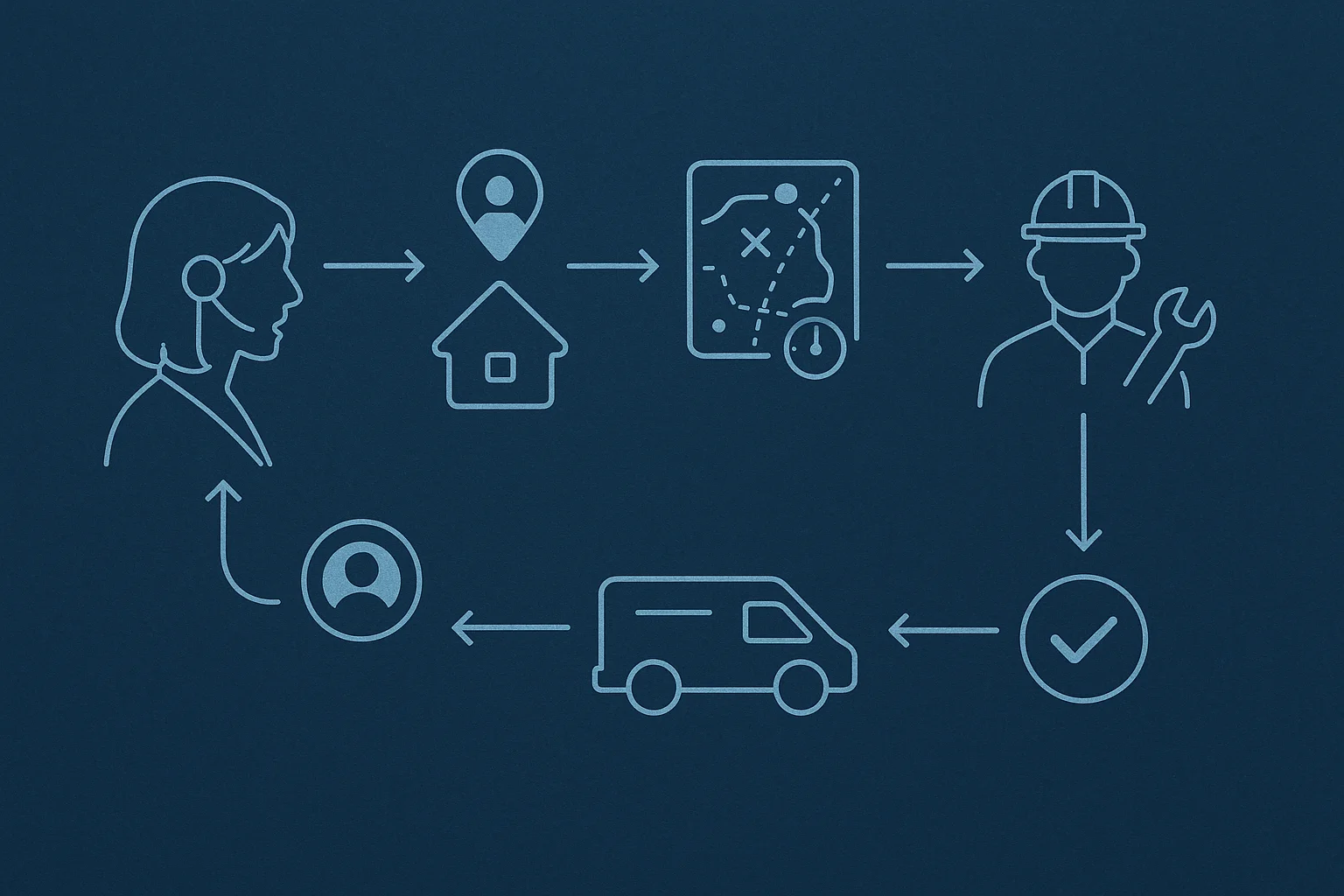
Standardize the call flow for every integration: 1) Customer call arrives at contact center or Voice AI ingress; 2) Voice AI conducts initial intent detection and slot-filling; 3) System performs account or premise validation; 4) Voice AI queries approved APIs or knowledge sources for status or authorizations; 5) Action is either a read-only status response, creation/update of a service request, or escalation to a human agent; 6) Full event log and transcript stored for audit and reporting.
- Account validation must be explicit — tokenized call-back numbers, multi-factor prompts, or CRM crosschecks before any change.
- Approved APIs and knowledge sources should be defined in data contracts and event schemas to avoid unauthorized lookups or writes.
- Every routing decision must record the rationale, confidence score, and any threshold that triggered escalation.
Integration pattern and adapters
Use controlled adapters and orchestration layers between Voice AI and utility systems (CIS/OMS/CRM/Workorder). These adapters enforce field-level whitelists, schema validation, and rate-limiting. Adopt event-driven contracts so that Voice AI produces structured events consumed by downstream systems, rather than granting direct database or UI access.
- Design adapters for write-review patterns: create a draft service request in a staging queue that requires human approval for execution.
- Log all API calls with request/response payload hashes to support non-repudiation and replay for audits.
3. Model risk controls and auditability
Manage model risk by treating Voice AI models like regulated software: inventory, provenance, validation, and explainability where required. Implement practical controls to make model behavior auditable.
Model inventory, versioning, and provenance
Maintain a model inventory that records model identifier, vendor, training date, prompt/policy sets, deployment region, and allowed actions. Version every model change and tie it to the deployment tag used in production. This inventory supports traceability if regulators or auditors request the model state associated with a particular interaction.
- Record deployment artifacts: model binary reference, prompt templates, policy overrides, and canary experiment IDs.
- Keep a change log for prompt, policy, and post-processing rules and link each production cutover to an approved change request.
Testing, benchmarks, and acceptance criteria
Define objective acceptance criteria before deploying or updating models: intent classification accuracy, false-positive rates for safety-critical intents (e.g., emergency reporting), and end-to-end task success for service-request creation. Use representative, utility-domain test sets and maintain an auditable test-run history.
- Run pre-release shadow testing against live traffic with no customer-impact actions (read-only) to measure drift and new failure modes.
- Establish rollback criteria tied to measurable KPIs (e.g., escalation rate spike, drop in intent accuracy).
Explainability and human review
Provide operational explainability: when a Voice AI routes or creates a request, surface the detected intent, key slots, confidence scores, and the evidence (API responses or knowledge-base matches) that led to the decision. This information is essential for on-shift agents to validate outcomes and for regulators to reconstruct events.
- Make explainability concise and operational — produce a single summary event per transaction consumable by agents and auditors.
- Schedule regular human review of low-confidence or high-impact transactions to detect systemic model drift.
4. Audit trails, recording, and regulatory reporting
Design recordkeeping so that audit demands and regulatory reporting can be satisfied without exposing unnecessary customer data. Separate transcript storage from structured event logs and ensure access controls.
Structured events vs. raw transcripts
Store structured event logs—intent labels, validation steps, API responses, routing decisions, timestamps, and operator IDs—alongside but separate from raw audio or transcripts. Structured logs enable quick regulatory queries while transcripts support deeper forensic review when needed.
- Index events by service request ID, customer account, premise ID, and outage/event ID to support cross-system reporting.
- Apply role-based access to raw transcripts; restrict retrieval to authorized investigators and preserve an audit log of transcript access.
Retention, residency, and data transfer considerations
Define retention policies that reflect regulatory obligations and business needs. Be explicit about hosting region, backup region, subprocessors, and mechanisms for cross-border transfer. Document recording consent and customer-notification practices where required. Confirm obligations with legal counsel in each jurisdiction.
- Map where live audio, transcripts, and event logs are stored and where backups reside.
- Document subprocessors and remote-support access and set contractual limits on onward transfer and purpose-limited processing.
Reporting to regulators and internal stakeholders
Prepare reporting templates that summarize Voice AI performance and notable incidents: model version at time of event, rate of escalations, error classes, and times to human-handback. For cybersecurity or service-impact incidents, align reporting items with existing incident reporting timelines and content used by compliance teams.
- Automate extraction of required fields to reduce time-to-report in the event of audits or regulatory inquiries.
- Maintain an incident binder linking each significant event to event-level logs, model state, and remediation actions.
5. Integration safeguards, failure modes, and human oversight
Practical safeguards prevent erroneous or unsafe actions. Focus on account-safe validation, gating write operations, and clearly defined human escalation thresholds.
Account-safe validation and authorization
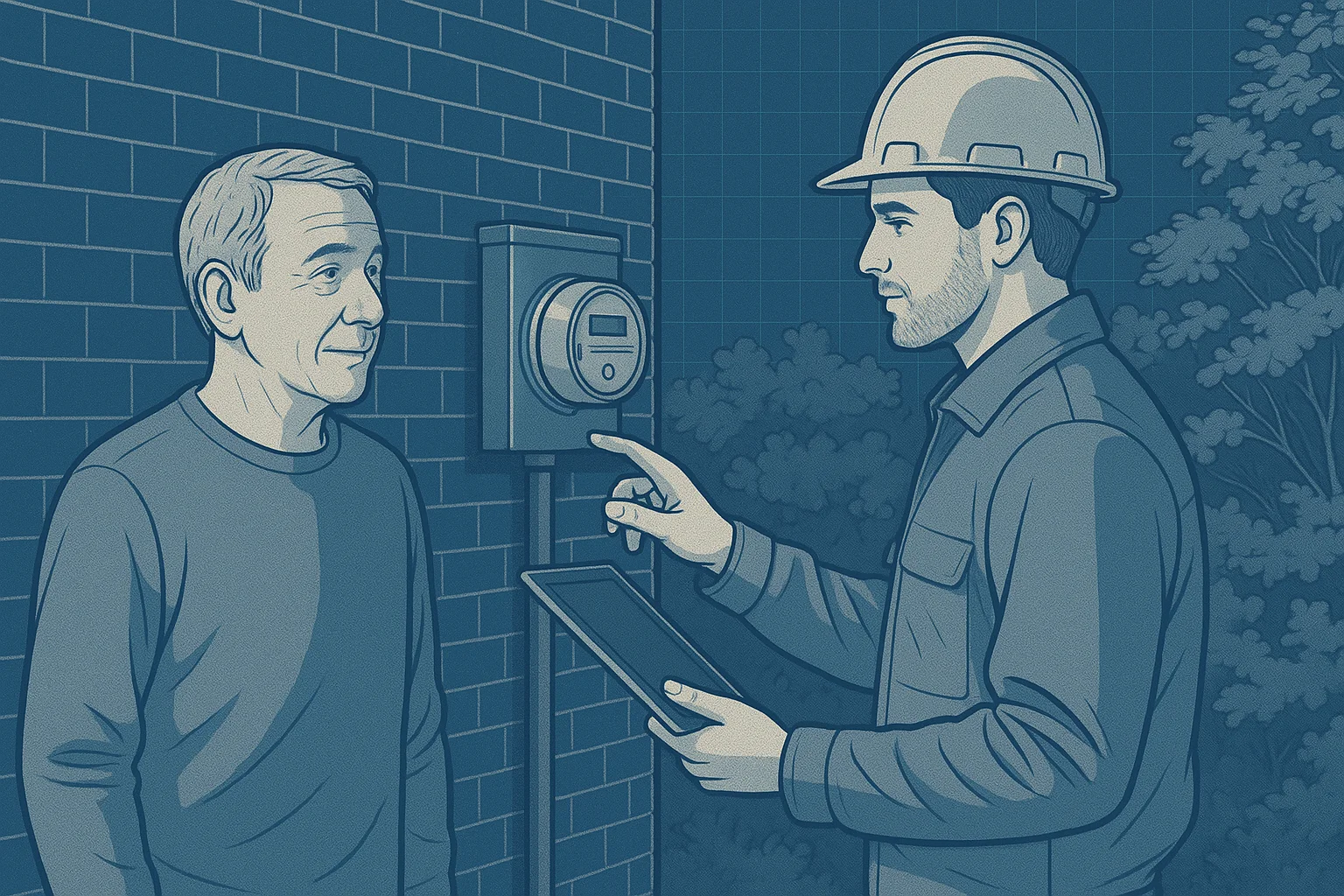
Require multi-step validation for any action that modifies account data or schedules field work. Validation can include caller ANI verification, security questions based on CIS, one-time PINs, or an authentication handoff to a human agent for high-risk changes.
- Treat validation failures as a hard stop — default to escalation to a live agent rather than a permissive fallback.
- Log validation attempts and outcomes as first-class fields in the event record to support post-incident audits.
Write-gating and staging for service requests
Adopt a gated write pattern: Voice AI creates a draft service request in a staging queue with risk metadata and recommended priority. A human operator or an automated rules engine with conservative thresholds reviews and approves writes to OMS or work-order systems.
- Define explicit rules for immediate writes (low-impact informational updates) versus staged writes (field dispatch, meter locks, reconnections).
- Use an approvals ledger so every write to production is linked to a unique approver and timestamp.
Failure-mode designs and degraded operations
Specify degraded-mode behaviors before deployment: if downstream API fails, Voice AI should switch to read-only responses, present cached status, or offer call-back. Ensure the system exposes clear error messages and fold to human agents when thresholds (latency, error rates, or confidence drops) are exceeded.
- Define capacity thresholds and automated throttles to prevent cascading failures during major outages.
- Instrument synthetic transactions and health probes for API chains that support rapid fault isolation.
6. Procurement, QA, and measurable operating outcomes
Procurement and contractual language must enable auditability and operational controls. QA and KPIs translate governance into measurable performance.
Procurement evidence and contract clauses
Include specific operational deliverables in statements of work: model inventory exports, change logs for prompts/policies, full event logging schema, subprocessor lists, performance baselines, and incident response playbooks. Require vendor cooperation for regulatory audits and define data extraction formats.
- Contract clauses should require advance notice and testing windows for model or policy updates that affect production routing.
- Insist on contractual limits for automatic system changes and require human approval for policy changes that alter customer outcomes.
QA, observability, and KPIs
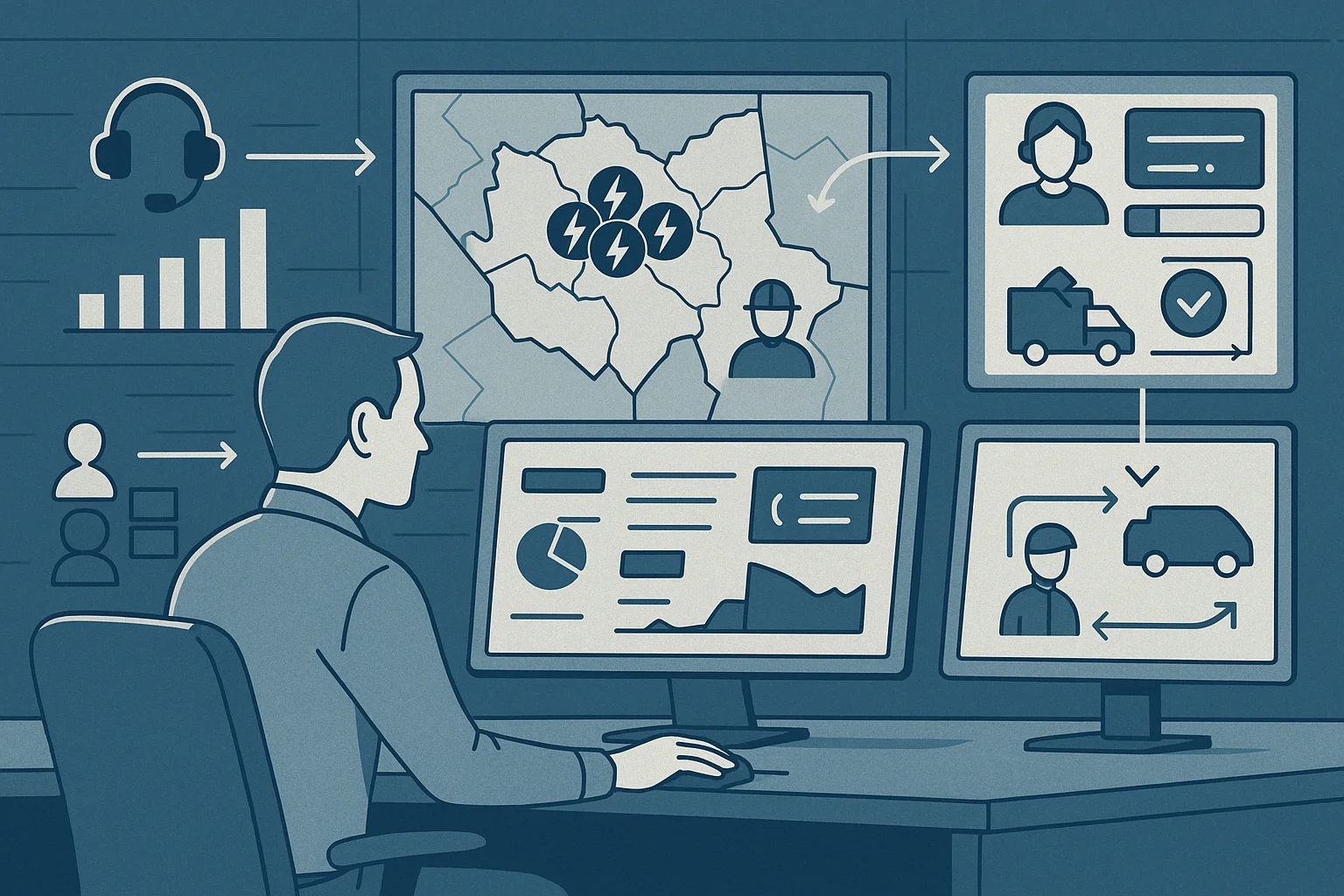
Operationalize continuous QA: monitor intent accuracy, escalation rate, false-positive safety events, average time-to-human-handback, API error rates, and SLA adherence for event archival. Correlate Voice AI metrics with customer satisfaction and field dispatch quality to evaluate value and risk.
- Use canary releases and incremental rollouts with telemetry gates to prevent wide exposure to regressions.
- Report KPIs in a governance dashboard with daily operational metrics and monthly trend reports for regulators and executives.
Surge capacity and disaster recovery
Specify surge models and failover behavior for emergency-scale events: scalable ingestion, prioritized routing rules for critical calls, and pre-authorized human overflow. Define backup region, recovery RTO/RPO for logs and recordings, and remote-support access paths.
- Practice surge scenarios in tabletop and live drills and capture metrics on time-to-stable routing and message consistency.
- Include recovery obligations for vendors and subprocessors in incident response plans.
Related Peak Demand resources
Industry and AI sources reviewed
- Cybersecurity Capability Maturity Model (C2M2)U.S. Department of Energy
- AI Risk Management Framework — Critical Infrastructure ProfileNational Institute of Standards and Technology (NIST)
- Cross-Sector Cybersecurity Performance GoalsCybersecurity and Infrastructure Security Agency (CISA)
Utility cybersecurity, critical-infrastructure, records, customer-protection, and emergency-communications obligations vary by jurisdiction and service type. This article is operational guidance, not legal advice; organizations should confirm applicable requirements with qualified professionals.
Frequently asked questions
Good starting points include billing and account questions, move-in or move-out intake, appointment scheduling, service-request capture, outage-status messaging from approved systems, payment-routing assistance, and structured escalation. Safety-critical and infrastructure-control decisions should remain with qualified utility teams.
Official reference: Cross-Sector Cybersecurity Performance Goals
Use the minimum approved identifiers needed for the workflow, validate them against the utility's system of record, limit data exposure, and provide a human-assisted path when verification fails. The Voice AI should not guess account, premise, or outage information.
Official reference: Cross-Sector Cybersecurity Performance Goals
Use controlled adapters, strict schemas, timeouts, retries, audit logs, safe failure states, and human escalation. The system should distinguish approved utility data from model-generated language and should never present stale or unverified operational information as fact.
Official reference: Cybersecurity Capability Maturity Model (C2M2)
Track containment by request type, successful validations, transfers, abandoned calls, integration errors, incorrect or stale responses, time to resolution, customer follow-up, and the percentage of cases completed safely without manual rework.
Official reference: Cybersecurity Capability Maturity Model (C2M2)
Build resilient utility customer-service automation
Peak Demand helps utilities connect Voice AI to approved customer-information, outage-communication, service-request, dispatch, escalation, and analytics workflows.
Schedule a discovery call


